Posts from 2023

Cmd-Tab switcher on all screens

1 min read

This week, on Monday gone in fact, we moved office. We've now got a bigger space and, as part of that, bigger desks. Somewhat (but not entirely) coincidentally the work desk will also convert into a standing desk1. Also also... I inherited a second screen for the desk too. Ever since the days of CRTs and video cards that supported it, I've been a fan of having at least a couple of screens in front of me, and now at my work desk I've got 3 (two external displays and the display of the MacBook Pro itself).

This caused a slight problem though: horizontally there's quite the spread of things to look at. This is fine, mostly I'm looking at the screen that's in front of me; the MacBook is to the left and the "second" screen is to the right, both with "other" stuff on them. In front of me is Emacs and my browser, which I flip between lots.

The problem is this: the MacBook needs to go to the left (because of physical layout), which means that despite me setting the screen in front of me as the "main" screen, the Cmd-Tab display (you know the thing: when you hit Cmd-Tab you see the icons of all your active applications) appears on the left-most display, which is the MacBook.

Not great. If I'm looking at the right-most display, and want to switch using the keyboard, I've got to look over to the left, as a worst case. That makes for a lot of unnecessary head-swivelling.

One quick Google later and Today I Learnt that the following pretty much solves the problem:

defaults write com.apple.Dock appswitcher-all-displays -bool true
killall Dock

As the name of the setting would suggest: once done, the switcher appears on all displays.

That's perfect.


  1. Although the work one is manual hand-cranked, not electronic button-push goodness like my new one at home

Dot Files

1 min read

While I'm still in blog-tinkering mode (long may it last!), I thought it might be handy to keep a page kicking around that has links to the small collection of "dot file" repositories I have.

Like many people, I keep these in a central location (in my case up on GitHub) so that I can very quickly spin up a familiar work environment on a new machine (new machines are something that doesn't happen too often, but it's always good to be able to get going quickly when it does).

So, depending on browser type/size, either above here or off to the side, there should now be a permanent link to a page of links to those repositories.

As I look at it now it's actually surprising to me how much of my "comfortable" environment is encapsulated in so few tools, and configured with so few collections of files. There are other tools I use a lot too, but most of them either have their own sync systems, or they have so few configuration options (and are likely in a format that isn't easy to grab/store) that it's not worth the bother.

This feels like a good thing, really.

One thing that's not amongst all of this, partly because it's not that interesting, but also partly because the repository is private, is a single bash script called myenv. On a new machine, once I've got enough of a setup that I can clone from GitHub, I drag this down and run the script and most of the rest of the environment follows.

It's quite satisfying when I need to use it.

New desk

2 min read

I moved into my current place back in August 2019, bringing with me a fairly small desk. Originally, many years back, I'd had a pretty big office with lots of office space but, upon moving up to Scotland back in 2016, I needed to go with something a lot smaller.

Which was perfectly fine. Me and that desk wrote a lot of code. Me and that desk transitioned from one job to another, and then another. Me and that desk made it through the pandemic.

It's been a good desk.

But it was small. I'm in a place where I could spread out a fair bit again, but I also kept putting it off and putting it off.

Earlier this year I decided that it was high time I actually upgraded; I also promised the desk to someone else who I know will get a lot of good use out of it; so finally earlier this week I put in the order for something bigger and fancier.

Yesterday, with the help of a very good friend (thanks Mariëlle!), I got the desk built and roughly in place, and then today I've been putting the desktop back together and adding extra bits.

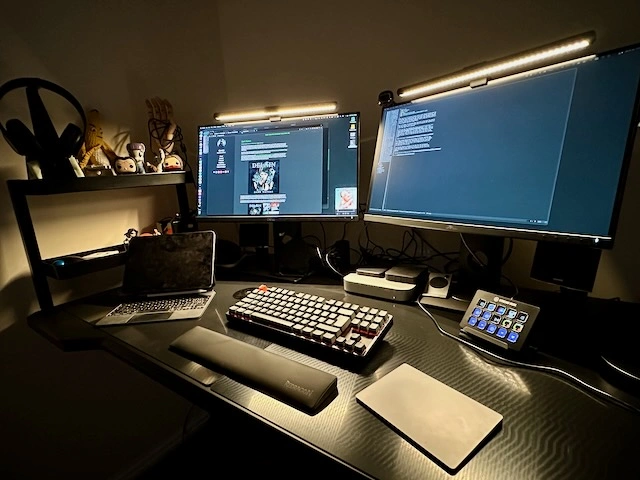
My new desk

It's so nice to have more space to spread out, it's also nice to have a black desk again! (the last one was white because... reasons) But what's really exciting is that it transforms into a standing desk at the touch of a button.

I've been trying it in the standing configuration today and, while I doubt I could do a whole day of coding with it like that, I'm already really liking it as a way of breaking up the time at the keyboard. On the days I work from home, or the days of my own where I get sucked into a personal project, I can absolutely see me swapping between the two states.

All that's left now is to get used to it. The screens are ever so slightly further away, the height is ever so slightly different (although I can adjust it, of course, but what I've done is adjust the sitting position to a nicer one and that's going to take some getting used to), my iPad and Stream Deck are in just a slightly different location, etc, etc... So I'm sure there'll be a few days of sitting here and making small tweaks to the spot where things live.

Before I know it I'll be used to it. It'll be "my spot".

Dark Waters

1 min read

More than ever I'm listening to music while I work. Despite having grown up in the 80s, and so having a good vinyl collection, and then having got into buying all the CDs in the 90s and 00s, these days I have managed to embrace the "just stream all the things" approach. After a long time using Spotify I finally ended up migrating to Apple Music.

One of the things I do find Apple Music does well is the whole "you seem to like this, have you tried this?" thing; which on occasion has resulted in a pretty neat rabbit hole of discovery.

Earlier this year this happened with female-fronted Dutch goth/rock type bands. I don't even remember how that happened, but it's a thing that happened and I gleefully dived right in. I came away with a few names I didn't know before, but one album has really stuck in my head and, now that we're just over 1/2 way through the year, I feel it's the one that gets played more than anything else.

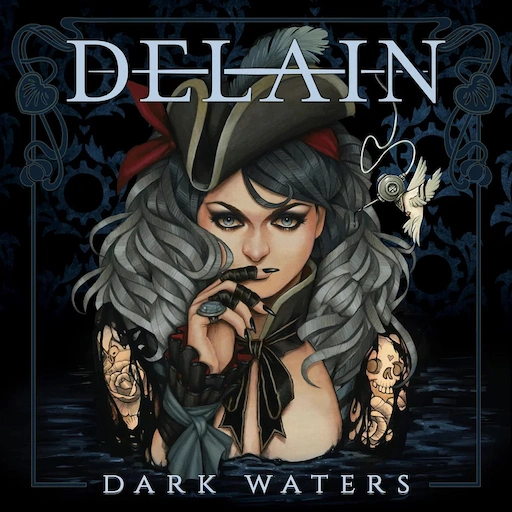
Delain Dark Waters

This keeps creeping back to the top of things I'm playing; sometimes when I'm in "bang on the keyboard lots" coding mode (you know the sort of coding mode: where you don't have to think too much because you have a good plan for what you're doing, but you've got a lot of tapping away to do), plus also often while I'm in the car.

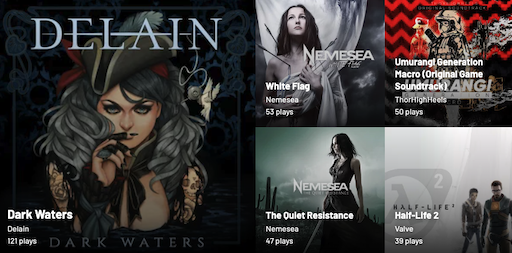
I won't be the least bit surprised to find that this ends up being my most-played album this year. According to last.fm it's at the top of the albums I've played (in places where I have scrobbling set up) in the last 365 days.

My last 365 days of albums on last.fm

The switch has been made

2 min read

Well, it didn't take as long as I expected it to. Just yesterday morning I was giving Pelican a look over as a possible engine for generating my blog, having wanted to move away from Jekyll for a while now. Having tried it and liked what I saw to start with, I wrote about how I liked it and wondered how long it would take me to make the switch.

By the evening I was making a proper effort to get the switchover started, and just a wee while earlier, before writing this post, the switch was made!

The process of making the switch was roughly this (and keep in mind I'm coming from using Jekyll):

  1. Made a branch in the repo to work in.
  2. Removed all of the Jekyll-oriented files.
  3. Decided to set up Pelican and related tools in a virtual environment, managed using pipenv.
  4. Ran pelican-quickstart to kick things off and give me a framework to start with.
  5. Renamed the old _posts directory to content.
  6. Kept tweaking the hell out of the Pelican config file until it started to look "just so" (this is a process that has been ongoing, and doubtless will keep happening for some time to come).
  7. Tried out a few themes and settled on Flex; while not exactly what I wanted, it was close enough to help keep me motivated (while rolling my own theme from scratch would seem fun, I just know it would mean the work would never get done, or at least finished).
  8. Did a mass tidy up of all the tags in all the posts; something I'd never really paid too much attention to as the Jekyll-based blog never actually allowed for following tags.
  9. Went though all the posts and removed double quotes from a lot of the titles in the frontmatter (something Jekyll seems to have stripped, but which Pelican doesn't).
  10. Tweaked the FILE_METADATA to ensure that the slugs for the URLs came from the filenames -- by default Pelican seems to slugify the title of a post and this meant that some of the URLs were changing.

All in all I probably spent 6 or 7 hours on making the move; a lot of that involving reading up on how to configure Pelican and researching themes. The rest of it was a lot of repetitive work to fix or tidy things.

The most important aspect of this was keeping the post URLs the same all the way back to the first post; as best as I can tell I've managed that.

So far I'm pleased with the result. I'm going to live with the look/theme for a wee while and see how it sits for me. I'm sure I'll tweak it a bit as time goes on, but at the moment I'm comfortable with how it looks.

Considering Pelican

2 min read

Since getting my blog editing environment set up on the "new" machine a couple of days back I've been thinking some more about moving away from Jekyll. Jekyll itself has served me well since I started this blog back in 2015, but I was reminded again when installing it on the Mac Mini that it's Ruby-based and I have very little understanding of how to get a good Ruby experience on macOS1.

Having mentioned on Mastodon that I was thinking about finally looking at moving my blog management/generation to something new, and specifically something Python-based and ideally some sort of site generator, I got a few suggestions.

One that looks promising so far is Pelican. At first glance it seems to tick a few boxes for me:

  • Python-based (so easy for me to grok in terms of installing, and also more chance of being hackable).
  • Uses Markdown (curiously as an alternative, to reStructuredText, which looks to be the default).
  • Does article-based stuff as well as page-based stuff.
  • Lots of themes, and themes are Jinja2-based (I'm pretty familiar with Jinja thanks to my Django days and also using the library when kicking off ng2web).
  • RSS feed generation.
  • Syntax-highlighted code blocks.

While I'm not quite ready to dive in and make the move just yet (I am on a "muck about at home" holiday this week, but I've got enough planned without losing a day to rebooting my blog), I did do a quick experiment to see if Pelican would work for me.

Key to this is can I keep the URLs for all the posts the same? If I can't that's a non-starter.

Things got off to a good start with an easy install:

pipx install "pelican[markdown]"

I then used the pelican-quickstart to kick off a test site, copied in my existing Markdown files, dived into the docs and found how to configure the generated URLs and... yeah, within like 10 minutes I had a very rough version of my blog up and going.

It looked like garbage, the theme really wasn't to my taste at all, but the core of the blog was working.

I've nuked it all for now but a more considered evaluation is now on my TODO list. Things I'll need to drive into properly are:

  • Find a base theme that's to my taste.
  • Get Disqus working with it so that any old comments remain in place.
  • Get my image/attachment layout back in place.
  • Go through and tidy up all the tagging (which has been a mess with this blog because I never did get round to getting Jekyll to actually use tags).
  • Figure out the best way to do the publishing to GitHub pages.
  • Likely a bunch of other stuff I've not thought about yet.

But, yeah, for a brief "over first coffee of the day" tinker to see if I like it... I like!

Let's see how long it takes me to actually get around to making the switch. ;-)


  1. When setting this up a couple of days back, I had to pin some packages for the blog to older versions because of Ruby version issues; I'm sure that Ruby has virtual environment solutions akin to Python, but diving into that just for one tool... nah. 

A new GitHub profile README

2 min read

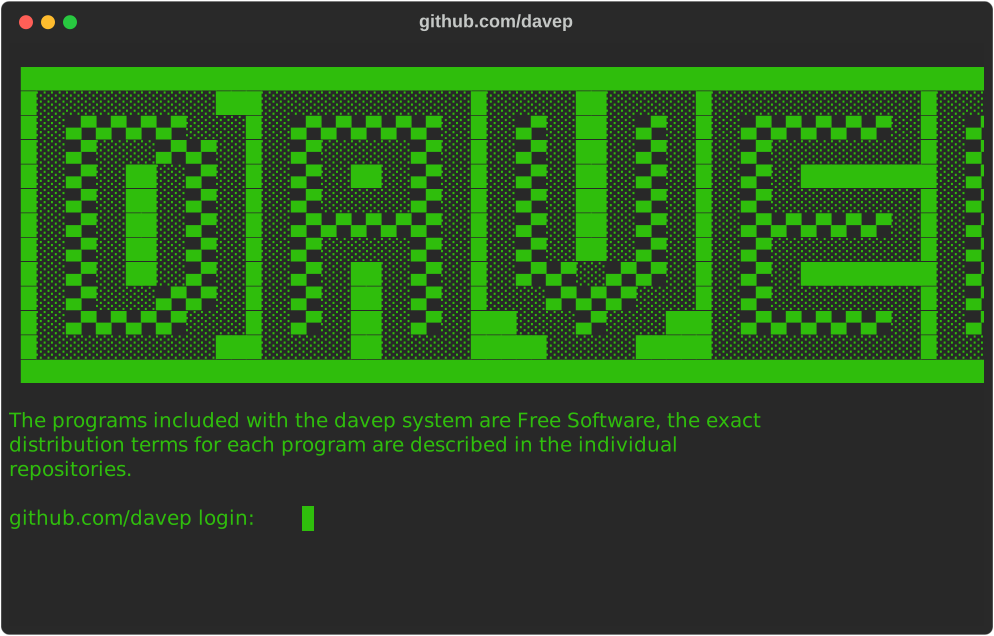
My new GitHub banner

Ever since GitHub introduced the profile README1 I've had a massively low-effort one in place. I made the repo, quickly wrote the file, and then sort of forgot about it. Well, I didn't so much forget as just keep looking at it and thinking "I should do something better with that one day".

Thing is, while there are lots of fancy approaches out there, and lots of neat generator tools and the like... they just weren't for me.

Then yesterday, over my second morning coffee, after getting my blog environment up and going again, I had an idea. It could be cool to use Textual's screenshot facility to make something terminal-themed! I mean, while it's not all I am these days, so much of what I'm doing right now is aimed at the terminal.

So... what to do? Then I thought it could be cool to knock up some sort of login screen type thing; with a banner. One visit to an online large terminal text generator site later, I had some banner text. All that was left was to write a simple Textual application to create the "screen".

The main layout is simple enough:

def compose(self) -> ComposeResult:
    yield Label(NAME, classes="banner")
    yield Label(PRATTLE)
    yield Label("github.com/davep login: [reverse] [/]")

where NAME contains the banner and PRATTLE contains the "login message". With some Textual CSS sprinkled over it to give the exact layout and colour I wanted, all that was left was to make the snapshot. This was easy enough too.

While the whole thing isn't fully documented just yet, Textual does have a great tool for automatically running an application and interacting with it; that meant I could easily write a function to load up my app and save the screenshot:

async def make_banner() -> None:
    async with GitHubBannerApp().run_test() as pilot:
        pilot.app.save_screenshot("davep.svg")

Of course, that needs running async, but that's simple enough:

if __name__ == "__main__":
    asyncio.run(make_banner())

Throw in a Makefile so I don't forget what I'm supposed to run:

.PHONY: all
all:
    pipenv run python make_banner.py

and that's it! Job done!

From here onward I guess I could have some real fun with this. It would be simple enough I guess to modify the code so that it changes what's displayed over time; perhaps show a "last login" value that relates to recently activity or something; any number of things; and then run it in a cron job and update the repository.

For now though... I'll stick with keeping things nice and simple.


  1. It was actually kind of annoying when they introduced it because the repo it uses is named after your user name. I already had a davep repo: it was a private repo where I was slowly working on a (now abandoned, I'll start it again some day I'm sure) ground-up rewrite of my davep.org website. 

Catching up

1 min read

So... erm... yeah... I did it again. I looked away for a moment and somehow almost 7 months passed without a post! It's so easily done too isn't it? While, when I revived this blog last year, I didn't make a point of intending to write lots and often, I had hope that I'd manage something at least once a week; perhaps at least once a month.

Ahh well.

There's been two main reasons why it's been quiet around here. The first is that my (now not so) new job keeps me busy (in a good way). It involves a reasonable amount of trekking into town and back (which I don't mind on the whole), and once I'm home in the evening I'm generally (but not always) done with the keyboard and desk.

The second reason, which is probably the dafter one, is that a bit earlier this year I finally upgraded my desktop setup from the 2019 Intel MacBook Pro I was using to a recently-released M2Pro Mac Mini (and what an upgrade!). How this plays into blogging being even more quiet is... I needed to set up jekyll again, and I'd forgotten how I got it running in the first place, so I kept putting off getting it going, and...

Well, this morning, I sat down with coffee, grepped the history on my previous machine, and got it running in like 5 minutes (of course).

So, here I am, back adding another blog post. I'm writing this as much to test that the setup works as anything else.

But also, this time, I'm going to try and make a promise to myself: I'm going to try and write more. I can and should write about anything. I can and should write short things as well as long things. I can and should remember that it's not about writing things that are going to be super important or anything like that, it's about just getting stuff down and creating and recording.

Note of course I said "try" and make a promise.

We'll see. ;-)

So you're looking for a wee bit of Textual help...

(Modified: 2026-04-28 09:34:45 UTC+01:00)
11 min read

Introduction

Patience, Highlander. You have done well. But it'll take time. You are generations being born and dying. You are at one with all living things. Each man's thoughts and dreams are yours to know. You have power beyond imagination. Use it well, my friend. Don't lose your head.

Juan Sánchez Villalobos Ramírez, Chief metallurgist to King Charles V of Spain

As of the time of writing, I'm a couple or so days off having been with Textualize for 3 months. It's been fun, and educational, and every bit as engaging as I'd hoped, and more. One thing I hadn't quite prepared for though, but which I really love, is how so many other people are learning Textual along with me.

Even in those three months the library has changed and expanded quite a lot, and it continues to do so. Meanwhile, more people are turning up and using the framework; you can see this online in social media, blogs and of course in the ever-growing list of projects on GitHub which depend on Textual.

This inevitably means there's a lot of people getting to grips with a new tool, and one that is still a bit of a moving target. This in turn means lots of people are coming to us to get help.

As I've watched this happen I've noticed a few patterns emerging. Some of these good or neutral, some... let's just say not really beneficial to those seeking the help, or to those trying to provide the help. So I wanted to write a little bit about the different ways you can get help with Textual and your Textual-based projects, and to also try and encourage people to take the most helpful and positive approach to getting that help.

Now, before I go on, I want to make something very clear: I'm writing this as an individual. This is my own personal view, and my own advice from me to anyone who wishes to take it. It's not Textual (the project) or Textualize (the company) policy, rules or guidelines. This is just some ageing hacker's take on how best to go about asking for help, informed by years of asking for and also providing help in email, on Usenet, on forums, etc.

Or, put another way: if what you read in here seems sensible to you, I figure we'll likely have already hit it off over on GitHub or in the Discord server. ;-)

Where to go for help

At this point this is almost a bit of an FAQ itself, so I thought I'd address it here: where's the best place to ask for help about Textual, and what's the difference between GitHub Issues, Discussions and our Discord server?

I'd suggest thinking of them like this:

Discord

You have a question, or need help with something, and perhaps you could do with a reply as soon as possible. But, and this is the really important part, it doesn't matter if you don't get a response. If you're in this situation then the Discord server is possibly a good place to start. If you're lucky someone will be hanging about who can help out.

I can't speak for anyone else, but keep this in mind: when I look in on Discord I tend not to go scrolling back much to see if anything has been missed. If something catches my eye, I'll try and reply, but if it doesn't... well, it's mostly an instant chat thing so I don't dive too deeply back in time.

ℹ️ Note

As a slight aside here: sometimes people will pop up in Discord, ask a question about something that turns out looking like a bug, and that's the last we hear of it. Please, please, please, if this happens, the most helpful thing you can do is go raise an issue for us. It'll help us to keep track of problems, it'll help get your problem fixed, it'll mean everyone benefits.

My own advice would be to treat Discord as an ephemeral resource. It happens in the moment but fades away pretty quickly. It's like knocking on a friend's door to see if they're in. If they're not in, you might leave them a note, which is sort of like going to...

GitHub

On the other hand, if you have a question or need some help or something where you want to stand a good chance of the Textual developers (amongst others) seeing it and responding, I'd recommend that GitHub is the place to go. Dropping something into the discussions there, or leaving an issue, ensures it'll get seen. It won't get lost.

As for which you should use -- a discussion or an issue -- I'd suggest this: if you need help with something, or you want to check your understanding of something, or you just want to be sure something is a problem before taking it further, a discussion might be the best thing. On the other hand, if you've got a clear bug or feature request on your hands, an issue makes a lot of sense.

Don't worry if you're not sure which camp your question or whatever falls into though; go with what you think is right. There's no harm done either way (I may move an issue to a discussion first before replying, if it's really just a request for help -- but that's mostly so everyone can benefit from finding it in the right place later on down the line).

The dos and don'ts of getting help

Now on to the fun part. This is where I get a bit preachy. Ish. Kinda. A little bit. Again, please remember, this isn't a set of rules, this isn't a set of official guidelines, this is just a bunch of "if you want my advice, and I know you didn't ask but you've read this far so you actually sort of did, don't say I didn't warn you!" waffle.

This isn't going to be an exhaustive collection, far from it. But I feel these are some important highlights.

Do...

When looking for help, in any of the locations mentioned above, I'd totally encourage:

Be clear and detailed

Too much detail is almost always way better than not enough. "My program didn't run", often even with some of the code supplied, is so much harder to help than "I ran this code I'm posting here, and I expected this particular outcome, and I expected it because I'd read this particular thing in the docs and had comprehended it to mean this, but instead the outcome was this exception here, and I'm a bit stuck -- can someone offer some pointers?"

The former approach means there often ends up having to be a back and forth which can last a long time, and which can sometimes be frustrating for the person asking. Manage frustration: be clear, tell us everything you can.

Say what resources you've used already

If you've read the portions of the documentation that relate to what you're trying to do, it's going to be really helpful if you say so. If you don't, it might be assumed you haven't and you may end up being pointed at them.

So, please, if you've checked the documentation, looked in the FAQ, done a search of past issues or discussions or perhaps even done a search on the Discord server... please say so.

Be polite

This one can go a long way when looking for help. Look, I get it, programming is bloody frustrating at times. We've all rage-quit some code at some point, I'm sure. It's likely going to be your moment of greatest frustration when you go looking for help. But if you turn up looking for help acting all grumpy and stuff it's not going to come over well. Folk are less likely to be motivated to lend a hand to someone who seems rather annoyed.

If you throw in a please and thank-you here and there that makes it all the better.

Fully consider the replies

You could find yourself getting a reply that you're sure won't help at all. That's fair. But be sure to fully consider it first. Perhaps you missed the obvious along the way and this is 100% the course correction you'd unknowingly come looking for in the first place. Sure, the person replying might have totally misunderstood what was being asked, or might be giving a wrong answer (it me! I've totally done that and will again!), but even then a reply along the lines of "I'm not sure that's what I'm looking for, because..." gets everyone to the solution faster than "lol nah".

Entertain what might seem like odd questions

Aye, I get it, being asked questions when you're looking for an answer can be a bit frustrating. But if you find yourself on the receiving end of a small series of questions about your question, keep this in mind: Textual is still rather new and still developing and it's possible that what you're trying to do isn't the correct way to do that thing. To the person looking to help you it may seem to them you have an XY problem.

Entertaining those questions might just get you to the real solution to your problem.

Allow for language differences

You don't need me to tell you that a project such as Textual has a global audience. With that rather obvious fact comes the other fact that we don't all share the same first language. So, please, as much as possible, try and allow for that. If someone is trying to help you out, and they make it clear they're struggling to follow you, keep this in mind.

Acknowledge the answer

I suppose this is a variation on "be polite" (really, a thanks can go a long way), but there's more to this than a friendly acknowledgement. If someone has gone to the trouble of offering some help, it's helpful to everyone who comes after you to acknowledge if it worked or not. That way a future help-seeker will know if the answer they're reading stands a chance of being the right one.

Accept that Textual is zero-point software (right now)

Of course the aim is to have every release of Textual be stable and useful, but things will break. So, please, do keep in mind things like:

  • Textual likely doesn't have your feature of choice just yet.
  • We might accidentally break something (perhaps pinning Textual and testing each release is a good plan here?).
  • We might deliberately break something because we've decided to take a particular feature or way of doing things in a better direction.

Of course it can be a bit frustrating at times, but overall the aim is to have the best framework possible in the long run.

Don't...

Okay, now for a bit of old-hacker finger-wagging. Here's a few things I'd personally discourage:

Lack patience

Sure, it can be annoying. You're in your flow, you've got a neat idea for a thing you want to build, you're stuck on one particular thing and you really need help right now! Thing is, that's unlikely to happen. Badgering individuals, or a whole resource, to reply right now, or complaining that it's been $TIME_PERIOD since you asked and nobody has replied... that's just going to make people less likely to reply.

Unnecessarily tag individuals

This one often goes hand in hand with the "lack patience" thing: Be it asking on Discord, or in GitHub issues, discussions or even PRs, unnecessarily tagging individuals is a bit rude. Speaking for myself and only myself: I love helping folk with Textual. If I could help everyone all the time the moment they have a problem, I would. But it doesn't work like that. There's any number of reasons I might not be responding to a particular request, including but not limited to (here I'm talking personally because I don't want to speak for anyone else, but I'm sure I'm not alone here):

  • I have a job. Sure, my job is (in part) Textual, but there's more to it than that particular issue. I might be doing other stuff.
  • I have my own projects to work on too. I like coding for fun as well (or writing preaching old dude blog posts like this I guess, but you get the idea).
  • I actually have other interests outside of work hours so I might actually be out doing a 10k in the local glen, or battling headcrabs in VR, or something.
  • Housework. :-/

You get the idea though. So while I'm off having a well-rounded life, it's not good to get unnecessarily intrusive alerts to something that either a) doesn't actually directly involve me or b) could wait.

Seek personal support

Again, I'm going to speak totally for myself here, but I also feel the general case is polite for all: there's a lot of good support resources available already; sending DMs on Discord or Twitter or in the Fediverse, looking for direct personal support, isn't really the best way to get help. Using the public/collective resources is absolutely the best way to get that help. Why's it a bad idea to dive into DMs? Here's some reasons I think it's not a good idea:

  • It's a variation on "unnecessarily tagging individuals".
  • You're short-changing yourself when it comes to getting help. If you ask somewhere more public you're asking a much bigger audience, who collectively have more time, more knowledge and more experience than a single individual.
  • Following on from that, any answers can be (politely) fact-checked or enhanced by that audience, resulting in a better chance of getting the best help possible.
  • The next seeker-of-help gets to miss out on your question and the answer. If asked and answered in public, it's a record that can help someone else in the future.

Doubt your ability or skill level

I suppose this should really be phrased as a do rather than a don't, as here I want to encourage something positive. A few times I've helped people out who have been very apologetic about their questions being "noob" questions, or about how they're fairly new to Python, or programming in general. Really, please, don't feel the need to apologise and don't be ashamed of where you're at.

If you've asked something that's obviously answered in the documentation, that's not a problem; you'll likely get pointed at the docs and it's what happens next that's the key bit. If the attitude is "oh, cool, that's exactly what I needed to be reading, thanks!" that's a really positive thing. The only time it's a problem is when there's a real reluctance to use the available resources. We've all seen that person somewhere at some point, right? ;-)

Not knowing things is totally cool.

Conclusion

So, that's my waffle over. As I said at the start: this is my own personal thoughts on how to get help with Textual, both as someone whose job it is to work on Textual and help people with Textual, and also as a FOSS advocate and supporter who can normally be found helping Textual users when he's not "on the clock" too.

What I've written here isn't exhaustive. Neither is it novel. Plenty has been written on the general subject in the past, and I'm sure more will be written on the subject in the future. I do, however, feel that these are the most common things I notice. I'd say those dos and don'ts cover 90% of "can I get some help?" interactions; perhaps closer to 99%.

Finally, and I think this is the most important thing to remember, the next time you are battling some issue while working with Textual: don't lose your head!
ℹ️ Note

This advice blog post was first hosted on the Textual devlog.