Posts from March 03, 2026

BlogMore v1.5.0

3 min read

Since switching over on the 19th of last month I've been making lots of changes to BlogMore. While there's been a good few bug fixes and QoL changes, I've also been adding new features that I've found myself wanting.

Here's a list of some of the significant additions I've added in the last couple of weeks (and, yes, as per the experiment, all of these have been developed by me prompting GitHub Copilot):

  • All parts of a date in a post's timestamp can be clicked to get to an archive of that point in time.
  • Added fully-client-side full text search (I'm finding this especially useful).
  • Added sitemap generation.
  • Added a general fallback description for any page that doesn't have one.
  • Added fallback keywords for any page that doesn't have any.
  • Added author metadata to the header of all pages.
  • Hugely optimised the use of FontAwesome.
  • Made best possible use of all the usual og: type metadata in the head of all pages.
  • Added optional CSS minification, improving page load times.
  • Added optional JavaScript minification, improving page load times.
  • Where appropriate, all pages now have rel="prev" and rel="next" tags in the <head>.
  • Added a rel="canonical" tag to the <head> of all pages.
  • Improved the style and workings of the pagination of all archive type pages.
  • Improved the cosmetics of the category and tag clouds.
  • Improved how the first paragraph is discovered for a page or post, when using it as the default description in the <head> of a page.
  • Cleaned up the generated HTML so it's more compact.
  • Added support for custom 404 pages.

As I say, they're just the improvements I've made that have come to mind as I've used BlogMore. I've also done a lot of bug fixing too. You can read the full changelog over on the BlogMore website1.

I feel that the pace of updates and additions has started to slow; I think I've now got more or less everything I wanted from this. I'm pretty sure I can do everything I ever bothered to do with Jekyll and Pelican, and I am enjoying "owning" the code such that, if I have an idea for something I want, it's easy enough to make it happen.

I'm also pretty happy with how well the results perform. Despite the fact I'm not a web developer, and despite this blog being served by GitHub Pages (which, let's be honest, isn't the most speedy host), the measurements for a single page in the blog look fairly good:
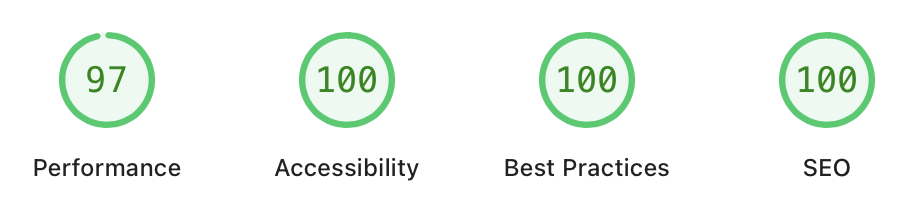
Desktop

That's measuring loading in a desktop context. Even measured as mobile (which I've tried to make work well too) it's not too shabby:

Mobile

I think I can rightfully be satisfied with those values, given this isn't normally my primary focus when it comes to software development.

Anyway, if you like messing with static site generators, and one that is blog-centric sounds useful, and if you're not put off by the fact that this is a deliberate "use GitHub Copilot" experiment, feel free to take a look.


  1. Which, somewhat amusingly, is built with MkDocs. 

Hike v1.3.0

2 min read

I've just released v1.3.0 of Hike, my little terminal-based Markdown browser. It's about a year now since I made the first release and I've been making the odd update here and there, but mostly it's a pretty stable tool. There's a few other things I'd like to do with it but I keep getting distracted by different ideas.

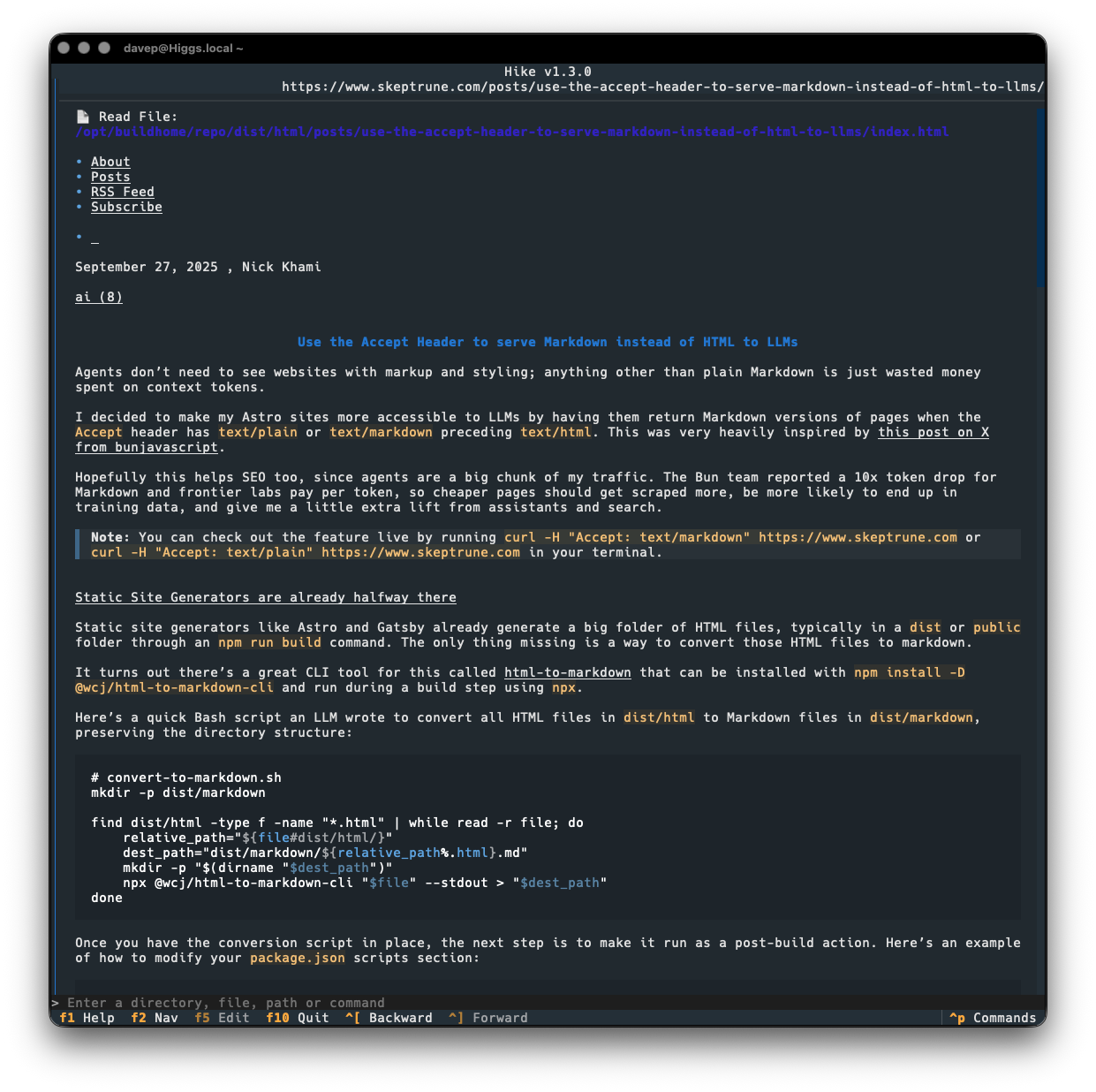
Today's release sort of rides on the coattails of the current love for all things Markdown because of "the AI". It seems that some folk are now keen on the idea of serving Markdown from their websites, when asked for it: as you can see in this post for example. While that might be handy for some LLM bot or whatever, it's also pretty handy if you happen to have a web-friendly Markdown browser!

So v1.3.0 makes a small change to how a URL is looked at when deciding if it might be a Markdown document, by saying "hey, web server, I like Markdown more than anything else, so feel free to serve me that up". If we get a Markdown type back, we go ahead and load it into Hike.

This means that the post mentioned above loads up just fine now:

Viewing a Markdown site in Hike

Previously, Hike would have gone "nah, that's not a Markdown document" and would have handed off to the environment's web browser.

Hike is licensed GPL-3.0 and available via GitHub and also via PyPi. If you have an environment that has pipx installed you should be able to get up and going with:

$ pipx install hike

If you're more into uv:

uv tool install hike

If you don't have uv installed you can use uvx.sh to perform the installation. For GNU/Linux or macOS or similar:

curl -LsSf uvx.sh/hike/install.sh | sh

or on Windows:

powershell -ExecutionPolicy ByPass -c "irm https://uvx.sh/hike/install.ps1 | iex"

Original Seen by davep rescued

1 min read

Still Alive

At the end of yesterday's post I said I might see if I can rescue the original photoblog from its backup on WordPress. This was the first photoblog I played with, posting to the long-dead Posterous between 2009 and 2013.

So, yesterday evening, I did an extract of the full feed from WordPress, and also asked for a full backup of all the media. I then fired up Emacs and rattled out some Python code that would marry up the two sets of data and add to the photoblog repository. It took a little bit of working out; it seems that every post had two entries in the feed: a parent and a child entry. I've no clue why that's the case; I didn't really care to get too deeply into it.

Soon enough seen-by.davep.dev was updated with an extra 1,833 posts! So now the categories on that blog site are broken down into Seen By Me 1 (the original) and Seen By Me 2 (the second incarnation).

Sadly, for the first blog, tagging wasn't really much of a thing so the tag cloud hasn't grown too much.

But, finally, I've got both the photoblogs back up and hosted somewhere I can point to, and I'm fully in control of their content. While it is hosted on GitHub Pages I've done this in a way that it would be pretty easy to move elsewhere; this is down to the fact that it's a simple static site built with BlogMore.