Posts from March 31, 2026

eg.el v1.2

1 min read

Okay, that's it then; this is turning into a thing I think. Second in an occasional series of posts where I tidy up some of my old Emacs packages. This time I dug out eg.el and cleaned up some of the frowned-upon behaviour.

For anyone who doesn't know it: eg.el is one of many Norton Guide readers I've written over the years. This particular one was possibly the most fun as it was the most unlikely one to write and also, I think it's fair to say, my most ambitious one as well. It also holds a special place for me in that the bulk of it was written on trains during multiple trips up to Scotland, before I finally moved here (on the MacBook Air I mentioned the other day).

As I look at it now, I sort of want to give it a proper revisit. I've written more Norton Guide code since (see AgiNG for example) and have learnt better ways to handle certain things, and I also have an even bigger Norton Guide collection to test against. All of this could make for an even better Emacs implementation.

I also suspect that, this time around, I can do a better job of handling the colour and retaining the original Norton Guide reader look and feel. But, for now, the code has been tidied up and should keep working for some time yet.
thinks.el v1.13

1 min read

Given the recent spate of hacking on some Emacs Lisp, I've got a real taste for hacking on some more. Or, more to the point, revisiting some of the packages I have in Melpa and tidying them up where necessary.

The main thing I'll need to address is cutting back on all my old setf ways. I liked that approach to doing things, it made lots of sense and felt elegant; sadly the Emacs maintainers didn't seem to agree.

So... kicking this off I've released v1.13 of thinks.el. This is a bit of nonsense I wrote back in the days when Usenet was still pretty busy and the place to be (well, okay, back in 2000 when I was still hanging out on Usenet). The package itself lets you quickly and easily...

. o O ( ...write some text and then mark it all and then run a command and )
      ( have it turned into something that looks a little like a thought   )
      ( bubble.                                                            )

It has some variations on how the bubble looks, and also lets you use customize to tweak the characters to use, and also has an "extra silly" mode too.

Updating this wasn't too bad. Mostly just a case of turning some instances of (setf (point) ...) into (goto-char ...), and also modifying one instance of incf to be cl-incf.

Honestly, I don't know how useful this package is to anyone anymore. Most folk don't even know what Usenet is these days, and all the "social" places seem to favour non-monospaced fonts, meaning the bubbles would look pretty terrible anyway.

On the other hand, it seems a shame to not update it, and perhaps someone somewhere still uses it to make some pithy parenthetical remark, possibly about September never ending.

blogmore.el v2.3

1 min read

I've bumped blogmore.el to v2.3. The main change in this release, which I've had on my mental to-do list for a couple of days now, revolves around categories, tags and case.

I've got BlogMore set up so that it's pretty relaxed about case when it comes to categories and tags; so when it comes to generated files and URLs everything collapses to lowercase. However, blogmore.el wasn't taking this into account.

While it wasn't a serious issue, it did have the side-effect that, if you had a tag of lisp and a tag of Lisp, both would appear in the list of tags you could complete from. Also, when you went to add a tag to the tags frontmatter (via the blogmore-add-tag command), if you selected Lisp and lisp was already there, you'd end up with both versions after the command finished.

â„šī¸ Note

As mentioned earlier: BlogMore itself would collapse Lisp and lisp to the same tag; the downside here is you'd see both tags shown in the post itself. Not a real problem, just not very tidy.

So earlier I changed things up a little; first cleaning up when loading pre-existing values and then ensuring the newly-set tags are deduplicated.

This now means I can edit and update a post even faster, without needing to worry about accidentally duplicating tags. This in turn reduces the friction to writing a post for my blog. That is, after all, the whole point of the name of the package and the blogging tool it's connected to!

OldNews v1.3.0

1 min read

OldNews

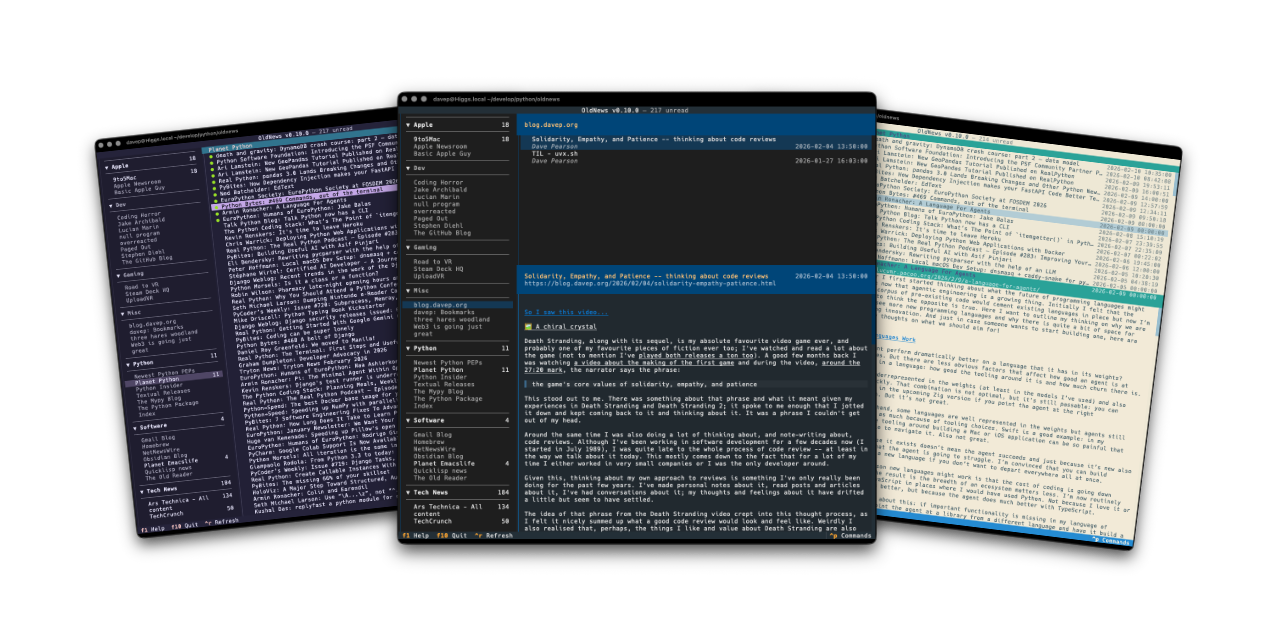
Yesterday evening I released v1.3.0 of OldNews, my terminal-based client for TheOldReader.

The main reason for this release is that html_to_markdown had a major release and the one function I use from it fundamentally changed the return type, causing OldNews to crash any time you tried to read an article.

It was a quick enough fix, although it's one I want to go back and review and perhaps see if there's a better approach, or see if this new return type offers something I could be making better use of.

The one other change, which I made a wee while ago but hadn't got round to releasing yet (I've been kind of distracted recently), is that OldNews now only makes a call out to the API to mark an article as read when you read it, but only if it was previously unread. A small internal change nobody should really notice, but it saves on work.

If you're a user of TheOldReader and fancy interacting with it from the terminal too then it's out there to try out. It's licensed GPL-3.0 and available via GitHub and also via PyPI. If you have an environment that has pipx installed you should be able to get up and running with:

pipx install oldnews

It can also be installed using uv:

uv tool install oldnews

If you don't have uv installed you can use uvx.sh to perform the installation. For GNU/Linux or macOS or similar:

curl -LsSf uvx.sh/oldnews/install.sh | sh

or on Windows:

powershell -ExecutionPolicy ByPass -c "irm https://uvx.sh/oldnews/install.ps1 | iex"

Once installed, run the oldnews command.