Posts from April 01, 2026

blogmore.el v2.4

1 min read

I've just released a little update to blogmore.el, adding blogmore-toggle-draft as a command. This came about in connection with the feature request that resulted in BlogMore v2.7.0 being released.

While I don't personally use draft for my posts, I can see the utility of it and if someone were to happen to use blogmore.el, it could be useful to have this bound to a handy key combination.

As for how it works: that's simple. When run, if there is no draft: frontmatter property, then draft: true is added. If draft: is there it is removed. Yes, it does mean that it will also remove draft: false too but... eh. Okay, fine, I might handle that case as a followup but I couldn't really imagine someone wanting to keep draft: false in the frontmatter.

If a post is ready to go, why bother with a header that means the same thing when it's not there?
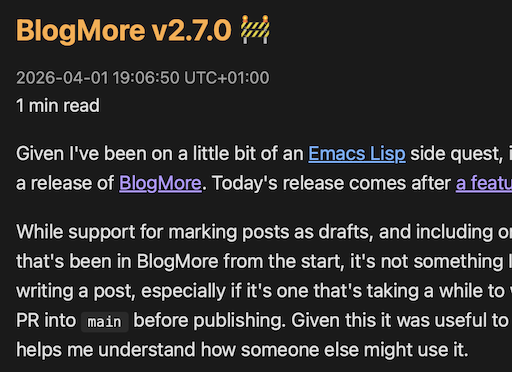
BlogMore v2.7.0

1 min read

Given I've been on a little bit of an Emacs Lisp side quest, it's been a couple or so days since I made a release of BlogMore. Today's release comes after a feature request about draft posts.

While support for marking posts as drafts, and including or excluding them from a build, is something that's been in BlogMore from the start, it's not something I've ever used. These days, when I'm writing a post, especially if it's one that's taking a while to write, I'll do it in a branch and eventually PR into main before publishing. Given this it was useful to get a request relating to the feature as it helps me understand how someone else might use it.

So as of v2.7.0, if a post is marked as a draft, and if drafts are included in the build, it will be pretty obvious:

A draft post

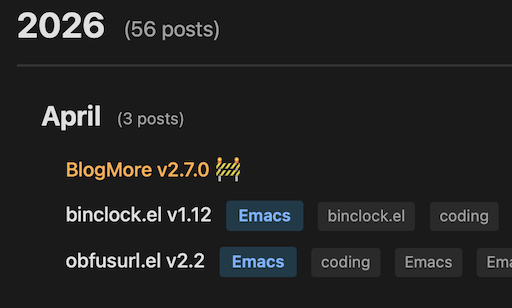
When the post's title appears in the archive it will also appear obvious that it's still a draft too:

A draft post in the archive

All of this is, of course, modifiable via the template API and via styling, so if the choice of colour or icon doesn't suit it can be modified to taste.

binclock.el v1.12

1 min read

Some time in the late 1990s, after I'd been using GNU Emacs for a few years1, I grabbed a copy of Writing GNU Emacs Extensions. While I'd obviously created and added to and tinkered with my ~/.emacs some, I'd never written any non-trivial code. I feel it was around 1998 or 1999 that I really started to get into trying to write actual extensions, thanks to that book.

I can't remember what the first complete package was. I think it was actually 5x5.el2 but it might also have been binclock.el. Honestly, it's so long ago now that I don't have any good recollection and I don't have any record3. All of which is to say, binclock.el is one of my oldest bits of Emacs Lisp code, so it seemed fair that while I'm cleaning things up, I should give it a tidy too.

For anyone curious: it's a very simple binary clock type of thing. It opens a very small window and, depending on your settings, shows the time in various ways, all of which are in some way a binary display.

I can't say I've honestly ever had it running for more than a few moments, as an amusement, but I do remember it being a really helpful body of code to work on to help get familiar with Elisp. So, 27 years on from when I first opened the buffer to create it, it's tweaked and tidied and hopefully ready for another 27.

Would be cool if I'm around long enough to give it yet another tweak then.


  1. I first met it on OS/2 of all places, in 1994, or thereabouts. 

  2. Yes, the one that became Tools > Games > 5x5

  3. If I was using version control at all then, it was probably just rcs

obfusurl.el v2.2

1 min read

This bit of Emacs Lisp absolutely comes from a more innocent time on the Internet. Looking at it, it seems I wrote the first version, at least as a proper package, back in 2001. It's very possible that I carried a non-package version of it around as part of dp-lib.el1 for some time before, so it might date from the late 1990s. While we weren't absolutely innocent back then, the idea of a slightly-risky-looking URL wasn't quite so bad as it is now.

So obfusurl.el came about from my time on Usenet, where sometimes you'd want to post a URL that would otherwise be a spoiler. This package was my solution to that. It's a simple idea: keep the protocol and domain and so on visible, just hide the remaining part. So rather than post:

https://blog.davep.org/about/

You'd post:

https://blog.davep.org/%61%62%6f%75%74/

I suppose this is still useful today, although I would expect a lot of people to be way less likely to want to attempt that click -- readable domain or not.

But, anyway, the code needed a tidy and cleanup for today's Emacs and Emacs Lisp. So obfusurl.el v2.2 now exists.


  1. For a good chunk of my first decade of using Emacs, I carried a lot of personal code around in a rather large "library" file.