Posts from April 16, 2026

I should use webp

2 min read

For a good while now I've been pretty happy with the PageSpeed measurements of this blog, which in turn means I've been happy with the state of what's generated by BlogMore. I have pretty much everything that can be minified nice and minimal. At this point, the main thing that causes the speed measurement to fluctuate is image sizes.

I use a lot of PNGs on this blog. When I'm using images, they're almost always in posts that include screenshots, which in turn pretty much demand that I use a lossless format. When I take these screenshots I don't worry too much about the dimensions (within reason), and of course I don't really do anything to optimise how they'll work and appear on different display sizes. If I was to get too into that, it would add friction to writing something, and the whole point of this is to feel less friction when it comes to sitting at the keyboard.

So I've been living with the fact that some images can be pretty big. While I do make a point of using pngcrush on every image, it generally doesn't make a huge saving.

Then yesterday I read this post on Andy's blog and I suddenly realised what I had to do!

I should use webp

Borrowing from what Andy did, I used mogrify too, setting up this Fish abbr in my Fish configuration:

if type -q mogrify
    abbr -g mkwebp "mogrify -format webp -define webp:lossless=true -quality 100"
end

In my case, at least in the initial experiment, I decided to keep it all lossless. So far the results have been really good, cutting the image sizes down by a significant amount. For example, if I look at the images for yesterday's posts:

 90581 15 Apr 18:14 sl-overview.png
 33446 16 Apr 20:23 sl-overview.webp
392661 15 Apr 18:14 slstats-region-info.png
225392 16 Apr 20:23 slstats-region-info.webp
 36049 15 Apr 19:39 year-chart.png
 15590 16 Apr 20:23 year-chart.webp

That's a pretty reasonable saving!

So far all I've done is convert the few latest posts that make up the front page of my blog, just so I can see what impact it has. I'm getting improved load times on mobile, for sure.

There are a couple of downsides to this, of course.

  1. Now I want to do the whole blog, so while I can easily go through and convert all the png files to webp, converting all the image markup in the Markdown files isn't quite so simple, and even if I do write something to automate it, I'm then going to want to review it to make 100% sure nothing has broken.
  2. I can't just then remove all the png files to cut back on the space used by the generated site. The front page of the site has a feed, and all the categories have a feed each too. This means that there could be HTML out there from some of my oldest posts, referring to the png files, and just removing them will result in broken images.

Overall though, it might be worth doing at some point soon. Meanwhile, from now on, I think I'm going to replace my pngcrush step with a mkwebp step and just use webp instead of png now.

I guess I'm all modern now!
boxquote.el v2.4

2 min read

boxquote.el is another of my oldest Emacs Lisp packages. The original code itself was inspired by something I saw on Usenet, and writing my own version of it seemed like a great learning exercise; as noted in the thanks section in the commentary in the source:

Kai Grossjohann for inspiring the idea of boxquote. I wrote this code to mimic the "inclusion quoting" style in his Usenet posts. I could have hassled him for his code but it was far more fun to write it myself.

While I never used this package to quote text I was replying to in Usenet posts, I did use it a lot on Usenet, and in mailing lists, and similar places, to quote stuff.

The default use is to quote a body of text; often a paragraph, or a region, or perhaps even Emacs' idea of a defun.

,----
| `boxquote.el` provides a set of functions for using a text quoting style
| that partially boxes in the left hand side of an area of text, such a
| marking style might be used to show externally included text or example
| code.
`----

Where the package really turned into something fun and enduring, for me, was when I started to add the commands that grabbed information from elsewhere in Emacs and added a title to explain the content of the quote. For example, using boxquote-describe-function to quote the documentation for a function at someone, while also showing them how to get at that documentation:

,----[ C-h f boxquote-text RET ]
| boxquote-text is an autoloaded interactive native-comp-function in
| ‘boxquote.el’.
|
| (boxquote-text TEXT)
|
| Insert TEXT, boxquoted.
`----

Or perhaps getting help with a particular key combination:

,----[ C-h k C-c b ]
| C-c b runs the command boxquote (found in global-map), which is an
| interactive native-comp-function in ‘boxquote.el’.
|
| It is bound to C-c b.
|
| (boxquote)
|
| Show a transient for boxquote commands.
|
|   This function is for interactive use only.
|
| [back]
`----

Or figuring out where a particular command is and how to get at it:

,----[ C-h w fill-paragraph RET ]
| fill-paragraph is on fill-paragraph (M-q)
`----

While I seldom have use for this package these days (mainly because I don't write on Usenet or in mailing lists any more) I did keep carrying it around (always pulling it down from melpa) and had all the various commands bound to some key combination.

(use-package boxquote
  :ensure t
  :bind
  ("<f12> b i"   . boxquote-insert-file)
  ("<f12> b M-w" . boxquote-kill-ring-save)
  ("<f12> b y"   . boxquote-yank)
  ("<f12> b b"   . boxquote-region)
  ("<f12> b t"   . boxquote-title)
  ("<f12> b h f" . boxquote-describe-function)
  ("<f12> b h v" . boxquote-describe-variable)
  ("<f12> b h k" . boxquote-describe-key)
  ("<f12> b h w" . boxquote-where-is)
  ("<f12> b !"   . boxquote-shell-command))

Recently, with the creation of blogmore.el, I moved the boxquote commands off the b prefix (because I wanted that for blogging) and onto an x prefix. Even then... that's a lot of commands bound to a lot of keys that I almost never use but still can't let go of.

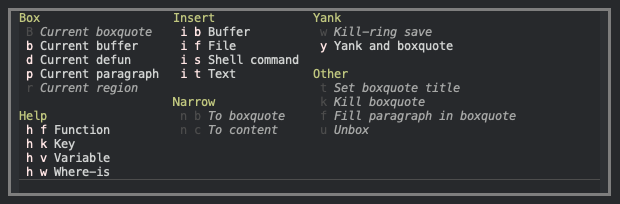
Then I got to thinking: I'd made good use of transient in blogmore.el, why not use it here too? So now boxquote.el has acquired a boxquote command which uses transient.

The boxquote transient in action

Now I can have:

(use-package boxquote
  :ensure t
  :bind
  ("C-c b" . boxquote))

and all the commands are still easy to get to and easy to (re)discover. I've also done my best to make them context-sensitive too, so only applicable commands should be usable at any given time.