boxquote.el is another of my oldest Emacs Lisp packages. The original code itself was inspired by something I saw on Usenet, and writing my own version of it seemed like a great learning exercise; as noted in the thanks section in the commentary in the source:
Kai Grossjohann for inspiring the idea of boxquote. I wrote this code to mimic the "inclusion quoting" style in his Usenet posts. I could have hassled him for his code but it was far more fun to write it myself.
While I never used this package to quote text I was replying to in Usenet posts, I did use it a lot on Usenet, and in mailing lists, and similar places, to quote stuff.
The default use is to quote a body of text; often a paragraph, or a region, or perhaps even Emacs' idea of a defun.
,----
| `boxquote.el` provides a set of functions for using a text quoting style
| that partially boxes in the left hand side of an area of text, such a
| marking style might be used to show externally included text or example
| code.
`----
Where the package really turned into something fun and enduring, for me, was when I started to add the commands that grabbed information from elsewhere in Emacs and added a title to explain the content of the quote. For example, using boxquote-describe-function to quote the documentation for a function at someone, while also showing them how to get at that documentation:
,----[ C-h f boxquote-text RET ]
| boxquote-text is an autoloaded interactive native-comp-function in
| ‘boxquote.el’.
|
| (boxquote-text TEXT)
|
| Insert TEXT, boxquoted.
`----
Or perhaps getting help with a particular key combination:
,----[ C-h k C-c b ]
| C-c b runs the command boxquote (found in global-map), which is an
| interactive native-comp-function in ‘boxquote.el’.
|
| It is bound to C-c b.
|
| (boxquote)
|
| Show a transient for boxquote commands.
|
|   This function is for interactive use only.
|
| [back]
`----
Or figuring out where a particular command is and how to get at it:
,----[ C-h w fill-paragraph RET ]
| fill-paragraph is on fill-paragraph (M-q)
`----
While I seldom have use for this package these days (mainly because I don't write on Usenet or in mailing lists any more) I did keep carrying it around (always pulling it down from Melpa) and had all the various commands bound to some key combination.
(use-package boxquote
  :ensure t
  :bind
  ("<f12> b i"   . boxquote-insert-file)
  ("<f12> b M-w" . boxquote-kill-ring-save)
  ("<f12> b y"   . boxquote-yank)
  ("<f12> b b"   . boxquote-region)
  ("<f12> b t"   . boxquote-title)
  ("<f12> b h f" . boxquote-describe-function)
  ("<f12> b h v" . boxquote-describe-variable)
  ("<f12> b h k" . boxquote-describe-key)
  ("<f12> b h w" . boxquote-where-is)
  ("<f12> b !"   . boxquote-shell-command))
Recently, with the creation of blogmore.el, I moved the boxquote commands off the b prefix (because I wanted that for blogging) and onto an x prefix. Even then... that's a lot of commands bound to a lot of keys that I almost never use but still can't let go of.
Then I got to thinking: I'd made good use of transient in blogmore.el, why not use it here too? So now boxquote.el has acquired a boxquote command which uses transient.
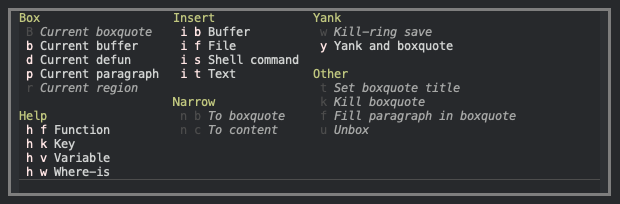
Now I can have:
(use-package boxquote
  :ensure t
  :bind
  ("C-c b" . boxquote))
and all the commands are still easy to get to and easy to (re)discover. I've also done my best to make them context-sensitive too, so only applicable commands should be usable at any given time.
Have a comment or query about this post? Feel free to drop me a line about it.