One of the things I noticed when I started on the BlogMore experiment was the fact that Copilot/Claude seemed to love to write monolithic code. Pretty early on most of the code was landing in just a couple of files. Once I noticed this I instructed it to break things up and always try and be more modular. This started out in the instructions for Copilot but eventually I migrated the instruction to AGENTS.md (as seems to be the fashion these days).
While this rule seems to have held, one file that always remained pretty large was generator.py. This is, as you might guess from the name, the main site generation code. While it does sort of make sense that it is the pivotal body of code for the application, it doesn't follow that it has to contain so much code.
So, yesterday evening, I decided to experiment by asking Gemini CLI to look over the code and tell me what it thinks. The prompt was:
Quite a bit of work has been done on
@src/blogmore/generator.pyto try and reduce duplication of effort and boilerplate. I wonder if we can do a little more? Please take a look over the code there and see if there is any more repetitive code that can be cleaned up, to make the codebase more maintainable.Also, the file is getting quite long. I prefer Python files to be no more than 1000 lines at most. Please also look at the code with a view to it being broken up into more logical sub-modules. Perhaps @src/blogmore/generator.py could turn into a
generatordirectory with smaller modules inside it.Look over this and report back with any findings. Also, don't look for anything, look for and report back changes that will make cleaner code and will be impactful.
I then left it to come up with an assessment while I got on with other things.
Its headline finding was:
Status: The file is currently 2,146 lines long, significantly exceeding the 1,000-line maintainability threshold. It has become a "God Object" that handles everything from low-level byte-copying and regex-based minification to high-level site orchestration.
The full assessment has been saved to a public gist.
This seemed reasonable, so I told it to get on with the job of doing this. I've also saved the plan it made as a gist.
What is notable in the plan is the validation strategy at the end. While there is a full suite of tests available, and while this is documented in AGENTS.md:
- Run the test suite after every change: `make test`.
- Any new functionality **must** have associated tests.
- If a change in behaviour makes existing tests incorrect, update those tests.
  Do not change tests purely to make them pass without a genuine reason.
- Do not delete or comment out failing tests; fix the underlying code instead.
the plan that Gemini arrived at seemed to concentrate only on test_generator.py and test_integration.py.
Once the work to break up generator.py was done I could see it had run those tests and it was happy with the outcome. So I did the obvious thing and ran make test and, sure enough, there was a failed test (I think there was just the one). So I said to Gemini:
you should have run all the tests. Did you read @AGENTS.md at all?
It replied with:
Verifying Refactor Quality: Running comprehensive quality checks as mandated by AGENTS.md.
and then got on with the work of fixing what had been broken.
At this point it should be noted that another instruction I have in AGENTS.md is:
Use full, descriptive names for variables, functions, and classes. Do not use abbreviations when the full word is readable.
I've found that Copilot/Claude has done an excellent job of sticking to this wish. If anything I'd say at times it's got a little too carried away. But, I'm not typing this code, I'm only reading it; making the code very readable from a symbol point of view makes a lot of sense.
I swear, I can see why people sometimes fall into the trap of thinking agents have personalities, because the next thing I see, after telling it off for obviously not reading the rules of messing in my repo, is this:
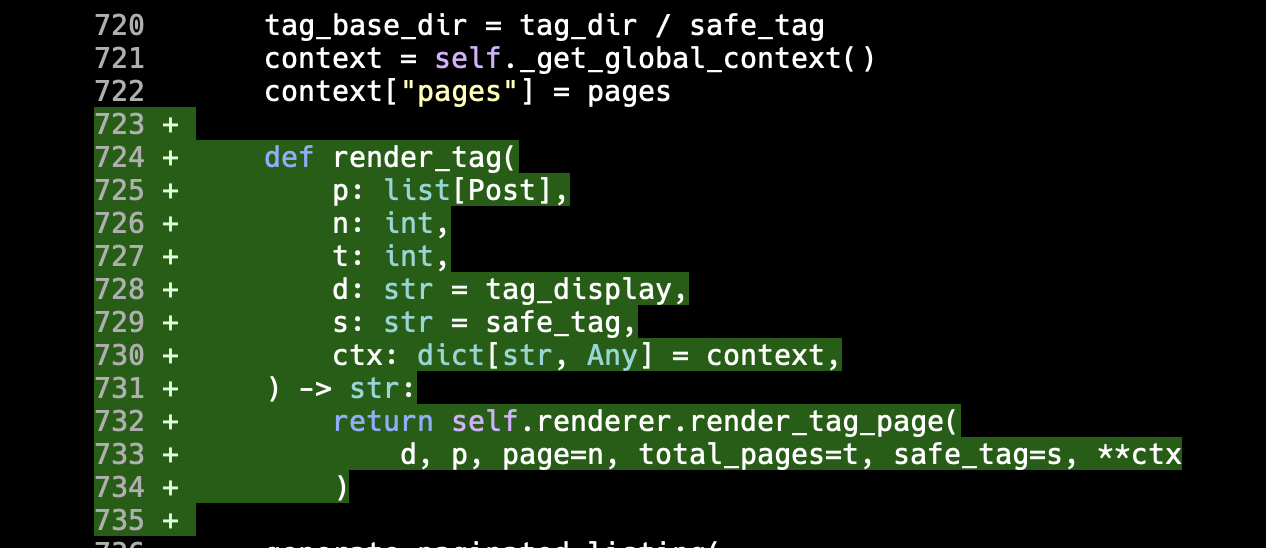
Now, to be fair, my instruction does mention variables, functions, and classes. It doesn't explicitly say "parameters", I guess. But... come on!
In all other respects though it got things fixed and I ended up with a cleaned-up generation engine that was more modular. In review, I did find a couple of things in its plan that I wasn't super keen on (and which I could have pushed back on right at the planning stage, so I'd say that's on me, not on the agent), but overall it was a workable solution.
I prompted it once more to fix the things I didn't like, which it did and did a fine job of. As part of that prompt I did say:
I'm seeing functions in there with single letter parameter names. Please keep in mind the instruction about naming things in @AGENTS.md
And it did do as it was told.
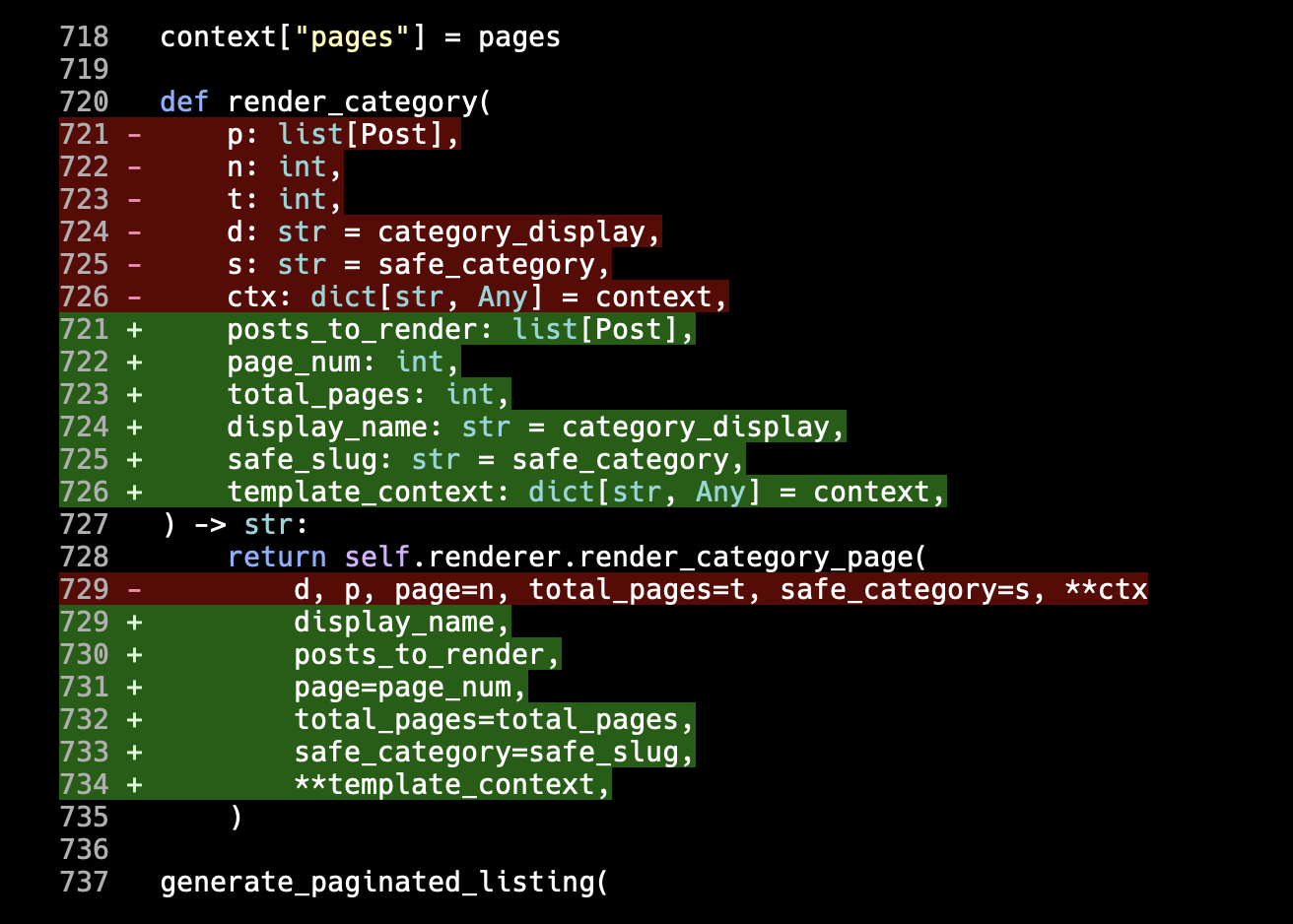
As amusing as this was (really, it's so tempting to think it decided to be stroppy after I told it to go read AGENTS.md), it has left me wondering though: just how widespread is the convention of looking for and reading the agents file? While I get that each of the command-line tools seem to have a preference for their self-named instructions file first, it was my understanding that in the absence of such a file AGENTS.md is looked for.
During the session I'm talking about here, either Gemini CLI didn't do that, or it did and just didn't take on board the conventions I wanted it to follow.
As for the great breakup of generator.py... I grabbed the assessment and the plan that Gemini came up with, turned it into an issue, and set Copilot to work on it too. Despite working off the same prompt, as it were, it came up with a very different approach. So my next job is to decide which of the two I like most.
As of the time of writing, the Gemini approach to cleaning this up results in the main site.py file inside the new generator subdirectory being 996 lines; that's just under the 1,000 line limit I tend to set myself1, so close enough, but not ideal. Copilot/Claude, on the other hand, is sat at 278 lines! While the idea of Gemini was to make site.py a small descriptive top-to-bottom and start-to-finish description of how a site is generated, it's somehow managed to make a more verbose version; the Copilot/Claude version looks to do a far better job of fulfilling that intention.
Then again the Gemini version has broken the work up across 9 files, the Copilot/Claude version across 13. Also the Copilot/Claude version has taken a really fun and interesting approach to solving the problem that I'm kind of digging2.
So now I have to decide which, if either, I'm going with.
That's probably another post.
Have a comment or query about this post? Feel free to drop me a line about it.