Posts from May 05, 2026

Me vs Claude (redux)

1 min read

It's a small thing, but here's round 2 of me vs Claude. This time I'm directing the agent to clean up the code that does word counts, getting it to use the Markdown to plain text code that exists in BlogMore, rather than the regex-based Markdown-stripper it was using. The approach it landed on made sense to me, adding another text extractor class, but one that ignores fenced codeblocks1. So, in addition to this code (I've removed all docstrings and comments for the sake of including here):

class _AllTextExtractor(HTMLParser):

    def __init__(self) -> None:
        super().__init__(convert_charrefs=True)
        self._chunks: list[str] = []

    def handle_data(self, data: str) -> None:
        self._chunks.append(data)

    @property
    def text(self) -> str:
        return re.sub(r"\s+", " ", "".join(self._chunks)).strip()

it also added this:

class _TextWithoutCodeExtractor(HTMLParser):

    def __init__(self) -> None:
        super().__init__(convert_charrefs=True)
        self._chunks: list[str] = []
        self._pre_depth: int = 0

    def handle_starttag(self, tag: str, attrs: list[tuple[str, str | None]]) -> None:
        if tag == "pre":
            self._pre_depth += 1

    def handle_endtag(self, tag: str) -> None:
        if tag == "pre" and self._pre_depth > 0:
            self._pre_depth -= 1

    def handle_data(self, data: str) -> None:
        if self._pre_depth == 0:
            self._chunks.append(data)

    @property
    def text(self) -> str:
        return re.sub(r"\s+", " ", "".join(self._chunks)).strip()

The function that converts Markdown to plain text then decides which extractor to use, based on if the caller asked for codeblocks to be included or not.

All pretty reasonable.

Only... that text property on both those classes is identical. The __init__ method is the same save for one extra line. Even handle_data is more or less the same except for that guarding if.

I can't. I can't let that stand. It's almost copy/paste. For me, this is the ideal time to use just a little bit of inheritance. Here's my take (with classes renamed too, the leading _ didn't feel necessary for one thing):

class TextExtractor(HTMLParser):

    def __init__(self) -> None:
        super().__init__(convert_charrefs=True)
        self._chunks: list[str] = []

    def handle_data(self, data: str) -> None:
        self._chunks.append(data)

    @property
    def text(self) -> str:
        return re.sub(r"\s+", " ", "".join(self._chunks)).strip()


class TextSansCodeExtractor(TextExtractor):

    def __init__(self) -> None:
        super().__init__()
        self._pre_depth = 0

    def handle_starttag(self, tag: str, attrs: list[tuple[str, str | None]]) -> None:
        if tag == "pre":
            self._pre_depth += 1

    def handle_endtag(self, tag: str) -> None:
        if tag == "pre" and self._pre_depth > 0:
            self._pre_depth -= 1

    def handle_data(self, data: str) -> None:
        if self._pre_depth == 0:
            super().handle_data(data)

Much better!

I was tempted to prompt Copilot/Claude about this and see what clean-up it would do, if it would arrive at similar code. But really it didn't seem like a good use of a premium request (perhaps I should have given Gemini a shot).

I see this kind of thing in the code quite a bit, and it speaks to what I've said before about what I'm seeing: the code it writes is... fine. It's okay. It does the job. The code runs. It's just not... to my taste, I guess.


  1. This is important for working out word counts and so read times. It doesn't make sense that embedded code counts towards those. 

And then there were three

2 min read

Given the concerns I wrote about yesterday, in regard to the core generation code in BlogMore, I've been thinking some more about how I would probably have the code look. First thing this morning, over breakfast and coffee, I concluded that I'd probably have gone with something that was a single orchestration function/method, into which would be composed some modular support code. Back when I started the process of breaking up the generator I seem to recall that Gemini sort of went along those lines, but the code it created seemed pretty messy and the main site generation class was still a lot bigger than I would have liked. This is why, at the time, I went with Copilot/Claude's mixin-based approach; it felt a bit more hacky but the code felt tidier.

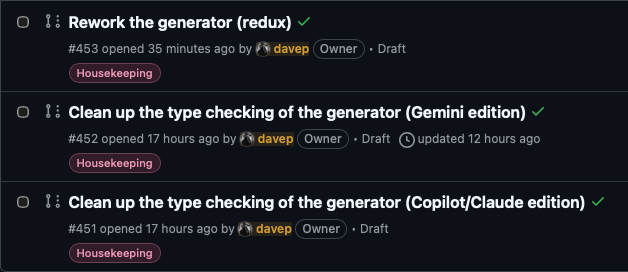
With this all in mind, I popped to my desk, made a branch off the current Gemini attempt to clean up the typing issues with the mixin approach, fired up Gemini CLI, and wrote it a prompt explaining what I didn't like and what I wanted it to do. The key points being:

  • I wanted a similar separation of concerns as the mixin approach was aiming for.
  • I wanted to move away from mixins.
  • I wanted to favour something closer to composition.
  • I wanted to favour simple functions over classes where possible.

I then set it off working and left it to get on with things. Overall I think it took around an hour, with the need for me to approve things now and again (so probably could have been faster, I wasn't there to answer right away every time), but it got there in the end. This has resulted in a third PR to clean up the generator typing issues. In doing so I feel I've also addressed most of the unease I was feeling yesterday evening, and might actually have got closer to where I'd rather the code was.

Glancing over the result, I can still see things I'd want cleaned up, and done in a slightly different way, but overall I have a better feeling about this third approach. I sense this is a better place to move on from.

Three PRs

So that's three PRs I have lined up to address the code smell that's been bugging me for a couple of days. One fixes it with an ABC; one fixes it with a protocol; and now one fixes it by reworking the submodularisation of the generator to use a different approach entirely. On the one hand, this seems like a lot of work and a lot of faff (and, as I said yesterday, I wouldn't start here to get where I want to be), but on the other hand I do kind of understand the appeal of being able to get hours of work done in a relatively short period of time, so you can experiment with the results.

Would I recommend someone work this way? No, of course not. Does it make for an interesting side-quest when I'm in "it is still my hobby too" mode? Yeah, it does.

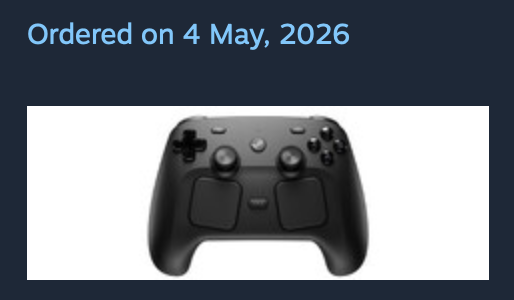
Steam Controller ordered

1 min read

After dropping one in my basket at 18:00 (UTC+01:00) yesterday, it took around 70 minutes of trying and trying and trying to get to a point where I could pay.

It paid off.

Confirmation of purchase

Now I just need to wait however long it takes for it to turn up.

Confirmation of order

When I first dropped the controller in my basket it was showing that shipping would be within 3 to 5 working days; by the time I managed to pay it was saying 6 to 10 working days.

Which is fine, it's not like I need this right now. My plan is to use it with my Steam Deck in console mode, plugged into the TV; eventually though I hope I'll be using it with a Steam Machine.

So, yeah, I can wait a couple of weeks.