At some point this morning I was looking for something on this blog and stumbled on a post that had a broken link. Not an external link, but an internal link. This got me thinking: perhaps I should add some sort of linting tool to BlogMore? I figured this should be doable using much of the existing code: pretty much work out the list of internal links, run through all pages and posts, see what links get generated, look for internal links1, and see if they're all amongst those that are expected.
Later on in the day I prompted Copilot to have a go. Now, sure, I didn't tell it how to do it, instead I told it what I wanted it to achieve. I hoped it would (going via Claude, as I've normally let it) decide on what I felt was the most sensible solution (use the existing configuration-reading, page/post-finding and post-parsing code) and run with that.
It didn't.
Once again, as I've seen before, it seemed to understand and take into account the existing codebase and then copy bits from it and drop it in a new file. Worse, rather than tackle this using the relevant parts of the existing build engine, it concocted a whole new approach, again obsessing over throwing a regex or three at the problem.
I then spent the next 90 minutes or so, testing the results, finding false reports, finding things it missed, and telling it what I found and getting it to fix them. It did, but on occasion it seemed to special-case the fix rather than understand the general case of what was going on and address that.
Eventually, probably too late really, I gave up trying to nudge it in the right direction and, instead, decided it was time to be more explicit about how it should handle this2. The first thing that bothered me was that it seemed to ignore the configuration object. Where BlogMore has a method of loading the configuration into an object, which can be passed around the code, but with the linter it loaded it up, pulled it all apart, and then passed some of the values as a huge parameter list. Because... reasons?
Anyway, I told it to cut that shit out and prompted it about a few other things that looked pretty bad too. Copilot/Claude went off and worked away on this for a while, using up my 6th premium request of the session, and then eventually came back with an error telling me I'd hit a rate limit and to come back in a few hours.
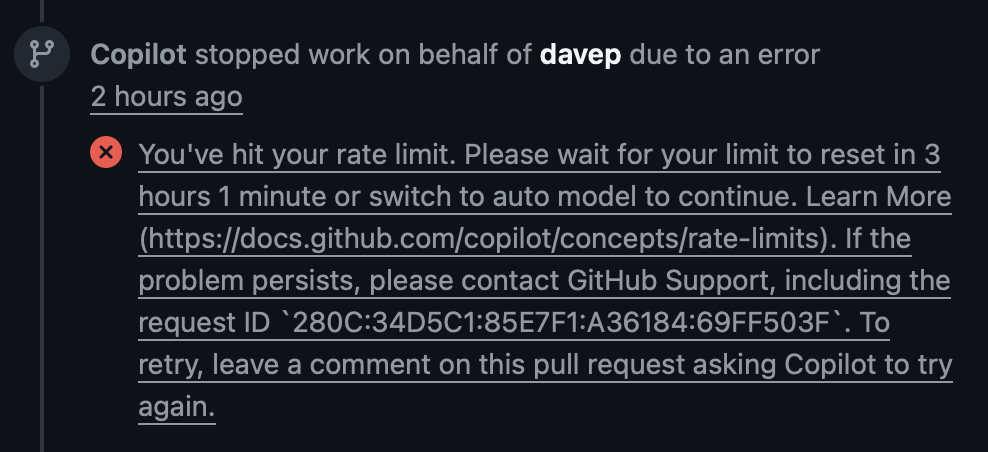
Could I have got it to where I wanted to be a bit earlier, with more careful prompting? No doubt. Will a lot of people? I suspect that's rather unlikely. This is one of the many things that make me pretty sceptical about this as the tool some sell it as, at least for the moment. I see often that it's written about or talked about as if it's a really useful coding buddy. It can be, at times, but it's hugely unreliable. Here I'm testing it by building something as a hobby, and I'm doing so knowing that there's no real consequence if it craps out on me. I'm also doing it safe in the knowledge that I could write the code myself, albeit at a far slower pace and with less available time. Not everyone this is aimed at has that going for them.
But these tools are still sold like they're the most reliable coding buddies going.
All that said: having hit the rate limit, and having squandered six premium requests on the problem with no real progress, I decided to use my Google Gemini coding allowance instead (which, in my experience so far, seems pretty generous). I threw more or less the same initial prompt at it, but this time I stressed that I really wanted it to use the existing engine where possible. It managed to pretty much one-shot the problem in about 9 minutes and used up just 2% of my daily quota3.
I've done a little more tidying up since, and I still need to properly review the result, but from what I can see of the initial results it's found all of the issues I wanted it to find, first time (something Claude didn't manage) and hasn't found any issues that don't exist (also something Claude didn't manage).
So I guess this time Gemini was the reliable buddy. But not knowing which buddy you can rely on makes for a pretty unreliable group of buddies.
This process could, of course, work for external links too, but I'm not really too keen on having a tool that visits every single external link to see if it's still there. ↩
Which is mostly fine; I'm doing this as an experiment in what it's capable of, and also I was sofa-hacking while having a conversation about naming Easter eggs in Minecraft. ↩
Imagine that too! Imagine knowing exactly how much of your quota you've used at any given moment! Presumably GitHub don't show you where you are in respect to the rate limits on top of your monthly quota because grinding to a halt with no warning is more... fun? ↩
Have a comment or query about this post? Feel free to drop me a line about it.