When I moved to Newcastle, as a student, back in 1986, I was introduced to many new things. So many new things. Different folk. Different accents. Different backgrounds. People from the south! But, as well as all the eye-opening things that student life had to throw at a working-class Yorkshire lad, there were also all the things that Tyneside had to offer too.
Without question, my absolute favourite discovery was the stottie. This became my go-to food, especially in my second and third years, when I was no longer in halls.
I left Newcastle in 1989 and never went back1, and sadly, have never had a stottie since. While I'm sure I could have found some niche place in the various places I've lived since, they're not a thing you find normally in Hampshire, Lincolnshire or Midlothian.
Meanwhile...
Earlier this week I was sat watching some TV and the cat was chilling on the sofa too. She's a ragdoll, a magnificent collection of floppy liquid floof. It occurred to me that she's not a cat that loafs, she stotties! Seriously, she sits there and just flows into a huge furry circle. I mentioned this to my partner, and then realised that I'd have to explain the concept, given that they're not familiar with the North East of England.
The ensuing conversation resulted in the idea that, to fix my wish to have a stottie again (after I'd done an Internet search for them around the Edinburgh area), I should just have a go at making them!
Which brings me to today. I attempted making a stottie and it actually wasn't a complete disaster.

While I've made plenty of bread in the past, I've never been too brilliant at it and, honestly, it's not something that really excites or interests me. For some reason though, making my own had never occurred to me. So, with some yeast, water, sugar and white pepper...

Plus some flour...

Which I threw together, along with some salt...

And then kneaded for about 10 minutes, then left to stand for an hour while I went for a walk.

I don't think it managed to rise quite as much as it should have, but it also didn't seem like enough of a disaster to stop there. Besides, the lack of faffing is sort of the trademark of a stottie, so I also decided this might be fine. I then gave it a bit more of a mix before cutting into two halves and getting it ready for the oven.

I think this was a step where I went a little wrong. I wanted to try and get the size and thickness I remember (and which you see in plenty of photos online), but I was somewhat hesitant when it came to flattening it out. I was concerned I'd made it too thin at this point anyway and it wouldn't rise much. I was wrong. Next time2 I think I'll flatten it a lot more.
Anyway, I threw both proto-stotties into the oven and about 20 minutes later I had something that was passable!


Neither was really quite the nicely-round shape I was hoping for, and both were quite a bit thicker than I would have liked too. But both were baked well, and looked and felt fine inside too, with the texture having the chewy density that I remember.

As for the taste: they were actually good! They made for good sarnie bread for a slightly late lunch, and also got finished off along with dinner.
Overall I would say that things didn't work out as well as I'd hoped, but for a first attempt they came out okay and tasted just fine. Now I know how I'd do things differently in the future, and it's also given me the confidence to have another go at some point.
As for the cat that inspired this, it's only fair I pay the cat tax.
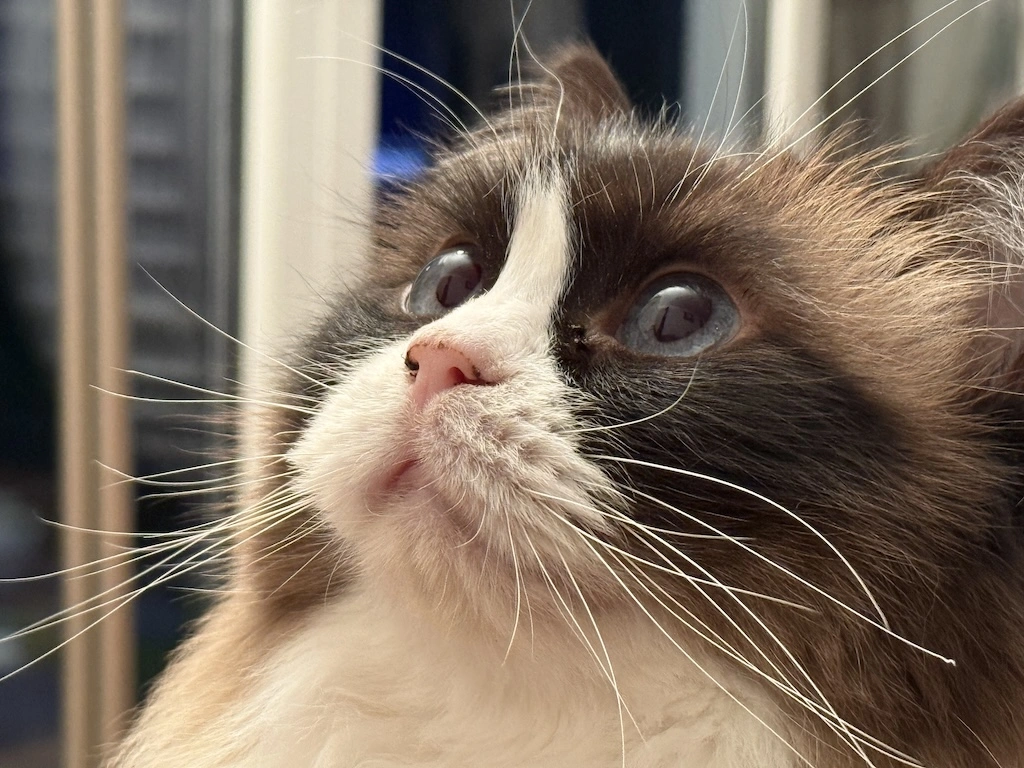
This is the Internet after all.