Posts from June 11, 2026

blogmore.el v5.1.0

1 min read; 12 GFI

A quick little update to blogmore.el to fix a couple of issues introduced by the new YAML-parsing approach to reading frontmatter; both pretty much stemming from how falsy values are handled.

Simply put, both boolean false values, and also empty values (something that could commonly happen with tags and series) would end up showing up in the frontmatter as null. This release handles that situation.

Also, under the hood, I cleaned up some repeated boilerplate related to how the cached dump calls to BlogMore took place. The code for categories, tags and series data was almost exactly the same, save for the actual name of the thing being dumped. So I turned it all into a macro:

(defmacro blogmore--cache-dump (dump-name)
  "Generate a function to get DUMP-NAME from BlogMore, with caching."
  (let ((cache-name (intern (format "blogmore--current-%s-cache" dump-name)))
        (getter-name (intern (format "blogmore--current-%s" dump-name))))
    `(progn
       (defvar ,cache-name nil
         ,(format "Cache for the list of %s from existing posts." dump-name))
       (defun ,getter-name ()
         ,(format "Get a list of %s from existing posts." dump-name)
         (or ,cache-name (setq ,cache-name (blogmore--list-of ,(symbol-name dump-name))))))))

and now the defvar that creates the variable that holds the cache, and the defun that creates the getter function for the data, are reduced to this for all three collections of values:

(blogmore--cache-dump categories)
(blogmore--cache-dump tags)
(blogmore--cache-dump series)

Sure, I probably could have done all of this in a single global, a central getter function, and a hash table, but the macro approach feels so much more elegant, and more... lispy.
Trouble with PyPI

2 min read; 7 GFI

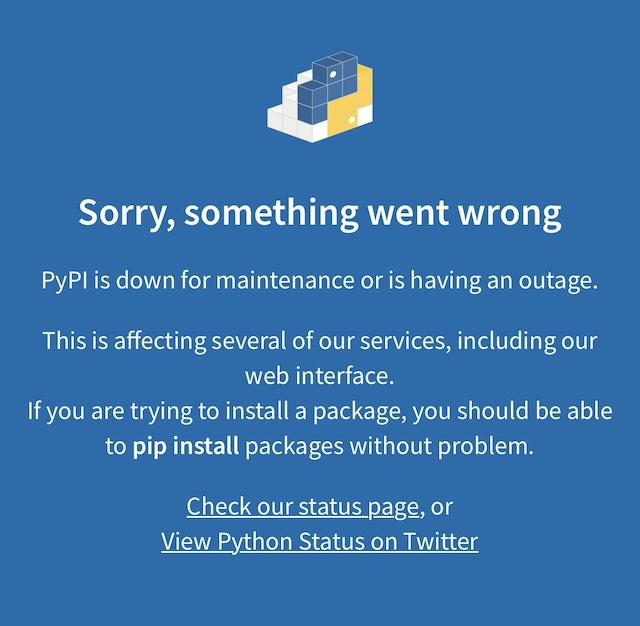
I had quite the adventure with PyPI this morning, and I don't think it's over yet. It started out with the release of BlogMore v2.43.0. I did my usual thing of doing a test release to the test version of PyPI, and then did a production release.

As normally happens, I then went on to tag the release on GitHub, followed by writing the blog post to announce the new version. While doing this, despite the fact that it wasn't necessary given the nature of the change, I decided to update BlogMore in my blog's repository. That's when things started to look odd.

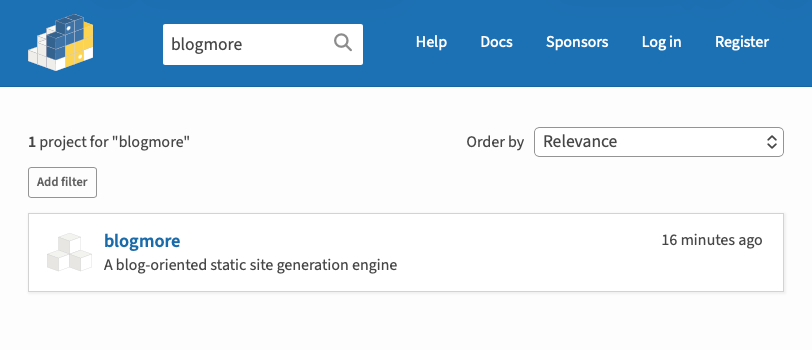
I did the usual make update but nothing new appeared. Now, it's not unheard of that I do this and no new version of BlogMore appears. Often I do it a couple more times and it's fine. So I kept trying every minute or two and still nothing. So I checked back on PyPI. Sure enough, a search showed that it had updated:

PyPI search

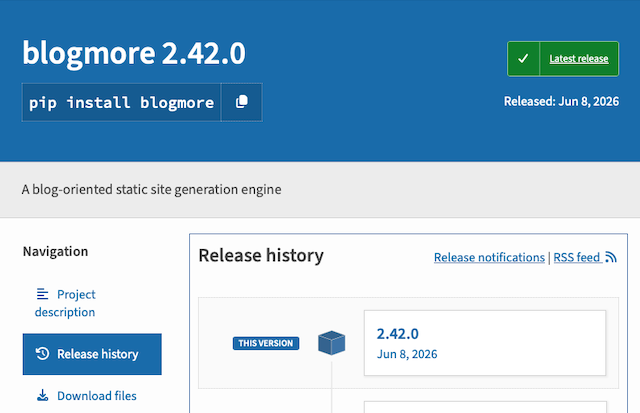
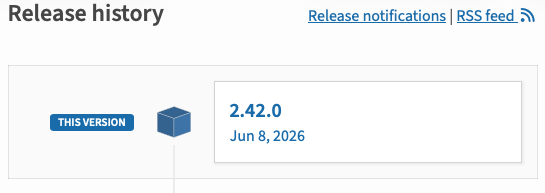
(The 16 minutes being about the time since I'd made the release), but when I clicked through it was showing the last version from a couple of days ago. Even when I looked at the release history it was saying the latest version was the previous version:

The apparent latest release

Odd.

At this point, depending on how I searched and where I went, I'd either see that my latest upload wasn't available, or I'd get a 500 error.

PyPI 500 error

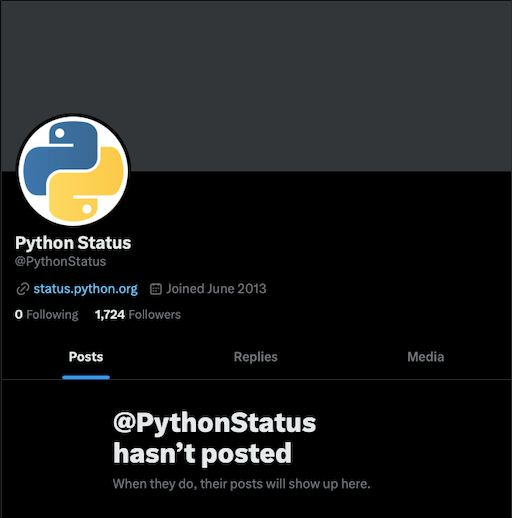
Clicking through to the status page showed no errors. Clicking through to the Twitter account that was suggested showed nothing at all.

PyPI status on Twitter

Leaving aside the whole issue of having an account on Twitter these days anyway, I felt it wasn't that useful to point people at a resource that seems to have never been updated, so I did raise an issue about that.

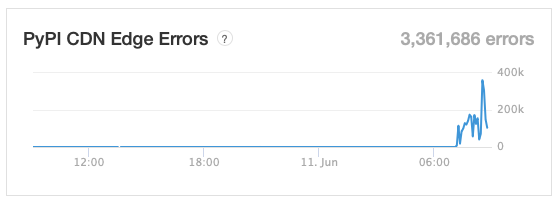
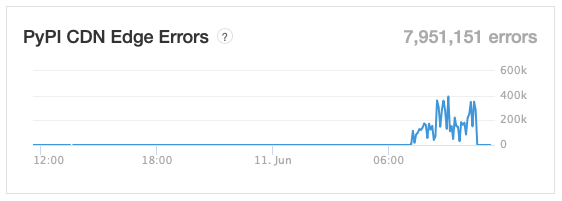
Digging around the status page at some point, despite the fact that the main display was green all the way, I did see a rise in "PyPI CDN Edge Errors". I'm not a web guy, I'm not an infrastructure guy, so I'm not really sure what this would mean, but it sounds like it's not a good thing.

CDN edge errors

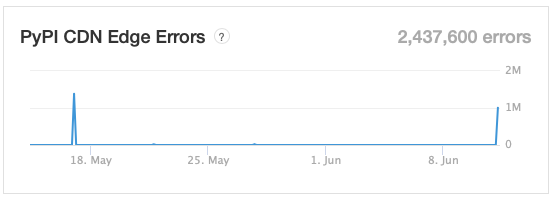
Opening the graph to look longer term, it did seem today was a spike, with another spike quite some time ago.

More CDN edge errors

At this point I left it a while, not announcing the new version of BlogMore. I came back some time later and, finally, I could see 2.43.0 was showing! Also, this seemed to coincide with the above graph calming down again.

A calm CDN

Seeing this I went to upgrade BlogMore in my blog's repo/venv and this time it all worked.

Yay!

At that point I left it alone and went about my work day. However, I don't think whatever is going on is over. Despite the fact that it was showing BlogMore as being v2.43.0 earlier today, once things were settled, I just checked again as I started to write this and:

Old BlogMore again

The search index on PyPI shows it as having been updated about 8 hours ago (as I write this), but the page itself shows that the latest version is from 2 days ago. At least installing it gives me 2.43.0:

$ uv add blogmore
Using CPython 3.13.1
Creating virtual environment at: .venv
Resolved 17 packages in 325ms
Installed 16 packages in 41ms
 + blogmore==2.43.0
 + feedgen==1.0.0
 + jinja2==3.1.6
 + lxml==6.1.1
 + markdown==3.10.2
 + markupsafe==3.0.3
 + minify-html==0.18.1
 + pillow==12.2.0
 + pygments==2.20.0
 + python-dateutil==2.9.0.post0
 + python-frontmatter==1.3.0
 + pyyaml==6.0.3
 + rcssmin==1.2.2
 + rjsmin==1.2.5
 + six==1.17.0
 + watchdog==6.0.0

Also: PISpy sees 2.43.0 as the latest version too (something it wasn't seeing during the height of the issues this morning).

It's all kind of confusing though.

Guess it's time for me to read up on CDN edge errors or something...

BlogMore v2.43.0

1 min read; 12 GFI

After recently adding Mermaid and maths support to BlogMore, I got to thinking that it now has connections with a handful of third-party resources. While almost all of them are optional (only FontAwesome comes close to being a hard requirement), it does mean that there are resources the user doesn't directly supply or control, and for which the URLs are hard-coded in the source for BlogMore.

I wasn't keen on this. While it's my intention to keep an eye on things and, periodically, check on those libraries and see if they need an update, I felt it was important that the user could override them on their own, without waiting on me.

So v2.43.0 adds a third_party section to the configuration file to give full control over these resources. The full version of it looks like this:

third_party:
  mermaid:
    script_url: "https://cdn.jsdelivr.net/npm/mermaid@11/dist/mermaid.esm.min.mjs"
  katex:
    css_url: "https://cdn.jsdelivr.net/npm/katex@0.16.9/dist/katex.min.css"
    js_url: "https://cdn.jsdelivr.net/npm/katex@0.16.9/dist/katex.min.js"
  mathjax:
    js_url: "https://cdn.jsdelivr.net/npm/mathjax@3/es5/tex-mml-chtml.js"
  fontawesome:
    metadata_url: "https://raw.githubusercontent.com/FortAwesome/Font-Awesome/6.7.2/metadata/icons.json"
    webfonts_base: "https://cdnjs.cloudflare.com/ajax/libs/font-awesome/6.7.2/webfonts"
    css_url: "https://cdnjs.cloudflare.com/ajax/libs/font-awesome/6.7.2/css/all.min.css"
    woff2_url: "https://cdnjs.cloudflare.com/ajax/libs/font-awesome/6.7.2/webfonts/fa-brands-400.woff2"
  force_graph:
    js_url: "https://unpkg.com/force-graph"

Of course, it's not an all-or-nothing setting; you can just set one of the values. So if you wanted to override the force_graph value it's enough to do:

third_party:
  force_graph:
    js_url: "https://unpkg.com/force-graph"

Hopefully this adds some useful flexibility. As well as giving the option to use a different version of a resource, it also allows you to host your own copy and refer to that instead. Heck, it would even allow totally replacing a library with a different one that has the same API, should you ever find yourself in that situation.