A quick little update to GopherMap. v0.2.0 greatly relaxes the validation of incoming lines, being a lot less fussy about missing tab characters and also about fully empty lines.
I've got no desire for Rogallo to be harsh in this respect, so here's a much more relaxed version of GopherMap.
As of right now, the exceptions that are defined in the library are never raised. I've left them in for the moment because there's a window of time between this version being pushed to PyPI and Rogallo being updated (it does use the exceptions), where failure to supply them would cause Rogallo to crash under normal circumstances (nobody wants an unnecessary ImportError). Once I've updated Rogallo to pin a new lower bound, and removed use of the exceptions, I'll remove them from GopherMap.
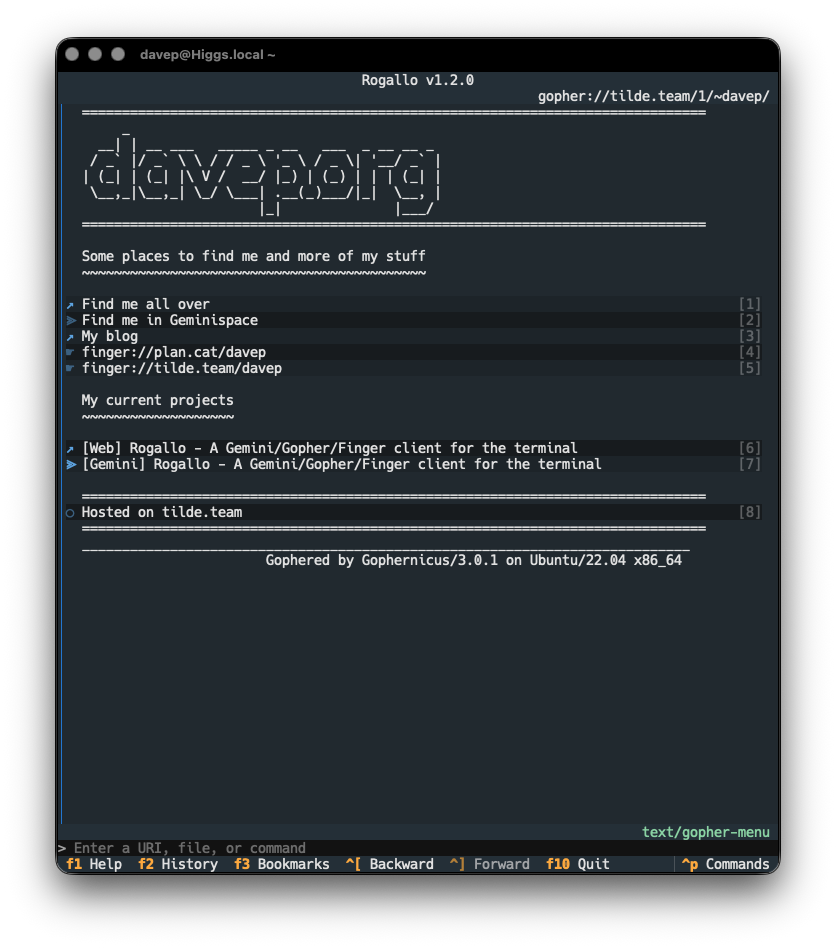
Rogallov1.2.0 is now available. The main change in this release is the kick-off of support for the Gopher protocol.
As I've mentioned before: Gopher is kind of an unknown to me, in terms of actually using it. I'm aware of it, I've known about it ever since I first got on the Internet back in the 1990s, I have a half-recalled memory of dabbling with a Gopher client at some point back then, but I had no conscious knowledge of its workings. So, when I say "kick-off" above, I say it because I suspect there's going to be more work to do to make it work "just so".
However, right now, gopher:// URIs are supported in Rogallo.
The approach to supporting this is pretty simple: given a gophermap, as pulled from a server, Rogallo converts it into Gemtext and then displays it using the normal Gemtext viewer.
There is more to Gopher than just displaying the maps, of course: there's access to all kinds of resources. Where possible, Rogallo will display text-based resources within the viewer; all other kinds of resources are handed off to the operating system as they probably need applications and tools that Rogallo doesn't offer (viewing images, playing audio, etc).
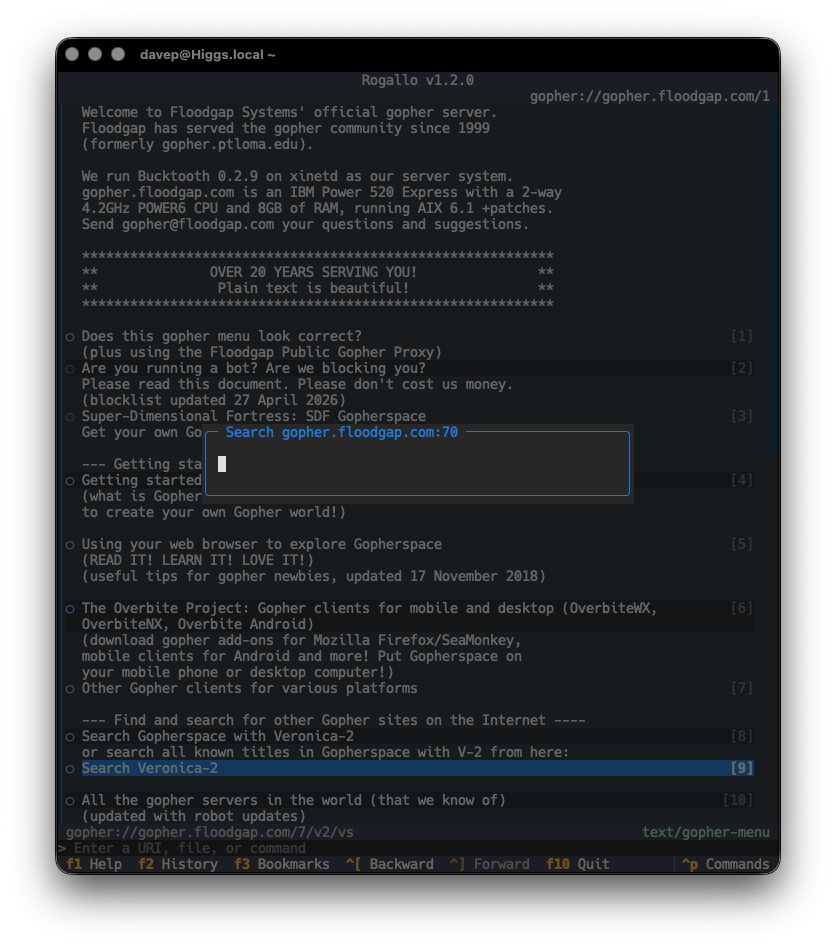
Searches (item type 7) are supported, and when following such a link, you will be prompted for input, which will be used as the query.
Note that, for the moment, there is no support for extensions to the protocol such as Gopher+. Doubtless I'll look into doing something with this in the future; Rogallo's development is incremental and for me it's all about having fun (re)discovering new/old things.
There are two other notable changes in Rogallo v1.2.0:
I've modified the ordering of entries in the history search so that the items appear in most to least recent order. While being able to type in things to find back a location is the primary use, I also found I was often pulling it up to find something I'd visited very recently.
I fixed the "view source" status being sticky during navigation. If I was viewing the source of a location, and then navigated to another location (by using the Back command, for example), that other location would also show the source. The status is now reset every time you navigate to somewhere else.