Another quick little update to Wasat, bumping the version to v1.8.0. This version is in support of some work I'm about to do on Rogallo: Titan support.
This release adds TitanURI and makes a number of changes to handle such URIs alongside GeminiURI. A lucky side-effect is that a problem was uncovered and corrected with how Gemini URIs are sliced and diced in the library. This first showed up for me when I was having a look at the Scriptonite examples. None of them were working for no obvious reason. Eventually it became clear that parts of the URIs were being lost as they travelled through Wasat's code.
So v1.8.0 clears up that problem (fixing the bug in Rogallo by simply upgrading the library).
A quick little update to next-gh-pr.el. Since writing the first version I've found it to be really useful, but I've also bumped into one small issue. Sometimes I'll create a draft PR before I remember to start the changelog entry, and so then I want to insert the current PR link rather than the next one.
Now, sure, I can just go and copy the URL and create the link in the changelog, but where's the fun in that when I can solve the problem in Emacs Lisp? So, with this in mind, I've just updated the package so that, with a prefix argument to the command, it will include a link for the latest PR rather than for the next one.
This does, of course, make the name a little less correct, but I'm not going to rename the package or the command for this one minor difference in intent.
Rogallov2.2.0 is available. This release contains a handful of small new features and also a very minor cosmetic change.
First to the small cosmetic change: the overall design behind the UI of Rogallo is that it's split into a couple of key panels -- the side-panel and the main viewer. The styling of a panel when focus is within it, and when it is outwith it, is different; the idea being that your eye should be drawn to the active panel. This is an approach I take with all my Textual applications.
Part of this styling is to have a thin border to the left of the active panel, which also helps signify that the panel is the one you should be paying attention to. In applications where there's always two or more panels on the screen all the time, this makes sense -- you want the line between the panels anyway to help break up the content. In Rogallo, however, it's going to be normal to only ever have the one panel in view (the viewer).
The other day I realised that, when it's just the viewer available, I should remove that left-hand border. So that's how Rogallo works now. If the viewer is the only panel visible: no border. If the side-panel is also visible: borders. I think it makes the display look a little cleaner; for what it's worth it also saves one column of the display for something more useful.
I've also added a couple of useful features to the active link in the viewer. Now, when a link is selected, you can press c to copy the URI of that link to the clipboard. You can also press o to open the URI by passing it to the operating system. Both these changes should make it easier to take a link out of a document and go and do something else with it.
The last couple of changes are around visiting finger:// URIs. The first is a quick and simple change: any finger content now makes use of Rogallo's document cache, so if you find yourself navigating back and forth between finger responses, there should be fewer requests made in a short period of time.
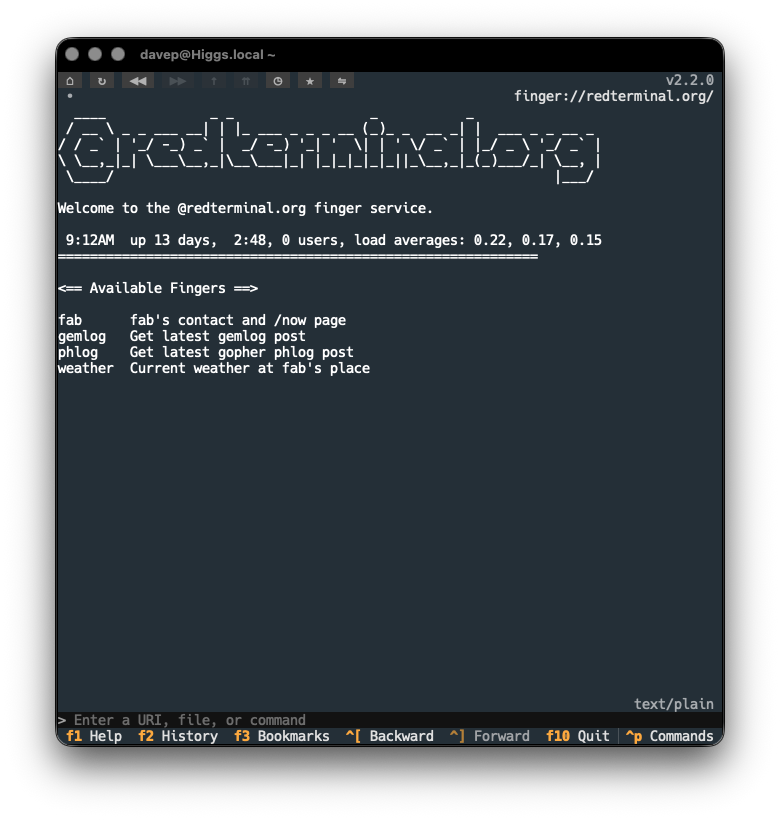
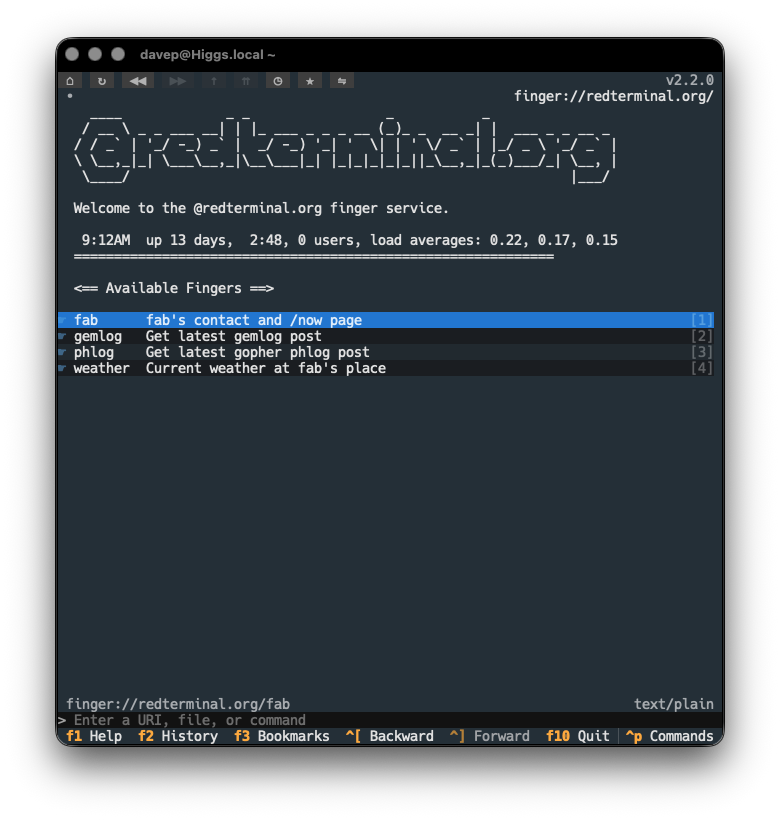
I added caching partly in anticipation of another change to finger responses: making them interactive where possible. Having created finger2gemtext, I've updated Rogallo so that, where possible, the response is turned into Gemtext and anything that can be turned into a link is now interactive. This means that some finger services should be easier to navigate, no longer requiring that you copy/edit/paste text to get a fresh finger:// URI to follow.
Now you get a version that lets you follow the implied links in the response:
This is, of course, going to be reasonably brittle. If any of the services change their output format such that the "links" can't be detected any more, the output won't be turned into Gemtext. Likewise, it's not impossible that false positives might turn up. I'm going to run with this for a while and see how it works out. I also have a vague plan for how the detection and smarter rendering of finger responses could be made configurable by the user.
Anyway, that's it for this release of Rogallo. Now I can return to the main change I was making a start on this week: Titansupport. I've not so much been putting it off as I have been allowing myself to get distracted by the above changes -- mostly because I don't quite get Titan support yet and I don't have a good location to play around with it. Time to solve that problem...