Posts in category "Emacs"

Some more ~/.emacs.d evolution

3 min read

When I started with this version of the blog on Hashnode1, my plan was to try and write something at least once a week. I managed to do that as far as January this year, give or take, but then things got a little busy, the world got trickier, and... Well, you don't need me to tell you about that. Anyway, I'm back to write some more and, hopefully, try and keep up with writing. I feel it'll do me good.

I have been busy since January. Work has, as far as possible, carried on as normal. The only big difference being I'm back working from home. It's an odd turn of events personally given that I'd worked from home for 21 years, then (with some trepidation) went back to working in an office. Having got used to being in an office and being around people, it took some adjusting to working alone again.

So, on to the main point of this post... During that period I've spent a lot more time at my machine than I would normally, and so it was inevitable that I'd end up tinkering with my Emacs configuration. While it's true that there's hardly a week goes by where I don't tinker with some small thing, I try not to make huge changes too often. Huge changes do happen though.

A handful of weeks back was another one of those times where I made a big change.

After I burnt my original ~/.emacs file back in 2016 I've had an approach where I've tried to make things as modular as possible, and as easy to clone down to a new machine as possible. The design I came up with, especially once I moved over to using use-package, has served me well. But there was always one thing that bothered me: the files that handled the loading and configuration of packages were, in effect, still three large monolithic files. While this was better than a single monolithic ~/.emacs, it still didn't feel quite right.

Giving it a bit of thought, I decided that what I really wanted was a single directory in which I could drop lots of small .el files that would handle the loading and configuration of all sorts of packages. While it didn't gain anything concrete, the idea felt tidier. Tidy is good. Feeling like the code smell is good, is good too.

First though I needed a way to load multiple files, ideally within a whole directory hierarchy, without needing to know in advance what files would be there. After a little bit of tinkering I settled on this bit of code that revolves around the use of directory-files-recursively:

(let ((source (expand-file-name "init.d/packages.d/" user-emacs-directory)))
  (when (file-exists-p source)
    (cl-loop for use in (directory-files-recursively source (rx ".el" eol))
             do (load (file-name-sans-extension use)))))

Simply put, this code finds every file in and below ~/.emacs.d/init.d/packages.d/ whose name ends in .el (note the use of a regular expression, using rx to create it), removes the extension from the name, and loads it with load (dropping the extension means load can decide if it wants to load the compiled version of the code, or the source, depending on what's available).

After writing that I could then start to populate ~/.emacs.d/init.d/packages.d/ with lots of smaller files that handled the loading of packages. In some cases there's a file just for one package, in other cases there's a file that handles a logical grouping of packages (where there are obvious direct dependencies, or where one package is designed to extend the other, etc). For now I've decided to break things down into three directories that map to the three monolithic files I had before:

Emacs

However, I'm not totally wedded to this design and I may change this as time goes on.

While I've not spent any time properly testing it out, I've also not really noticed any obvious impact on startup speed. However, this tends not to be a real concern for me. I seldom start Emacs anyway. I always have it running and use emacsclient as my editor in most places so files open instantly in the running version of Emacs.


  1. Note from future me: we're now back over on blog.davep.org of course. 

dnote.el - A wrapper for the dnote CLI

2 min read

Late on last year I stumbled on an article about dnote. Annoyingly, I can't recall now where I saw it, but I made a reminder to look at it over my Christmas break.

Dnote looked like a tool that would fill a hole I had in how I work. When it comes to making notes about things, and keeping things for future reference, I use a few tools, each one being just right (for me) for the job in question. I use Evernote to track documents and other household type things. I use Keep to make notes about stuff I need to remember short-term (say, the size of a space in my bedroom that I want furniture to go in) and also to record notes while in meetings at work. I use Journey to keep a journal about... anything, really. Finally, I use Pinboard to keep hold of URLs I might want to go back to (I also use it to create a to-read list).

Amongst all of this, however, I felt I was missing something for keeping track of things that don't really fall into any of the categories above. Mostly this would be work-based or hacking-based things that are short and sweet but I don't always use enough to easily remember. I wanted just the right tool that would let me ferret away useful one-liners, remind myself of obscure switches that get used once or twice a year, etc.

After reading up on dnote it seemed pretty clear that this was just such a tool.

After getting back to the office at the start of this month I decided to make use of it and see how it went. My idea was simple: I'd record any "TIL" stuff that I might want to remember in the future, as well as recording things I need now and again but can't always remember.

So far it's working quite well. I like that it has a simple CLI. I like that it's got a backend that you can use to sync between different machines. I like that it's got a web interface that's mobile-friendly. I like that it's Free Software and so you can host your own server if you wish.

I found I liked it enough that, of course, I felt the need to start a simple Emacs wrapper for the CLI.

At the moment dnote.el is designed to be a simple capture system. There are commands for capturing a one-liner (entered in the Emacs mini-buffer), for capturing the content of the current buffer, and for capturing freshly-entered multi-line text, entered in a buffer that uses markdown-mode. There's also a command for syncing notes if you have configured dnote to talk to a backend.

What I don't have right now is the ability to navigate and view notes. So far I've not really felt the need for that because the CLI approach works so well. Longer-term though I can see my tweaking this and adding in commands for searching, viewing, editing and deleting notes.

But, for now, if you've not had a look at dnote, I'd highly recommend having a play and seeing if it makes sense for you. And, if it does, and you're an Emacs user, perhaps dnote.el will be useful too?

nuke-buffers.el -- Tidy up open buffers in Emacs

2 min read

Both at work and at home I use Emacs by keeping a copy running all the time, and use emacsclient to open files inside it (including on remote machines thanks to a bit of ssh and heavy use of tramp -- I might write this up at some point). This works really well, but does mean I tend to build up a lot of buffers over time.

Having lots of buffers open isn't generally an issue, and if I'm working on lots of different files in a project during the course of a hacking session it's actually a good thing. But, quite often, I want to tidy up the buffer list, clearing it back to near-zero buffers open. Many years ago, when I had a "proper" tower system running 24/7, with Emacs open all the time, I'd use clean-buffer-list as part of midnight. Along the way that fell out of favour with me, likely because I drifted into using machines that had Emacs open all the time but where the machine wasn't awake all the time.

Eventually I decided to have some fun rolling my own solution, and nuke-buffers was born.

Rather than try and do things in an automated way, this was designed to be bound to a key (or two) and then be run when I wanted, being as harsh as possible about cleaning up the buffer list. Since first writing it it's worked well for me.

These days I tend to let the buffer list build up as I work on a new feature, or chase down a bug, etc. Then, once I've made the final commit for that period of focus, I'll hit the nuke-buffer key combo as the final act of confirming that I've done the job. So not only does this help tidy my Emacs session a bit, it also feels like a physical form of punctuation -- back in less sensible days, when I had some terrible habits, it would have been when I'd reach for the celebratory cigarette; buffer-tidying feels far more wholesome. ;)

The way the code works is, of course, mostly directed at how I work -- it's highly likely it wouldn't make sense for many other people. The main aim is to kill as many buffers as possible, but without disturbing anything else. The list of buffers it gathers for nuking avoids buffers that are visiting files but have unsaved content, avoids the minibuffer (obviously), avoids any "special" buffer (one that starts with a space then an asterisk), avoids the current buffer and also avoids any buffer in a list of names to avoid.

I've being using this on a daily basis for around 2.5 years now and it's done the job without ever losing me any work.

Being phony, and Lispy regular expressions

2 min read

While it does seem that they're a little out of fashion these days, in some circles anyway, I'm still an avid fan of make and make files. Even in environments where I don't need a Makefile to actually build anything, I'll use one (or more) to help create handy shortcuts for getting stuff done.

Looking at the main Makefile for one of my major work projects, there's 45 targets that help fire off various jobs (all of them self-documenting using a variation on an approach I read a while back).

In most cases the targets aren't real targets. That's to say, they don't build the thing they're called. They are phony targets. So, as makes sense, I make a point of marking them all as such. I follow the convention that has the .PHONY marker appear on the line before the target; this feels cleaner to me and easier to follow and maintain.

But.... I'm lazy. And I use Emacs. Typing out .PHONY foo all the time feels like far too much work. So, some time ago, I quickly threw together make-phony.el.

With this I could be really lazy. I could type out the Makefile target and then, with my cursor on it, press a key combination and have the .PHONY marker put in place.

Does it save much time? Yeah, probably not really. But it was a fun little exercise and an excuse to write a little bit of Emacs Lisp.

There's one thing I made a point of doing in the heart of this too: using rx. For anyone who doesn't know of it, think of it as a very Lispy way of writing regular expressions. I won't even try and explain it all here because others have done an excellent job already. What I will do is say this: if you're in the habit of writing some Emacs Lisp, or even tinkering with your configuration, and you find yourself writing a regular expression, consider looking at rx -- it's well worth the time to get to know it.

Slowly, as time goes on, I'm weeding out "vanilla" regular expressions from my config and code and moving over to using rx. I feel, quite rightly I think, that something like this:

(rx
 (or
  ;; Ignore hidden files.
  (group bol ".")
  ;; I never want to edit the desktop.
  (group "Desktop/" eol)
  ;; Ignore compiled files.
  (group "." (or "pyc" "elc") eol)
  (group ".egg-info/" eol)))

is much easier to write, read and maintain, than this:

"\\(^\\.\\)\\|\\(Desktop/$\\)\\|\\(\\.\\(?:\\(?:\\(?:el\\|py\\)c\\)\\)$\\)\\|\\(\\.egg-info/$\\)"

I mean, even if the regular expression above can be written in a more efficient way (and I imagine it can), as someone working in a Lisp environment, I'd much sooner write and work with the rx version.

EmacsConf 2019 videos are out

1 min read

At the start of this month I spent a very enjoyable Saturday afternoon watching EmacsConf 2019. If you missed it, or even if you didn't, you might like to know that the announcement has gone out that almost all of the videos are now available for watching.

While I mean nothing negative about any other video, I think the two that stand out the most for me, in terms of things that grabbed my interest, were How a Completely Blind Manager/Dev Uses Emacs Every Day and Emacs as my Go To Script Language.

I seem to recall that both those talks were hit with technical issues (many talks on the day were -- part of the enjoyment for me was how the whole conference was an experiment in using Free Software to host the whole thing), but they're well worth a watch despite this.

If you have any sort of interest in Emacs I'd highly recommend dipping into the whole collection.

I really hope there's going to be a 2020 EmacsConf.

Visual evolution of ~/.emacs.d

1 min read

As detailed in a blog post I wrote back in 2016, I first got into using Emacs in the mid 1990s, starting with it on OS/2 and then moving over to GNU/Linux. It's been my often-used and much-loved development environment for most of those years (I even have a couple of packages that are part of Emacs itself).

For most of that time my configuration was a single ~/.emacs file, which was around 1,000 lines in length (including comments and whitespace). It'd grown over the years, having special configuration sections for versions of Emacs I didn't use any more, and operating systems I didn't work on any more (yes, really, there were things in there specific to MS-DOS, for example). On top of that I always hand-installed packages I used -- Emacs' package management system having turned up long after I first got into using Emacs.

Then, in early 2016, I decided to nuke the whole thing and start from scratch. As mentioned above, the start of this is detailed in an older post. Another big round of changes happened round a year later -- which included the birth of delpa to manage my personal packages. A couple or so months later there was one last big round of changes, mostly killing off my enthusiastic embracing of customize and instead going back to hand-set settings, only this time done via use-package.

The full history of this can be found over on GitHub, starting with the first "throw everything away and start again" process and all the steps between then and where my Emacs configuration is now.

Which brings me to the fun part of this blog post. Earlier this week I stumbled on Gource. It's a tool that's primarily designed to visualise changes in repositories, although it can be used to visualise anything that has a tree structure and changes over time (this week I produced a video of the growth of my employer's electronic lab notebook by hooking up the Benchling API with Gource, for example). So I got curious. What did it look like as I reworked and tweaked and changed and tinkered with my Emacs configuration?

This is what it looked like:

Visit YouTube

EmacsConf 2019

1 min read

For anyone who doesn't know, today is the day for EmacsConf 2019. As you might gather from the name, it's a conference all about Emacs, the joys of Emacs, Emacs Lisp and other Emacs-related things.

Better still, it's an online conference (although there do appear to be a couple of related physical gatherings around the world).

I've got snacks and drinks in and no plans for my Saturday, and I hope to follow the whole thing from start to finish.

If Emacs is your thing, or knowing more about Emacs is your thing, be sure to check it out!

gitweb.el -- Quickly visit a repo's forge from Emacs

1 min read

gh.fish, which I wrote about yesterday, actually sprang from something I initially wrote for Emacs. I'm often spending my time switching between Emacs and the command line (which is fast and easy -- I normally work on macOS and have Emacs and iTerm2 running full screen, and I can switch between them without ever taking my hands off the keyboard), so it makes sense to have some handy commands repeated in both places.

So, originally, I'd written gitweb.el to open the current repo's "forge" in the web browser.

As with the fish version, how it works is quite simple. I use shell-command-to-string to call git and find the origin URL for the current repo, and then manipulate it a bit to turn it into a normal browser-friendly URL. Finally, if I get something workable, I use browser-url to have the resulting page open in the browsing environment of choice.

I have the command bound to a key combination that's similar to the ones I use with magit and forge, so in terms of muscle-memory it's easy for me to remember what to press when I quickly want to skip over from a magit view to the repo forge itself.

Similar to what I wrote a couple of days back, I think this again illustrates how handy Emacs is as a work environment. While it's absolutely true that there are other development environments out there that offer similar extensibility, Emacs is the one I'm comfortable with, and it has a long history of offering this.

pypath.el -- A little Emacs hack to help with Django

2 min read

One of the things I really like about coding with Emacs is how I can easily identify a repeated task and turn it into a command in my environment, saving me a load of work down the line.

pypath.el is one such example.

In my day job I write a lot of Django code. As part of that, I write a good number of unit tests too. Sometimes I'll write the tests as I'm writing the code they test, other times I'm writing them afterwards; it all really depends on where my head's at and how the code is flowing.

When I'm writing those tests, I often want to test them as I go. Given that starting up a test session can take a while, and given that running all the tests in the system can take a while, it's really handy if I can run that single test I'm working on.

This is easy enough with Django. In my work environment it's normally something like:

$ pipenv run ./manage.py test -v 2 app.test.some.sub.module.TestClass.test_method

Only... typing out the:

app.test.some.sub.module.TestClass.test_method

part is a bit of a pain. Sure, once you've typed it the once you can use your shell of choice (mine being fish and on occasion eshell) to recall it from history, but typing it out the first time is the annoying part.

So this was the point where I took 1/2 hour or so to code up pypath.el to solve the problem for me. It gives me two commands:

  • pypath: which simply places the dotted path of the current "defun", within the context of being part of a Django system, into the clipboard buffer.
  • pypath-django-test: which works similar to the above but places the whole Django testing command into the clipboard.

With the above, I can work on a test, hit the latter command above, flip to my command line, paste and I'm running the test.

Of course, I'm sure there's plenty of other handy ways to do this. Doubtless there's work environments where the test can be run right there, in the edit buffer, without flipping away, and which takes into account the fact that there's a pipenv-managed virtual environment involved, etc. If there is, that's great, but I don't think it'd work with how I work.

And that's one of the things I really love about Emacs, and why it's still my work environment after almost 25 years of on and off use: with very little work on my part I can create a couple of commands that work exactly how I need them to. While it's great to create generally-useful code for Emacs that lots of people benefit from, sometimes the real value is that you can code up your own particular quirk and just get on with stuff.

To conclude: this post isn't to show off pypath.el; really this post is to sing the praises of Emacs and why it still works so well for me after all these years.

More revamping of my Emacs config

2 min read

I've been pretty quiet on here since I last wrote about how I'd done a further revamp of my Emacs config, so I thought that subject would be a good reason to write another blog post.

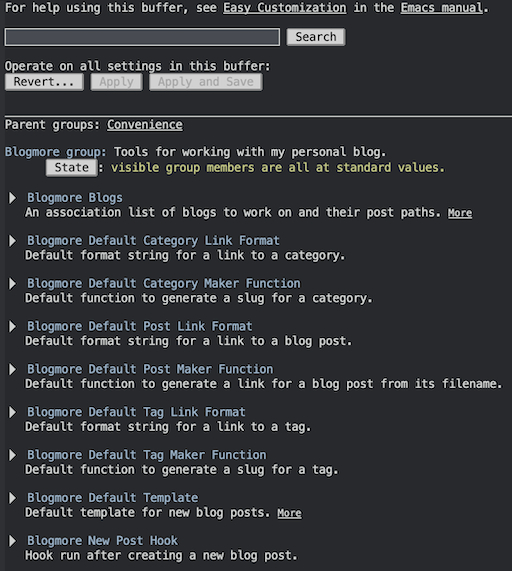
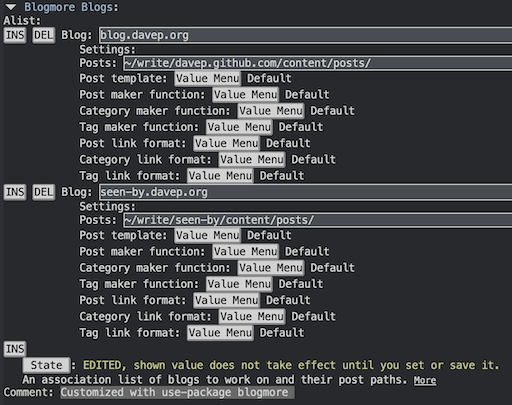
It'll be a mostly short one, and one to muse over something that's been bugging me for a while now: my decision to lean heavily on customize to set all sorts of settings.

Initially, when I nuked my original config over a year ago, it seemed to make a lot of sense. Let all the tweaks and set values "hide" in a file of their own and try and keep the hand-edited config files as small and as clean as possible. Recently though I've got to thinking that this obscures too much, hides too much detail, and removes the ability to actually document what I'm doing and why. It also does make it tricky to adapt some settings to different platforms or even environments on a single platform.

Another problem I've run into is this: when I made the second round of changes and decided to lean heavily on use-package, I soon ran into the minor issue of some packages not making sense, or even being needed, on some platforms (stuff that's useful on my macOS machines isn't always useful on my Windows machines, that sort of thing). While use-package can handle this easily thanks to the :if keyword, I'm still left with the fact that package-selected-packages still gets populated.

Having package-selected-packages contain a list of installed packages likely makes sense if you're using just the Emacs package system and you're not doing the installing with use-package and :ensure. But with use-package and :ensure I feel like I've got far more control over things and can adapt what gets installed when depending on which Emacs I'm running where.

But, because I'm syncing my ~/.emacs.d/.custom.el to all my machines too, any use-package that has a :if to not bother using a package has little effect because the package still ends up being listed/loaded/seen as part of the installation.

Ideally, I think, I'd like to be able to have package-selected-packages held in its own file, or I'd only ever use ~/.emacs.d/.custom.el for local stuff (and so stop syncing it).

Starting today I'm going about a process of moving as much as I can out of ~/.emacs.d/.custom.el and into hand-edited files. In some respects I guess I am going back to how I used to manage Emacs configuration, but this time it's not a massive monolithic file-of-Lisp, it's neatly broken down into sensible sections and it's also biased towards a "grab and config this package" approach.

Meanwhile, I've not seen any good discussions online about customize vs "hand-edit", which strikes me as a little odd as it feels like the perfect "religious issue" for people to have endless disagreements over. I guess, over the next couple or so weeks, I'll find out if switching back was a good idea.