While I'm having a moment of calling code stable, I've bumped Wasat to v1.0.0 as well. There's no actual difference here when compared to the last release, other than the development status classifier in the PyPI metadata and the version number.
The library feels pretty stable at this point. I've been using Rogallo every day for a wee while now and I've seen no surprising problems.
Thirty-three days ago, back on the 18th of June, I created a development directory called rogallo, and started adding dependencies and laying out the main user interface of Rogallo. It's been tons of fun working on it while exploring Geminispace. Given that it's quickly turned into my daily driver, and I'm finding it stable, I've decided it's time to drag it out of the 0verse and consider it worthy of being v1.0.0.
I was going to hold off a little longer, mainly because I wanted to flesh out the documentation some more, but that seems like a poor reason to keep it stuck somewhere in v0.x.
To recap, for anyone who might not have followed the development so far: Rogallo is a terminal-based client for the Gemini Protocol. I've built it for my own education. I've built it for fun. I've built it because I want to use it. I've built it hoping that someone else might enjoy it too. Some of the key features, as of this first "stable" release, are:
Keyboard-first TUI interface with good mouse support too.
Bookmark support.
Forward/backward navigation.
Location history.
Home page.
Designed to work on macOS, GNU/Linux and Windows.
Trust-on-first-use support.
In-application creation of client-side certificates.
Full support for user input, both normal and sensitive.
Full support for redirections.
Context-sensitive help screens.
All main application commands available via a command palette or an in-application command line.
Themes.
Responsive layout that dynamically adjusts to terminal resizing.
Support for viewing Gemtext files in the local file system.
View source support.
Copy-to-clipboard support for URIs or page content.
Optionally-numbered links with quick-jump support.
Supports ANSI escape sequences in content.
Supports filtering out ANSI escape sequences.
Emoji filter (lets you remove emojis from most text).
Support for handing off unsupported content to the operating system (with safety checks).
Probably some other stuff I've forgotten right now.
On top of this, there's more to come. v1.0.0 isn't the end of the line with Rogallo. I'm having plenty of fun using it, and improving it, and there's more I want to add. I very much want to add in-app support for the Finger Protocol, and I can see myself falling down the Gopher rabbit-hole1 at some point too. While I don't want the application to grow out of hand, I can see plenty of extensions and enhancements that will be satisfying to add.
If any of this sounds interesting and you want to have a play, Rogallo is licensed GPL-3.0 and available via GitHub and also via PyPI. If you have an environment that has pipx installed, you should be able to get up and running with (note that Python 3.12 or later is required):
Now that Rogallo is starting to settle down somewhat, with all the main Gemini Protocol work falling into place, I've been thinking about adding one or two adjacent protocols. The two most common and obvious ones are Finger and Gopher. While I'm still undecided about adding the latter, the former seems like a fun one to include (if only because I've had an account on plan.cat for around four years now).
With that in mind, much like I did with Wasat, I wrote a spec for what I wanted and pointed Antigravity at it. The result is Port79. As well as providing a library, there's also a small finger clone CLI, which can be run with python -m port79 (if it's installed as a library) or with port79 (if installed along with any command scripts).
To be clear: this isn't intended to be a serious finger command (like, why would anyone even need that?), it's just a tool within the library that can be used to do some testing within a development (v)environment.
At some point soon I'll be adding port79 as a dependency of Rogallo and adding finger as a "native protocol".
The first change is a simple addition of a !theme command to the command line. As much as possible, I've tried to make sure that every command that's in the command palette can also be run from the in-app command line, but I'd managed to leave this one out. Now you can type !theme and get the theme picker.
Next is the addition of an OpenFile command, bound to Ctrl+o by default. This opens a dialog for browsing the filesystem, allowing for easy access to local gemtext files.
Related to this, if you now enter the name of a directory in the command line, the same dialog will open, starting at that directory. Both these changes should make finding local gemtext files a smoother experience.
Another change is to the way that the recently added emoji removal works. I decided that it was a little too aggressive, in that it shouldn't remove them from the content of pre-formatted text. In my experience in Geminispace, so far, pre-formatted text is where the more creative displays happen. Indeed, I had a go at this myself for my new page:
Here I've used ANSI escape sequences and half-block characters to recreate my usual avatar. The problem is: the emoji-removal approach I've used sees the half-blocks as something to remove. The result isn't great.
Given that the unwanted emojis will generally be those in body text, links, quotes and headers, I've tweaked the way that pre-formatted text is shown, with it not having emojis removed. I feel this is a sensible approach.
I guess, if anyone really objects to this, I could add a configuration switch that dictates how aggressive the removal is.
The final change is something I wasn't really ever planning on doing, and I felt I'd removed the need for it when I added link stripes. But I got a request to do it and, really, the cost of doing it is nothing. The request? An option to move the link jump labels over to the left.
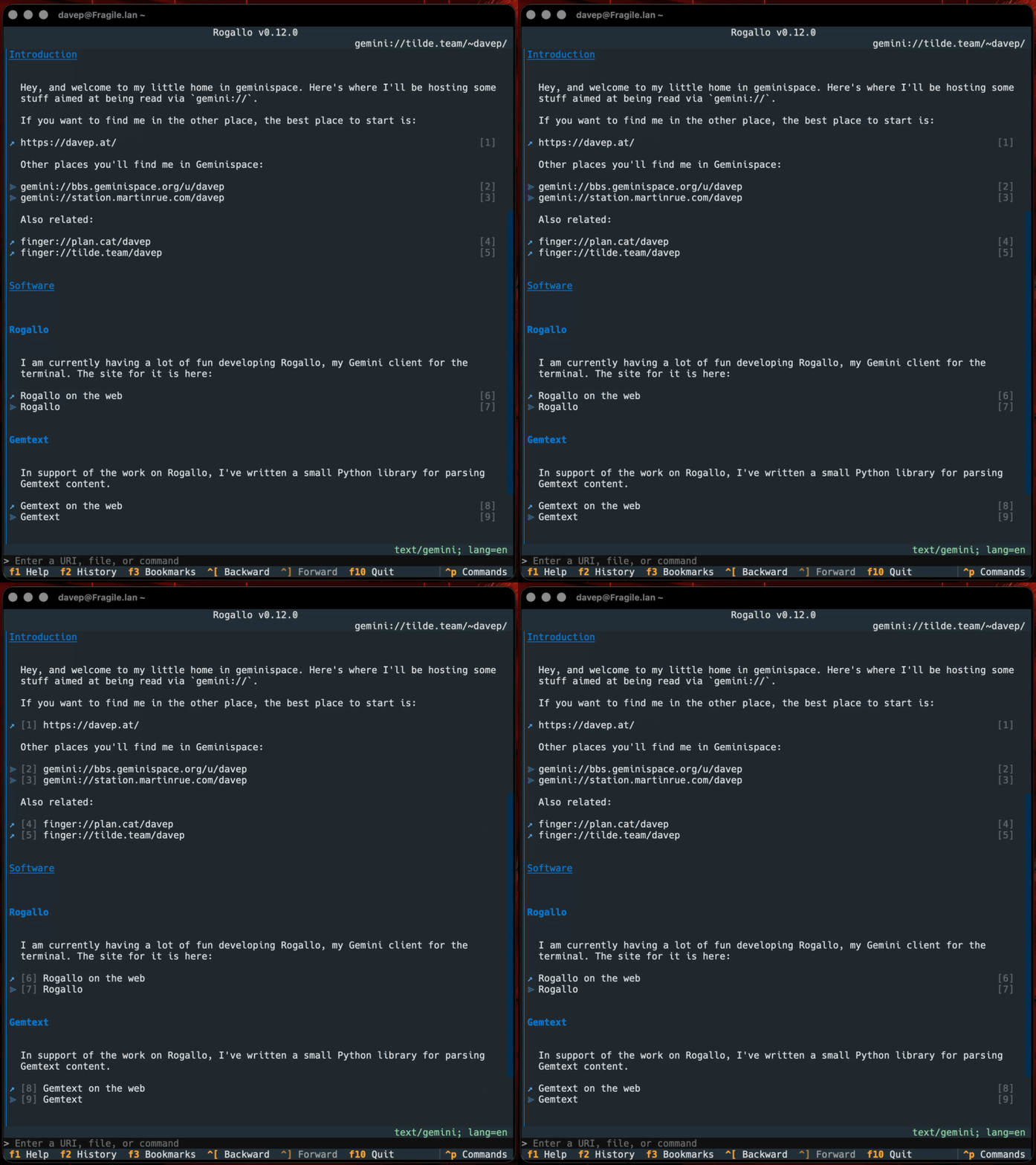
So now there's a ToggleCosyLinkNumbers command (bound to Super+F8 by default1) which does what it says:
Personally, I prefer them on the right, where they don't disrupt the left-aligned margin for all the text, but I can see why this would be far more comfortable for others, so... why the heck not?
One day I'll write a post about why I'm giving every command a default binding, even if it's not so accessible in less-advanced terminal emulators. Mostly it's down to one of my least favourite design decisions in Textual mixed with my wish to have a command-based interface that works via the palette first and bindings second. ↩
Given that Rogallo is coming on pretty well, I feel it's about time to get some sort of documentation for it going in Geminispace. With this in mind, I've created an account over on tilde.team so I can make use of their support for the Gemini protocol.
Initially, I set all of this up so that I was editing the files via Tramp. This worked fine and got me going, but pretty quickly I decided that it would make more sense to create a repository, edit stuff locally, and then just rsync it when I'm good to go.
Not editing in production... I know... How boring.
A quick update to Rogallo, with changes concentrating on giving the user more control over the content of a rendered page.
Despite the fact that the Gemini Protocol and gemtext are all about things being minimal, some capsules can deliver pretty busy content. Personally, I rather like it, and I'm generally impressed at how creative some people are with these tools. On the other hand, I've noticed that some people don't always appreciate the use of emojis or ANSI escape sequences to provide colour. So, with this in mind, I've added a couple of features to help control the content.
The first is a command to toggle emoji removal. If you're finding the emojis in a page too distracting, use the command to toggle them off and on (bound to F6 by default).
The setting is sticky too, so if you're so inclined, you can turn emojis off and they'll stay off.
There's a similar command related to the handling of ANSI escape sequences. While some applications let you toggle this at the capsule level (AstroBotany is one example where it's part of the game's settings), not all do. So I've added a command to toggle this (bound to Shift+F6 by default).
With both these commands, if this sort of view isn't to your taste:
You can quickly and easily turn it into this:
I think I prefer the richer view, but I can see the utility of the more austere view.
Somewhat related to the above, I've also added the ability to configure the main "icons" that get used inside the rendered content. So if you don't like the choice of ⪢ for links within a capsule, ↗ for links outwith a capsule, or • for a list item bullet, you can change them in the configuration file.
Interesting article about some of the downsides of working with AI to create code. Says a few things I've also been saying about my journey with BlogMore.
I feel like this project is jumping the gun quite a bit, but I also appreciate that it exists. I did also see someone say the other day that it was worth running with anyway to "get away from RMS". Which is fair I guess.
A24 got embroiled in copyright strikes against online creations related to the Backrooms. People, unsurprisingly, got very angry. The issue seems solved, for the moment, but it says a lot about capitalist appropriation of mass-created popular culture.
Rogallov0.10.0 is now available. This release has a number of changes, including some new features, some changes to the user interface, and a couple of quality-of-life improvements.
While, personally, I prefer Rogallo's default behaviour (I work in an environment where I can resize a window, and I'm capable of doing it), I can appreciate that someone might want to cap it. So for folk who prefer this, they can now make Rogallo look like this (with maximum_document_width set to 80):
For the moment this can only be set via the configuration file. At some point I might make this more of a dynamic thing. I can imagine this being something handy, or at least fun, to change up as you're viewing different content.
The same feedback "suggested" that the link jumping facility that Rogallo has should have a timeout that clears the buildup of the number being looked for. This seemed like a reasonable thing to ask for. So, before, if you typed 1, a link with a label of 1 would be selected. If you did nothing for a while, and then typed 2, a link with the label of 12 would be highlighted. With the new timeout (set to 1 second by default, configurable in the configuration file), if you type 1 and then 2 more than a second later, first link 1 will be selected, then link 2 will be selected. On the other hand, if you type 1 then 2 within a second, 12 will be selected.
Setting the timeout to 0 disables this and Rogallo's link jumping facility will work as it did before.
With this new feature, if you send input text to a capsule and it rejects it for some reason, the input will be held on to. If you then visit the same URI again, the input dialog will be pre-populated with what you attempted to send a moment ago. This gives you the opportunity to edit anything wrong with the submission and try again.
Added all application commands to the command line
If you prefer to use Rogallo's command line more than the command palette, I've now ensured that all bindable application commands can be accessed via the command line. There's a difference in their form, to stay in keeping with the command line. So whereas in the command palette you'd run GoHome by typing go home, in the command line it becomes a !-prefixed snake-case command: !go_home.
All possible commands are listed in the help screen if it's brought up while the command line has focus.
Rogallo now has two new commands for quickly navigating within the current capsule path. GoToParent will navigate up a level in the path of the current URI, and GoToRoot will go to the root of the capsule.
The icon for links is now used to show if a link is already in the location history (and so has been visited before), or not:
Here you can see that Account settings isn't in the visit history, but the other two links are. I was going to do the whole link, but I've never been a fan of how web browsers do this, so I've gone with just the icon. I've also made it subtle but still noticeable. So far, I'm much preferring this; I don't need it blasting out the difference, I just need it to be enough for me to notice1.
Until now the "history" and "bookmarks" shortcut keys advertised in the footer brought up the sidebar-based management widgets. This made sense when that's all I had in Rogallo. For a while now though I've had palette-based search tools for both history and bookmarks. Normally I want to search for and select a bookmark or history item way more than I want to manage those lists. So I've relegated the sidebar-based tools to a secondary position and placed the palette-based search tools up front.
This also means that the default bindings have changed a bit. As always, you can discover the bindings with rogallo
bindings.
I know I've nodded towards this before, but I think I'm getting close to making a v1.0.0 release. I want to daily-drive for a few more days, and I'd also like to expand the website. I'd also like to build a Gemini/Gemtext-based site for Rogallo -- it'd be pretty weird if I only documented it in http(s)space. I won't let those wishes become blockers for moving to calling Rogallo "stable", but it would be nice to have.
I do recognise that there's an a11y issue here with the subtle difference; there's some work to be done at some point to allow for a high-contrast theme that will resolve this sort of issue. ↩
I'm sure most people reading this will be familiar with the concept of "bean soup theory". In case anyone isn't, here's how Wikipedia describes it:
A specific phenomenon described as a 'What about me' effect. An individual watches a video that doesn't pertain to them, but finds a way to make it about them anyway. Stems from a 2023 TikTok recipe for bean soup, with commenters saying "What if I don't like beans?"
I feel there's a very specific set of folk who love to "bean soup" anything relating to terminals, and it's common to have them turn up in your mentions if you happen to do anything in the terminal, or for the terminal, that isn't about their purist opinions and how everything must be a Vim clone, or worse.
I first encountered this when I started working at Textualize. Unsurprisingly, given the point, purpose and focus of Textual, some folk would turn up in the Discord server, in the issues, in the discussions, in the mentions of posts in various places, and post their very important opinions about how TUI software must work. Not... discuss their preferences, or offer suggestions (there were plenty of people who were pleasant like that, they were lovely to converse with), no: their engagement was written as if every word that was mashed into their keyboard was a well-crafted, handed-from-on-high RFC-like holy document that MUST and SHOULD be followed1.
If I was being very charitable I could cut them some slack. If you're building a framework for building applications for the terminal, there's a good reason to make it at least possible for the application authors to follow recognised best practice and to stick with hard-won conventions. Indeed, Textual has some design choices that I think are deeply questionable and misguided and I objected to them on more than one occasion. So, yeah, if I was being charitable, I could cut them some slack.
I could... if they weren't such arseholes about it.
This gets worse though if you're building an application for the terminal, especially if it's built as Free Software and the motivation is to build something for yourself and be kind enough to share. It irks the hell out of me when I build some application for myself, as a TUI, and then someone turns up and starts complaining about my choice of default key bindings, that work in my choice of terminal emulator and my configuration for that emulator.
It's even worse when they do it in a way where they have to show their very deep knowledge of terminals, and how they're very proud of just how lacking in features and progress their own choice of terminal emulator is.
Dude...2 I know. I've used physical terminals. I've written COBOL on a minicomputer using a line editor on some honking great dumb all-green all-in-one box. I've even written code on a terminal using fan-fold paper. I've used all sorts of terminal emulators. I spent well over a decade doing shit inside rxvt which was running on my GNU/Linux server while displaying on my Windows desktop machine.
I'm well aware of the conventions and expectations. If Ctrl+C doesn't quit... that is my choice. It's not ignorance, it's not a lack of history with this stuff, it's a choice. For my software.
So when you turn up and feel the need to tell me that some function keys might not work in some terminal on some GNU/Linux box... I get it, you don't like beans. If that's the case, how about you either don't make my hobby all about your tastes and how I should build my application to suit you, or how about you RTFM and configure my application so it works in your choice of terminal?
I mean... we know you won't. We know you don't even care about the application I'm having tons of fun building, that I'm spending time in a joyous flow-state creating and tinkering with. You just care about making the post all about you and your purity. We know you just care about showing how smart you are.
We know you just can't resist the urge to reply-guy3.
We get it: you don't like bean soup. Nobody cares. Nobody asked.
That reminds me: one day I should write a rant about the folk who obsess about the "Zen of Python". ↩