Posts tagged with "atom"

BlogMore v2.39.0

1 min read; 13 GFI

BlogMore v2.39.0 has a couple of changes, one more or less cosmetic, the other a new feature that I probably should have added right near the start of the project.

First, the cosmetic: in pages and posts, when you use headings (#, ##, etc.), a is added to the end of each heading, along with some show-on-mouse-hover styling, to make it easy to grab the anchor of a particular section of a page1. A problem I'd noticed with this recently is that the shows up in the search text, and also in the content of all the feeds. While not a problem as such, it felt untidy.

So, with this release that particular character is stripped from the search index and from the feeds.

The second change is a facility that should be useful if you have legacy URLs that you really must have land on an actual page or post: redirection support.

This facility is provided by a new redirect_from frontmatter property. From now on, a page or a post can declare which URLs should be redirected to it. So, if you have a post that, given your current post location setup, would land at /2006/06/06/hello-world/, but in some other incarnation of your blog lived at /posts/2006-06-06-hello-world.html, you can now set this in the frontmatter:

redirect_from: /posts/2006-06-06-hello-world.html

and the old URL will be redirected to the new one. This is achieved by simply creating a very minimal HTML file at the old location, which contains a redirection. The content of the file will end up looking something like this:

<!DOCTYPE html>
<html>
  <head>
    <meta charset="utf-8">
    <title>Redirecting...</title>
    <link rel="canonical" href="https://example.com/2006/06/06/hello-world/">
    <meta http-equiv="refresh" content="0; url=/2006/06/06/hello-world/">
  </head>
  <body>
    <p>Redirecting to <a href="/2006/06/06/hello-world/">/2006/06/06/hello-world/</a>...</p>
  </body>
</html>

If a blog has migrated between locations and/or generation tools over the years, and there are a number of different legacy URLs out there still pointing to a post you really want to keep readable to all, you can also redirect from multiple URLs:

redirect_from:
  - /posts/2006-06-06-hello-world.html
  - /posts/2006/06/06/hello-world.html
  - /my/really/old/blog/structure/hello-world-06-06-06.html

While all of this would have been possible anyway, by creating the appropriate file, with the appropriate content, in the extras directory, this approach helps automate the process and also means that the redirection information lives with the page or post being redirected to.


  1. The recently-added floating ToC is another way to do this now too. 

OldNews v1.4.2

1 min read; 10 GFI

OldNews

I've made a minor bump to OldNews, my terminal-based client for TheOldReader. There's no significant change in this release, but it does change the dependency on html-to-markdown.

Since I initially released the application, this library seems to have been through a couple of significant changes, and not every breaking change seems to have resulted in a major version bump. OldNews doesn't pin this dependency to a major version (I try not to, only ever setting lower-bounds for dependencies where possible), so it's fair that a change there can break things. I also think it's fair to hope that minor version changes won't cause trouble.

Recently, I've seen the library update with a minor version change and it's flat-out caused runtime errors, either because the API has changed, or because of an error being thrown by legitimate use of the API.

Most recently, such an error happened, and was fixed by the time I noticed it, but the release that was made never made it up to PyPI. This left OldNews stuck not working. Because of this I had to pin the library to an earlier version.

It's now been updated again and PyPI is correct, so I think it's safe to relax the pin.

Fingers crossed...

OldNews v1.4.0

1 min read; 10 GFI

OldNews

Yesterday evening I released v1.4.0 of OldNews, my terminal-based client for TheOldReader.

The change in this release is pretty straightforward, but something I kept finding myself wanting. I've added three new commands to the application:

  • JumpToSubscriptions - Jump to the subscriptions panel
  • JumpToArticles - Jump to the articles panel
  • JumpToArticle - Jump to the article panel

By default they're bound to 1, 2 and 3. So now skipping around the UI and navigating to a different article or blog is just a bit quicker.

If you're a user of TheOldReader and fancy interacting with it from the terminal: OldNews is licensed GPL-3.0 and available via GitHub and also via PyPI. It can also be installed using uv:

uv tool install oldnews

If you don't have uv installed you can use uvx.sh to perform the installation. For GNU/Linux or macOS or similar:

curl -LsSf uvx.sh/oldnews/install.sh | sh

or on Windows:

powershell -ExecutionPolicy ByPass -c "irm https://uvx.sh/oldnews/install.ps1 | iex"

If uv isn't your thing then it can also be installed with pipx:

pipx install oldnews

Once installed, run the oldnews command.

Discovering powRSS

1 min read; 12 GFI

This was a nice find yesterday: I think I came across it when someone I follow on Mastodon boosted a post from the account related to the site; it's a site called powRSS. The concept is pretty simple: collect links to all sorts of small blogs on all sorts of topics, and then provide a honking great discovery feed/pool. You can read more about the idea on their about page.

For sure, this sort of thing isn't exactly novel: those of us of a certain age will fondly remember the fun of webrings and other similar initiatives, not to mention feed aggregation sites where you could discover trending blogs or see what your friends were reading, and all that. But, to some degree, that fell out of favour and/or the limelight when social media got really popular.

So with this in mind it's good to see people still providing such sites. I've added this blog to it and I'll be diving in there now and again to see if there's anything new I should be following.

It'll be fun to populate OldNews with more things to read.

OldNews v1.3.0

1 min read; 11 GFI

OldNews

Yesterday evening I released v1.3.0 of OldNews, my terminal-based client for TheOldReader.

The main reason for this release is that html_to_markdown had a major release and the one function I use from it fundamentally changed the return type, causing OldNews to crash any time you tried to read an article.

It was a quick enough fix, although it's one I want to go back and review and perhaps see if there's a better approach, or see if this new return type offers something I could be making better use of.

The one other change, which I made a wee while ago but hadn't got round to releasing yet (I've been kind of distracted recently), is that OldNews now only makes a call out to the API to mark an article as read when you read it, but only if it was previously unread. A small internal change nobody should really notice, but it saves on work.

If you're a user of TheOldReader and fancy interacting with it from the terminal too then it's out there to try out. It's licensed GPL-3.0 and available via GitHub and also via PyPI. If you have an environment that has pipx installed you should be able to get up and running with:

pipx install oldnews

It can also be installed using uv:

uv tool install oldnews

If you don't have uv installed you can use uvx.sh to perform the installation. For GNU/Linux or macOS or similar:

curl -LsSf uvx.sh/oldnews/install.sh | sh

or on Windows:

powershell -ExecutionPolicy ByPass -c "irm https://uvx.sh/oldnews/install.ps1 | iex"

Once installed, run the oldnews command.

OldNews - A terminal-based client for TheOldReader

3 min read; 10 GFI

OldNews

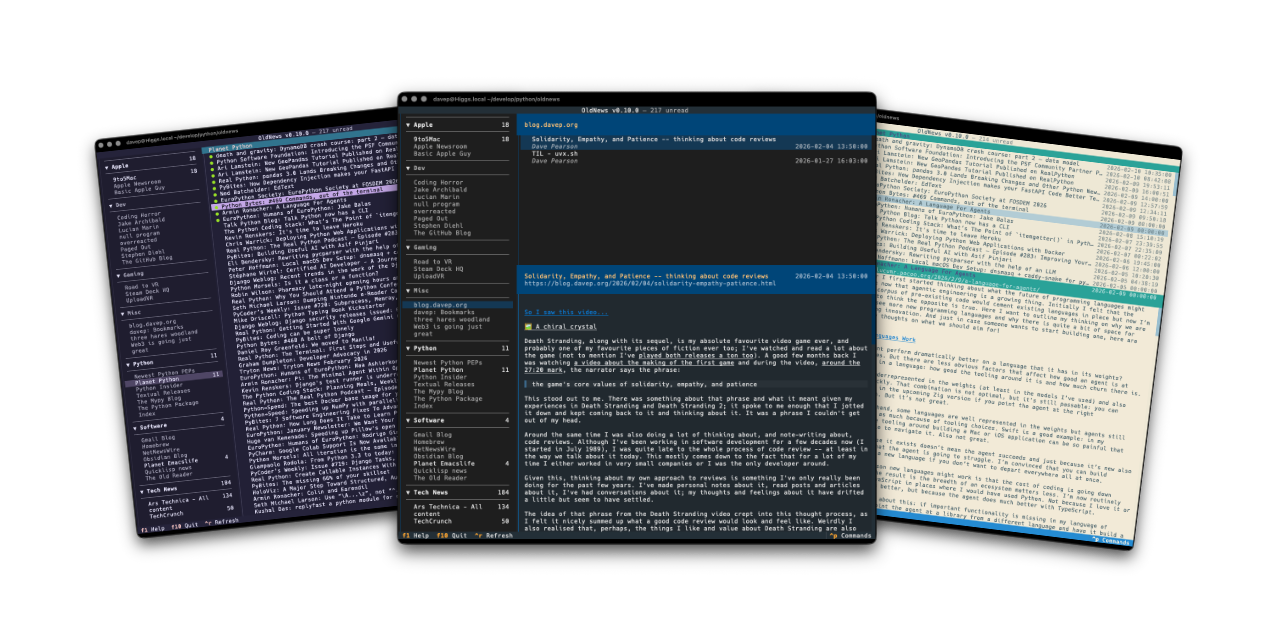
I honestly can't remember when I was first introduced to the idea of RSS/Atom feeds, and the idea of having an aggregator or reader of some description to keep up with updates on your favourite sites. It's got to be over 25 years ago now. I can't remember what I used either, but I remember using one or two readers that ran locally, right up until I met Google Reader. Once I discovered that I was settled.

As time moved on and I moved from platform to platform, and wandered into the smartphone era, I stuck with Google Reader (and the odd client for it here and there). It was a natural and sensible approach to consuming news and updates. It also mostly felt like a solved problem and so felt nice and stable.

So, of course, I was annoyed when Google killed it off, like so many useful things.

When this happened I dabbled with a couple of alternatives and, at some point, finally settled on TheOldReader. Since then it's been my "server" for feed subscriptions with me using desktop and mobile clients to work against it.

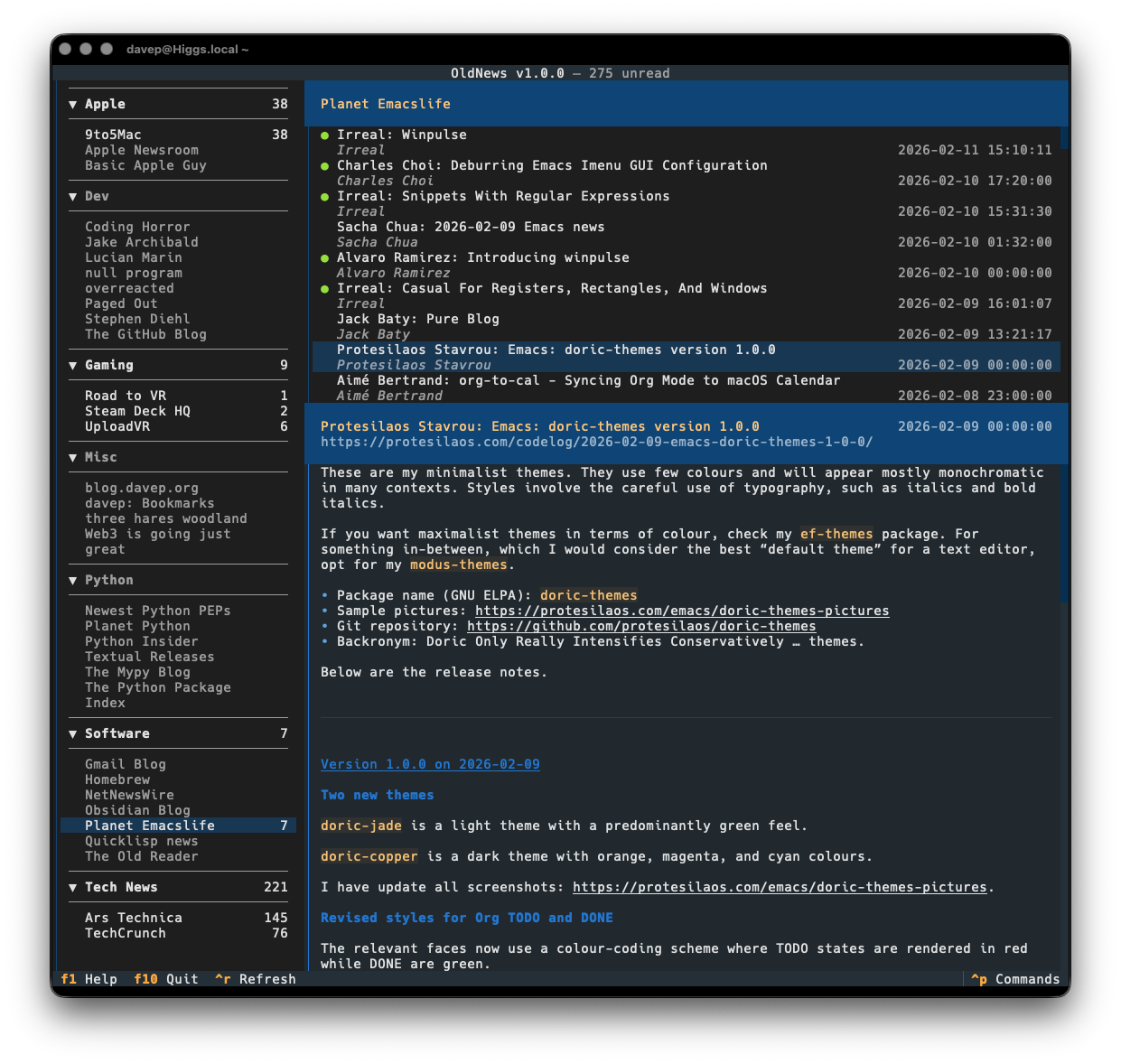
But... I never found anything that worked for me that ran in the terminal. Given I've got a thing for writing terminal-based tools it made sense I should have a go, and so OldNews became my winter break project.

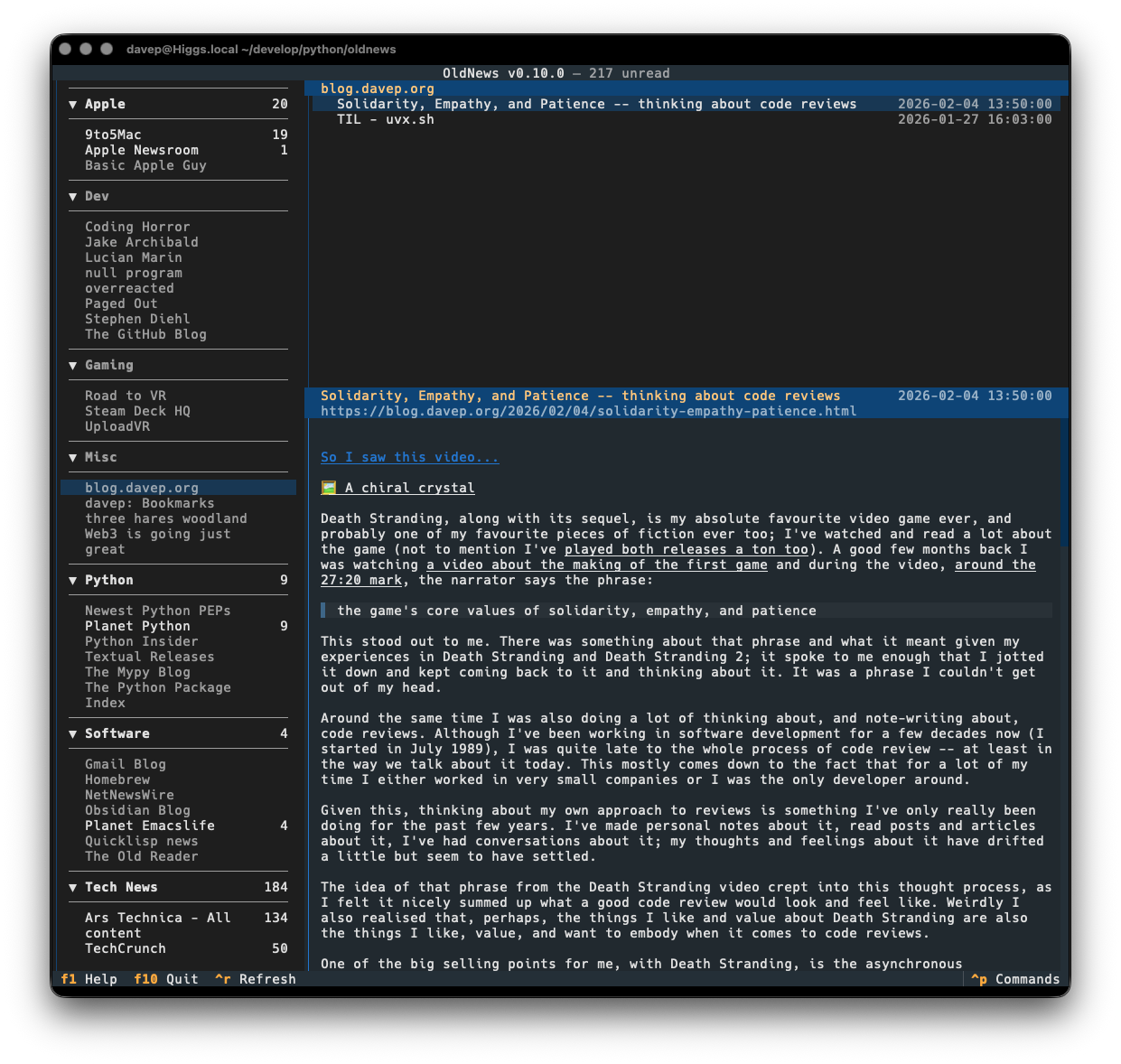
Reading an article in OldNews

I've written it as a client application for the API of TheOldReader, and only for that, and have developed it in a way that works well for me. All the functionality I want and need is in there:

  • Add subscriptions
  • Rename subscriptions
  • Remove subscriptions
  • Add folders
  • Rename folders
  • Remove folders
  • Move subscriptions between folders
  • Mark read/unread
  • Read articles (that provide actual content in their feeds)

Currently there's no support for starring feeds or interacting with the whole "friend" system (honestly: while I see mention of it in the API, I know nothing of that side of things and really don't care about it). As time goes on I might work on that.

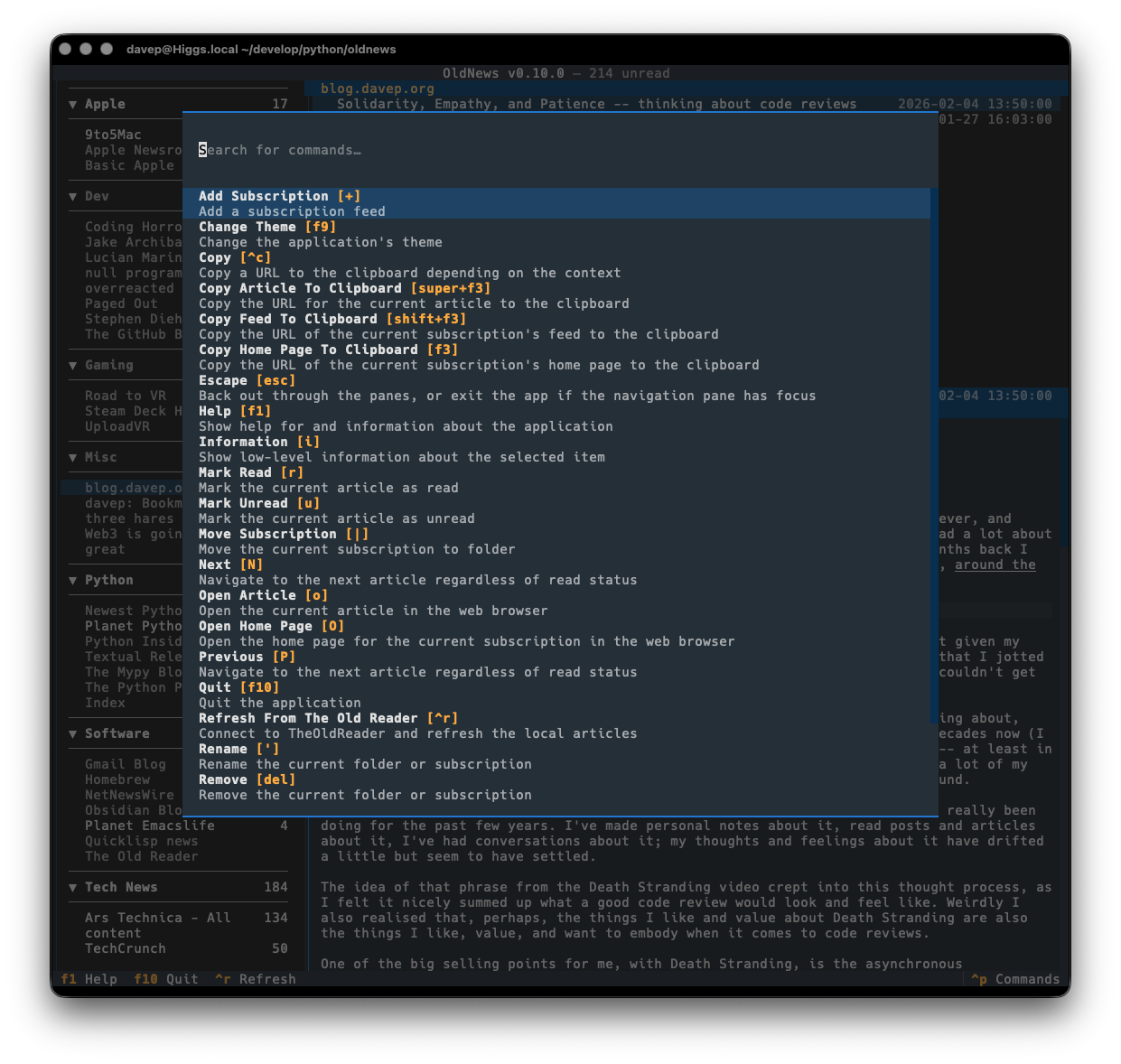
As with all of my other terminal-based applications, there's a rich command palette that shows you what you can do, and also what keyboard shortcuts will run those commands. While I do still need to work on some documentation for the application (although you'd hope that anyone looking for an RSS reader at this point would mostly be able to find their way around) the palette is a good place to go looking for things you can do.

The command palette

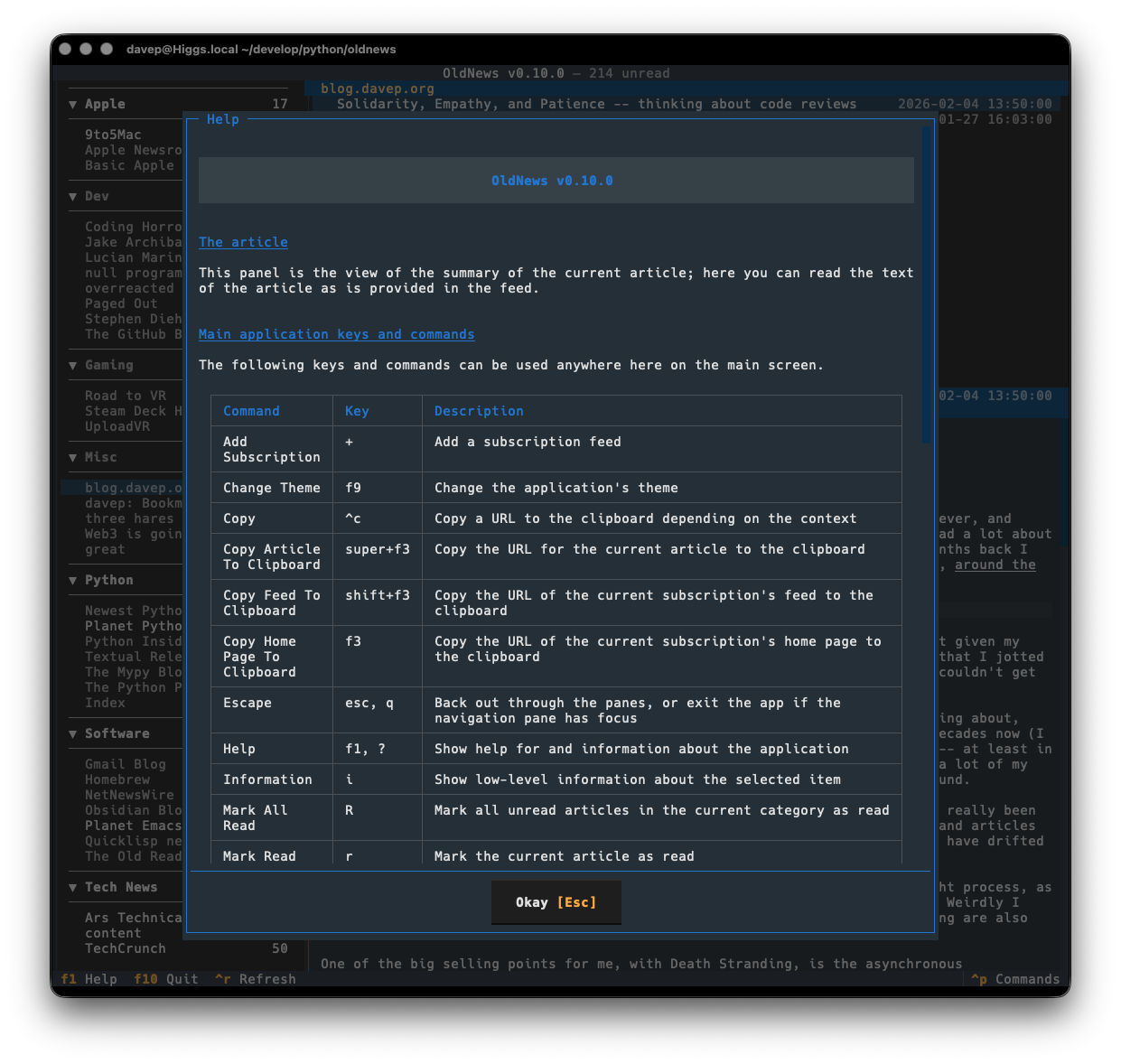
Plus there's a help screen too.

The help screen

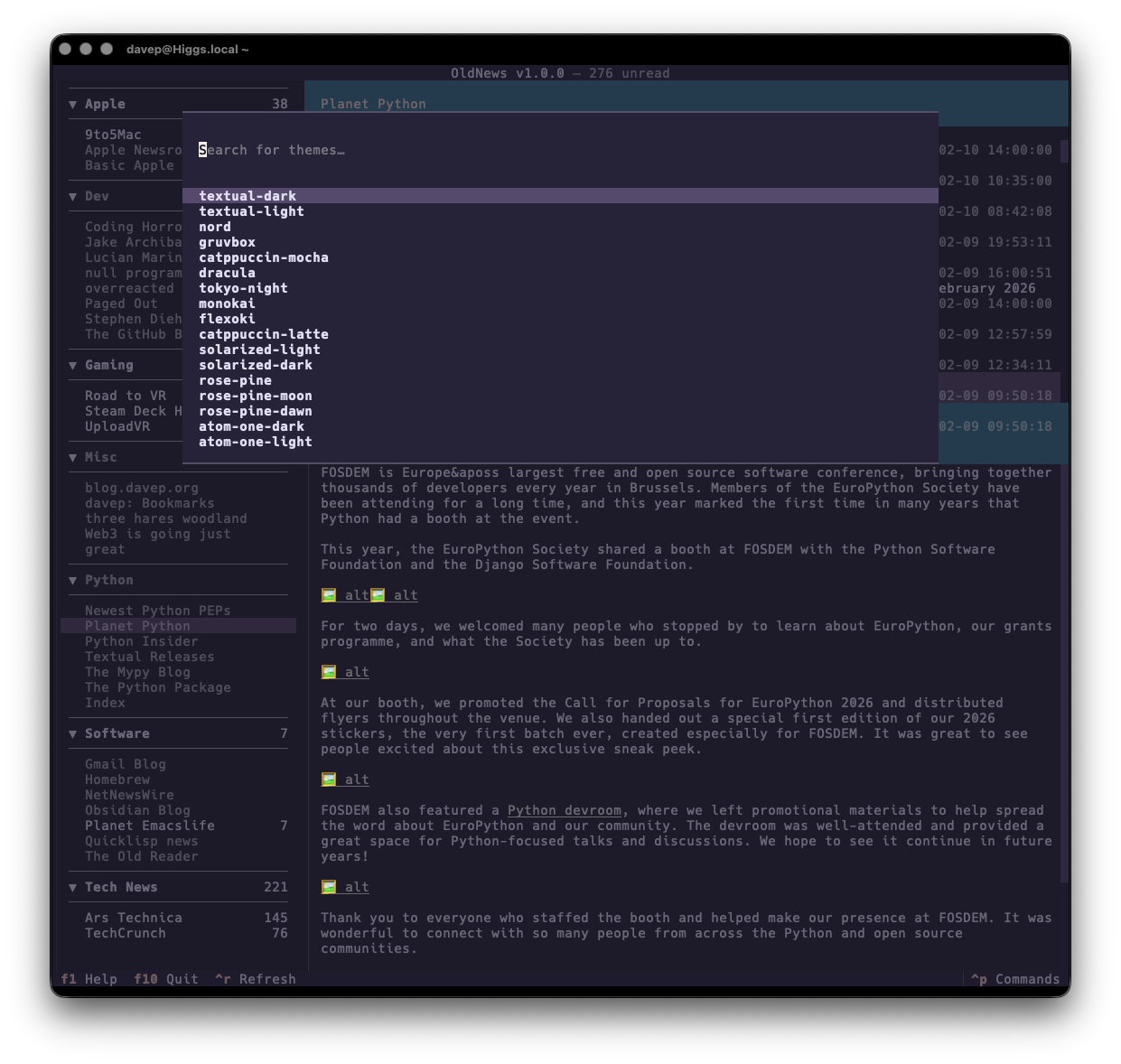
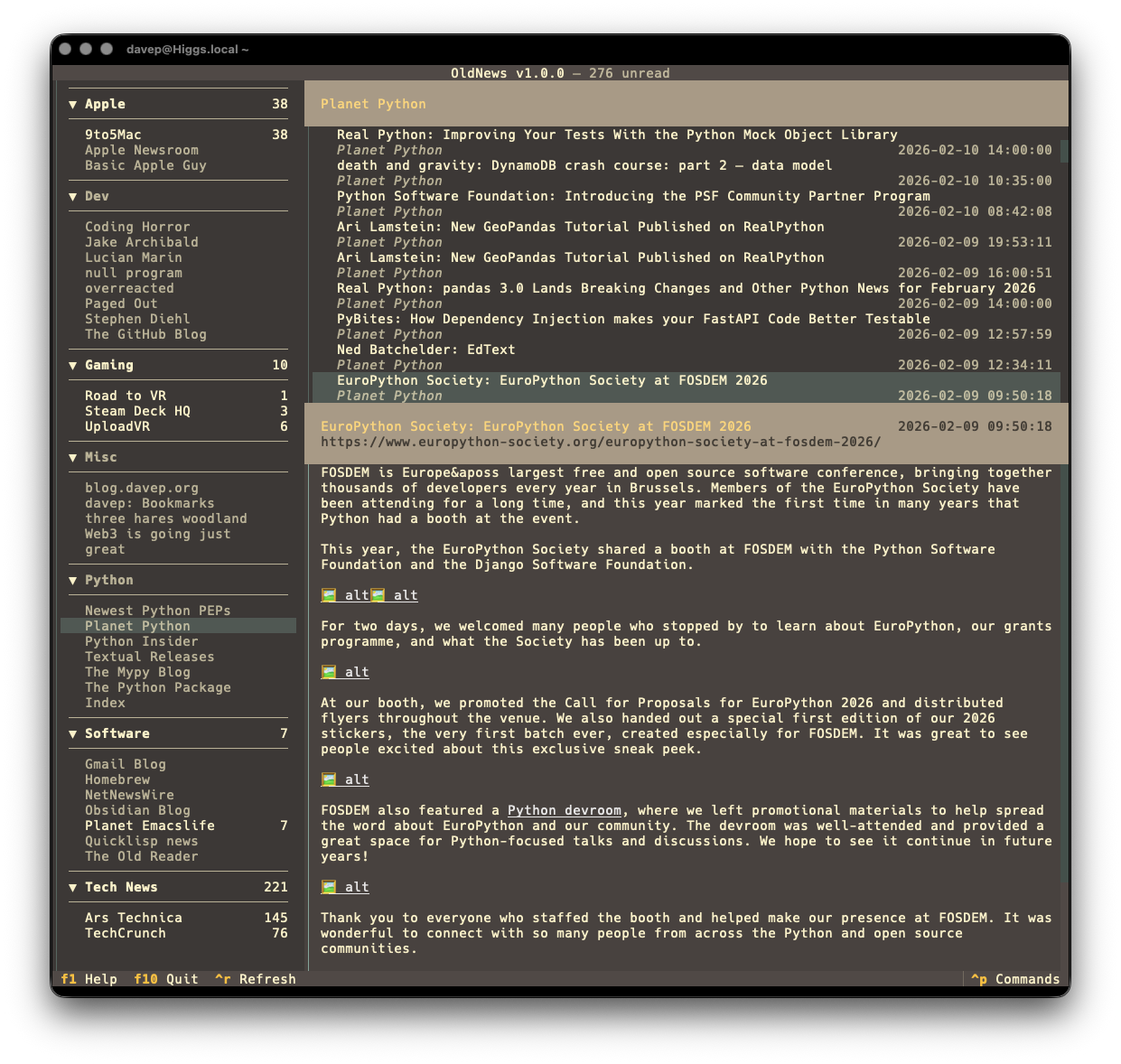
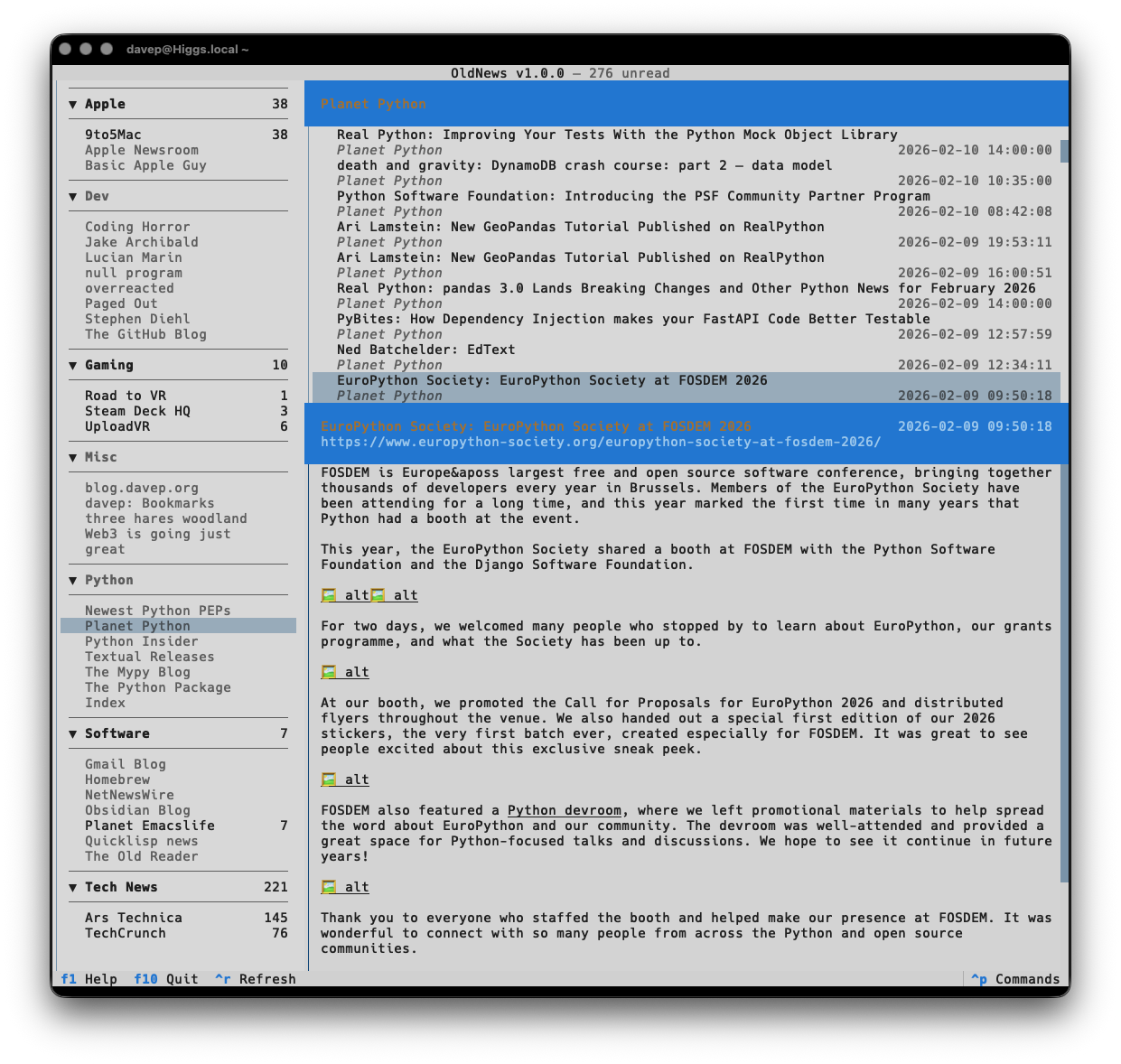
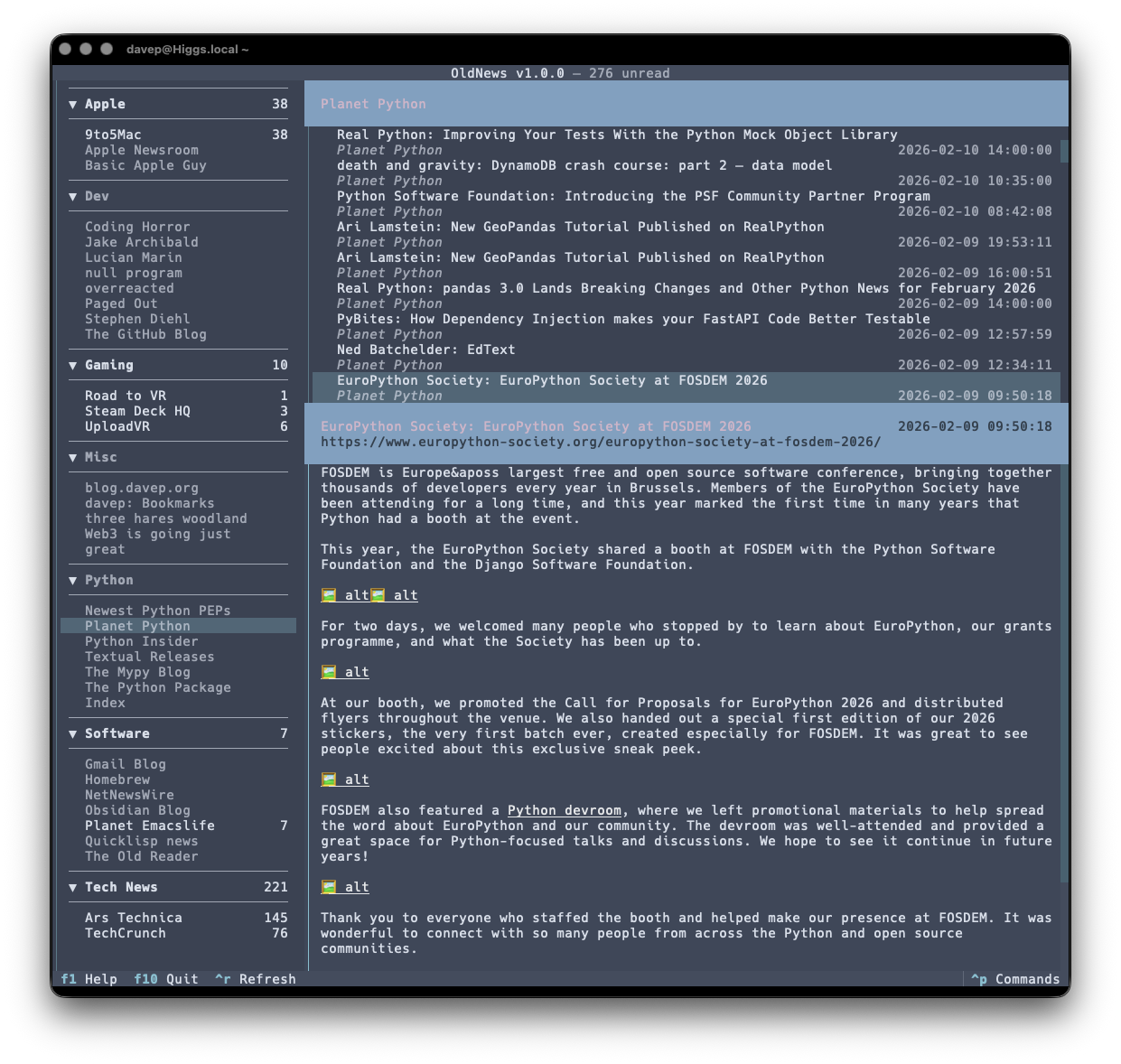
If themes are your thing, there's themes:

Available themes Gruvbox Textual Light Nord

That's a small selection, and there's more to explore.

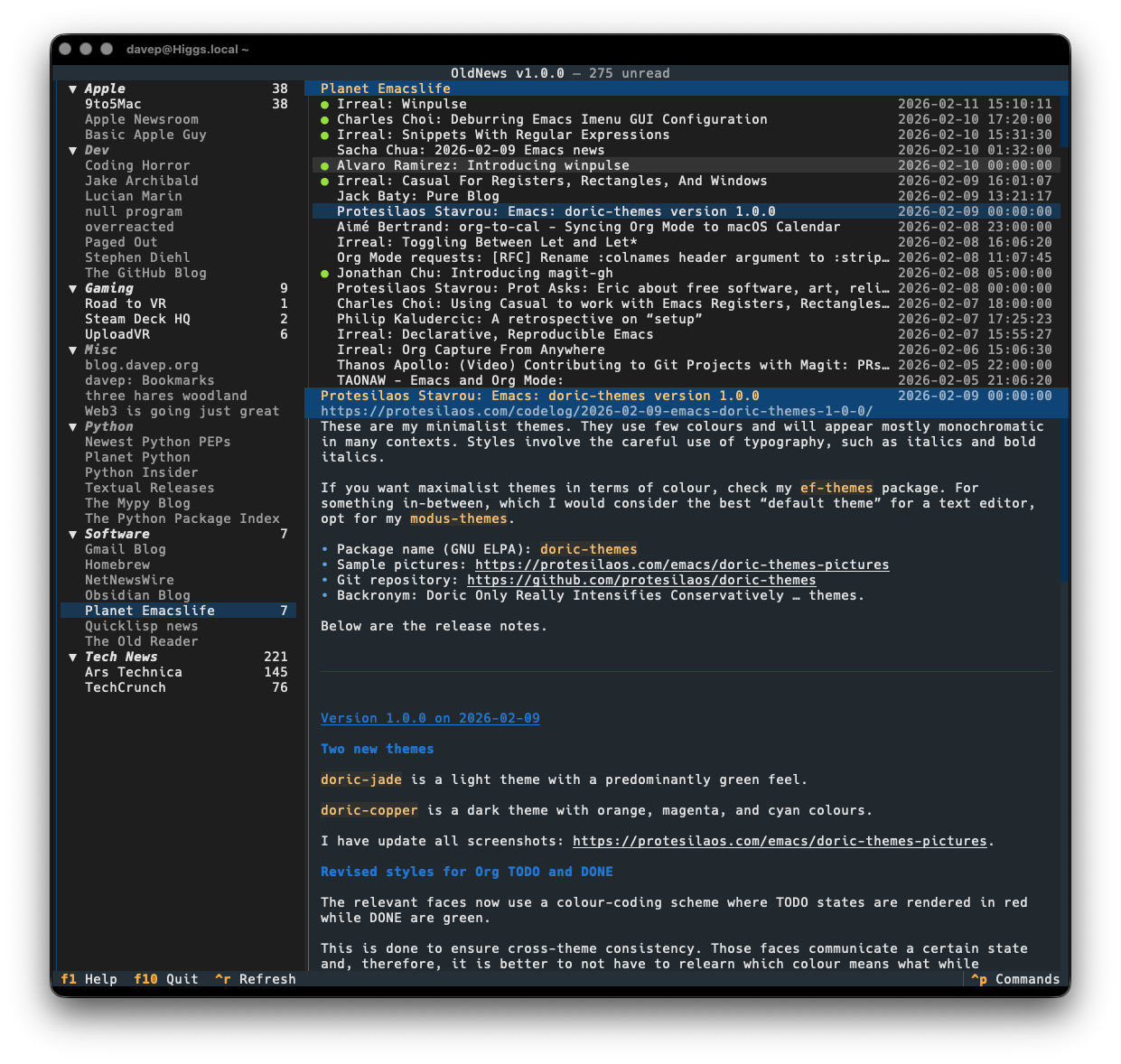
Also on the cosmetic front there's a simple compact mode, which toggles between two ways of showing the navigation menu, the article lists and the panel headers.

Not compact Compact

OldNews has been a daily-driver for a wee while now, while also under active development. I think I've covered all the main functions I want and have also shaken out plenty of bugs, so today's the day to call it v1.0.0 and go from there.

If you're a user of TheOldReader and fancy interacting with it from the terminal too then it's out there to try out. It's licensed GPL-3.0 and available via GitHub and also via PyPI. If you have an environment that has pipx installed you should be able to get up and running with:

pipx install oldnews

It can also be installed using uv:

uv tool install oldnews

If you don't have uv installed you can use uvx.sh to perform the installation. For GNU/Linux or macOS or similar:

curl -LsSf uvx.sh/oldnews/install.sh | sh

or on Windows:

powershell -ExecutionPolicy ByPass -c "irm https://uvx.sh/oldnews/install.ps1 | iex"

Once installed, run the oldnews command.

Hopefully this is useful to someone else; meanwhile I'll be using it more and more. If you need help, or have any ideas, please feel free to raise an issue or start a discussion.