Posts tagged with "blogmore.el"

blogmore.el v4.1

1 min read

Following on from yesterday's experiment with webp I got to thinking that it might be handy to add a wee command to blogmore.el that can quickly swap an image's extension from whatever it is to webp.

So v4.1 has happened. The new command is simple enough, called blogmore-webpify-image-at-point; it just looks to see if there's a Markdown image on the current line and, if there is, replaces the file's extension with webp no matter what it was before.

If/when I decide to convert all the png files in the blog to webp I'll obviously use something very batch-oriented, but for now I'm still experimenting, so going back and quickly changing the odd image here and there is a nicely cautious approach.

I have, of course, added the command to the transient menu that is brought up by the blogmore command.

One other small change in v4.1 is that a newly created post is saved right away. This doesn't make a huge difference, but it does mean I start out with a saved post that will be seen by BlogMore when generating the site.

blogmore.el v4.0

2 min read

Despite having bumped it from 2.x to 3.x yesterday, I'm calling v4.0 on blogmore.el today. There's a good reason for this though. While tinkering with some of the configuration yesterday, and also answering a configuration question last night, I realised that it made sense to make some of the internals into public utility functions.

Now, sure, Emacs Lisp doesn't really have internals in the private function sense, but I've always liked the approach that a package-- prefix communicates "internal, might go away" vs package- which tells me "this is a stable part of the API of this package". With this in mind I've always tried to write my code using this convention. I did this with blogmore.el too and a lot of the code had the blogmore-- prefix.

There's plenty of code in there that someone might want to make use of, if they wanted to add their own commands, or do fun things with the configuration. So with this in mind I've "promoted" a bunch of code to being "public" and, in that case, I feel this deserves another major version bump1.

Things that are now part of the "public" interface include:

  • blogmore-clean-time-string
  • blogmore-get-frontmatter
  • blogmore-remove-frontmatter
  • blogmore-set-frontmatter
  • blogmore-slug
  • blogmore-toggle-frontmatter
  • blogmore-with-post

Each one is documented via its docstring (just a quick Ctrl+h f function-name RET away) and hopefully is pretty self-explanatory.

blogmore-with-post is especially handy as it provides a quick and easy way of pulling information from a post file. So something like this:

(blogmore-with-post "~/write/davep.github.com/content/posts/2026/04/2026-04-05-blogmore-el-v3-1.md"
  (list
   (blogmore-get-frontmatter "title")
   (blogmore-get-frontmatter "date")))

resulting in:

("blogmore.el v3.1" "2026-04-05 20:04:44+0100")

Meaning that this snippet from yesterday's post:

(with-temp-buffer
  (insert-file-contents-literally file)
  (parse-iso8601-time-string
   (blogmore--clean-time-string (blogmore--get-frontmatter-property "date"))))

becomes:

(blogmore-with-post file
  (parse-iso8601-time-string
   (blogmore-clean-time-string (blogmore-get-frontmatter "date"))))

Not massively different, but it reads better and now all the calls are to the "public API" of the package.

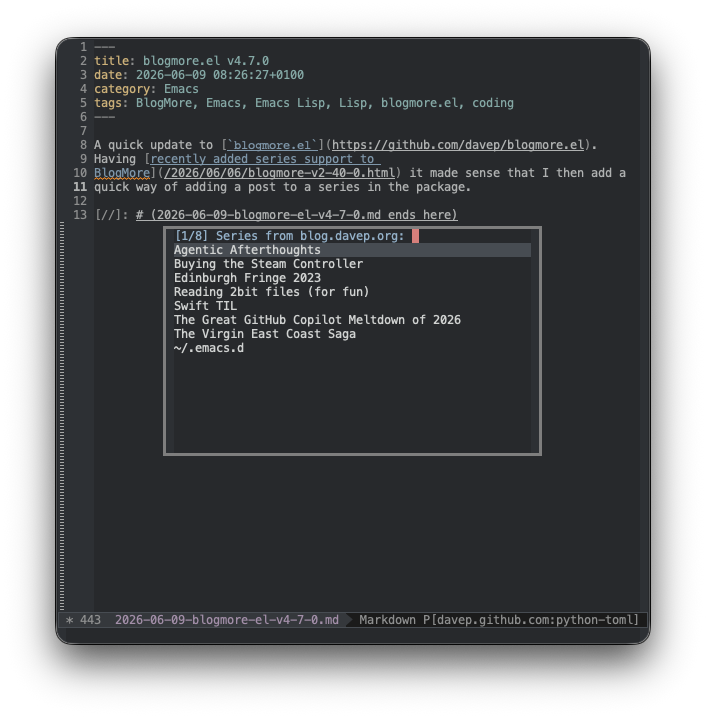
Not all the changes are "promoted internals". I've also added a blogmore-remove-tag command (and also added it to the transient menu).

Removing a tag

I've also changed the way that blogmore-add-tag works so that, now, if it's called from the transient, it immediately goes back to the tag input prompt, allowing for another tag to be immediately selected (you can quit out of this with Ctrl+g). Removal of a tag works in a similar way, making things a lot quicker.

I've also added some extra tests too, which makes it even easier for me to make future changes with confidence. The more I work with it the more I appreciate that ERT is available.


  1. Ordinarily it shouldn't matter as the public interface isn't changing, but some of the "internal" functions had been mentioned as options for configuration. 

blogmore.el v3.1

3 min read

When I first started writing blogmore.el it was just going to be a handful of commands that let me spin up a new blog post, and insert the odd link here and there when needed. Initially it only handled a single blog, and everything it did was based around how I lay my personal blog out, and was also very much geared to how I'd made BlogMore work.

But then I wanted to use it to edit both my personal blog and my photoblog. So then I had to add support for configuring different ways of laying out posts for different blogs, etc.

Still, it was mostly written as a personal tool that worked for my stuff. I tried to make it so that it was easy enough to configure (and let's be fair: it's for Emacs and written in Emacs Lisp, it's kind of hard to not be very configurable if you're happy to get your hands dirty with some coding), but there were still some parts of it that weren't as easy to change as I'd have liked.

Also, when I'd originally added the multi-blog configuration, I'd chosen a format for the list of blogs that was an assoc-list of pure lists wrapped by a cl-defstruct to make for easier access. It worked well but was very positional in its nature.

So when the request came in to be able to have better control over the name of the file when starting a new post, which meant I was going to need to rearrange the structure again, it was time to try and do something about it.

Which is how I'm now on v3.1 (yes, there was a v3.0 but I quickly found something in that that needed fixing1). It's a major version bump because I've totally changed how the blogmore-blogs variable holds the data.

From now on I'm using EIEIO to create a class that holds all of the data for a given blog. This, I believe, makes the code easier to read and should also make it more resilient to the addition of any new properties. Also thanks to how such classes can work with the customize system the customize experience remains pretty much the same too.

Personally I don't use the customize UI, instead I declare everything via use-package. As of the time of writing my declaration for blogmore looks like this:

(use-package blogmore
  :ensure t
  :defer t
  :vc (:url "https://github.com/davep/blogmore.el" :rev :newest)
  :init
  (add-hook 'blogmore-new-post-hook #'end-it)
  (blogmore-work-on "blog.davep.org")
  :custom
  (blogmore-blogs
   (list
    (blogmore-blog
     :title "blog.davep.org"
     :posts-directory "~/write/davep.github.com/content/posts/"
     :post-subdirectory-function (lambda () (format-time-string "%Y/%m/")))
    (blogmore-blog
     :title "seen-by.davep.dev"
     :posts-directory "~/write/seen-by/content/posts/")))
  :bind
  ("<f12> b" . blogmore))

There's a bunch of other changes and tweaks under the hood in this release too. All of these should come together to make blogmore.el a little more configurable than it was before. I think, to get the best out of it, anyone wanting to configure it "just so" for their purposes will still have to do a little bit of work, which makes me want to spend some time soon writing some proper documentation, complete with examples of how you might achieve different things.

One big change I've made under the hood is to the code that is used when you insert a link to a post (blogmore-link-post). When this runs it lets me pick a file in your filesystem that is a post from my currently-active blog. Once it has the filename it needs to turn it into a root-relative link. So this:

~/write/davep.github.com/content/posts/2026/04/01/2026-04-01-foo.md

needs to become:

/2026/04/01/foo.html

Until now I just did some regexp faffing that took the 2026-04-01- at the start of the filename and swapped each - for /. Nice and easy. Simple enough to code up and get things working a few weeks back. Not at all flexible.

So as a proof-of-concept of how sophisticated someone could get with configuring this I've changed blogmore-default-post-maker-function from this:

(defcustom blogmore-default-post-maker-function
  (lambda (file)
    (replace-regexp-in-string
     (rx bos (group (+ digit)) "-" (group (+ digit)) "-" (group (+ digit)) "-")
     "\\1/\\2/\\3/"
     (file-name-base (file-name-sans-extension file))))
  "Default function to generate a link for a blog post from its filename."
  :type 'function
  :group 'blogmore)

and turned it into this:

(defcustom blogmore-default-post-maker-function
  (lambda (file)
    (format
     "%s/%s"
     (format-time-string
      "%Y/%m/%d"
      (with-temp-buffer
        (insert-file-contents-literally file)
        (parse-iso8601-time-string
         (blogmore--clean-time-string (blogmore--get-frontmatter-property "date")))))
     (replace-regexp-in-string
      (rx bol (= 4 digit) "-" (= 2 digit) "-" (= 2 digit) "-")
      ""
      (file-name-base file))))
  "Default function to generate a link for a blog post from its filename."
  :type 'function
  :group 'blogmore)

So whereas before I was simply messing with the file's name, now I'm loading the date frontmatter from the chosen file and using that to create the date portion of the path in the URL that I use on my blog. The benefit here is that someone might want to keep the date portion of the path in the URL, but never want it as part of the Markdown source file's name, and so this change means they can call the file anything they want; it doesn't look at that but instead uses the actual date from the post's frontmatter.

I think this nicely demonstrates that, especially thanks to how powerful Emacs and Emacs Lisp are, it's fairly easy to make blogmore.el work just the way you want. I think I've provided almost all the hooks necessary to configure it all sorts of ways, but if you do happen to use it and run into something I might have missed, let me know.


  1. I have at least two slightly different date formats going on in my Markdown and Emacs' parse-iso8601-time-string is kind of picky. So I added a function to try and clean that up

blogmore.el v2.7

2 min read

There's no question that the experiment that is BlogMore has resulted in me blogging more. Although my previous setup wasn't exactly all friction, there's something about "owning" most of the tools and really knowing how they work, and being able to quickly modify them so they work "just so", that makes me more inclined to quickly write something up.

I can see this if I look at the numbers in the archive for this blog. In March alone I wrote 43 posts; that's more than I wrote in any whole year, other than 2023. While I suspect this will start to calm down as work on BlogMore and blogmore.el settles down, I sense I'll be writing a bit more often for some time to come.

Because of this I decided to do a little bit of housekeeping on the posts directory in the blog's source repository. Originally I had the Markdown source for every post all in one directory. Then last month I broke those down by year. Then earlier today, seeing how this year is going, I decided to break 2026 down by month.

Then I realised I had a problem in blogmore.el. It assumed that the Markdown file for a new post (blogmore-new) would always be created in a subdirectory named after the year, underneath the defined posts directory. Until today that was the case1, but now I wanted it to work differently.

So this is why I'm making a second release in one day: I added the ability to configure the subdirectory where a new post is created. I've changed the default now so that it assumes the user wants the subdirectory to be YYYY/MM/DD (because more granular feels like the right default). In my case I don't want that, I just want YYYY/MM, but now I can configure that. The value that is set is a function that returns the name of the subdirectory, so in the case of my blog I have it as:

(lambda () (format-time-string "%Y/%m/"))

On the other hand, for my photoblog I want the full date as a subdirectory so I can leave it as the default. The whole use-package for blogmore now looks like:

(use-package blogmore
  :ensure t
  :defer t
  :vc (:url "https://github.com/davep/blogmore.el" :rev :newest)
  :init
  (add-hook 'blogmore-new-post-hook #'end-it)
  (blogmore-work-on "blog.davep.org")
  :custom
  (blogmore-blogs
   '(("blog.davep.org"
      ;; Root directory for posts.
      "~/write/davep.github.com/content/posts/"
      ;; Subdirectory for new posts, relative to the root.
      (lambda () (format-time-string "%Y/%m/")))
     ("seen-by.davep.dev"
      ;; Root directory for posts.
      "~/write/seen-by/content/posts/")))
  :bind
  ("<f12> b" . blogmore))

Technically this is a breaking change because it bumps the meaning of each "position" in the values within blogmore-blogs. However, in my case, because I was only ever defining the blog name and the top-level directory for the posts (both mandatory), this didn't break anything; I also strongly suspect nobody else is using this so I very much doubt I'm messing with someone else's setup2. If I have I apologise; do let me know.

Anyway, all of this goes to explain why the heck I made two releases of the same package back to back in the same day. This is what happens when my namesake is having fun outside and so I just want to sit on the sofa, hack on some code, and watch the chaos in the garden.


  1. For my blog, which again shows that blogmore.el started as a quick hack for getting work done on my blog, but I also want to make it as configurable as possible. 

  2. Even if someone else is using this I would suspect they hadn't configured anything more than I have. 

blogmore.el v2.6

2 min read

Like most people, I imagine, I first ran into transient when first using magit. I took to it pretty quickly and it's always made sense to me as a user interface. But... I've never used it for any code I've ever written.

I think, incorrectly, I'd half assumed it was going to be some faff to set up, and of course for a good while it wasn't part of Emacs anyway. Given this, I'd always had it filed under the heading "that's so neat I'll give it a go one day but not at the moment".

Meanwhile... ever since I did the last big revamp of my Emacs configuration, I found myself leaning into a command binding approach that does the whole prefix-letter-letter thing. For reasons I can't actually remember I fell into the habit of using F121 as my chosen prefix key. As such, over the past 10 or so years (since I greatly overhauled my Emacs setup), I've got into setting up bindings for commands that follow this prefix convention.

So when I created blogmore.el I set up the commands following this pattern.

(use-package blogmore
  :ensure t
  :defer t
  :vc (:url "https://github.com/davep/blogmore.el" :rev :newest)
  :init
  (add-hook 'blogmore-new-post-hook #'end-it)
  (blogmore-work-on "blog.davep.org")
  :custom
  (blogmore-blogs
   '(("blog.davep.org" "~/write/davep.github.com/content/posts/")
     ("seen-by.davep.dev" "~/write/seen-by/content/posts/")))
  :bind
  ("<f12> b b" . blogmore-work-on)
  ("<f12> b n" . blogmore-new)
  ("<f12> b e" . blogmore-edit)
  ("<f12> b d" . blogmore-toggle-draft)
  ("<f12> b s c" . blogmore-set-category)
  ("<f12> b a t" . blogmore-add-tag)
  ("<f12> b u d" . blogmore-update-date)
  ("<f12> b u m" . blogmore-update-modified)
  ("<f12> b l p" . blogmore-link-post)
  ("<f12> b l c" . blogmore-link-category)
  ("<f12> b l t" . blogmore-link-tag))

It works well, it makes it nice and easy to remember the bindings, etc. Nobody needs me to sell them on the merits of this approach.

Then I got to thinking last night: why am I setting up all those bindings when I could probably do it all via a transient? So that was the moment to actually RTFM and get it going. The first version was incredibly quick to get up and running and I was kicking myself that I'd taken so long to actually look at the package properly.

This morning I've worked on it a little more and the final form is still pretty straightforward.

(transient-define-prefix blogmore ()
  "Show a transient for BlogMore commands."
  [:description
   (lambda ()
     (format "BlogMore: %s\n"
             (if (blogmore--chosen-blog-sans-error)
                 (blogmore--blog-title)
               "No blog selected")))
   ["Blog"
    ("b"  "Select blog" blogmore-work-on)]
   ["Post"
    ("n" "New post" blogmore-new :inapt-if-not blogmore--chosen-blog-sans-error)
    ("e" "Edit post" blogmore-edit :inapt-if-not blogmore--chosen-blog-sans-error)
    ("d" "Toggle draft status" blogmore-toggle-draft :inapt-if-not blogmore--blog-post-p)
    ("c" "Set post category" blogmore-set-category :inapt-if-not blogmore--blog-post-p)
    ("t" "Add tag" blogmore-add-tag :inapt-if-not blogmore--blog-post-p)
    ("u d" "Update date" blogmore-update-date :inapt-if-not blogmore--blog-post-p)
    ("u m" "Update modified date" blogmore-update-modified :inapt-if-not blogmore--blog-post-p)]
   ["Links"
    ("l c" "Link to a category" blogmore-link-category :inapt-if-not blogmore--blog-post-p)
    ("l p" "Link to a post" blogmore-link-post :inapt-if-not blogmore--blog-post-p)
    ("l t" "Link to a tag" blogmore-link-tag :inapt-if-not blogmore--blog-post-p)]])

With this in place I can simplify my use-package quite a bit, just binding a single key to run blogmore.

(use-package blogmore
  :ensure t
  :defer t
  :vc (:url "https://github.com/davep/blogmore.el" :rev :newest)
  :init
  (add-hook 'blogmore-new-post-hook #'end-it)
  (blogmore-work-on "blog.davep.org")
  :custom
  (blogmore-blogs
   '(("blog.davep.org" "~/write/davep.github.com/content/posts/")
     ("seen-by.davep.dev" "~/write/seen-by/content/posts/")))
  :bind
  ("<f12> b" . blogmore))

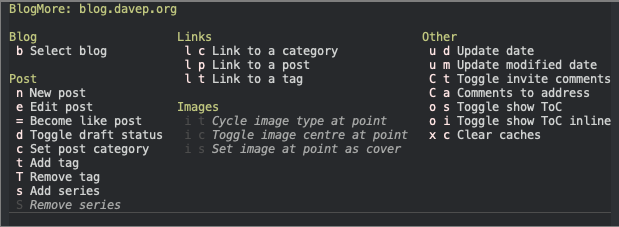
Now, when I'm working on a blog post, I can just hit F12 b and I get a neat menu:

BlogMore with all commands available

Better still, because of how transient works, I can ensure that only applicable commands are available, while still showing them all. So if I've not even got a blog selected yet:

With no commands available

Or with a blog selected but not actually working on a post yet:

With some commands available

So far I'm really liking this approach, and I'm tempted to lean into transient more with some of my packages now. While on the surface it does seem that it has the downside of the binding choices being dictated by me, the fact is that the commands are all still there and anyone can use their own bindings, or I guess override the transient itself and do their own thing.


  1. Yes, it is a bit out of the way on the keyboard, but so is Esc. I find my muscle memory has no problem with it. 

blogmore.el v2.5

2 min read

Following on from yesterday's release, I've bumped blogmore.el to v2.5. The main change to the package is the thing I mentioned yesterday about the toggle of the draft status. The draft toggle yesterday was pretty simple, with it working like:

  • If there is no draft frontmatter, draft: true is added
  • If there is any draft frontmatter, it is removed

This meant that if you had draft: false set and you went to toggle, it would be removed, which is the same as setting it to draft: false.

Unlikely to generally be an issue, but I also couldn't let that stay like that. It bothered me.

So now it works as you'd expect:

  • If there is no draft frontmatter, draft: true is added
  • If draft: true is there, it is removed
  • If draft: false is there, it is set to draft: true

Much better.

Another change is that I fixed a problem with older supported versions of Emacs. I didn't know this was a problem because I'm running 30.2 everywhere. Meanwhile, thanks to package-lint-current-buffer from package-lint.el, I have:

Package-Requires: ((emacs "29.1"))

in the metadata for the package. Turns out though that sort used to require two parameters (the sequence and the predicate), whereas now it's fine with just one (it will accept just the sequence and will default the predicate). So of course blogmore.el was working fine for me, but would have crashed for someone with an earlier Emacs.

As for how I found this out... well I finally, for the first time ever, dived into using ERT to write some tests. While I've used testing frameworks in other languages, I'd never looked at this with Emacs Lisp. It works a treat and is great to work with; I think I'll be using this a lot more from now on.

Having got tests going I realised I should run them with GitHub actions, which then meant I managed to discover setup-emacs. Having found this the next logical step was to set up a matrix test for all the versions of Emacs I expect blogmore.el to work on. This worked fine, except... it didn't. While the tests worked locally, they were failing for some Emacsen over on GitHub.

And that's how I discovered the issue with sort on versions earlier than the one I'm using locally.

All in all, that was a good little period of hacking. New things discovered, the package improved, and a wider range of support for different versions of Emacs.

blogmore.el v2.4

1 min read

I've just released a little update to blogmore.el, adding blogmore-toggle-draft as a command. This came about in connection with the feature request that resulted in BlogMore v2.7.0 being released.

While I don't personally use draft for my posts, I can see the utility of it and if someone were to happen to use blogmore.el, it could be useful to have this bound to a handy key combination.

As for how it works: that's simple. When run, if there is no draft: frontmatter property, then draft: true is added. If draft: is there it is removed. Yes, it does mean that it will also remove draft: false too but... eh. Okay, fine, I might handle that case as a followup but I couldn't really imagine someone wanting to keep draft: false in the frontmatter.

If a post is ready to go, why bother with a header that means the same thing when it's not there?

blogmore.el v2.3

1 min read

I've bumped blogmore.el to v2.3. The main change in this release, which I've had on my mental to-do list for a couple of days now, revolves around categories, tags and case.

I've got BlogMore set up so that it's pretty relaxed about case when it comes to categories and tags; so when it comes to generated files and URLs everything collapses to lowercase. However, blogmore.el wasn't taking this into account.

While it wasn't a serious issue, it did have the side-effect that, if you had a tag of lisp and a tag of Lisp, both would appear in the list of tags you could complete from. Also, when you went to add a tag to the tags frontmatter (via the blogmore-add-tag command), if you selected Lisp and lisp was already there, you'd end up with both versions after the command finished.

ℹ️ Note

As mentioned earlier: BlogMore itself would collapse Lisp and lisp to the same tag; the downside here is you'd see both tags shown in the post itself. Not a real problem, just not very tidy.

So earlier I changed things up a little; first cleaning up when loading pre-existing values and then ensuring the newly-set tags are deduplicated.

This now means I can edit and update a post even faster, without needing to worry about accidentally duplicating tags. This in turn reduces the friction to writing a post for my blog. That is, after all, the whole point of the name of the package and the blogging tool it's connected to!

blogmore.el v2.2

2 min read

It really feels like BlogMore has kicked off a whole new thing when it comes to personal hacking. During the past few years I've developed a lot of Python applications and libraries, and have had a ton of fun doing so, but during that time I've not really done anything with writing stuff for Emacs.

To a large degree I think this says something about how stable Emacs is for me (I've been using it for a touch over 30 years at this point, you'd think I'd be kind of settled with it), but it's still always fun to have a reason to hack on some Lisp code. There's little doubt my Lisp -- especially Emacs Lisp -- has got a wee bit rusty.

So I'm having a lot of fun at the moment falling into the rabbit hole of expanding on and tinkering with blogmore.el. The reason I've just made v2.2 is a good example of exactly this. There are no real user-facing changes in the code, it was all things I just wanted to tidy up.

The main thing that has been bugging me for the past day is the repeating boilerplate that resulted from adding all the different current-blog-aware setting getter functions. There were 7 different functions, all looking like this:

(defun blogmore--post-maker-function ()
  "Get the post maker function for the current blog."
  (or
   (blogmore--blog-post-maker-function (blogmore--chosen-blog))
   blogmore-default-post-maker-function))

Exact same pattern, the only thing different being the name of the getter function being called on, and the name of the variable that contained the global default value.

So just a little earlier I cleaned this up using one of my favourite things about Lisp: defmacro. There's something about macros that makes me really like coding in Lisp, and which I cite as a really good thing when asked why I like Lisp, but which I always seem to utterly fail to explain well. Macros feel like one of those things you just have to experience for yourself to really get1.

Now, thanks to this:

(defmacro blogmore--setting (setting)
  "Generate a function to get the value of SETTING for the current blog."
  `(defun ,(intern (format "blogmore--%s" setting)) ()
     ,(format "Get the %s for the current blog." setting)
     (or (,(intern (format "blogmore--blog-%s" setting)) (blogmore--chosen-blog))
         ,(intern (format "blogmore-default-%s" setting)))))

all those 7 functions can collapse to this2:

(blogmore--setting post-template)
(blogmore--setting post-maker-function)
(blogmore--setting category-maker-function)
(blogmore--setting tag-maker-function)
(blogmore--setting post-link-format)
(blogmore--setting category-link-format)
(blogmore--setting tag-link-format)

Now the code is shorter, cleaner, and if I need to change anything I only need to change it in one place. Sure, the latter part especially is one of those "you could do that with a function too" things (have the work in one place), but here I can get the language to write me a whole load of functions, all of which refer to different functions and variables, each one based off just the one symbol.

The point of all of this being: v2.2 of blogmore.el is now out, it adds nothing for the user (who I suspect is only me anyway), but I had an absolute blast dusting off more of my Emacs Lisp knowledge and getting back the urge to code even more Emacs Lisp.

All of this has even got me tidying up my ~/.emacs.d/ and has me thinking I should go back through some of my older code and clean up all that legacy nonsense.


  1. There was a time I would have said "grok" here but... well that's spoiled now. 

  2. I suppose I could reduce that to one "call" with a loop over a list of symbols, but that feels unnecessary here. 

blogmore.el v2.1

1 min read

I've given blogmore.el a wee bump to v2.1. This release fixes a small problem I noticed today when I tried to use it to edit the tags for a post on my photoblog: the code to find and gather properties from posts didn't handle deeply-nested directory hierarchies for the post markdown files. I should have noticed this when I first wrote the code, but of course I was so busy testing against my primary blog, which only goes one sub-level deep, that I never noticed it wasn't going to work deeper.

So rather than using grep to look for things like foo/**/*.md I swapped to a combination of find and grep. Which works, but is slightly (but noticeably) slower.

Then I got to thinking that if I was doing this by hand, on the command line, I'd be using ripgrep anyway. Given this I might as well use it here. Of course, not everyone who might use blogmore.el will have rg installed so it makes sense to look for that and use it if it's available, otherwise fall back on find/grep.

There's still some low-priority cleaning up I want to do around this; an obvious change I want to make being one where I want to collapse all cases of the same word (Tree vs tree, etc) into one "hit"1. For now though, as always, it's working well enough for my needs and this change fixed an obvious issue I ran into.


  1. BlogMore itself takes care of this, but it would be nice to have the prompt in blogmore.el also take this into account.