The new linting tool I've added to BlogMore has paid off already. While it is the case that it helped me find a couple of broken links and one or two other things to tidy, as I was working on the feature; by the time I released it, my blog was lint-free.
But last night I did a little more work on the slow migration of images over to WebP. As I've mentioned before: this is a process I'm doing by hand, one post at a time, for a couple of different reasons. The thing is, I'm in a part of my blog now where I was often posting about updates to projects I was working on (Tinboard being a good example), and the cover for all of the posts would be the same. To save having multiple copies of the cover image, all subsequent posts would point back to the first cover image1.
So what was happening was, I'd have a cover image that got transitioned from PNG to WebP, and then the covers of a number of posts, later in time, would be broken. While I would get to them eventually, if I'd called it a day there and rebuilt my blog, those would have been published broken.
Using blogmore lint while making those changes yesterday evening alerted me to this right away.
It's worth noting that I break down the post attachments by day. ↩
After noticing a broken link in a post yesterday, I got to thinking that it would be useful to add a linter to BlogMore. So I've released v2.21.0 which adds linting support.
A number of things are checked and the results are broken down into things that are errors or warnings. Errors result from any of these checks:
Ensures all posts and pages have valid YAML frontmatter. If a file cannot be parsed, it is reported as an error.
Scans the generated HTML for links to non-existent internal paths (other posts, pages, categories, tags, archives, site features like search, or files in extras/).
Checks that all <img> sources resolve to valid internal paths or files in the extras/ directory.
Checks that the cover property in a post or page frontmatter points to a valid resource.
Verifies that all page slugs listed in sidebar_pages actually exist.
Checks that all internal-looking URLs in the links: and socials: configuration settings point to valid targets.
On the other hand, the following just result in a warning:
Flags if a post is missing a title, category, tags, or a date.
Reports if a post's date or modified date is set in the future.
Notes if a post's modified date is earlier than its original publication date.
Identifies if two or more posts share the exact same title.
Flags inline images missing an alt attribute, or those with an empty/whitespace-only alt attribute.
If clean_urls is enabled, warns if internal links point explicitly to index.html.
Reports internal links using the full site_url (e.g., https://example.com/path/) instead of a root-relative path (/path/).
I feel like all of these cover most of the things that are low-cost to detect but have a positive impact on the state of the content of a blog.
One thing I've not done is any sort of checking of external links. This would be costly and could possibly have unintended consequences that I don't want to be messing with (perhaps a tool to export the list of external links for checking could be useful, at some point).
Having run this against this blog, I did find some things that needed cleaning up, mostly absolute links that could be turned into root-relative links (always good for making the content portable).
At some point this morning I was looking for something on this blog and stumbled on a post that had a broken link. Not an external link, but an internal link. This got me thinking: perhaps I should add some sort of linting tool to BlogMore? I figured this should be doable using much of the existing code: pretty much work out the list of internal links, run through all pages and posts, see what links get generated, look for internal links1, and see if they're all amongst those that are expected.
Later on in the day I prompted Copilot to have a go. Now, sure, I didn't tell it how to do it, instead I told it what I wanted it to achieve. I hoped it would (going via Claude, as I've normally let it) decide on what I felt was the most sensible solution (use the existing configuration-reading, page/post-finding and post-parsing code) and run with that.
It didn't.
Once again, as I've seen before, it seemed to understand and take into account the existing codebase and then copy bits from it and drop it in a new file. Worse, rather than tackle this using the relevant parts of the existing build engine, it concocted a whole new approach, again obsessing over throwing a regex or three at the problem.
I then spent the next 90 minutes or so, testing the results, finding false reports, finding things it missed, and telling it what I found and getting it to fix them. It did, but on occasion it seemed to special-case the fix rather than understand the general case of what was going on and address that.
Eventually, probably too late really, I gave up trying to nudge it in the right direction and, instead, decided it was time to be more explicit about how it should handle this2. The first thing that bothered me was that it seemed to ignore the configuration object. Where BlogMore has a method of loading the configuration into an object, which can be passed around the code, but with the linter it loaded it up, pulled it all apart, and then passed some of the values as a huge parameter list. Because... reasons?
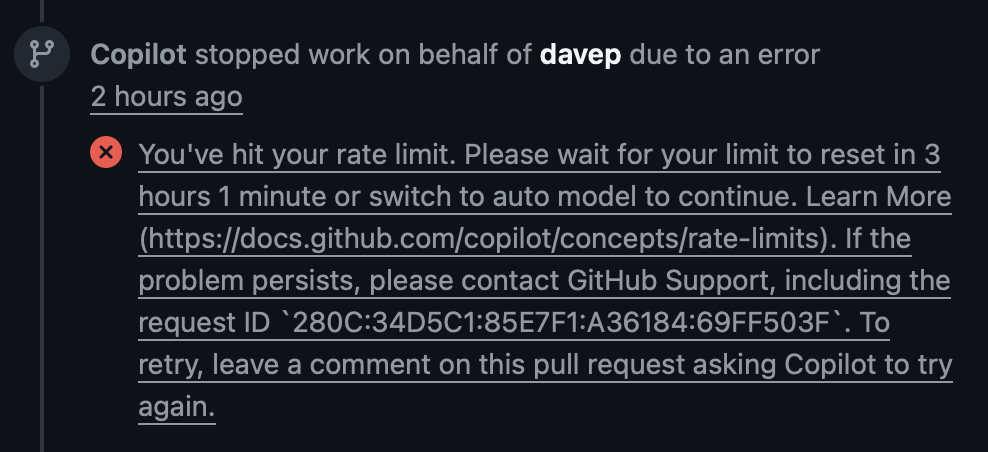
Anyway, I told it to cut that shit out and prompted it about a few other things that looked pretty bad too. Copilot/Claude went off and worked away on this for a while, using up my 6th premium request of the session, and then eventually came back with an error telling me I'd hit a rate limit and to come back in a few hours.
Could I have got it to where I wanted to be a bit earlier, with more careful prompting? No doubt. Will a lot of people? I suspect that's rather unlikely. This is one of the many things that make me pretty sceptical about this as the tool some sell it as, at least for the moment. I see often that it's written about or talked about as if it's a really useful coding buddy. It can be, at times, but it's hugely unreliable. Here I'm testing it by building something as a hobby, and I'm doing so knowing that there's no real consequence if it craps out on me. I'm also doing it safe in the knowledge that I could write the code myself, albeit at a far slower pace and with less available time. Not everyone this is aimed at has that going for them.
But these tools are still sold like they're the most reliable coding buddies going.
All that said: having hit the rate limit, and having squandered six premium requests on the problem with no real progress, I decided to use my Google Gemini coding allowance instead (which, in my experience so far, seems pretty generous). I threw more or less the same initial prompt at it, but this time I stressed that I really wanted it to use the existing engine where possible. It managed to pretty much one-shot the problem in about 9 minutes and used up just 2% of my daily quota3.
I've done a little more tidying up since, and I still need to properly review the result, but from what I can see of the initial results it's found all of the issues I wanted it to find, first time (something Claude didn't manage) and hasn't found any issues that don't exist (also something Claude didn't manage).
So I guess this time Gemini was the reliable buddy. But not knowing which buddy you can rely on makes for a pretty unreliable group of buddies.
This process could, of course, work for external links too, but I'm not really too keen on having a tool that visits every single external link to see if it's still there. ↩
Which is mostly fine; I'm doing this as an experiment in what it's capable of, and also I was sofa-hacking while having a conversation about naming Easter eggs in Minecraft. ↩
Imagine that too! Imagine knowing exactly how much of your quota you've used at any given moment! Presumably GitHub don't show you where you are in respect to the rate limits on top of your monthly quota because grinding to a halt with no warning is more... fun? ↩
I've just released BlogMorev2.20.0. There are five main changes in this release, and a lot of changes under the hood.
First, the under-the-hood stuff: while this isn't going to make a difference to anyone using BlogMore (at least it shouldn't make a difference -- if it does that's a bug that deserves reporting), the main site generation code has had a lot of work done on it to break it up. The motivation for this is to make the code easier to maintain, and to try and steer it in a direction closer to how I'd have laid things out had I written it by hand. The outcome of this is that, where the generator was over 2,000 lines of code in a single file, it's now a lot more modular and easier to follow.
Some other internals have been cleaned up too. Generally I've had a period of reviewing some of the code and reducing obvious duplication of effort, that sort of thing.
Now for the visible changes and enhancements in this release:
Until now the word counting (and so the reading time calculations) were done by stripping most of the Markdown and HTML markup from the Markdown source. I wasn't too keen on this approach given that the codebase had a method of turning Markdown into plain text. So in this release the regex-based cleanup code is gone and word counts (and so reading times) use the same Markdown to plain text pipeline as anything else that needs to work on plain text.
It was possible, in the stats page, to have one post appear to have the lowest or highest word count, but to not have the lowest or highest reading time. This was because reading times are always calculated to the minute and so there could be a disparity due to this rounding. The calculation of those stats now takes this into account.
The socials setting in the configuration file has had an optional title property added for each entry. Until now the tooltip for an entry would be whatever the site was set to. Generally this works but if you have two or more accounts on the same site, or if you want to use a site value for something different, there was no way of making the tooltip more descriptive.
Yesterday I noticed that, on one of my posts, what had been written as a simple caption for an image wasn't rendering as it used to. The actual content of the Markdown source for the post contained this:
<center>
*(Yes, the tin was once mine and was once full; the early 90s were a
different time)*
</center>
While the text was centred, the raw Markdown was left in place (it should have been italic text). The reason for this is that BlogMore had never enabled Markdown-in-HTML support. So, as of this release, if the enclosing tag has markdown="1", any Markdown inside the tags will be parsed. This means the above becomes this:
<center markdown="1">
*(Yes, the tin was once mine and was once full; the early 90s were a
different time)*
</center>
I did think about doing something to turn it on by default (the fact that I didn't have such a "switch" in the post before suggests that Pelican did just always do this), but really I feel this approach is more flexible and less likely to result in unintended consequences.
Carrying on with the theme of being lazy while editing posts, I've released blogmore.el v4.5.0. This version adds blogmore-set-as-cover. With this, if you place point on a line that is an image and run the command, it is set as the cover for the post.
Sure, it's not like it's hard to copy, move, insert a new line, type cover: and then paste the text, but this is faster and more accurate.
And I'm lazy.
And I like hacking on Emacs Lisp that makes my workflow flow faster.
I've released an update to blogmore.el, my Emacs package that helps me out when writing this blog. I've added two commands to this version which help me be lazier than ever.
The first is blogmore-become-like. When run, this prompts for another post and, once selected, it sets this post's category and tags to be the same as the other one. I added this because I'm often writing an occasional series of posts that are all about the same project, and so I always find myself copying and pasting those frontmatter properties from another post.
The second command I've added is blogmore-toggle-image-centre. Built into BlogMore is a little bit of styling that will ensure an image is placed in the centre of the page, if the URL for the image has #centre on the end. This means that, for most images I add, I have to go and edit the URL to add that. Now I can just run a single command when the cursor is on an image and it'll add (or remove, if it's already there) that styling hint.
In both cases, I've added the commands to the transient menu too.
It's a small thing, but here's round 2 of me vs Claude. This time I'm directing the agent to clean up the code that does word counts, getting it to use the Markdown to plain text code that exists in BlogMore, rather than the regex-based Markdown-stripper it was using. The approach it landed on made sense to me, adding another text extractor class, but one that ignores fenced codeblocks1. So, in addition to this code (I've removed all docstrings and comments for the sake of including here):
The function that converts Markdown to plain text then decides which extractor to use, based on if the caller asked for codeblocks to be included or not.
All pretty reasonable.
Only... that text property on both those classes is identical. The __init__ method is the same save for one extra line. Even handle_data is more or less the same except for that guarding if.
I can't. I can't let that stand. It's almost copy/paste. For me, this is the ideal time to use just a little bit of inheritance. Here's my take (with classes renamed too, the leading _ didn't feel necessary for one thing):
I was tempted to prompt Copilot/Claude about this and see what clean-up it would do, if it would arrive at similar code. But really it didn't seem like a good use of a premium request (perhaps I should have given Gemini a shot).
I see this kind of thing in the code quite a bit, and it speaks to what I've said before about what I'm seeing: the code it writes is... fine. It's okay. It does the job. The code runs. It's just not... to my taste, I guess.
This is important for working out word counts and so read times. It doesn't make sense that embedded code counts towards those. ↩
Given the concerns I wrote about yesterday, in regard to the core generation code in BlogMore, I've been thinking some more about how I would probably have the code look. First thing this morning, over breakfast and coffee, I concluded that I'd probably have gone with something that was a single orchestration function/method, into which would be composed some modular support code. Back when I started the process of breaking up the generator I seem to recall that Gemini sort of went along those lines, but the code it created seemed pretty messy and the main site generation class was still a lot bigger than I would have liked. This is why, at the time, I went with Copilot/Claude's mixin-based approach; it felt a bit more hacky but the code felt tidier.
I wanted a similar separation of concerns as the mixin approach was aiming for.
I wanted to move away from mixins.
I wanted to favour something closer to composition.
I wanted to favour simple functions over classes where possible.
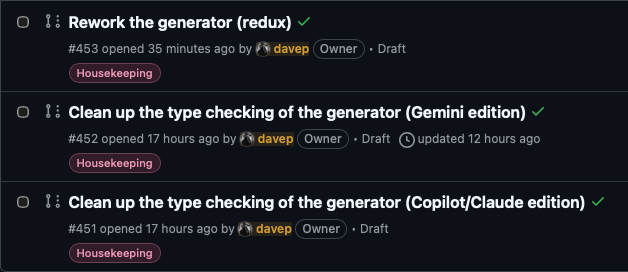
I then set it off working and left it to get on with things. Overall I think it took around an hour, with the need for me to approve things now and again (so probably could have been faster, I wasn't there to answer right away every time), but it got there in the end. This has resulted in a third PR to clean up the generator typing issues. In doing so I feel I've also addressed most of the unease I was feeling yesterday evening, and might actually have got closer to where I'd rather the code was.
Glancing over the result, I can still see things I'd want cleaned up, and done in a slightly different way, but overall I have a better feeling about this third approach. I sense this is a better place to move on from.
So that's three PRs I have lined up to address the code smell that's been bugging me for a couple of days. One fixes it with an ABC; one fixes it with a protocol; and now one fixes it by reworking the submodularisation of the generator to use a different approach entirely. On the one hand, this seems like a lot of work and a lot of faff (and, as I said yesterday, I wouldn't start here to get where I want to be), but on the other hand I do kind of understand the appeal of being able to get hours of work done in a relatively short period of time, so you can experiment with the results.
Would I recommend someone work this way? No, of course not. Does it make for an interesting side-quest when I'm in "it is still my hobby too" mode? Yeah, it does.
The tidying of the BlogMore source carries on; sometimes by hand, but also sometimes by using either Copilot/Claude or Gemini to decide how best to nudge the codebase in a desired direction. When I do the latter, if I like the suggestions the agents make, but it looks like a bunch of work and I can't be faffed with all that typing, I get them to do the work; otherwise, I'll do it myself.
I am, however, seeing lots of evidence of what I expected to happen, and anticipated happening: to get to where I would like the code to be, I wouldn't have started here.
I'll stress again, for anyone who hasn't been following along, for anyone who might have landed into the middle of this long thread of AI experimenting, that this was the point and purpose. I wanted to use this tool to build something relatively inconsequential, and which I could likely build myself given the time and the inclination, and also something I would actively use.
So where am I at? My main distaste at the moment is the core generation code. Just a few days ago this was a couple of thousand lines of repetitive code that did the job, but which was a bit messy. There's no question that I would not have written it anything like this. Because of this I've been on a push to try and break it up and tidy it up. While doing this I've been playing Copilot/Claude and Gemini off against each other, to see who does what.
As of the time of writing, the generator is split up, but in a way I wouldn't have done myself either. It's pretty much half a dozen mixin classes in a trench coat, all pretending to be one cohesive class. I feel that's a reasonable solution given where I started, but honestly I wouldn't have started there had I been coding this by hand.
Right at the moment I'm working out the best way forward to tidy up an outcome of this approach that I really don't like. The generator code is littered with lots of # type: ignore[attr-defined] to keep mypy happy, because that's what Claude did when it built all those little mixins. To borrow from the explanation in AGENTS.md, the current makeup looks like this:
The issue is (for example) that MinifyMixin defines a method _write_html. Meanwhile OptionalPagesMixin and ListingMixin and so on make use of self._write_html. But because there's no direct connection between those two classes and MinifyMixin, mypy complains that _write_html isn't defined. Of course, it isn't defined, because it only becomes available when all those classes climb into the SiteGenerator trench coat and pretend to be a real class.
The ignore direction solves the problem, but it's ugly and it's cheating.
So I then set the two different agents on the path of proposing a solution to this. Both were quite different. Claude (via Copilot) decided that an abstract base class was the solution. Gemini decided that a protocol was the solution. I think I'm siding with Gemini on this one because this is a provides/needs problem, not a "kind of" problem. Even then though, while I sense Gemini has the right approach, I'm not always happy with its implementation of it1, and once again: it's a cleanup of something I'd sooner not be cleaning up in the first place.
So here's the thing, and this harks back to wondering if the code is that bad: it isn't... but it's also generating work if you look at the code and decide that you want it clean and maintainable.
To get to where I want to go, I wouldn't start from here.
I get why I'm seeing the odd report here and there of people abandoning their code bases, or deciding to rebuild them from scratch by hand. Part of me wants to start a fresh branch, remove almost everything, and rewrite the code so it has feature-parity but in a way where I feel the code is tidy and elegant.
While I'm messing around in the background of BlogMore, looking at the state of the code and looking for opportunities to clean it up, either by hand, or by pitting agent against agent, I've also been doing the odd little fix here and there.
I've just released BlogMore v2.19.0, which has a couple of fixes, and also a small improvement.
The first fix is something I noticed late on last week when I was sharing one of the archive pages from my blog with someone. I noticed that the preview that appeared didn't have the default blog image, nor did it have any sort of description. This should happen in that, on any page that isn't a post with a specific cover image or description, it should fall back to the blog's defaults. Turns out this logic was missing from things like the date-based archives, the category and tag archives, and a number of other parts of the generated output.
The second fix is to the recently-added backlinks feature. While reviewing the effect of something else I was working on, I specifically noticed that this post didn't have a backlink section at the bottom, despite the fact that it was linked to from this post. The cause seemed pretty clear: the fact that I had parentheses in the URL. My guess was that the regex that the link-finding code uses wasn't taking this sort of thing into account; my guess was right.
The final change in this release is that the per-build cache-busting feature has been extended to all the JavaScript files that are generated when building the site. Before it was mostly only applied to the main stylesheets and a couple of long-standing bits of JavaScript. Now it's added to the code that's used for search, the code-block support code, the graph, etc. This means that if there are any changes in those files between builds and deployments of a site, there's less chance of unexpected behaviour that needs a "clear the cache first" fix.