I woke up this morning to find that EE had sent me an email at around 00:30 last night.
We're sorry we didn't stick to our appointment or give you 24 hours' notice that we couldn't make it.
We've added a £32.31 credit to your next bill to try and make up for it.
You don't need to do anything, we'll add it automatically.
If you have any questions, please visit our help page.
And then at 08:17 this morning, I got an SMS:
Hi from EE.
We're sorry for not sticking to our appointment or giving you 24 hours' notice that we couldn't make it. We've added a credit of 32.31 GBP to your next bill. You don't need to do anything, but please go to ee.co.uk/go/compensation if you have any questions. Thanks.
Which is kind of weird, because I remember someone turning up yesterday, and my broadband speed is now 935/107 Mbps at the router (vs. the 35/2.7 it was at the start of yesterday). Perhaps it's their way of saying sorry for the failure to deliver the other day? Who can tell though, it doesn't actually say when and why.
We came to see if we can connect your property to our Full Fibre network yesterday.
The good news is we can, but the engineer found that the existing network connection point wasn't suitable for private land's underground connection, so we need to plan a new way to bring the fibre cable to your home, which may also require a specialist engineer for a flat roof connection.
We're really sorry for the delay, but we're on it and will update you again in the next 10 days (we're usually much quicker).
We promise Full Fibre's worth the wait. It's the UK's most reliable broadband technology.
The flat roof thing was... interesting, but okay, I'm sure they know what they're doing and that it's some automated system with a restricted set of outcomes.
Skip forward one day and I get an SMS out of the blue:
Hi, it's Openreach on behalf of EE/BT.
Sorry we missed you.
Book a new date for your Full Fibre installation here: [removed]
The "Sorry we missed you" was very odd. They didn't miss me. I saw them two days earlier. But, again, okay... I followed the link and it also seemed to be written as if one of us had missed an appointment and I needed to pick another day. Anyway, I ignored what it said and just used the date picker to pick the next available day (which was today: as in the day I'm writing this).
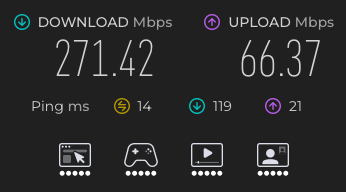
Fast forward to today and there's a knock on the door at around 08:30. Around two hours later, and this is what I was seeing:
To be clear: this isn't the actual speed of the connection. This was a quick test from my Mac, in my office, via the Wi-Fi connection. I don't currently have a Mac or PC wired into the router so can't measure the full speed. Testing on the router itself, it's much closer to 943Mbps/100Mbps. But, yeah, I'm good. I finally have full fibre again!
There was an immediate downside though. Once it was all set up, with the new router (which I swapped to as it has Wi-Fi 6, so why not?), I noticed that the ping times between my Macs were all over the place; this was also noticeable in that the ssh connections were so jittery to the point of being almost unusable.
Bugger.
So I did a bunch of digging online and, without getting too deeply into it (because I'm not a networking guy): the problem is AirDrop/Sidecar. They don't play well with a Wi-Fi 6 connection, so do stuff in the background that causes your ping times to be all over the place.
The solution? Turn this off for the Wi-Fi connection on the affected Macs:
I can't find anything that suggests I'm going to regret doing this for the couple of Macs in my office, and for my MacBook Air, and having done it, the performance is fine again.
This is why I avoid anything to do with networking: it always seems like if you improve one thing, it degrades some other thing, and it's only ever fixed by remembering to tweak some reasonably obscure setting somewhere on some particular item of hardware.
I knewit was too good to be true. While a little bit of me hoped it was going to happen this time, mostly I was expecting it to not happen.
It didn't happen.
Today was the day when Openreach were supposed to turn up again and deliver me a full fibre connection. The engineer was booked to turn up some time between 08:00 and 13:00 (as before). I was ready at 08:00. I was ready before 08:00 if I'm honest.
By 12:00 there was no sign of them. Despite there being an hour left to go, I'd written them off as a no-show again. I was wrong this time though. There was a knock on the door about 10 minutes later.
The engineer introduced himself, said he needed to go for a walk around first to get a feel for how and where the work needed to happen, and to figure out where the fibre was to come from (I kind of feel like this would be the sort of thing they'd know up front, but it's not my job and I trust them to know it).
Another 5 minutes and he's back... to tell me they can't do the job because the pole the fibre needs to come from is too far away. O_o
Now, I'm not going to get annoyed at this chap; presumably someone should have done some sort of site survey beforehand. Presumably this was the sort of thing that should have happened before the previous attempt to deliver the product?
So now I'm still without fibre, but with part of the job done. He installed the wee box that goes inside the house, and also the wee box that goes on the outside of the house. Of course, he drilled a hole and hooked them both up. So now I'm down an electrical socket, but have gained a box with a little red light that tells me I don't have full fibre.
He left assuring me that, having done this, it ensures that the actual delivery of the cable is turned into a priority. I can't say I'm that convinced, having sort of been here before. Some time later I got this text message:
We're sorry we couldn't get you connected today. The job is a bit more complex than usual.
We are going to get it sorted though and promise Full Fibre's worth the wait. We'll be back in touch in the next few days.
Again, I'm not convinced, having sort of been here before.
If I was a little more cynical and a little more prone to seeing a conspiracy where there was just a cock-up, I'd almost be tempted to entertain the idea that they turned up and fitted the box knowing full well that there was no fibre to be hooked up. Doing half a job is starting the job, after all. Presumably on some sheet somewhere that looks better than failing to do the job a second time.
I'm going to give them a couple of days to get back to me, as per the message, and then I think it's time to chase up EE and ask why, once again, they've failed to deliver me a product they promised me was available.
So after the screw-up by Openreach and EE, where I was promised full fibre and then it never happened, I'd assumed that nothing was going to happen for quite some time. I was told that (likely) Openreach would contact me when they'd solved whatever the problem was, but I wasn't holding out much hope that it would be a swift turnaround.
Yesterday, however, I got an email from EE claiming that full fibre was available at my address. While sceptical about this, assuming it was just some marketing nonsense that wasn't paying attention to the details of where I live, I called them to check. I explained the problem, I had them read the notes on my account, I had them acknowledge all that had happened and they reassured me that, for real, no kidding, no nonsense, this was all gonna happen this time.
So... watch this space. I already have an installation date (it's next month) just from the order-planning call -- something which didn't happen the last time. Within the next few weeks, I will either finally be returning to streaming, and enjoying all the other benefits of full fibre, or I'll be writing yet another post about how EE and Openreach messed up.
It looks like some of those friendships have lasted a while.
Some saw the opportunity to create content out of the situation.
Some have figured out that the thing that costs money, costs money.
Someone used up half their monthly allowance on just 8 requests.
Although, of course, there's always someone who has to do it better.
To be fair though, at least one person loves the new system.
As for my subscription, which came about after I initially experimented with free access to the tool, I've not actually cancelled yet, but I can't see me making use of it much more. I might try a couple of prompts with it, along the lines of what I was doing while working on BlogMore, just to get a feel for how different the usage is now.
Meanwhile, though, I've found that I'm getting on a lot better with Antigravity and getting the bits done I want to do. I suspect this is how I'll keep tinkering with BlogMore, until Google come to their senses anyway.
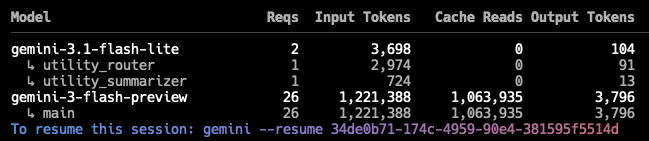
As I've written about a few times in the last week or so, the journey with AI-based coding tools has hit an interesting time when it comes to prices, quotas, usage, availability and all that. Having come into all of this via a place where it was a flat fee, and where I didn't really need to think about input tokens and output tokens and so on, I'm pretty ignorant of what that all means in terms of scale. If I'm looking at a new tool and I see prices and/or quotas for in/out tokens, it means nothing to me. I can't relate to it. I've never had to care about it.
Seeing that got me thinking: is there a way to get the total usage for all of my sessions, or at least the sessions that have still been retained (I'm guessing they expire after a wee while)? After a little bit of searching I found ccusage. That looked exactly like the sort of thing I was after.
Now, this is only going to be good for Gemini (it says it supports Copilot too, but it seems to be failing to find any Copilot sessions), but it should give me a feel for what my token usage looks like.
I work on BlogMore on two different machines: the MacBook Air and also a Mac Mini I have in my office. Here's all of the available token usage data I can get out of the Air:
Date
Input
Output
Cache Read
Total Tokens
Cost (USD)
2026-04-29
235,238
20,282
773,642
1,032,608
$0.23
2026-05-01
315,001
3,181
447,556
768,532
$0.20
2026-05-02
2,621,628
52,290
18,260,597
20,955,447
$2.44
2026-05-03
3,627,846
30,538
11,819,279
15,509,213
$5.74
2026-05-04
869,829
49,163
2,721,074
3,656,649
$0.77
2026-05-09
2,287,760
50,081
9,973,764
12,327,819
$1.84
2026-05-10
1,019,550
34,556
8,061,897
9,125,838
$1.05
2026-05-11
1,112,123
35,610
10,523,348
11,689,576
$1.24
2026-05-13
1,506,513
41,802
7,561,168
9,124,651
$2.88
2026-05-15
123,161
3,155
587,248
716,813
$0.11
2026-05-16
111,334
14,836
519,161
646,275
$0.13
2026-05-17
940,485
36,171
7,682,314
8,706,034
$1.41
2026-05-18
67,033
1,357
205,921
275,707
$0.05
2026-05-21
60,904
1,182
119,055
184,117
$0.05
Total
14,898,405
374,204
79,256,024
94,719,279
$18.13
And also the same for the Mac Mini (which gets used less frequently for this sort of thing):
Date
Input
Output
Cache Read
Total Tokens
Cost (USD)
2026-05-04
212,178
31,631
2,128,074
2,389,927
$0.36
2026-05-05
1,108,903
31,997
6,222,868
7,374,732
$1.13
2026-05-08
30,899
1,194
64,074
98,146
$0.03
2026-05-11
1,339,333
27,399
8,074,904
9,459,253
$1.21
2026-05-12
952,057
53,023
12,751,539
13,838,943
$1.52
2026-05-18
166,875
4,774
651,417
827,746
$0.22
2026-05-19
449,087
23,976
3,236,324
3,721,558
$0.54
2026-05-22
335,151
10,012
1,919,815
2,272,553
$0.32
Total
4,594,483
184,006
35,049,015
39,982,858
$5.33
In both cases I've removed a couple of columns to make the tables fit better. The first was the model name (varying between gemini-3-flash-preview and gemini-3.1-pro-preview), the second was Cache Create (which was always 0 all the way down).
From what I can see, it would appear that these two tables do cover my increasing use of Gemini CLI for doing work on BlogMore (the first intensive use being back around the 5th of this month, if I recall correctly). So this would seem to be a reasonably informative way to view things.
All of which is to say, over a roughly three week period, while getting things done, I've used getting on for 20,000,000 input tokens, and around 600,000 output tokens (presumably I do also need to be keeping the 114,300,000 cache read tokens in mind too). With this in mind I might now be able to make more sense of the pricing I see for various tools.
Now that we're near the end of the free or cheap GitHub Copilot party, I thought it might be interesting to look at how much BlogMore has "cost" me to build, and what it would have cost under the proposed new pricing structure that is coming in next month. While I've looked at the comparison for last month, I've not looked at the whole period I've been seriously using it.
So, for this review, I'm looking at all the data I can pull out of GitHub for the months of February, March, April and May of this year. Development of BlogMore started back in February and, while it hasn't been 100% the cause of my use of Copilot premium requests, it's been almost all of it. For the purposes of this review I'm just going to take the approach that all I worked on was BlogMore.
Remember that, even when I had free access, I had a maximum of 300 premium requests per month. Once I lost free access I had the same number of requests for $10 a month.
Here's how those months broke down:
Month
Paid
Premium Requests
%age
Predicted Price
February
$0.00
249
83%
$21.67
March
$10.00
140
47%
$56.38
April
$10.00
132
44%
$53.77
May
$10.00
34
11%
$53.69
Total:
$30.00
555
46%
$185.51
So, give or take, something that I've actually spent $30.00 on could have, at best, cost me $185.51. That's assuming that the "cost" of the models I was using stays the same. You can see that the costs have risen already in that the predicted price from February, where I used 83% of my premium requests, is a touch under half the cost for this month, where I've used just 11%. From what I can see in the raw data, it's down to some models suddenly being considered more expensive (perhaps I was doing something that just consumed more tokens, I'm not 100% sure if I'm honest, but I don't recall anything that seemed like harder work).
Who knows what the real costs will be come June.
Now, technically, the actual cost under the new regime could or should be $156, because it would be 4 lots of the $39.00/month plan, which would better cover that use1. Again though, that's assuming the actual cost of using whatever models remains pretty stable. It also assumes that I'd want to spend that much each month, and that I would be correctly anticipating that I'd need that much.
Also, this isn't even the total cost of getting this project done. As I've written recently: I've been using Gemini CLI more this month, and while the usage there is a flat cost, until now, that's changing too.
Now, of course, these aren't the only games in town. I could "go to the source" and just get a sub for Claude Code or something, and as Tim pointed out over in the Fediverse, something like Cursor does a lot of this and is just $20/month. Which all sounds fine, but what happens when those fleeing GitHub Copilot or Gemini CLI/Antigravity head over to something like Cursor? Is it sensible to expect the pricing to stay the same2?
I guess, at this point, I'm just mulling over the same issue time and again, but from different angles. It does seem clear to me, though, that in less than 4 months, in my experiment of "what happens if I use agents to develop a Free Software tool I want?", the market has gone from being entirely reasonable to pretty much unjustifiable from a price point of view.
The recent changes to pricing and usage, in relation to AI, aren't just about agents and coding. Not only have I seen GitHub Copilot and Gemini CLI hugely restrict their offerings for the same price, it's also come to at least one "general" tool I use too.
For a while now, as part of a Google One subscription I keep, I've had a Gemini AI Pro subscription. I've generally found this useful, mainly using the Gemini app on my iPhone to research things1, and also commonly using the web application to help proofread blog posts, and sometimes explore coding problems. Another way I use it is via NotebookLM. The subscription has meant that I can do all of this without ever having to worry about hitting any usage limits. While I'm sure they were there, I was never aware of them and never hit them.
Gemini will move to compute-based usage limits that will refresh every 5 hours until you reach your weekly limit. Calculation of your usage will factor in the complexity of your prompt, the features you use, and the length of your chat. Paid users have higher limits than users without a Google AI subscription.
The thing that bothers me about this -- and I've seen this with other companies in this market too -- is just how vague the wording is. Look at this table that is supposed to inform you about your usage limits, depending on your plan:
Plan
Limit
Without a plan
Standard limits
AI Plus
2x higher than standard limits
AI Pro
4x higher than standard limits
AI Ultra
5x or 20x higher than AI Pro depending on your subscription
Okay, great, thanks to my Pro plan I get 4x the limits. Awesome. But... 4x what exactly? What exactly are the standard limits? How do I assess which plan is better for me? How do I compare Google's product against another offering?
I suspect, for the most part, I'll be fine where I am. So far today I've used Gemini to proofread the previous post I wrote, there was a bit of back and forth as I edited my post, and that cost me 1% of my five hour window.
What impact that has on my weekly usage, I don't know, but based on this it would appear to be almost nothing.
I can appreciate that it's been a bit of a free party for a while, and now each provider has to start to have this cost them less -- if not actually make them money -- before the whole thing collapses. Fair enough. But it's annoying as hell to not be able to gauge what I'm actually getting, or easily compare products.
That's not to say that I know how this can be communicated well. There's a flip-side to all of this. If I go and look at the Anthropic website and their detailed pricing information it seems to take it to the other extreme. There's so much you need to know and understand, and you'd need to know so much about how their models work and how your needs would interact with them... it feels like you need specialised training to comprehend any of it. While I can't find it back at the moment, I seem to remember a similar issue with trying to follow such information with GitHub Copilot.
If it doesn't exist already, I suspect there's a market here for a site that makes it incredibly simple to plug in your requirements and have a product recommendation be made.
In the past six months I've found it's generally a far better method of finding things than simply using a search engine; no ads, cited sources, results that are easy to revisit, etc. ↩
Well, it's here: GitHub's tool to let you see how much better off you're going to be under the new Copilot billing system that comes in next month. It's... something.
But let's set the background first. I'm here (in Copilot usage space) as an observer, spending time on an experiment that started with the free pro tier and then transitioned into the "okay, I'll play along for $10 a month, the tool I'm building is fun to work on and is useful to me" phase. I doubted it would last forever -- the price was obviously too good to be true for too long -- but I wasn't expecting it to collapse quite so soon and in quite such a spectacular way.
When GitHub announced the move to usage-based billing I was curious to see if I'd be better off or worse off. It was hard to call really. My use of Copilot is sporadic, and as BlogMore has started to settle down and reach a state approaching feature-saturation the need to do heavy work on it has reduced. I did use it a fair bit last month, but that was more in tinkering and experimenting mode rather than full development mode1, so it's probably a good measure.
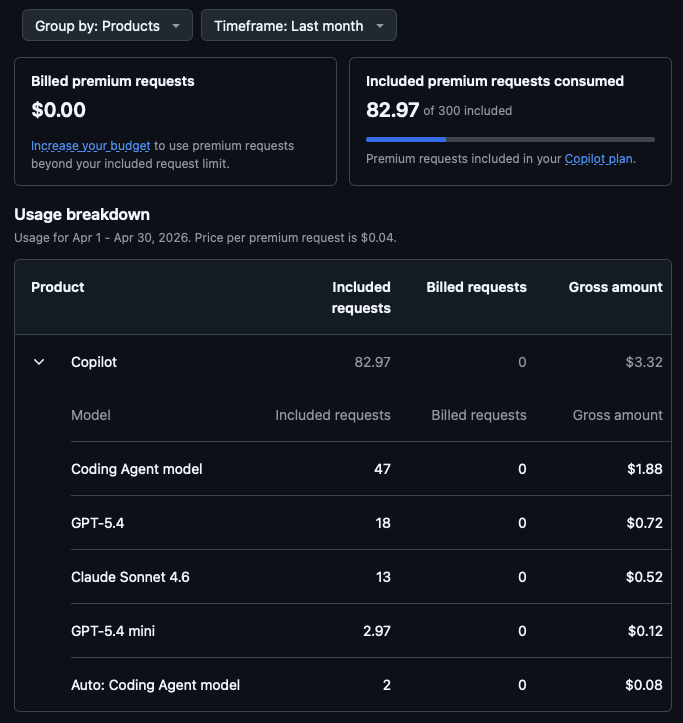
Checking the details on GitHub, it looks like I used a touch under 1/3 of my premium requests.
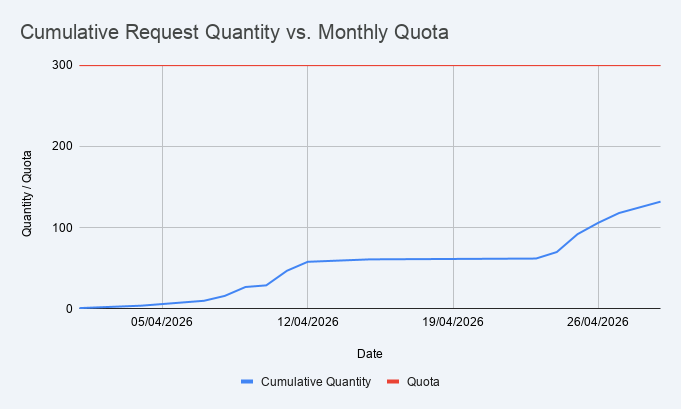
It also looks like the usage came in a couple of bursts lasting a few days, with a pretty flat period in the middle of the month.
So, technically, GitHub won. I paid them $10 for 300 premium requests, I left a touch over 2/3 unused. I think it's fair to suggest that I'm a pretty lightweight user, even when I have a project under active development.
This is where the new usage-based preview tool comes in. Launched yesterday, it lets you take your existing usage stats and see how much it would have really cost you.
The app itself comes over as being hastily spat out with an agent and little communication between responsible teams. You'd think you just press a button when viewing some historical usage figures and get a display that shows you what it would cost under the new approach.
You'd think.
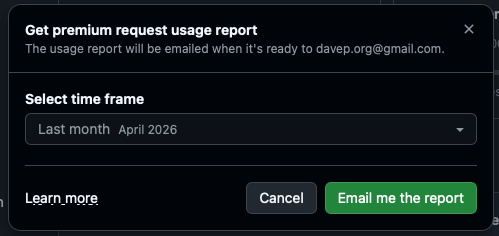
Nope. First you generate your report for a particular month. Then have to ask for it to be emailed to you as a CSV!
Even that part isn't super reliable. When I tried it last night it took a wee while to turn up, and that was after about 10 attempts where I got an error message saying it couldn't generate the report. This morning I tried again and I've yet to see the email, 30 minutes later2.
Having done that you click through to another page/app where you have to upload the CSV, to GitHub, that GitHub just sent you in an email. Brilliant. It then gives you the good news.
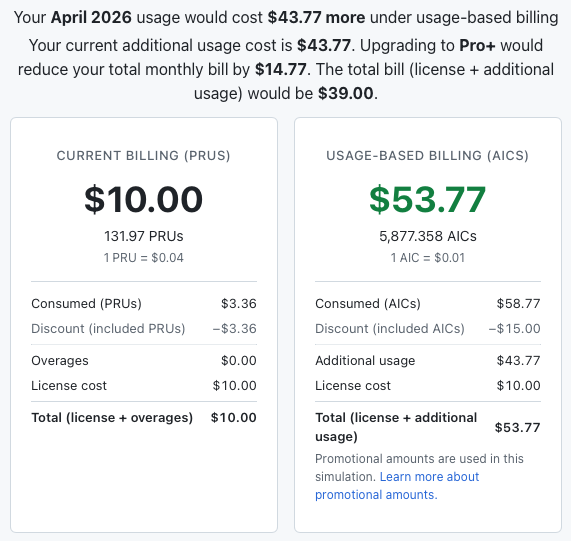
So what is my 1/3 use of the premium request allowance going to save me under the new approach to billing?
Amazing. I especially like the part where they spin it as: if I spent $39/month with them I would save money!
Watching this journey has been wild. The free Pro as a taster to get me onto $10/month I can go with, that's fair enough. For the longest time I never even paid it any attention. But watching GitHub give it to so many people, and especially so many students, and then watching them do shocked Pikachu when it cost them an arm and a leg and probably caused the degradation of the performance of their systems... who could possibly have seen this coming? Impossible to predict.
Back when I first wrote about my initial impressions of working with Copilot I wondered in the conclusion if I'd transition to a paying version of Copilot. I obviously did. At $10/month it was a very affordable tinker toy that gave me a new dimension to the hobby side of my love of creating things with code. But the prospect of paying $39/month for something in the region of 1/3 of requests that I had before: nah, I'm not into that.
It looks like this month will be the last month I keep a Copilot subscription. BlogMore will carry on being developed, I'll probably transition to leaning on Gemini CLI more (as I have been the last week anyway), and also start to get my hands dirty with the code more too.
This feels like one of the early signs of the bait and switch that the AI suppliers have been building up all along. Experimenting and better understanding how and why people use these tools has been seriously useful, and I can't help but feel that I accidentally started at just the right moment. Watching this happen, with actual experience of what's going on, is very educational. It's going to be super interesting to see if this same stunt gets pulled on a bigger scale, with all the companies that uncritically embraced AI at every level of their organisation.
It's going to be especially interesting to watch the AI leaders in those companies to see how they spin this, if and when the real costs are more widely applied.
Is my recollection. I should probably review the ChangeLog and see what I actually did add in April. ↩