I've given blogmore.el a wee bump to v2.1. This release fixes a small problem I noticed today when I tried to use it to edit the tags for a post on my photoblog: the code to find and gather properties from posts didn't handle deeply-nested directory hierarchies for the post markdown files. I should have noticed this when I first wrote the code, but of course I was so busy testing against my primary blog, which only goes one sub-level deep, that I never noticed it wasn't going to work deeper.
So rather than using grep to look for things like foo/**/*.md I swapped to a combination of find and grep. Which works, but is slightly (but noticeably) slower.
Then I got to thinking that if I was doing this by hand, on the command line, I'd be using ripgrep anyway. Given this I might as well use it here. Of course, not everyone who might use blogmore.el will have rg installed so it makes sense to look for that and use it if it's available, otherwise fall back on find/grep.
There's still some low-priority cleaning up I want to do around this; an obvious change I want to make being one where I want to collapse all cases of the same word (Tree vs tree, etc) into one "hit"1. For now though, as always, it's working well enough for my needs and this change fixed an obvious issue I ran into.
BlogMore itself takes care of this, but it would be nice to have the prompt in blogmore.el also take this into account. ↩
After kicking off blogmore.el, and then tinkering with it more and more, I've found it really quite helpful while writing posts. One thing I have noticed though -- given I use BlogMore for this blog and my photoblog -- is that I wanted to be able to use the package for working with more than one blog.
So today I found myself with some time to kill and the result is that blogmore.el v2.0 has now been released. This version allows for setting up multiple blogs, each with their own settings for where posts live, how their paths are formatted, and so on.
To handle this I've also added the blogmore-work-on command so that the active blog can be quickly changed.
All of this can be configured using Emacs' customize feature.
This has all changed since v1.x, where most of the customize options have now been renamed to include -default- in their name. The idea here is that what was the value for a setting previously is now the default value if a given blog hasn't had that setting defined.
For any given blog you wish to work with, you configure a name (for your own reference) and the path to the posts. Optionally you can also set lots of other values too.
If a value is left on Default, then the corresponding default setting will be used; if it's set, then that value is used for that specific blog.
The defaults out of the box match how I do things with my blogs, of course, so the configuration is pretty straightforward. As of the time of writing my use-package for blogmore.el looks like this:
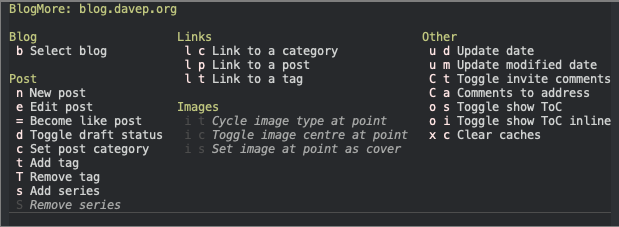
(use-packageblogmore:vc(:url"https://github.com/davep/blogmore.el":rev:newest):init(add-hook'blogmore-new-post-hook#'end-it):custom(blogmore-blogs'(("blog.davep.org""~/write/davep.github.com/content/posts/")("seen-by.davep.dev""~/write/seen-by/content/posts/"))):bind("<f12> m b".blogmore-work-on)("<f12> m p n".blogmore-new)("<f12> m p e".blogmore-edit)("<f12> m s c".blogmore-set-category)("<f12> m a t".blogmore-add-tag)("<f12> m u d".blogmore-update-date)("<f12> m u m".blogmore-update-modified)("<f12> m l p".blogmore-link-post)("<f12> m l c".blogmore-link-category)("<f12> m l t".blogmore-link-tag))
In the above you can see that I've set only the blog title and posts path for each blog in blogmore-blogs; the remaining values are all implied nil and so will be defaulted. The full list of values for any given blog are:
BLOG-NAME is the descriptive name to use for the blog.
POSTS-DIRECTORY is the directory where the blog's posts are stored.
POST-TEMPLATE is a template for new posts. If nil, blogmore-default-template is used.
POST-MAKER-FUNCTION is a function that takes a filename and returns a string to be used in the post's URL. If nil, blogmore-default-post-maker-function is used.
CATEGORY-MAKER-FUNCTION is a function that takes a category name and returns a string to be used in the category's URL. If nil, blogmore-default-category-maker-function is used.
TAG-MAKER-FUNCTION is a function that takes a tag name and returns a string to be used in the tag's URL. If nil, blogmore-default-tag-maker-function is used.
POST-LINK-FORMAT is a format string for the post's URL, where %s is replaced with the value returned by the post maker function. If nil, blogmore-default-post-link-format is used.
CATEGORY-LINK-FORMAT is a format string for the category's URL, where %s is replaced with the value returned by the category maker function. If nil, blogmore-default-category-link-format is used.
TAG-LINK-FORMAT is a format string for the tag's URL, where %s is replaced with the value returned by the tag maker function. If nil, blogmore-default-tag-link-format is used.
While I very much doubt any of this is useful to anyone else, it's at least flexible for my purposes and can probably be configured to someone else's purpose should they happen to be using BlogMore and Emacs.
See, when BlogMore makes a post, if the author of the post hasn't provided a description in the frontmatter, the first paragraph of text will be used instead. When doing this the code should strip out any markup (and also skip any initial images, that sort of thing).
But, as you can see, there are things like [Dave][davep] in that description. So I checked in with Andy and that was something that came from the underlying Markdown. After a bit of checking, it became obvious that the code in BlogMore was only looking for and removing inline links, but wasn't doing anything about reference links.
As it stands, I don't think I'll keep up with the current approach. It doesn't feel quite right to me. The whole point is that the Markdown should be rendered down to pure text and then the first actual paragraph of text is used. The code I have there now is doing some regexp-based mucking about as an approximate approach. It works, more or less, but it feels like it's implementing a poor Markdown parser when there's a Markdown parser already built in.
Given this, at some point soon, I might have a play and look at the idea of "let's have a Markdown to pure text parser" and then use that. I could see it being useful for other purposes too.
Anyway, the upshot of all of this is that BlogMore v2.6.0 is now available and it handles the stripping of reference links from the description, plus the recently-added strikethrough markup too.
I guess it was inevitable1, but yesterday GitHub announced a new opt-out approach to learning from people's interactions with Copilot. I don't have anything novel or insightful to say on this switch, and I'm sure folk with better-informed opinions have already rushed out posts and articles about this, but I did want to jot down just how curious I am to see this roll out.
For starters: for me this feels like one of those things that will get a lot of backlash, and in a day or so GitHub will say they're pausing rolling this out while they reevaluate this approach2. Then, eventually, they roll it out anyway after a "period of consultation with the community". That sort of thing.
I've not read further this morning, but before going to bed last night it wasn't a happy time in the comments section of the FAQ. I can also see why some would be cynical about this change, given the tone of some of the questions and answers in that FAQ. I'll hand it to them: they're pretty candid and honest with the FAQs, but kinda yikes too.
Here's the key thing I'm curious about, and which I'll be thinking about and watching for movement on in the next few days: all the talk here seems to be about protecting the privacy of the proprietary code of businesses3. That... is understandable, from a business point of view, from a commercial adoption point of view, from a "we want all software engineering departments to use Copilot" point of view. But how the heck are they really going to manage that?
We do not train on the contents from any paid organization’s repos, regardless of whether a user is working in that repo with a Copilot Free, Pro, or Pro+ subscription. If a user’s GitHub account is a member of or outside collaborator with a paid organization, we exclude their interaction data from model training.
This seems somewhat unclear to me. Let's walk this one through for a moment: my GitHub accountis a member of a "paid organisation". My account is also my account, for my personal code, I've had it a long time and it's filled with a lot of FOSS repos and I keep adding more. So which scenario is the right one here?
Because I'm currently a member of at least one "paid organisation" I'm always opted-out of this training no matter how the opt in/out setting is set and no matter what code I work on?
Because I'm currently a member of at least one "paid organisation" I can opt in when working on code that is from a repository which is mine, but I'm opted out when I'm working on code from a repository belonging to the paid organisation?
I think it reads like it's #1. But then that seems rather odd to me because, if I go and look at my settings right now, I can elect to opt in/out of this training system. If the correct reading is #1 why not just disable that setting altogether and say below it that I'm opted-out because I'm part of a paid organisation?
Which sort of suggests we should perhaps read it as #2? If that, that raises all sorts of questions. How would Copilot know I'm working on code from such a repository? Sure, it's not impossible to infer if I am working within the context of a given repository, doing some fun stuff to work out the origin and so on, but it feels messy. It also feels like a scenario that could end up being incredibly leaky. It really would not be difficult to run into a scenario where I'm working on some non-Free code but in an environment where the licence isn't clear, or where it appears that the licence4 would permit such training.
ℹ️ Note
Editing to add: there is even a comment where it is acknowledged that someone could be working in such a way that it's impossible to know the provenance of the code: "Copilot ... can even work when you are not connected to any repo."
Or... perhaps there's a #3, or a #4, or so on, that I've not even considered yet. The fact that software engineering departments suddenly have to start thinking about this issue (yes, I know, it's been a background issue for a while but this really drags it out into the open) is going to make for a few interesting weeks, assuming people care about where their code ends up.
Who knows. Perhaps, in some strange way, this is how all software ends up being Free.
And I think a bit of me is surprised that they weren't just doing it anyway. ↩
This isn't a prediction, I'm just saying it feels like that sort of announcement. ↩
It's not that simple, but to save getting into the deep detail... ↩
I'm using licence here as shorthand for a lot of things to consider relating to who should have access to the code and how. ↩
After adding the stats page to BlogMoreyesterday I realised that the main stylesheet was starting to get fairly large. Not so big that it was a problem for downloading (and of course normally it would get cached anyway), just more that it was carrying around styles for things that only appear on one page (the styles for the stats, for example).
This should keep the load times for the main pages and individual posts just a wee bit faster when first encountered, leaving off all those styles that aren't necessary.
Hike, my wee terminal-based Markdown viewer/browser, has had an update to v1.4.0. In this update I've made a change I've been meaning to make for ages: some support for "wiki links".
By that I mean the sort of link markup you often see in Markdown documents made with Obsidian:
In other words [[this]] instead of [this](kind-of-link.md)
Personally it's something I seldom need, but on the occasion I have been delving into my Obsidian vaults with Hike I've wished the links at least rendered "correctly", even if they wouldn't fully work.
On that note, it's worth keeping in mind that this "wiki link" implementation in Hike doesn't support something that Obsidian does: find the most likely target file for a given link. If you click such a link, Hike expects the file to be exactly where the link suggests. There's no going off and finding the most likely match in the "vault", etc (Hike obviously has no concept of a "vault").
I'm open to the idea of extending this at some point, perhaps, but not yet. The intention here isn't to build a terminal-based Obsidian-a-like, but instead to build and maintain a workable Markdown browser/viewer (and occasional editor).
Hike is licensed GPL-3.0 and available via GitHub and also via PyPI. If you have an environment that has pipx installed you should be able to get up and going with:
The first new feature, which came in as a request, is to add support for control over the themes used for code blocks, including independent control of the themes used for light and dark mode. With these you can specify any of the Pygments styles to use for code blocks. Personally, I prefer to have things blend in, but this now also gives you the chance to have them really contrast (use a light mode theme for dark-mode blog, or a dark mode theme for a light-mode blog).
Yes, the last time I mentioned blogmore.elit was v1.4 and now it's up to v1.7. So I tinkered a little with it last night, okay?
Anyway, the changes and additions keep happening as I have more fun writing some Elisp again. Since the last post about the package I've:
Added a command to refresh the date frontmatter property
Added a command to add/refresh the modified frontmatter property
Added a command to insert a link to a previous post into what I'm writing
Made a few things defcustom rather than defconst for easier tweaking
Added a hook that can be run after a new post is started
Dropped the dependency on end-it and used the above hook to do the same thing
While this package is never intended for use by others, I guess it's not impossible someone might want to work with it (I had the same thing in mind with BlogMore itself yet someone else has started working with it!) and so I'm moving it in the direction of being my way by default but easy to modify to other requirements.
So, now, rather than forcing someone to have to use my obsession with end-of-file markers, I still have that without imposing it on anyone else by simply setting the hook.
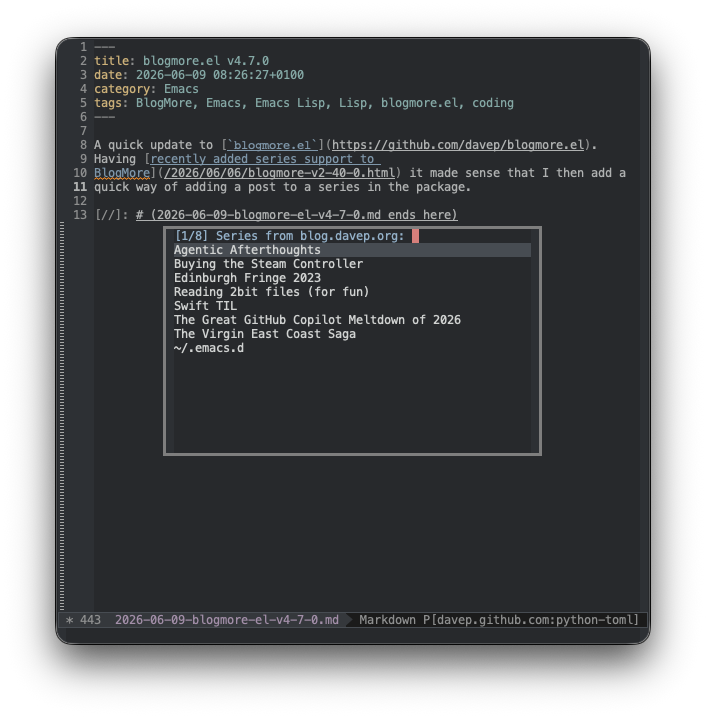
I think my favourite addition right now is blogmore-link-post. I like to cross-link posts in my blog as much as possible so having something that lets me do that and stay inside Emacs really speeds things up. So now I just run that command, I get speedy picker to find the post:
and the result is some Markdown inserted with the cursor between the two [] ready for me to write the text:
[](/2026/03/20/blogmore-el-v1-4.html)
Other things I link often are categories and tags, so I'm planning on adding commands that does something similar for those two.
Following on from yesterday's post, in the evening I found myself in a cafe with my MacBook Pro and an hour to kill, so I tinkered with blogmore.el a little more. The main aim here was to add a command for adding tags to a post and I now have blogmore-add-tag as of v1.4.
One thing that stood out was just how rusty my Emacs Lisp skills are. It took me a wee while to get the code working, mostly due to me being caught out by the gotchas I'd forgotten about surrounding match data and the need to make good use of save-match-data (I had a combination of re-search-forward, string-split and replace-match going on and it was chaos for a while).
I got there in the end, though, when I bothered to RTFM with a quick C-h f
string-split RET.
So now I have the following commands in Emacs when I get the urge to do something blog-related:
blogmore-new starts a new blog post
blogmore-edit lets me edit an existing post
blogmore-set-category lets me set the category from existing categories, or set a new one
blogmore-add-tag lets me add a tag from the existing tags, or add a new one
As suggested before, I think I'll probably add some other helper commands, things such as:
Update the date
Set the cover to a particular attachment
Insert a particular attachment as a Markdown image
Insert a link to another post in the blog
I'm sure more will come to me, but they seem like the most common operations I perform that would be helped with a little bit of Emacs Lisp magic.