I wasn't quite planning on making a new release of BlogMore so soon after the previous version, but I had a couple of ideas that I wanted to add, and then also got a nifty request too; so here we are: we have v2.23.0.
The first couple of changes relate to the cache. In the previous release I added a cache of the FontAwesome metadata, which in turn means that a cache directory is being created. I felt it would be fair and useful to provide a command that both lets the user know where the cache lives, and to also remove it. So now BlogMore has a cache command with two sub-commands:
location: tells you where the cache directory is located
clear: removes the cache directory
Also, now that we have a cache directory, it makes sense to use it a bit more to squeeze even more time out of the build process. So starting with this release, per content directory, the various icons that are created for the site are cached. This means that if the source image doesn't change, for each subsequent build there's no conversion and resize for every variation. This saves a good fraction of a second, making the build of my blog feel noticeably quicker.
Finally, earlier today, Andy asked if it would be possible to have the BlogMore serve mode auto-reload any page being viewed in a browser, when the site is regenerated. It was something I'd considered myself a couple of times so that was a good reason to finally look into it. Not knowing how this could be achieved1, I prompted Gemini for an idea, stressing I wanted a solution that didn't disturb a generated site; it came up with a convincing solution. I let it run at it and, along with a few changes of my own, it seems to be working a treat.
This, of course, now makes me want to squeeze even more time out of the build process.
Web development has never been my primary area of knowledge. ↩
While I've had some troubles with it -- as can be seen here, here and here for example -- I'm mostly having an okay time. The code it writes isn't too bad, and while it seems to need a little more direction and overseeing than I've been used to while using Copilot/Claude, it generally seems to arrive at sensible solutions for the problems I'm throwing at it1.
One difference with working with Copilot CLI that I have noticed, however, is that Gemini doesn't seem to care for cleaning up after itself. When faced with a problem it'll often write a test program or two, perhaps even create a subdirectory to hold some test data, run the tests and be sure about the outcome. This is good to see. It's not unusual for me to do this myself (or at least in the REPL anyway). But it really doesn't seem to care to actually clean up those tests. A handful of times now I've had it leave those files and directories kicking around. I've even said to it "please clean up your test files" and it's gone right ahead and done so, which suggests it "knows" what it did and what it should do.
This also feels like a new source of mess for all the people who commit their executables and the like to their repositories. That should be fun.
The thing I don't know or understand, at least at the moment, is if this is down to the CLI harness itself, or the choice of model, or a combination of both, or something else. I'm curious to know more.
There is a weird thing I'm seeing, which I want to try and properly capture at some point, where it'll start tinkering with unrelated code, I'll undo the change, it'll throw it back in the next go, I'll undo, rinse, repeat... ↩
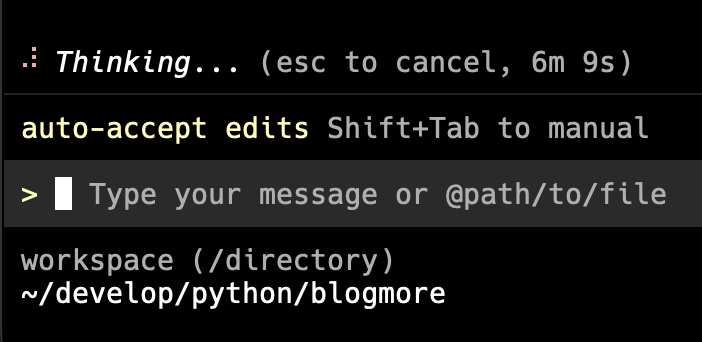
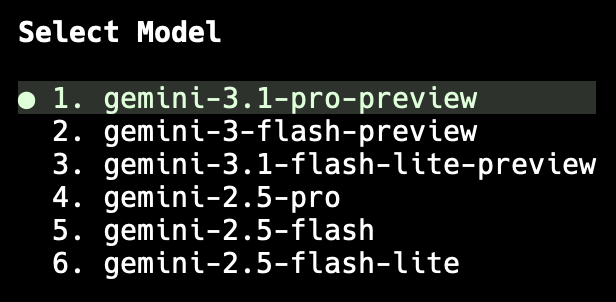
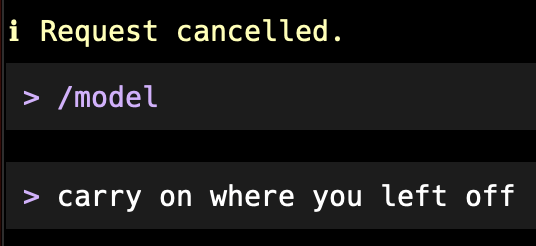
I was working on something new for BlogMore and, sure enough, after a wee while, we got stuck in "Thinking..." mode. So I hit Escape and asked to pick a different model. I chose to pick manually, and went with gemini-3.1-pro-preview.
I then literally asked that it carry on where it left off...
...and it did! It worked. No more sitting around thinking for ages.
Watching the quota after doing this, it looks like the model I was using ate quota faster, but that was worth it given I've never come close to hitting full quota with Gemini CLI.
Once the immediate job was done, I went back to auto and it worked for a bit, only to get stuck thinking again. I repeated this process and it did the trick a second time. From now on I'm going to use this approach.
It does, again, highlight how unreliable these tools are, but at least I've found a workaround that works for now.
As mentioned a couple of days ago, I've been toying with finding areas of improvement in respect to the performance of BlogMore. Until now, for good reasons, I've not really paid any attention to how fast (or slow) BlogMore is when it comes to generating my blog. While it's never been blindingly fast, it's always been fast enough and I was more keen on making it work right. So for a good while the focus has been on well-formed output, stuff that keeps the crawlers happy, that sort of thing.
But now that I'm in a place where new features aren't really so necessary, it does feel like a good point to find any easy wins in speeding up the code. I think it's gone well.
BlogMore v2.22.0 contains quite a few internal changes that speed up some core parts of site generation. Many of the things identified by Gemini, back when I first kicked this process off, have been done. The amount of Markdown->HTML conversion work has been vastly reduced, which has had a pretty big impact on all sorts of things. There's also caching of the FontAwesome metadata1 which should save a fair bit of time on slower connections. I did avoid the whole business of parallel processing as I dabbled with this near the start of the project and I could not wrangle a win out of that at all; given how much of a win I've had with these changes, I doubt that would change (it could conceivably make things worse).
So, how much faster is it? Roughly, based on my tests, a site generates in about 1/4 of the time it did before. On my M2 Mac Mini my blog builds in under 3 seconds; with v2.21.0 it took around 13 seconds. In my case that's with all the optional features of BlogMore turned on.
Naturally this work has touched on a lot of internals of the code, and made significant changes to the generation pipelines of lots of different pages and features. I've done my absolute best to compare2 the output of v2.21.0 and v2.22.0 and I can't see any significant differences3. When trying out v2.22.0 I would suggest paying just a little extra attention to the result, to be sure you're happy that nothing has changed.
It lives in ~/.cache/blogmore on Unix and Unix-like systems, or %LOCALAPPDATA%\blogmore\cache on DOS/VMS-influenced systems. ↩
Lots of diff -rq and then diffing an assorted sample of files that showed differences to inspect what was actually different. ↩
Actually, there's a small difference in the context shown in backlinks, but this was a deliberate change and a very small cosmetic enhancement. ↩
When I first tried it out, a week back, I found it worked fairly well but could be rather slow at times. On the whole though, I found it easy enough to work with; the results weren't too bad, even if it could throw out some mildly annoying code at times.
Yesterday evening though, because of the failure of Copilot, I decided to go just with Gemini and work on the problem of speeding up BlogMore. This worked really well. I found that it followed instructions well1 when given them, and also did a good job of applying what it was told, constantly, without needing to be told again. I actually found I had a bit of a flow going (in the minimal way that you can get any sort of flow going when you're not hand-coding).
Using it, I tackled all the main bottlenecks in BlogMore and got things working a lot faster (at this point it's generating a site in about 1/4 of the time it used to take). By the time that work was done, I wanted to do some last tidying up.
This was where it suddenly got unreliable. I asked it a simple question, not even tasking it with something to do, and it went into "Thinking..." mode and never came back out of it. I seem to remember I gave it 10 minutes and then cancelled the request.
After that I tried again with a different question, having quit the program and started it again with --resume. This time I asked it a different question and the same thing happened. I hit cancel again and then, a moment later, finally got an answer to the previous question.
From this point onwards I could barely ever get a reply out of it. I even tried quitting and starting up again without --resume, only for the same result.
A quick search turns up reports similar to this issue on Reddit, Google's support forums and on GitHub. It looks like I'm not alone in running into this.
This here is one of the things that concerns me about the idea of ever adopting agents as the primary tool for getting code written: the unreliability of their availability, and so the resulting inconsistency of the output. It feels like any perceived win in terms of getting the code written is going to be lost in the frustration of either waiting and trying again when it just gives up playing along, or in running from one agent to another, hoping you find the one that is capable of working with you at that given moment.
Meanwhile folk talk like it's the solution to the problem of software development. It's especially concerning when those folk are in "engineering leadership" or a position with a similar name. When they talk like this they are either displaying a lack of foresight, or betraying a lack of care for the craft they are supposed to represent (amongst other reasons).
It's very timely that this post from Rob Pike popped up in my feed this morning:
Although trained in physics, I worked in the computing industry with pride and purpose for over 40 years. And now I can do nothing but sit back and watch it destroy itself for no valid reason beyond hubris (if I'm being charitable).
Ineffable sadness watching something I once loved deliberately lose its soul.
Yup.
Albeit I sense it pays little to no attention to AGENTS.md↩
I seem to remember that, early on, I did have a bit of a play with trying to get Copilot to tackle the idea of parallel generation of parts of the site, but I didn't seem to get any sort of win out of it so I closed the PR and gave up on the idea.
Now though, especially having added the elapsed time of each step to the progress report during generation, I am curious about what wins there are. One that came to mind right away, and I have been considering dealing with for a wee while, is the fact that every generation downloads the FontAwesome metadata. Caching that would be a simple win, for example.
But, if I'm going to do this, it makes sense that I stick to the spirit of this project and get one or more agents to tackle the problem. So I asked Gemini CLI to look over the codebase and give me some big easy wins. I made clear I didn't want it to do any work yet, I just wanted it to report back what it could find.
The result made a lot of sense. Here's what it said:
Performance Optimization Recommendations for BlogMore
I have conducted a comprehensive review of the blogmore codebase and identified several areas where measurable and significant speedups can be achieved, particularly for larger sites.
The most significant bottleneck is in src/blogmore/backlinks.py. The build_backlink_map function iterates through every internal link in every post. For each link, it calls _extract_snippet, which re-parses the entire Markdown content of the source post to generate a plain-text snippet.
The Issue: If a post has 20 internal links, it is parsed 20 times just for backlinks.
The Win: Modify the logic to insert unique markers for all links in a post and perform a single Markdown-to-plain-text conversion per post.
The Post object in src/blogmore/parser.py has properties like description and reading_time that are accessed frequently (on the post page, index pages, RSS feeds, search index, etc.).
The Issue:Post.description calls extract_first_paragraph, and Post.reading_time calls calculate_reading_time. Both of these functions perform a full Markdown conversion every time they are called because they are not cached.
The Win: Use functools.cached_property on these fields. Additionally, these should be calculated by extracting text from the html_content that has already been generated during the initial parse, rather than re-parsing the raw Markdown.
The generator currently processes everything sequentially in a single thread.
The Issue: For a site with hundreds or thousands of posts, the initial Markdown parsing and the subsequent Jinja2 rendering are strictly serial, leaving multi-core CPUs mostly idle.
The Win: Use multiprocessing (e.g., ProcessPoolExecutor) to parallelize the parsing of Markdown files and the rendering of HTML pages. Since these tasks are CPU-bound and independent, this would scale almost linearly with the number of CPU cores.
Navigation Lookups: In PageGenerator.generate_post_page, the code uses all_posts.index(post) to find the current post's position for prev/next links. This is an O(N) operation called N times, leading to O(N^2) behavior. Pre-calculating a mapping would make this O(1).
Markdown Instance Reuse: Several utility functions (markdown_to_plain_text, extract_first_paragraph) create a fresh markdown.Markdown instance on every call. Reusing a single instance (and calling .reset()) or caching the instance creation would reduce overhead.
The "Big Wins" are definitely optimizing backlink snippet extraction and implementing parallel parsing/rendering. Together, these would likely reduce generation time for large sites by 60-80% on modern hardware.
At first glance they all seem pretty sensible, and I like that it seems to have found some really obvious big improvements, and also the little wins that might have a cumulative effect. I strongly suspect the parallel generation suggestion is again going to be a non-win (and so for now I'm going to pass on it), but most of the other suggestions seem doable and worth trying out.
I think what I will do, rather than work through them all in one PR, is tackle one at a time. So, over the next few days, expect to see some PRs turn up and get merged (hopefully), as I try and tease some speed wins out of the code.
After noticing a broken link in a post yesterday, I got to thinking that it would be useful to add a linter to BlogMore. So I've released v2.21.0 which adds linting support.
A number of things are checked and the results are broken down into things that are errors or warnings. Errors result from any of these checks:
Ensures all posts and pages have valid YAML frontmatter. If a file cannot be parsed, it is reported as an error.
Scans the generated HTML for links to non-existent internal paths (other posts, pages, categories, tags, archives, site features like search, or files in extras/).
Checks that all <img> sources resolve to valid internal paths or files in the extras/ directory.
Checks that the cover property in a post or page frontmatter points to a valid resource.
Verifies that all page slugs listed in sidebar_pages actually exist.
Checks that all internal-looking URLs in the links: and socials: configuration settings point to valid targets.
On the other hand, the following just result in a warning:
Flags if a post is missing a title, category, tags, or a date.
Reports if a post's date or modified date is set in the future.
Notes if a post's modified date is earlier than its original publication date.
Identifies if two or more posts share the exact same title.
Flags inline images missing an alt attribute, or those with an empty/whitespace-only alt attribute.
If clean_urls is enabled, warns if internal links point explicitly to index.html.
Reports internal links using the full site_url (e.g., https://example.com/path/) instead of a root-relative path (/path/).
I feel like all of these cover most of the things that are low-cost to detect but have a positive impact on the state of the content of a blog.
One thing I've not done is any sort of checking of external links. This would be costly and could possibly have unintended consequences that I don't want to be messing with (perhaps a tool to export the list of external links for checking could be useful, at some point).
Having run this against this blog, I did find some things that needed cleaning up, mostly absolute links that could be turned into root-relative links (always good for making the content portable).
At the moment I'm working on a linting command for BlogMore. Having given up on Copilot/Claude for this, I've been having quite a bit of success with Gemini CLI. But while doing this, I've noticed some odd things with it. It does have this habit of cargo-culting some changes, or just rewriting code that doesn't need it.
For example, the tests for the new linting tool: it keeps adding import
pytest near the top of the test file despite the fact that pytest doesn't get used anywhere in the code. Every time, I'll remove it, every time it adds more tests, it'll add it back.
Another thing I've noticed is it seems to be obsessed with adding indentation to empty lines. So, if you've got a line of code indented 8 spaces, then an empty line, then another line of code indented 8 spaces, it'll add 8 spaces on that empty line. That sort of thing annoys the hell out of me1.
But the worst thing I just ran into was this. It had written this bit of code:
deflint_site(site_config:SiteConfig)->int:"""Convenience function to run the linter. Args: site_config: The site configuration. Returns: 0 if no errors, 1 if errors were found. """linter=Linter(site_config)returnlinter.lint()
On the surface this seems fine: a function that hides just a little bit of detail while providing a simple function interface to a feature. But that use of a variable to essentially "discard" it the next line... nah. I dislike that sort of thing. The code can be just a little more elegant. So seeing this I edited it to be (removing the docstring for the purposes of this post):
I then had Gemini work on something else in the linting code. What did I see towards the end of the diff? This!
Sneaky little shit!
Now, sure, the idea is you review all changes before you run with them, but knowing that it's likely that any given change might rewrite parts of the code that aren't related to the problem at hand adds a lot more overhead, and I wonder how often people using these tools even bother.
I've seen some IDEs do that on purpose too; I've got Emacs configured to strip that out on save. ↩
#!/bin/sh# Check if the current directory is a Git repositoryif!gitrev-parse--is-inside-work-tree>/dev/null2>&1;thenecho"Error: This directory is not a Git repository."exit1fiREPO_NAME="$1"# If no repository name was provided, try to get it from the origin remoteif[-z"$REPO_NAME"];thenORIGIN_URL=$(gitremoteget-urlorigin2>/dev/null)if[-n"$ORIGIN_URL"];thenREPO_NAME=$(basename-s.git"$ORIGIN_URL")elseecho"Error: No repository name provided and no 'origin' remote found."echo"Usage: $0 <repo-name>"exit1fifiecho"Configuring multi-forge backup sync for: $REPO_NAME"# Set up the remote called backups. Anchor it to Codeberg.
gitremoteremovebackups>/dev/null2>&1
gitremoteaddbackups"ssh://git@codeberg.org/davep/${REPO_NAME}.git"# Set up the push URLs.
gitremoteset-url--pushbackups"ssh://git@codeberg.org/davep/${REPO_NAME}.git"
gitremoteset-url--add--pushbackups"git@gitlab.com:davep/${REPO_NAME}.git"# Only ever backup main.
gitconfigremote.backups.pushrefs/heads/main:refs/heads/main
# Also backup all tags.
gitconfig--addremote.backups.push'refs/tags/*:refs/tags/*'echo"----------------------------------------------------"echo"Backups configured:"
gitremote-v
echo"----------------------------------------------------"echo"To perform the initial sync, run: git push backups"### setup-forge-sync ends here
The changes from last time include:
The repo name now defaults to whatever is used for GitHub, so I don't have to copy/paste it or type it out.
It now backs up all the tags too.
I've been running with this for a couple of days now and it's proving really useful. Well, when Codeberg is available to push anything to...
At some point this morning I was looking for something on this blog and stumbled on a post that had a broken link. Not an external link, but an internal link. This got me thinking: perhaps I should add some sort of linting tool to BlogMore? I figured this should be doable using much of the existing code: pretty much work out the list of internal links, run through all pages and posts, see what links get generated, look for internal links1, and see if they're all amongst those that are expected.
Later on in the day I prompted Copilot to have a go. Now, sure, I didn't tell it how to do it, instead I told it what I wanted it to achieve. I hoped it would (going via Claude, as I've normally let it) decide on what I felt was the most sensible solution (use the existing configuration-reading, page/post-finding and post-parsing code) and run with that.
It didn't.
Once again, as I've seen before, it seemed to understand and take into account the existing codebase and then copy bits from it and drop it in a new file. Worse, rather than tackle this using the relevant parts of the existing build engine, it concocted a whole new approach, again obsessing over throwing a regex or three at the problem.
I then spent the next 90 minutes or so, testing the results, finding false reports, finding things it missed, and telling it what I found and getting it to fix them. It did, but on occasion it seemed to special-case the fix rather than understand the general case of what was going on and address that.
Eventually, probably too late really, I gave up trying to nudge it in the right direction and, instead, decided it was time to be more explicit about how it should handle this2. The first thing that bothered me was that it seemed to ignore the configuration object. Where BlogMore has a method of loading the configuration into an object, which can be passed around the code, but with the linter it loaded it up, pulled it all apart, and then passed some of the values as a huge parameter list. Because... reasons?
Anyway, I told it to cut that shit out and prompted it about a few other things that looked pretty bad too. Copilot/Claude went off and worked away on this for a while, using up my 6th premium request of the session, and then eventually came back with an error telling me I'd hit a rate limit and to come back in a few hours.
Could I have got it to where I wanted to be a bit earlier, with more careful prompting? No doubt. Will a lot of people? I suspect that's rather unlikely. This is one of the many things that make me pretty sceptical about this as the tool some sell it as, at least for the moment. I see often that it's written about or talked about as if it's a really useful coding buddy. It can be, at times, but it's hugely unreliable. Here I'm testing it by building something as a hobby, and I'm doing so knowing that there's no real consequence if it craps out on me. I'm also doing it safe in the knowledge that I could write the code myself, albeit at a far slower pace and with less available time. Not everyone this is aimed at has that going for them.
But these tools are still sold like they're the most reliable coding buddies going.
All that said: having hit the rate limit, and having squandered six premium requests on the problem with no real progress, I decided to use my Google Gemini coding allowance instead (which, in my experience so far, seems pretty generous). I threw more or less the same initial prompt at it, but this time I stressed that I really wanted it to use the existing engine where possible. It managed to pretty much one-shot the problem in about 9 minutes and used up just 2% of my daily quota3.
I've done a little more tidying up since, and I still need to properly review the result, but from what I can see of the initial results it's found all of the issues I wanted it to find, first time (something Claude didn't manage) and hasn't found any issues that don't exist (also something Claude didn't manage).
So I guess this time Gemini was the reliable buddy. But not knowing which buddy you can rely on makes for a pretty unreliable group of buddies.
This process could, of course, work for external links too, but I'm not really too keen on having a tool that visits every single external link to see if it's still there. ↩
Which is mostly fine; I'm doing this as an experiment in what it's capable of, and also I was sofa-hacking while having a conversation about naming Easter eggs in Minecraft. ↩
Imagine that too! Imagine knowing exactly how much of your quota you've used at any given moment! Presumably GitHub don't show you where you are in respect to the rate limits on top of your monthly quota because grinding to a halt with no warning is more... fun? ↩