Posts tagged with "documentation"

Zensical

3 min read

After first getting involved with Textual, back in 2022, I became acquainted with MkDocs/mkdocs-material. It was being used for the (then still being written) Textual docs, and I really liked how they looked.

Eventually I adopted this combination for many of my own projects, and even adopted it for the replacement for davep.org. It's turned into one of those tools that I heavily rely on, but seldom actually interact with. It's just there, it does its job and it does it really well.

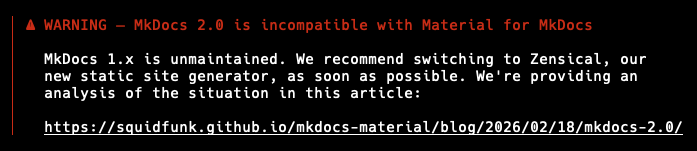
Recently though, while working on OldNews, something changed. When I was working on or building the docs, I saw this:

MkDocs warning

This was... new. So I visited the link and I was, if I'm honest, none the wiser. I've read it a few times since, and done a little bit of searching, and I still really don't understand what the heck is going on or why a tool I'm using is telling me not to use itself but to use a different tool. Like, really, why would MkDocs tell me not to use MkDocs but to use a different tool? Or was it actually MkDocs telling me this?1

Really, I don't get it.

Anyway, I decided to wave it away as some FOSS drama2, muse about it for a moment, and carry on and worry about it later. However, I did toot about my confusion and the ever-helpful Timothée gave a couple of pointers. He mentioned that Zensical was a drop-in replacement here.

Again, not having paid too much attention to what the heck was going on, I filed away this bit of advice and promised myself I'd come back to this at some point soon.

Fast-forward to yesterday and, having bumped into another little bit of FOSS drama, I was reminded that I should go back and look at Zensical (because I was reminded that there's always the chance your "supply chain" can let you down). Given that BlogMore is the thing I'm actively messing with at the moment, and given the documentation is in a state of flux, I thought I'd drop the "drop-in" into that project.

The result was, more or less, that it was a drop-in replacement. I did have to change $(mkdocs) serve --livereload to drop the --livereload switch (Zensical doesn't accept it, and I'd only added it to MkDocs recently because it seemed to stop doing that by default), but other than that... tool name swap and that's it.

Testing locally the resulting site -- while themed slightly differently (and I do like how it looks) -- worked just as it did before; which is exactly what I was wanting to see.

There was one wrinkle though: when it came to publishing to GitHub pages:

uv run zensical gh-deploy

Usage: zensical [OPTIONS] COMMAND [ARGS]...
Try 'zensical --help' for help.

Error: No such command 'gh-deploy'.

Oh! No support for deploying to the gh-pages branch, like MkDocs has! For a moment this felt like a bit of a show-stopper; but then I remembered that MkDocs' publishing command simply makes use of ghp-import and so I swapped to that and I was all good.

So, yeah, so far... I think it's fair to say that Zensical has been a drop-in replacement for the MkDocs/mkdocs-material combo. Moreover, if the impending problems are as bad as the blog post in the warning suggests, I'm grateful to this effort; in the long run this is going to save a lot of faffing around.

The next test will be to try the docs for something like Hike. They're a little bit more involved, with SVG-based screenshots being generated at build time, etc. If that just works out of the box too, without incident, I think I'm all sorted.


  1. Turns out that it was Material for MkDocs doing this; I wish the warning had said this. 

  2. It's not the first I've seen in my years, and I doubt it'll be the last. 

MkDocs/mkdocstrings 404 CSS TIL update

1 min read

Following on from my post this morning, regarding the problem I was having with _mkdocstrings.css being 404 any time I deployed my documentation, built with mkdocs/mkdocstrings, to GitHub Pages...

It's come to light that I was doing this on hard mode, pretty much.

While trying to figure out the best way of deploying the docs, I'd stumbled on ghp-import and had been using that. On the other hand, MkDocs has it's own command for doing the same thing: mkdocs gh-deploy.

Timothée pointed out to me that he never runs into this problem, but he used this command. As it turns out, if you use mkdocs gh-deploy it creates the .nojekyll file by default.

And how does it do this? It uses the ghp-import code and uses a switch it has to achieve exactly this. In fact... the command line version even has a switch for it!

-n, --no-jekyll      Include a .nojekyll file in the branch.

This is off by default, when you run the command itself, but I wish I'd noticed this when I was first experimenting. O_o

Anyway, thanks to Timothée's pointers, I've now managed to simplify how I build and publish the docs from textual-fspicker, and I'll apply this to other projects too.

Documenting textual-fspicker (plus a TIL)

3 min read

I've just made a wee update to textual-fspicker, my dialog library for Textual which adds FileOpen, FileSave and SelectDirectory dialogs. There's no substantial change to the workings of the library itself, but I have added something it's been lacking for a long time: documentation!

Well... that's not quite true, it's always had documentation. I'm an avid writer of Python docstrings and I make a point of always writing them for every class, function, method or global value as I write the code. As such the low-level "API" documentation has always been sat there ready to be published somehow, eventually.

Meanwhile the description for how to use the library was mostly a pointer to some example code inside the README. Not ideal, and something I really wanted to improve at some point.

Given I'm still on a bit of a coding spree in my spare time, I finally decided to get round to using the amazing mkdocstrings, in conjunction with mkdocs, to get some better documentation up an running.

The approach I decided to take with the documentation was to have a page that gave some general information on how to use the library and then also generate low-level documentation for the all the useful content of the library from the docstrings. While latter isn't really useful to anyone wanting to use the library in their own applications, it could be useful to anyone wanting to understand how it hangs together at a lower-level, perhaps because they want to contribute to or extend the library in some way.

While writing some of the general guide took a bit of work, of course, the work to get the documentation up and running and generating was simple enough. The effort comes down to 3 rules in the Makefile for the project:

##############################################################################
# Documentation.
.PHONY: docs
docs:                    # Generate the system documentation
    $(mkdocs) build

.PHONY: rtfm
rtfm:                    # Locally read the library documentation
    $(mkdocs) serve

.PHONY: publishdocs
publishdocs: docs        # Set up the docs for publishing
    $(run) ghp-import --push site

The rtfm target is useful for locally-serving the documentation so I can live preview as I write things and update the code. The publishdocs target is used to create and push a gh-pages branch for the repository, resulting in the documentation being hosted by GitHub.

A wee problem

NOTE: I've since found out there's an easier way of fixing the issue.

This is, however, where I ran into a wee problem. I noticed that the locally-hosted version of the documentation looked great, but the version hosted on GitHub Pages was... not so great. I was seeing a load of text alignment issues, and also whole bits of text just not appearing at all.

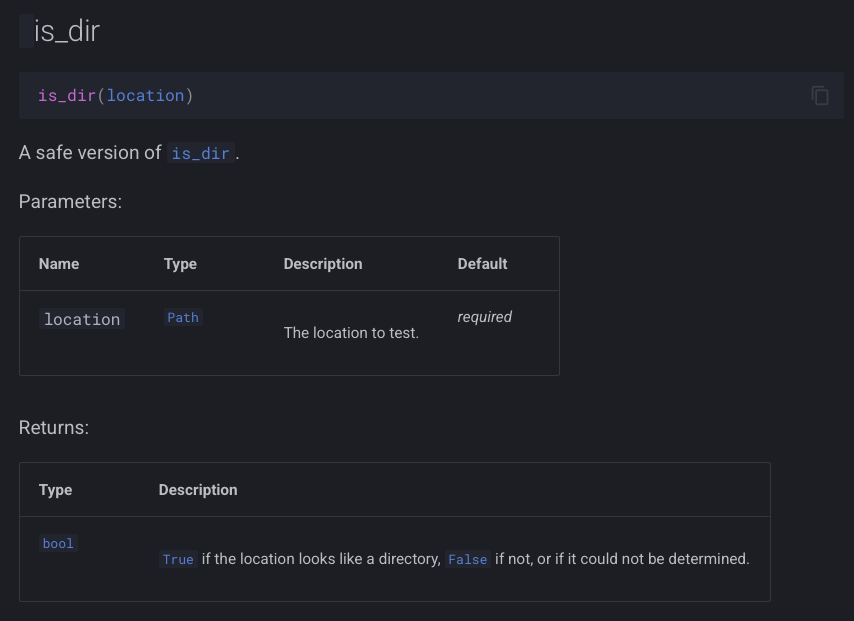
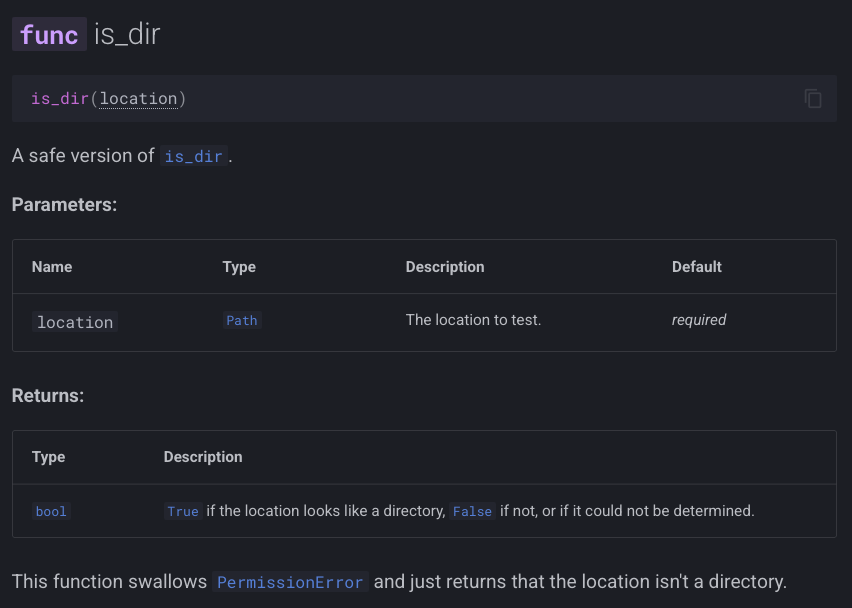
Here's an example of what I was seeing locally:

Good layout

and here's what I was seeing being served up from GitHub Pages:

Bad layout

As you can see, in the "bad" version the func label is missing from the header, and the Parameters and Returns tables look quite messy.

I spent a little bit of time digging and, looking in Safari's console, I then noticed that I was getting a 404 on a file called _mkdocstrings.css in the assets folder. Problem found!

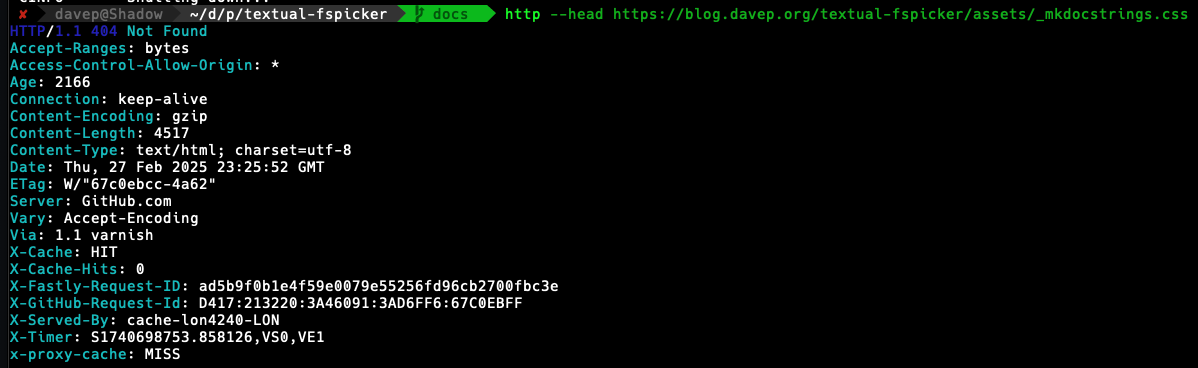
Only... was it though? If I looked in the gh-pages local branch the file was there (and with fine permissions). If I looked in the remote branch, it was there too. Thinking it could be some odd browser problem I even tried to grab the file back from the command line and it came back 404 as well.

Testing from the command line

At this point it was getting kind of late so I decided I must have screwed up somehow but I should leave it for the evening and head to bed. Before doing so though I decided to drop a question into the mkdocstrings discussions to see if anyone could see where I'd messed up.

As it turns out, it looked like I hadn't messed up and the reply from the always super-helpful Timothée was, in effect, "yeah, that should work fine". At least I wasn't the only one confused.

Fast forward to this morning and, with breakfast and coffee inside me, I decided to try and methodically get to the bottom of it. I wrote up the current state of understanding and looked at what might be the common cause. The thing that stood out to me was that this was a file that started with an underscore, so I did a quick search for "github pages underscore" and right away landed on this result.

Bingo!

That had to be it!

A little bit of testing later and sure enough, the documentation hosted on GitHub Pages looked exactly like the locally-hosted version.

So, TIL: by default sites hosted by GitHub Pages will pretend that any asset that starts with an underscore doesn't exist, unless you have a .nojekyll in the root of the repository, on the gh-pages branch (or whatever branch you decide to serve from).

To make this all work I added .nojekyll to docs/source and added this to mkdocs.yml:

exclude_docs: |
  !.nojekyll

All done!

And now I've worked out a simple workflow for using mkdocs/mkdocstrings for my own Python projects, in conjunction with GitHub Pages, I guess I'll start to sprinkle it over other projects too.

So you're looking for a wee bit of Textual help...

(Modified: 2026-04-28 09:34:45 UTC+01:00)
11 min read

Introduction

Patience, Highlander. You have done well. But it'll take time. You are generations being born and dying. You are at one with all living things. Each man's thoughts and dreams are yours to know. You have power beyond imagination. Use it well, my friend. Don't lose your head.

Juan Sánchez Villalobos Ramírez, Chief metallurgist to King Charles V of Spain

As of the time of writing, I'm a couple or so days off having been with Textualize for 3 months. It's been fun, and educational, and every bit as engaging as I'd hoped, and more. One thing I hadn't quite prepared for though, but which I really love, is how so many other people are learning Textual along with me.

Even in those three months the library has changed and expanded quite a lot, and it continues to do so. Meanwhile, more people are turning up and using the framework; you can see this online in social media, blogs and of course in the ever-growing list of projects on GitHub which depend on Textual.

This inevitably means there's a lot of people getting to grips with a new tool, and one that is still a bit of a moving target. This in turn means lots of people are coming to us to get help.

As I've watched this happen I've noticed a few patterns emerging. Some of these good or neutral, some... let's just say not really beneficial to those seeking the help, or to those trying to provide the help. So I wanted to write a little bit about the different ways you can get help with Textual and your Textual-based projects, and to also try and encourage people to take the most helpful and positive approach to getting that help.

Now, before I go on, I want to make something very clear: I'm writing this as an individual. This is my own personal view, and my own advice from me to anyone who wishes to take it. It's not Textual (the project) or Textualize (the company) policy, rules or guidelines. This is just some ageing hacker's take on how best to go about asking for help, informed by years of asking for and also providing help in email, on Usenet, on forums, etc.

Or, put another way: if what you read in here seems sensible to you, I figure we'll likely have already hit it off over on GitHub or in the Discord server. ;-)

Where to go for help

At this point this is almost a bit of an FAQ itself, so I thought I'd address it here: where's the best place to ask for help about Textual, and what's the difference between GitHub Issues, Discussions and our Discord server?

I'd suggest thinking of them like this:

Discord

You have a question, or need help with something, and perhaps you could do with a reply as soon as possible. But, and this is the really important part, it doesn't matter if you don't get a response. If you're in this situation then the Discord server is possibly a good place to start. If you're lucky someone will be hanging about who can help out.

I can't speak for anyone else, but keep this in mind: when I look in on Discord I tend not to go scrolling back much to see if anything has been missed. If something catches my eye, I'll try and reply, but if it doesn't... well, it's mostly an instant chat thing so I don't dive too deeply back in time.

ℹ️ Note

As a slight aside here: sometimes people will pop up in Discord, ask a question about something that turns out looking like a bug, and that's the last we hear of it. Please, please, please, if this happens, the most helpful thing you can do is go raise an issue for us. It'll help us to keep track of problems, it'll help get your problem fixed, it'll mean everyone benefits.

My own advice would be to treat Discord as an ephemeral resource. It happens in the moment but fades away pretty quickly. It's like knocking on a friend's door to see if they're in. If they're not in, you might leave them a note, which is sort of like going to...

GitHub

On the other hand, if you have a question or need some help or something where you want to stand a good chance of the Textual developers (amongst others) seeing it and responding, I'd recommend that GitHub is the place to go. Dropping something into the discussions there, or leaving an issue, ensures it'll get seen. It won't get lost.

As for which you should use -- a discussion or an issue -- I'd suggest this: if you need help with something, or you want to check your understanding of something, or you just want to be sure something is a problem before taking it further, a discussion might be the best thing. On the other hand, if you've got a clear bug or feature request on your hands, an issue makes a lot of sense.

Don't worry if you're not sure which camp your question or whatever falls into though; go with what you think is right. There's no harm done either way (I may move an issue to a discussion first before replying, if it's really just a request for help -- but that's mostly so everyone can benefit from finding it in the right place later on down the line).

The dos and don'ts of getting help

Now on to the fun part. This is where I get a bit preachy. Ish. Kinda. A little bit. Again, please remember, this isn't a set of rules, this isn't a set of official guidelines, this is just a bunch of "if you want my advice, and I know you didn't ask but you've read this far so you actually sort of did, don't say I didn't warn you!" waffle.

This isn't going to be an exhaustive collection, far from it. But I feel these are some important highlights.

Do...

When looking for help, in any of the locations mentioned above, I'd totally encourage:

Be clear and detailed

Too much detail is almost always way better than not enough. "My program didn't run", often even with some of the code supplied, is so much harder to help than "I ran this code I'm posting here, and I expected this particular outcome, and I expected it because I'd read this particular thing in the docs and had comprehended it to mean this, but instead the outcome was this exception here, and I'm a bit stuck -- can someone offer some pointers?"

The former approach means there often ends up having to be a back and forth which can last a long time, and which can sometimes be frustrating for the person asking. Manage frustration: be clear, tell us everything you can.

Say what resources you've used already

If you've read the portions of the documentation that relate to what you're trying to do, it's going to be really helpful if you say so. If you don't, it might be assumed you haven't and you may end up being pointed at them.

So, please, if you've checked the documentation, looked in the FAQ, done a search of past issues or discussions or perhaps even done a search on the Discord server... please say so.

Be polite

This one can go a long way when looking for help. Look, I get it, programming is bloody frustrating at times. We've all rage-quit some code at some point, I'm sure. It's likely going to be your moment of greatest frustration when you go looking for help. But if you turn up looking for help acting all grumpy and stuff it's not going to come over well. Folk are less likely to be motivated to lend a hand to someone who seems rather annoyed.

If you throw in a please and thank-you here and there that makes it all the better.

Fully consider the replies

You could find yourself getting a reply that you're sure won't help at all. That's fair. But be sure to fully consider it first. Perhaps you missed the obvious along the way and this is 100% the course correction you'd unknowingly come looking for in the first place. Sure, the person replying might have totally misunderstood what was being asked, or might be giving a wrong answer (it me! I've totally done that and will again!), but even then a reply along the lines of "I'm not sure that's what I'm looking for, because..." gets everyone to the solution faster than "lol nah".

Entertain what might seem like odd questions

Aye, I get it, being asked questions when you're looking for an answer can be a bit frustrating. But if you find yourself on the receiving end of a small series of questions about your question, keep this in mind: Textual is still rather new and still developing and it's possible that what you're trying to do isn't the correct way to do that thing. To the person looking to help you it may seem to them you have an XY problem.

Entertaining those questions might just get you to the real solution to your problem.

Allow for language differences

You don't need me to tell you that a project such as Textual has a global audience. With that rather obvious fact comes the other fact that we don't all share the same first language. So, please, as much as possible, try and allow for that. If someone is trying to help you out, and they make it clear they're struggling to follow you, keep this in mind.

Acknowledge the answer

I suppose this is a variation on "be polite" (really, a thanks can go a long way), but there's more to this than a friendly acknowledgement. If someone has gone to the trouble of offering some help, it's helpful to everyone who comes after you to acknowledge if it worked or not. That way a future help-seeker will know if the answer they're reading stands a chance of being the right one.

Accept that Textual is zero-point software (right now)

Of course the aim is to have every release of Textual be stable and useful, but things will break. So, please, do keep in mind things like:

  • Textual likely doesn't have your feature of choice just yet.
  • We might accidentally break something (perhaps pinning Textual and testing each release is a good plan here?).
  • We might deliberately break something because we've decided to take a particular feature or way of doing things in a better direction.

Of course it can be a bit frustrating at times, but overall the aim is to have the best framework possible in the long run.

Don't...

Okay, now for a bit of old-hacker finger-wagging. Here's a few things I'd personally discourage:

Lack patience

Sure, it can be annoying. You're in your flow, you've got a neat idea for a thing you want to build, you're stuck on one particular thing and you really need help right now! Thing is, that's unlikely to happen. Badgering individuals, or a whole resource, to reply right now, or complaining that it's been $TIME_PERIOD since you asked and nobody has replied... that's just going to make people less likely to reply.

Unnecessarily tag individuals

This one often goes hand in hand with the "lack patience" thing: Be it asking on Discord, or in GitHub issues, discussions or even PRs, unnecessarily tagging individuals is a bit rude. Speaking for myself and only myself: I love helping folk with Textual. If I could help everyone all the time the moment they have a problem, I would. But it doesn't work like that. There's any number of reasons I might not be responding to a particular request, including but not limited to (here I'm talking personally because I don't want to speak for anyone else, but I'm sure I'm not alone here):

  • I have a job. Sure, my job is (in part) Textual, but there's more to it than that particular issue. I might be doing other stuff.
  • I have my own projects to work on too. I like coding for fun as well (or writing preaching old dude blog posts like this I guess, but you get the idea).
  • I actually have other interests outside of work hours so I might actually be out doing a 10k in the local glen, or battling headcrabs in VR, or something.
  • Housework. :-/

You get the idea though. So while I'm off having a well-rounded life, it's not good to get unnecessarily intrusive alerts to something that either a) doesn't actually directly involve me or b) could wait.

Seek personal support

Again, I'm going to speak totally for myself here, but I also feel the general case is polite for all: there's a lot of good support resources available already; sending DMs on Discord or Twitter or in the Fediverse, looking for direct personal support, isn't really the best way to get help. Using the public/collective resources is absolutely the best way to get that help. Why's it a bad idea to dive into DMs? Here's some reasons I think it's not a good idea:

  • It's a variation on "unnecessarily tagging individuals".
  • You're short-changing yourself when it comes to getting help. If you ask somewhere more public you're asking a much bigger audience, who collectively have more time, more knowledge and more experience than a single individual.
  • Following on from that, any answers can be (politely) fact-checked or enhanced by that audience, resulting in a better chance of getting the best help possible.
  • The next seeker-of-help gets to miss out on your question and the answer. If asked and answered in public, it's a record that can help someone else in the future.

Doubt your ability or skill level

I suppose this should really be phrased as a do rather than a don't, as here I want to encourage something positive. A few times I've helped people out who have been very apologetic about their questions being "noob" questions, or about how they're fairly new to Python, or programming in general. Really, please, don't feel the need to apologise and don't be ashamed of where you're at.

If you've asked something that's obviously answered in the documentation, that's not a problem; you'll likely get pointed at the docs and it's what happens next that's the key bit. If the attitude is "oh, cool, that's exactly what I needed to be reading, thanks!" that's a really positive thing. The only time it's a problem is when there's a real reluctance to use the available resources. We've all seen that person somewhere at some point, right? ;-)

Not knowing things is totally cool.

Conclusion

So, that's my waffle over. As I said at the start: this is my own personal thoughts on how to get help with Textual, both as someone whose job it is to work on Textual and help people with Textual, and also as a FOSS advocate and supporter who can normally be found helping Textual users when he's not "on the clock" too.

What I've written here isn't exhaustive. Neither is it novel. Plenty has been written on the general subject in the past, and I'm sure more will be written on the subject in the future. I do, however, feel that these are the most common things I notice. I'd say those dos and don'ts cover 90% of "can I get some help?" interactions; perhaps closer to 99%.

Finally, and I think this is the most important thing to remember, the next time you are battling some issue while working with Textual: don't lose your head!
ℹ️ Note

This advice blog post was first hosted on the Textual devlog.

Build in public, even in private

4 min read

As mentioned yesterday, I'm about to start working at Textualize, and building Open-source software is important to the company. Will -- the CEO -- is all about building in public. If you follow him on Twitter you'll notice that his Python coding adventure tweets actually outnumber is cooking tweets!

As someone who has long been a supporter of and fan of Free Software and Open-source software, and has made some small contributions along the way, I've also always made a point of building my own tools in public. In most cases they're things that are likely only helpful to me, but some are more generally useful. The point being though: it's all there in case it's helpful to someone else.

Which means that, as much as possible, when I'm writing code, I write it as if it's going to be visible in public and someone else is going to be reading it. I try and make the code tidy. I try and comment it well. I try (but don't always manage for personal projects) to fully document it. The important thing here being that someone coming to the code fresh should be able to follow what's going on.

Against that background, and having just gone through the process of handing off almost 5 years of work to someone else as a left an employer, I got to thinking: we should always "build in public", even if it's in private.

When I started with my previous employer, and even to the day I left, I was the only software developer there. I worked with a team who wrote code, but being software developers wasn't what they did. Bioinformaticians and machine learning scientists have other things to be doing. But, as I wrote my code, I wrote every line assuming they, or some other developer down the line, would be reading it. Pretty much every line was written for an audience I couldn't see and didn't fully know. This, as mentioned above, meant trying to keep the code clean, ensuring it was commented in helpful ways, ensuring the documentation was helpful, and so on.

But it wasn't just about the code. Any non-trivial system will have more to it than code. We had an internal instance of GitLab and I tracked all of my work on there. So, as I planned and worked on new features, or went on bug hunts, I'd document the process in the issue tracker. As much as possible I'd be really verbose about the process. Often I wouldn't just open an issue, go work on it, and then mark it closed; as I worked through the issue I'd add comment after comment under it, documenting my thinking, problems, solutions, cite sources when looking something up, that sort of thing.

The whole process was an act in having a conversation with current or future team members if they ever needed to look; with future me (really, that helped more than once -- we all have those "that the hell was I thinking?" moments); with any developer(s) who took over from me in the future.

I did all this as if I was broadcasting it in public on Twitter or on GitHub, etc. It was in private, of course, but I approached it as if it was in public.

There were always three main reasons for this, I felt:

  1. Accountability. At any moment someone who I worked with could review what I was doing and why I was doing it; it was an invitation to anyone curious enough to talk with me about what I was building and how I was building it.
  2. Continuity of support for unplanned reasons. Life happens, sometimes you may, unplanned, never be available at work again. I never wanted to leave my employer in a position where picking up from such an event was a nightmare.
  3. Continuity of support for planned reasons. It was possible, and it became inevitable, that I'd move on to something else. If that was to happen I wanted to be sure that whoever picked up after me would be able to do so without too much effort.

In the end, item 3 seemed to really pay off. When it came time for me to hand over my work to someone else, as I left, the process was really smooth and trouble-free. I was able to point the developer at all the documentation and source code, at all the issues, and invite them to read through it all and then come back to me with questions. In terms of time actually spent talking about the main system I was handing over I'd say that 4 years of work was handed over with just a few hours of actual talking about it.

It remains to be seen if it really paid off, of course. If they get really stuck they do have an open invitation to ping me a question or two; I care enough about what I designed and built that I want it to carry on being useful for some time to come. But... I like to think that all of that building in public, in private, will ensure that this is an invitation that never needs to be called on. I like to think that, if something isn't clear, they'll be able to check the code, the documentation and the issue history and get to where they need to go.

git2gantt -- Simple tool to visualise coding runs

2 min read

At the start of this year, as part of a much bigger process to review the work that had taken place over the previous 12 months, I was asked (at work) to provide some information about how much time I'd spent on various projects. Now, for me, there's really only one project, but there's lots of different tools and libraries that I've written to support the main work I do. All of these are split into different repositories in the company-internal instance of GitLab. This meant that getting a rough idea of what I was working on and when would be easy enough -- it's all there in the commit history.

Given that this information would make up a couple of slides at most during a far bigger presentation, I wanted something that would be snappy and easy for non-developers to follow and understand. I spent a bit of time pondering some options and decided that (ab)using a gantt chart layout would make sense.

That choice was made all the more easier given that GitLab supports the use of mermaid charts within its Markdown. This meant I could quickly write some code that took the git log of each repository, turned it into mermaid code, and then render it (by hand, this was all about getting things done quickly) via GitLab.

This sounded like it could be a fun personal project. The result was some Python code called git2gantt.

As mentioned above, the output isn't anything too clever, it's just code that can be used to create a plot via mermaid. For example, running git2gannt over itself:

gantt
  title git2gantt output
  dateFormat YYYY-MM-DD

  section git2gantt
  Development: devgit2gantt20190208, 2019-02-08, 2019-02-13
  Development: devgit2gantt20190214, 2019-02-14, 2019-02-15
  Development: devgit2gantt20190303, 2019-03-03, 2019-03-04
  Development: devgit2gantt20191203, 2019-12-03, 2019-12-04

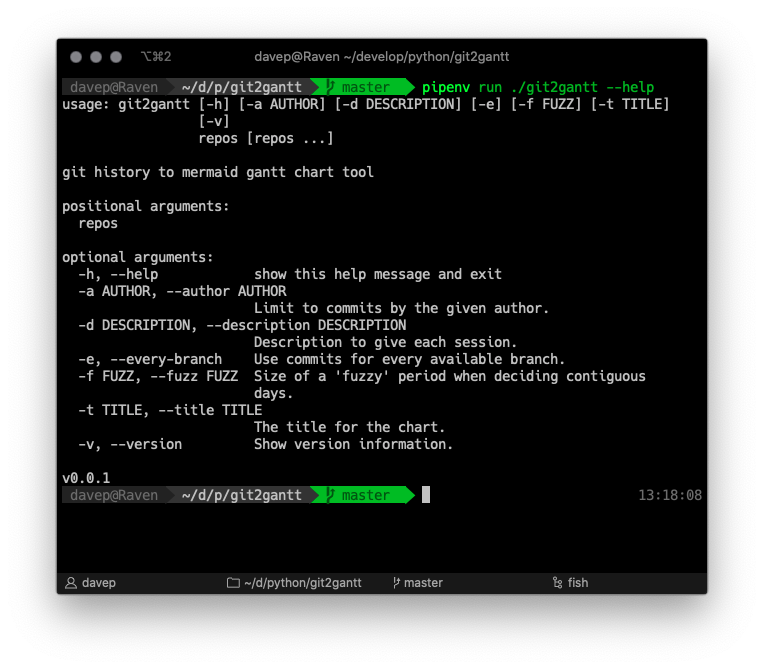
Usage is pretty straightforward:

Usage of the tool

As you can see, it can be run over multiple repos at once, and there's also an option to have it consider every branch within each repository. Another handy option is the ability to limit the output to just one author -- perhaps you just want to document what you've done on a repo, not the contributions of other people.

Also especially handy, if you don't want to bore people with too much detail, is the "fuzz" option. This lets you tell git2gannt how relaxed you want it to be when it tries to decide how long a run of work on a repo lasted. So, perhaps, you're working on and off on a library that supports some other system you're documenting, but you might only be making changes every other day or so. With the correct fuzz value you can make it clear you were working on the library for a couple of weeks, despite there only being a commit every other day.

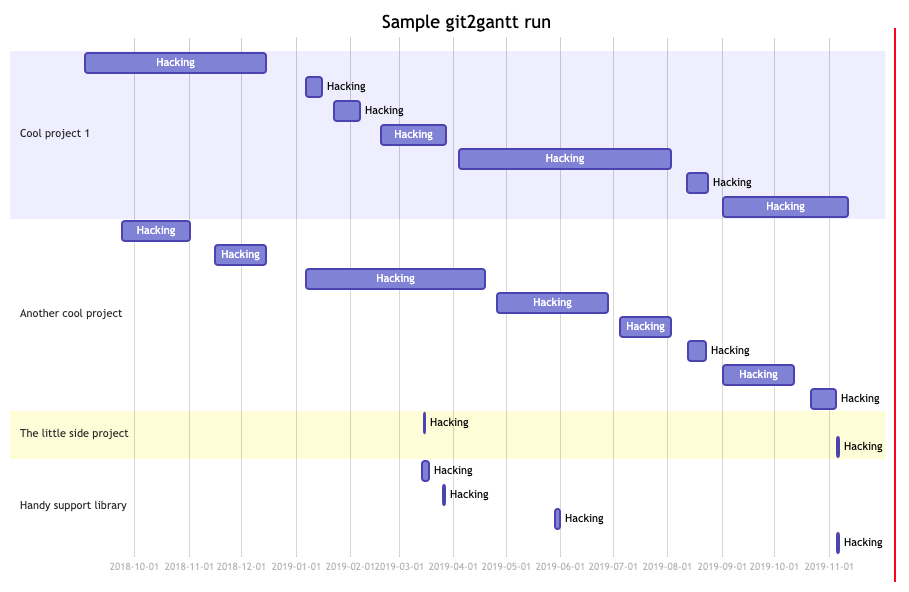
An example of running the output over a handful of projects would look something like this:

Output of the tool

This is one of those tools I knocked up quickly to get a job done, and haven't quite got round to finishing off fully. One thing I'd really like to do is add mermaid support directly within it, so that it actually has the option to emit plots, not just mermaid code (or, perhaps, drop the mermaid approach and use something else entirely).

Meanwhile though, if you're looking for something quick and dirty that will help you visualise what you've been working on and when for a good period of time... perhaps this will help.

pydscheck -- A quick hack that keeps slowly growing

3 min read

Something I always try to do when I'm coding is be consistent. I feel this is important. While people's coding standards may differ, I think different approaches are easier to handle if someone has been consistent with their style across all of their code.

This also stands for documentation too.

In my current position, I do a lot of Python coding, and one of the things I like about Python (there are things I don't like too, but that's not for now) is that it has doc-strings (just like my favourite language). I use them extensively, ensuring every function and method has some form of documentation, and generally I use Sphinx to generate documentation from those doc-strings.

Early on I was bothered by the fact that, just by the simple act of making typos, I wasn't keeping the form of the doc-strings consistent. And in this case it was a really simple thing that was bugging me. Normally, if I'm writing a single-line doc-string, I'll write like this:

def one_liner():
    """Here is a one-line doc-string."""

So far, so good. But, if the doc-string is a multi-liner, I prefer the ending quotes to be on a line of their own, like this:

def multi_liner():
    """Here is the first line.
    Here is another line.
    Here is the final line.
    """"

But, sometimes, by accident, I'd leave a doc-string like this:

def multi_liner():
    """Here is the first line.
    Here is another line.
    Here is the final line.""""

While it's really not a big deal, it would bug me and every time I found one like this I'd "fix" it.

Eventually, it bugged me enough that I decided I was going to write a little tool to find all such instances in my code and report them. My first approach was to think "I could just do this with some regexp magic", which was really a bad idea. Then I though, I know, I should use this as an excuse to to play with Python's ast library.

That worked really well! I had the first version of the code up and running in no time. It was simple but did the job. It ran through Python code I threw at it and alerted me to both missing doc-strings, and doc-strings with the ending I didn't like.

That served me for a while, until one day I realised that it wasn't quite doing the job correctly; it was only really looking at top-level functions and top-level methods in classes. Sometimes, not often, but sometimes, I'll define functions within functions, and I feel they deserve documentation too. So then I modified the code to ensure it walked every part of the AST.

Since then, when I've run into new things and had new ideas, pydscheck has grown and grown. I've added checks that all mentioned parameters have a type; I've added checks that any function/method that returns something actually documents the return value; I've added checks that any documentation of a returned value includes its type; I've added checks that any function or method that yields a value documents that fact; I've added checks that ensure that every parameter is documented in some way.

Each time I've done this it's helped uncover issues in my code's documentation that could be cleaner, and it's also given me a pet project to slowly better understand Python's AST.

It could be that there are better tools out there, I'd have thought that a good doc-string linting tool would be something someone had already written. But this time around I was happy to NIH it because I needed a fun learning exercise that would also have some benefits for my day-to-day work.

I'll caveat this with the fact that it's very particular to how I work and how I like my documentation to look, but if it sounds useful, here it is: https://github.com/davep/pydscheck.

There's still lots I could do with it. First off I should really properly package it up so it can be installed as a command line tool via pip. Other things that would be handy would be to allow some form of customisation of how it works. I'm sure there's other fun things I can do with it too.

That's part of the fun of having a pet project: you can tinker when you like and also get benefits from it as you use it.