I've just released the first version of another library in the collection of libraries that support the development of Rogallo: specifically, another one that helps convert text in other formats into Gemtext so Rogallo's display can be a little richer. In effect, this is a sibling to md2gemtext and html2gemtext.
This time it's a library to convert finger responses into Gemtext, where it makes sense. For the most part, finger responses are free-form plain text, but there are times when there's information in the response that would be of most use if you could interact with it. For example, if you get a user list from plan.cat1, that's a lot of data that could be turned into finger:// URIs that can be subsequently followed.
With this in mind, finger2gemtext can take a body of text, look at it to see if it might be possible to convert it to useful Gemtext, and will convert it if that's the case. Given that there's no standard to be had here, and given that any given response could be of any form the author desires, I'm making the conversion pretty conservative.
What I have done, though, is make it so that the conversion process can be extended. The finger_to_gemtext function can be given a collection of additional filtering classes; if the built-in classes can't find anything to convert, the additional classes get a go. There is a base class to inherit from.
I've not fully planned it out yet, but the vague idea I have here is that Rogallo could, at some point, have "finger plugins" which will handle various special cases and site-specific formats.
For now, though, this gives me the basics that let me turn this:
into something where I can follow finger:// links without the need to copy/paste/edit:
Now I need to find a few more online finger resources that respond with things worth making linkable...
Earlier today I saw a comment on a post on BBS that was really quite disappointing. The post itself was announcing a new Gemini client, in this case a fully-native macOS one called MajorTom. It's early days for the project, but it looks fun. It also looks like the author is having a ton of fun building it.
I can relate. I've been obsessing over building Rogallo since June this year and it's been an absolute blast. I don't see myself getting bored of it any time soon.
The comment that irked me was this:
Got excited, then I saw the AGENTS.md :(
It’s hard to get excited about new software when everything is just AI generated. I miss the old times when you got excited that someone built something. Now it’s just someone wrote a prompt to make a computer build something.
It comes over like some messed-up Calvinist puritanical work ethic thing. Yes, I know all the arguments against the use of AI, you'll find that I agree with a good few of them; but there's something wild about this "you didn't work hard enough to produce the software I might otherwise consider using so I've dismissed it" attitude. I'd say enough with this nonsense, but it's been going on for as long as I've been writing code and I doubt it'll stop any time soon. At every step in the evolution of software development there's always been someone, sat on the sidelines, tutting and judging because someone is using a new tool that makes it easier or quicker to do a thing.
What also bothers me is how easily the author of the comment belittles and diminishes the work of the author of the application. Sure, there are some folk who will try and one-shot something with a prompt or two, and who might then pass it off as something carefully considered and designed; but it's unfair, perhaps even dishonest, to attribute that to someone when you don't know what process they've gone through.
If I look at Rogallo, for example... AI has been involved along the way. To be clear: 100% of Rogallo is hand-written code, AI has not been involved in writing any of it. I have used Antigravity as an occasional rubber duck to hash out some ideas, but there's zero chance I'd let it anywhere near the code itself1. On the other hand, some of the protocol-based support libraries I've built have heavily involved AI. Even then, I didn't just slap in a prompt and run with the result. I did research, I followed the docs, I read more and more about Gemini and Spartan and Nex, etc. I used an agent to get the code going based on my understanding of the source material and I then used that code to support the main work I actually wanted to be doing.
ℹ️ Note
Thinking about it, here's roughly how it breaks down in terms of actual code written, so far:
Rogallo: zero AI
bagofstuff: pre-existing but zero AI
gemtext: zero AI
gophermap: zero AI
html2gemtext: zero AI
md2gemtext: mostly AI
port1900: mostly AI
port70: mostly AI
port79: mostly AI
sybaritic: mostly AI
textual_enhanced: pre-existing but zero AI
textual_fspicker: pre-existing but zero AI
wasat: mostly AI
There's zero chance I could have built Rogallo and all the support code from a position of ignorance. None of it was "just a prompt". Looking at what's gone into MajorTom so far, I doubt that's the case there either.
Anyway, back to the main topic...
I also find an element of entitlement in this comment. It reminds me somewhat of the person who felt they were owed something by FOSS authors. Excitement is not something a FOSS author owes you. You are, of course, welcome to go looking for excitement, but if something you discover doesn't do it for you... it's not for you, move on, go find something else. Announcing that you didn't get excited because someone else got creative in a way you don't approve of just makes you look like you want to centre the discussion around you.
Someone made a thing. Someone shared a thing. Someone posted a thing. You turned up and made it about you. That's kind of rubbish. Don't do that.
It's totally fine to not like the use of AI. It's totally fine to want to avoid anything built with AI or which is somewhat AI-adjacent. I get it: it's good to have your own standards and to stick to them. I would suggest, however, that it starts getting problematic when you need to tell someone having fun with their own free time that they're not doing so in a way that meets your standards. Doing that is kind of weird.
Doing that makes you look like the effort police.
I've yet to see an agent write Textual code I'd consider reasonable. ↩
I've just made a small release to Rogallo, bumping the version to v2.1.0. This release mostly has some small cosmetic fixes and improvements, and one new feature.
The cosmetic improvements include:
Fixed the verification method and client certificate status icons in the viewer title bar so they don't use the "this is clickable" mouse cursor when there's nothing worth clicking.1
Adjusted the styling of tooltips so they better stand out against the background text.
Fixed the cosmetics of the viewer when the content is set to a narrowed state (some of the changes in v2.0.0 had inadvertently changed some of the styling).
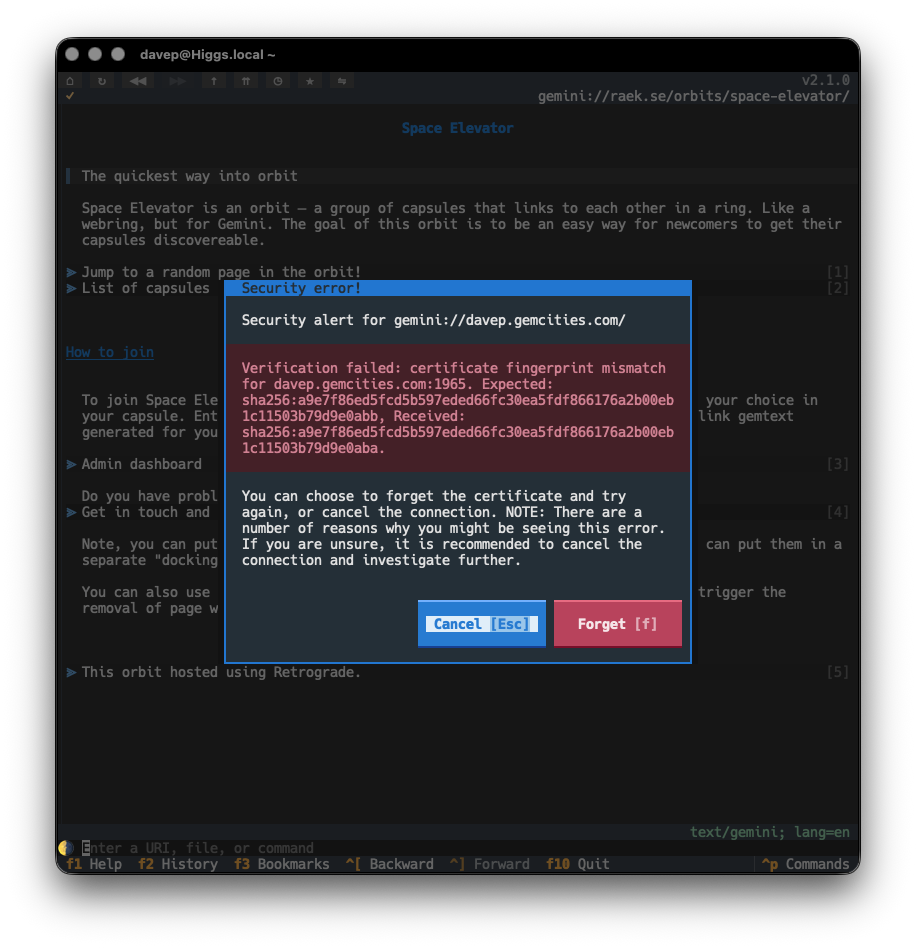
The new feature is one of the last issues I wanted to address when it came to all things related to Gemini and security: the option to "forget" the certificate fingerprint of a host when the fingerprint has changed.
Until now, if you visited a site that was using a self-signed certificate, and the fingerprint for that certificate had changed, you'd just get an error toast and the page would not be loaded. Technically this is the safest thing to do, but it's not the most pragmatic approach most of the time; capsules will change up certificates and you probably know you can still trust them.
So, from now on, rather than simply refusing to load the page, Rogallo will tell you about the issue and then offer to forget the fingerprint and try again.
This should make the issue more noticeable and also easier to handle.
A quick little update to Wasat, bumping the version to v1.7.0. In service of a feature I'm adding to Rogallo, I've added a forget method to the trust store class, so that a certificate fingerprint for a particular host/port combination can be forgotten.
This came about because, if a fingerprint does change for a Gemini capsule, I want a Rogallo user to be able to decide to either avoid it or forget it and re-establish trust. While the fingerprint mismatch should be a warning to distrust the capsule, there might be a legitimate reason why the certificate has changed, and I want to make that decision fairly frictionless.
I've just released v2.0.0 of Rogallo. This release has quite a lot of changes, one or two of them "breaking changes", hence the bump to v2.0.0. I will add though that, when I say "breaking changes", nothing should actually break, it's just some features have changed in an incompatible way and some application commands have been removed or renamed (and so some default keyboard bindings have changed). The worst that might happen is a keyboard binding you set up no longer works.
While Rogallo supported the creation and use of client certificates for use with Gemini capsules, it never made it that easy to work with them. Creating and using them was pretty frictionless, but if you were someone who wanted to bring your own certificate from another application, you were on your own. Actually doing that was easy enough, if you were comfortable with diving into the certificate directory and hand-editing the JSON file to create the association. What was lacking though was a good interface to manage all of this in the application.
This version solves that problem. Rogallo now contains a client certificate manager that lets you:
Create new client certificates
Add and remove associations for client certificates
Delete client certificates
Import client certificates
Export client certificates
Also, when you encounter a capsule that demands a certificate and you don't have one associated, you can pick an existing one from your certificate library; before the only option you had was to create a new one.
Initially, when I first started work on Rogallo, I had a simple history list that could be popped in/out on the side of the display. Then, when I added bookmarks, this became a sort of toggle, with either the history showing, the bookmarks showing, or both hidden. The command to show the history would hide the bookmarks; the command to show the bookmarks would hide the history; both would toggle themselves to hide. This was... kind of messy, but it worked.
When I started work on the certificate manager it made sense that it also occupied the same space. However, the code for managing this, and the resulting user experience, started to get pretty messy. I wasn't at all happy with it so ended up going on a bit of a side-quest to clean this up.
The result is that Rogallo now has a tabbed side panel (similar to the one in Hike). This contains the bookmark manager, history manager and client certificate manager.
This is where one of the main breaking changes comes in: the ToggleHistoryManager and ToggleBookmarksManager commands have been removed from Rogallo and their default keyboard bindings have been freed up. Also, to clean up the naming of things, I've renamed JumpToSidebar to JumpToSidePanel.
I feel this side panel approach is far cleaner and far easier to work with.
It's also worth noting that it's moved over to the left side of the display. However, if you'd prefer it on the right there's a configuration option for that.
As part of the work on managing client certificates, I added a dialog that lets you view details of a certificate. As well as being available in the certificate manager, it can also be used to view any certificate that might be in use when viewing the current page. The AboutClientCertificate command (bound to Shift+F7 by default) can be used to bring up the view.
For the folk who lean more on the mouse, the key icon that appears in the title bar of the viewer can be clicked on to get the same view.
The command line in the application now tries to be a little bit smarter when it comes to understanding input. Before now, if you were to type in example.com, Rogallo would assume that you were attempting to visit a Gemini capsule on that host and process the input as if it were gemini://example.com/. This release extends this a little.
If the input doesn't appear to be anything else and it includes a @ it will be turned into a finger URI. So user@example.com becomes finger://example.com/user and @example.com becomes finger://example.com/.
If the first part of the host has a recognisable protocol name, it will be assumed that that protocol should be used. In other words:
I've overhauled the code that does emoji removal if you toggle removal on. More work is done to identify "real" emoji. This should mean that all the usual colourful image-like candidates are removed, but now things like braille and box drawing characters, etc, won't be removed.
Also, when removing an emoji, if there is a space following it, that space will also be removed. This solves the cosmetic problem of "👉 This" being turned into " This" when it would make more sense that it is turned into "This".
It's worth keeping in mind here that this isn't intended to be a 100%-correct solution. It's aimed at being a good-enough solution to clean up most of the emoji clutter if you don't like that sort of thing.
My general approach to developing anything is one of "make it right then make it fast". I've never been a fan of early optimisation, and when I've watched people obsess over such things far too early in a codebase's lifecycle I've generally watched them get into a mess. I like to try and avoid that mess.
So this was my approach with Rogallo. When it came to building the widget that displayed the content of a page, I spent my time trying to ensure it was correct, not that it was fast. Quite quickly, however, I found that once a page had quite a few links on it -- especially when you got to many 100s of links -- performance was terrible. I'd had an issue sat in TODO for this from the start, but hadn't gone back to address it.
Then the other day someone else noted this issue so I decided it was time to go back and work on it. As of this release of Rogallo you should find that a page with 1,000 links on it performs about as well as a page with a handful of links.
In doing this work I've also made a lot of optimisations to how a page is initially built; so not only should a page be more responsive as you navigate it, it should be noticeably quicker to appear in the first place.
There's a lot in this release and I'm really delighted with how it's turned out. I wasn't intending to make quite so many large changes, but each bit of work naturally caused the next bit of work and... well, here we are.
With this work out of the way I can start to look at the one remaining protocol that's currently on the TODO list, and also look at making some other quality-of-life improvements.
The client certificate management PR for Rogallo is very close to completion now -- although the thing has grown arms and legs and turned into a bit of a UI overhaul1. Something I wanted to add was a quick and easy way for the user to view the details of a client certificate that's being used for the current page. Rogallo lets you do this for the server certificate, but not the client certificate.
It was at this point that I realised I'd never provided easy access to the ClientCertificate on the Response object. So v1.6.0 addresses this and provides Response.client_cert.
With this in place, I think I can finally get that Rogallo PR over the line...
Not unrelated. The UI overhaul was in support of the client certificate manager. ↩
I'm still working on the client certificate management PR for Rogallo, which, of course, heavily leans on the API of Wasat. In most cases, I've noticed that something I want to do in the PR can already be done, but the work to perform the action would seem like unnecessary detail in a client application; I want to make using Wasat as frictionless as possible.
With this in mind, v1.5.0 adds interfaces for exporting and importing client certificate data.
I've just made a small but important bug fix to Rogallo. Currently, I'm working on a more comprehensive approach to managing client-side certificates and, in doing so, I noted a bug with how such certificates are currently created by Rogallo.
Simply put: by default, Rogallo should create certificates that effectively never expire (the actual expiry time is the end of 9999-12-31). Instead, if no actual expiry time was given, the certificates were being created to expire a year after creation.
This does mean that, if you've created a client certificate with Rogallo and didn't specify your own expiry date, it currently has a far more limited lifespan than you were probably expecting. As such, you might want to review them and consider making fresh ones and setting them up well before they expire (expiry probably being some time in July next year, given that Rogallo itself has only been fully usable since around July this year).
Apologies if you've used this facility and it accordingly results in a little extra work. Thankfully it came to light sooner rather than later, and it has come to light while I'm giving client certificate management a big overhaul.
Another bump to Wasat, this being v1.4.0. This release is in support of some work I want to do on Rogallo, where I intend to add proper client certificate management.
While Wasat provided good support for the generation, storage, and use of client certificates, there was no real public API that would allow for the management of those certificates. This version addresses that.
Now there are methods for doing things like:
Listing all client certificates
Getting a specific certificate's details
Creating a certificate
Associating and disassociating a certificate with a URI
Deleting a certificate
This should give me everything I need to implement a simple client certificate user interface in Rogallo.
For a wee while now I've been wanting to tweak the way the navigation history works. Up until this release, this was simply a backward/forward affair with no attempt to restore the actual context of a page you've gone back to. This could best be felt if you're a fan of AstroBotany. If you were to visit the flowering plants in your community garden, with a view to visiting each one and picking petals, the natural thing to do would be to visit a specific plant, pick a petal, then go Backward twice to get back to the list of flowering plants. The problem at that point is that the link for the just-visited plant would no longer be focused. This made it just a bit more faff to go to the next plant on the list.
From this release, when going backward and forward through navigation history, Rogallo attempts to ensure that the link you had followed on that page is focused again.
Internally, this caused a fairly big overhaul of how history navigation information is recorded. I've done a fair bit of testing and all seems good; but do let me know if you experience any oddness.
This is a small fix. If you were to visit a URI that resulted in an empty document being received, the viewer would disappear. The viewer is supposed to disappear if you are visiting nowhere, but it shouldn't disappear if you're visiting somewhere that has nothing to show. This is now fixed.
Rogallo has a couple of commands that make it easier to navigate to the parent directory of a visited location, and also to the root. However, I'd only implemented this for Gemini and Spartan URIs and sort of forgotten to finish this off. With this release Gopher and Nex get to join in on the parent/root navigation party.
This one came up because, as of the time of writing, the server where my wee capsule lives is dead1. This meant that if I checked if it was there, and got impatient and went to navigate somewhere else, the somewhere else would load and then, after the defined timeout, the error about the previous request would pop up.
Rogallo now ensures that, if you have an in-flight request running, and then navigate elsewhere, that pre-existing request is cancelled.
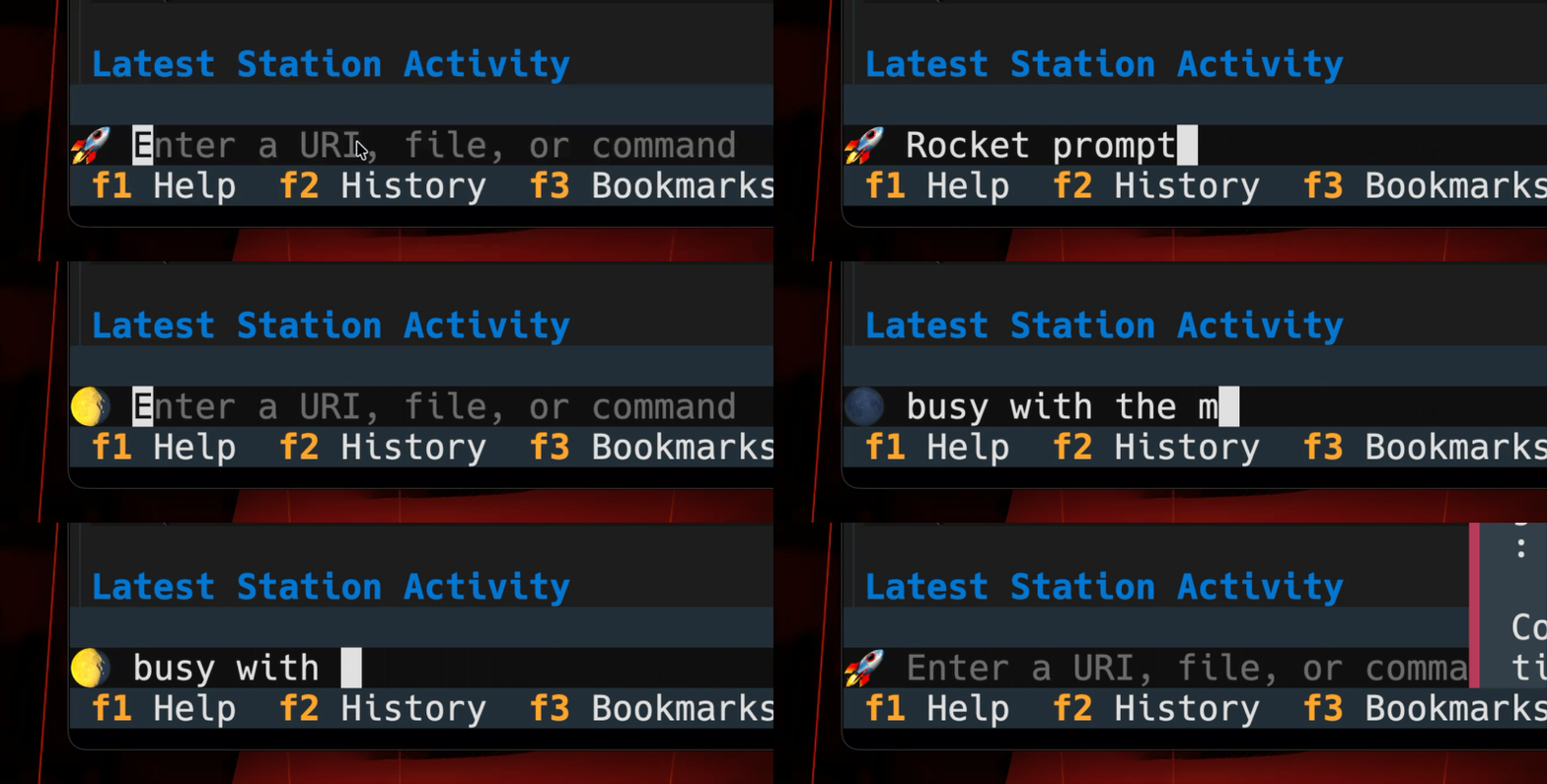
The in-application command line of Rogallo has two styles of prompt. The normal input prompt (shown as >), and the busy prompt (shown as a series of braille characters that animate as dots snaking around). I realised that some folk might enjoy setting their own prompts. While I think the defaults are nice and clean, if you wanted something more colourful and on-theme (in a Gemini sense anyway, which tends to be space-oriented), you could update your configuration file with:
I'm currently running with this for my own installation of Rogallo and it's rather growing on me.
From what I've seen, someone managed to break in and pretty much rm -rf / the thing. The restore of the server is being used as a good moment to change the architecture of the services it offers. This does mean it'll be a wee while before I get my capsule back. ↩