Posts tagged with "Gemini Protocol"

Gemini client history (redux)

1 min read; 12 GFI

A couple of days ago I thought I had history working well in the Gemini client I'm working on; I was wrong. It worked, but the more I used it the more I felt it wasn't quite right. The main problem was I had a single history structure that served both the navigation history (moving backwards and forwards) as well as the general location visit history (the list of places I've visited). It made sense initially, but in use it just wasn't cutting it.

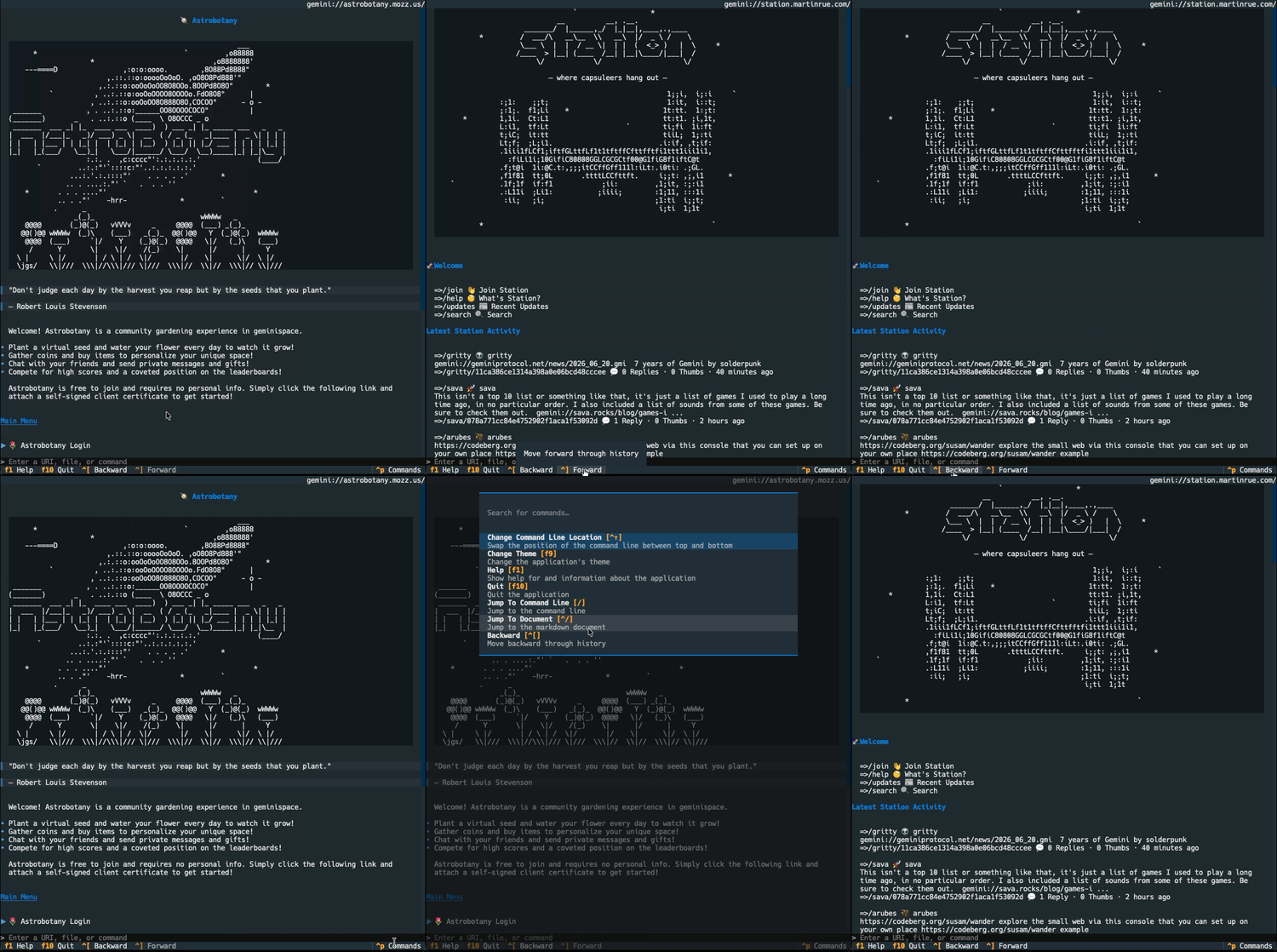
So now I've redone it, using two different history lists that also grow in rather different ways. For the navigation history, when "adding" a new location, everything after the current location gets removed, making the new location the latest in the list. The visit history, on the other hand, grows more like an ordered set: if I add a location that is already in the list, the older version is removed and it is added to the end of the list. In doing this, it's also allowed me to track the date and time I've visited a location, which means I can now have a useful history panel (which can be popped in and out of view) that shows me where I've been, and when.

Client, showing the history panel

Having done this, I now want to take some of these approaches and apply them to Hike. It has a pretty simple location and navigation history system that suffers from the same issues that I wasn't liking in this project. It'll benefit quite a bit from this improvement. I sense a v2.0.0 of Hike in the next few months.

As for when I'll let this project see the light of day: I think I'm close to opening the repository and publishing the first version to PyPI. I had wanted to do it sometime yesterday, but the above kicked in and I've been tinkering more to try and make a stable foundation for the initial release. There's still a lot of work needed for it to be feature-complete, but there's enough here to play and experiment.
Recently I found - 2

1 min read; 12 GFI

Introduction

An occasional collection of things I've recently found on the Internet and added to my bookmarks.

Gemini hypertext format specification

The specification for the hypertext format used by the Gemini protocol, also known as "gemtext". Currently I'm developing my own terminal-based Gemini client so this comes in very handy.

UK government's under-16s social-media ban

The press release from the UK government, covering the intended ban on social media for under-16s. Even if we were to assume this is a good thing (and I'm far from convinced it is), the proposal as it looks right now is hilariously bad and appears to be as ill-informed as any attempt to control the Internet that has gone before.

How to be mean to IIS-based servers

A funny, and kind of informative, post about how you can be mean to IIS servers. Not that I'd ever do that (no, really, I wouldn't, that's not my sort of thing), but it's fun to know that some folk actually do that.

NetNewsWire Status

I was very late coming to NetNewsWire, only discovering it in the last year; it's been one of my go-to RSS tools (along with OldNews, of course) on macOS and iOS ever since. Here the author talks about the progress made in the last year.

The LLMentalist Effect

An article in which the author talks about the con played by psychics, and how large language models pretty much do exactly the same thing.

Dialog attendance list

Does what it says on the tin: shows the list of people who were "leaked" on the Dialog website.

The Community is the Achievement; the Achievement is the Community

An article on how community is one of the important properties of where tech has taken us, and the threat that AI poses to this. As of the time of writing, this is still on my to-read list, but I strongly suspect it's going to be a good and useful read.

Gemini client history

1 min read; 12 GFI

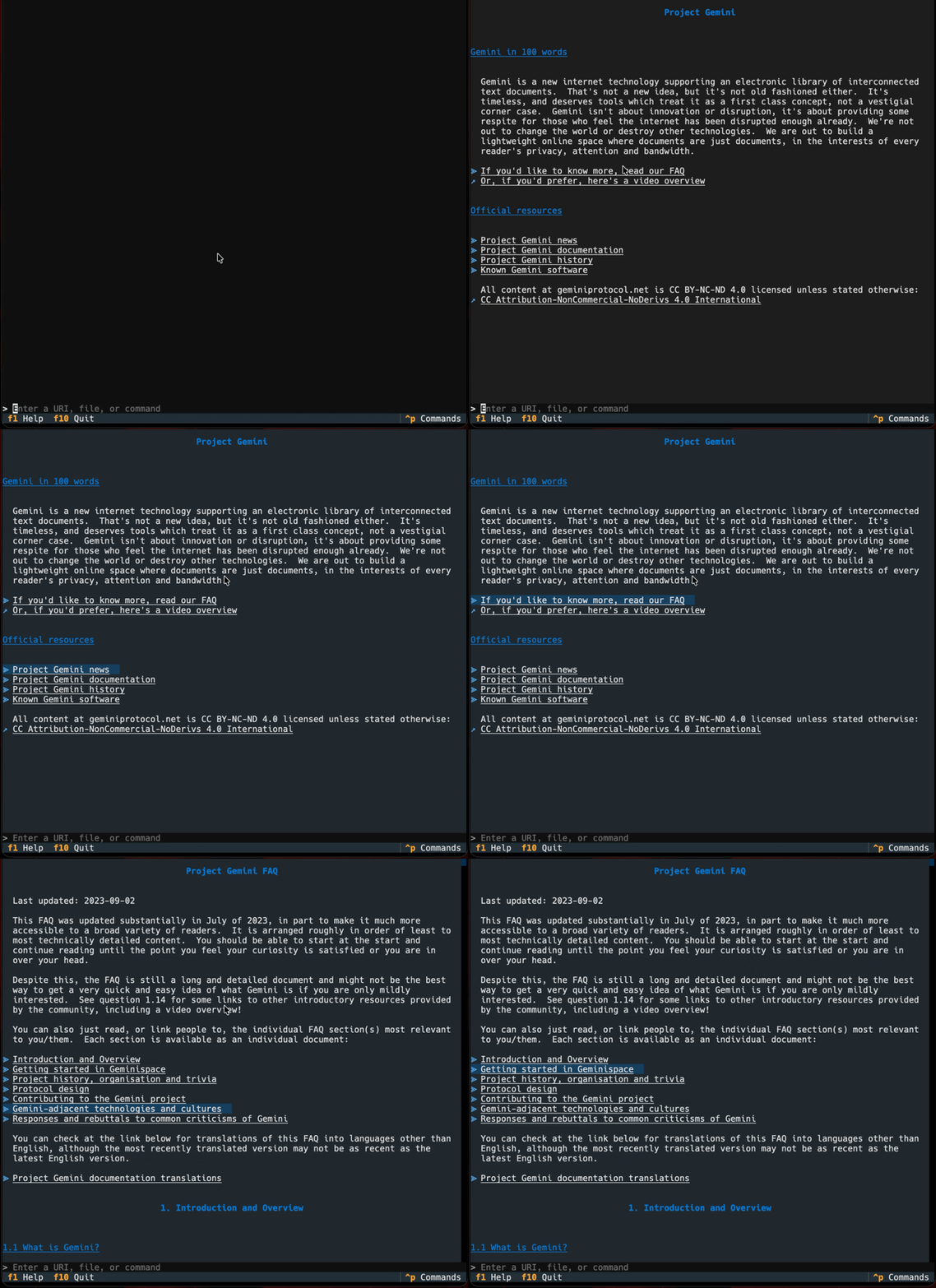
Work continues on my terminal-based Gemini client. So far today I've done a bunch of work on tweaking the presentation of a site, improving some of the widgets that go into the on-screen document. I've also added the start of a history system. So now it's easy to navigate backwards and forwards between pages.

History navigation in action

While there's still a lot of work that I want to do on it, I feel that with the addition of this feature, it might be close to time for me to make it public. It's going well and heading in the right direction, so it feels like the moment when I accept it's not going to be something I abandon, but now have to see to completion.

There are also some design choices I've made this time around that have made me want to revisit Hike at some point in the future. Not for a while yet, but I want to go back and clean up some of the code. After AI-based coding I've been doing lately, it's really nice to be hands-on again and designing every single line. It's a good reminder that working this way ensures a much bigger-picture view of how an application hangs together, and how it can benefit other applications you're maintaining.

Gemini client rendering

1 min read; 11 GFI

Yesterday I got the basic framework of my Gemini client up and going, and this evening I've been working on getting rendering of the gemtext in place. It's not the most tricky format to handle, so the parser and Textual widget to display the result have come together pretty quickly.

Browsing with the client

With this in place I've got the core of a working client now. Next up is going to be adding history with forward and backward navigation, then after that things like bookmarks and so on.

Gemini client basic framework

1 min read; 10 GFI

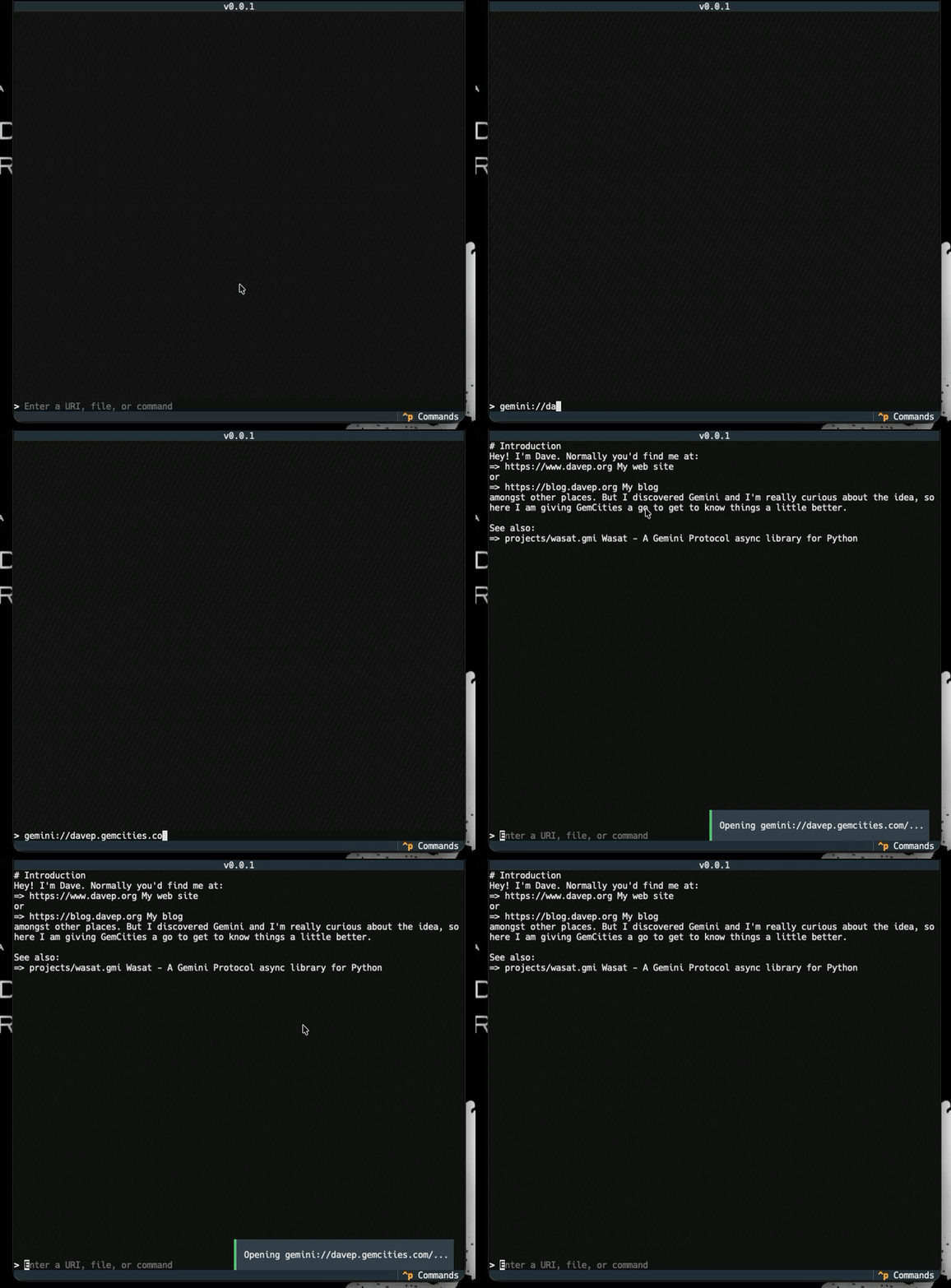
Following on from the initial release of Wasat yesterday, I've got a very basic proof-of-concept client up and running. So far, so good. Here it is loading up my own capsule on GemCities:

Loading my capsule

There's a lot to do yet, it'll be some time before this turns into a public project, but having it at least load up a document from a capsule means there's enough there for me to want to keep going and developing this.

Also, as I said yesterday, this is all home-grown and hand-crafted code. BlogMore has been tons of fun, but it's nice to kick off a significant bit of Python code where I'm writing it all myself. It's nice to be in that flow state once again.

Wasat - A Gemini protocol library for Python

2 min read; 10 GFI

I can't remember how and where I saw it, but just over a week ago I ran into Project Gemini. Somehow I've never read or seen anything about this before, which is pretty wild considering it's been on the go for around seven years now. As I read up on it I got more and more intrigued. I had the urge to do... something with it.

I think the thing I want to do, and I know I'm far from the first, is write a client for the terminal. I'm envisioning something very similar to Hike, but obviously only targeting the gemini protocol itself, and only handling and rendering gemtext.

I will, obviously, be looking to write this in Python, and of course, will be looking to use Textual, which means that it would be useful to have a Python client library for the protocol, and ideally a client library that is async. I did some searching, found client libraries, but none of them seemed to be async-first.

With this in mind, and to kick-start the project, last night I fired up Antigravity1 and got a library up and going. Wasat is the result. For the moment this should be considered alpha-status software (hence v0.0.1). I've done some very rudimentary testing and experimenting with it and, so far, so good. It's also proving to be a good tool with which to get to know the protocol. It also gives me another project to use to experiment with an agent (this being the first project I've started from scratch using Antigravity).

Over the next few days I'm going to toy with the library more, clean up the code, look for any issues, and then I'll start on the client application. That will be hand-built; no AI. I have some ideas of fun things I want to do, especially when it comes to handling gemtext.

It'll be nice to have a new pet project that's a hand-coded project. The first significant one since OldNews.

Getting back to Wasat itself: I believe it has everything necessary to allow for writing such a client (which, to be fair, isn't much -- that's kind of the point of the protocol). It also comes with a simple CLI built in, which can be run with python -m wasat (if it's just installed as a library) or with wasat (if installed globally, along with any command scripts). The command itself is just a simple download tool for a "page" in a "capsule". For example, I can grab the content of a test capsule I've created:

$ wasat gemini://davep.gemcities.com/
# Introduction
Hey! I'm Dave. Normally you'd find me at:
=> https://www.davep.org My web site
or
=> https://blog.davep.org My blog
amongst other places. But I discovered Gemini and I'm really curious about
the idea, so here I am giving GemCities a go to get to know things a little
better.

(with thanks to GemCities for providing a neat little service).

As for where this is all going: there's no direction, really. I've found a neat new thing that I didn't know about before, the idea sits well with me, and I want to explore it more. It also gives me an excuse to do a thing I really enjoy doing: writing terminal-based TUI applications for the sake of it, and especially writing one that works just how I want.


  1. No, not that one, the other one. ↩