Posts tagged with "Markdown"

kbdify.el v1.0.0

1 min read

When I'm writing documentation in Markdown I like, where possible, to mark up keys with the <kbd> tag. This was the reason for one of the updates to BlogMore: I'd not done any good default markup for <kbd> and the moment I realised, I knew I had to fix it.

Now that I'm writing more on this blog, and especially about coding, I'm mentioning keys pretty often (even more so given I'm doing a lot of tidying up of my Emacs Lisp packages). The thing is though: I find having to type out <kbd> and </kbd> kind of tedious, and it's something I mistype from time to time. I guess I could use some sort of HTML tag inserting tool or whatever, but I got to thinking that it would be handy if I could point an Emacs command at a particular sequence in a buffer and have it mark up the whole thing.

This resulted in a small bit of code I'm calling kbdify.el. It's pretty simple, if point is sat on some text that looks like this:

C-M-S-s-<up>

and I run kbdify I get this:

<kbd>C</kbd>-<kbd>M</kbd>-<kbd>S</kbd>-<kbd>s</kbd>-<kbd>&lt;up&gt;</kbd>

The result rendering as C-M-S-s-<up>.

I could probably take it a bit further, have it optionally work on a region and stuff like that, but even in its current simplistic form it's going to be loads quicker and a lot more accurate and will probably perfectly cover 99% of the times I need it. There is the issue that it's not going to handle something like M-x some-command RET in the way I might like, but then again some-command isn't a key. Like, does it make more sense to have:

M-x some-command RET

anyway? Personally I think this:

M-x some-command RET

probably makes more sense.

I think I'm good for now.

BlogMore v2.14.0

1 min read

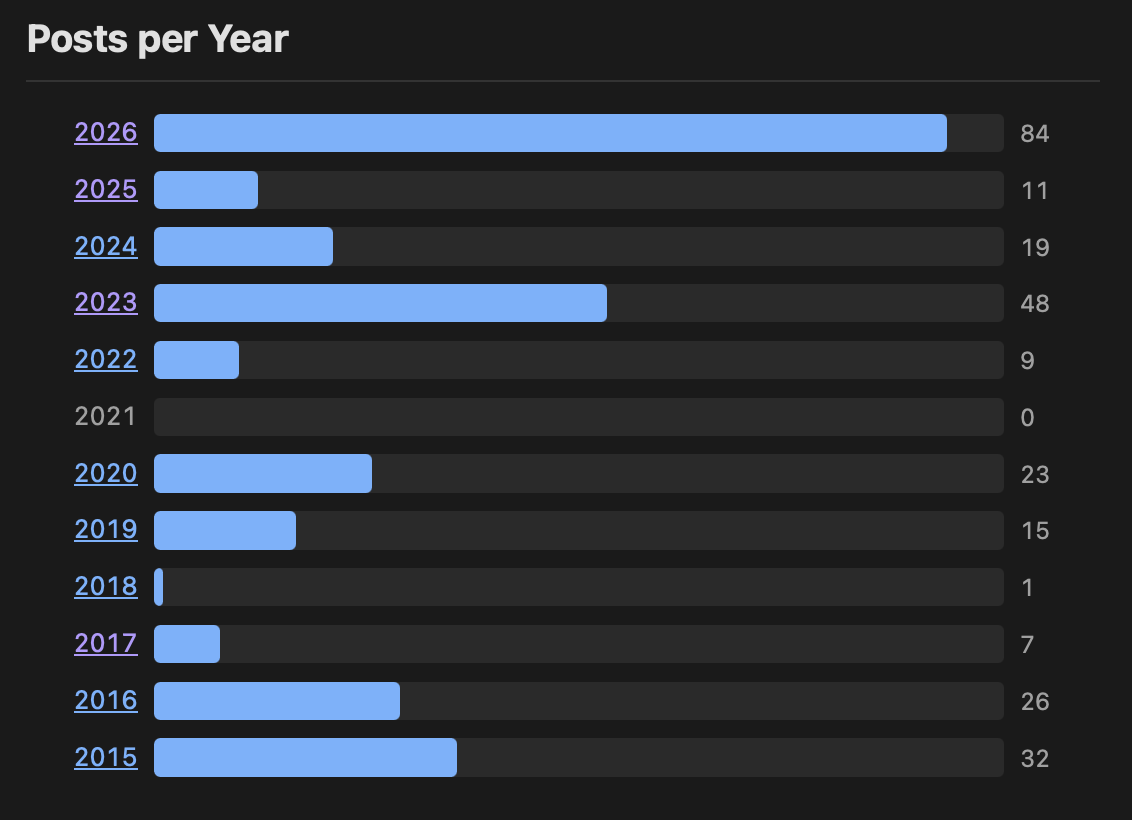
Quick little update for BlogMore, with a bump up to v2.14.0. This release comes from another feature request from Andy1, where he asked if it would be possible to have a year-based bar chart in the stats page.

Funnily enough I'd been thinking about the same thing just yesterday. I'd been wondering if it was worth adding, or if it would be overkill given the numbers can be seen in the archive. Having been asked by someone else... that was all the prompting I needed to kick that off.

Posts per year for my blog

Now I'm glad I did this. I like the result, it's a different way to visualise the values, and it's yet another way for people to discover past posts on the blog.

For sure BlogMore is now feature complete.


  1. Who recently wrote an interesting article about his experience of migrating his blog from Hugo to BlogMore 

OldNews v1.4.0

1 min read

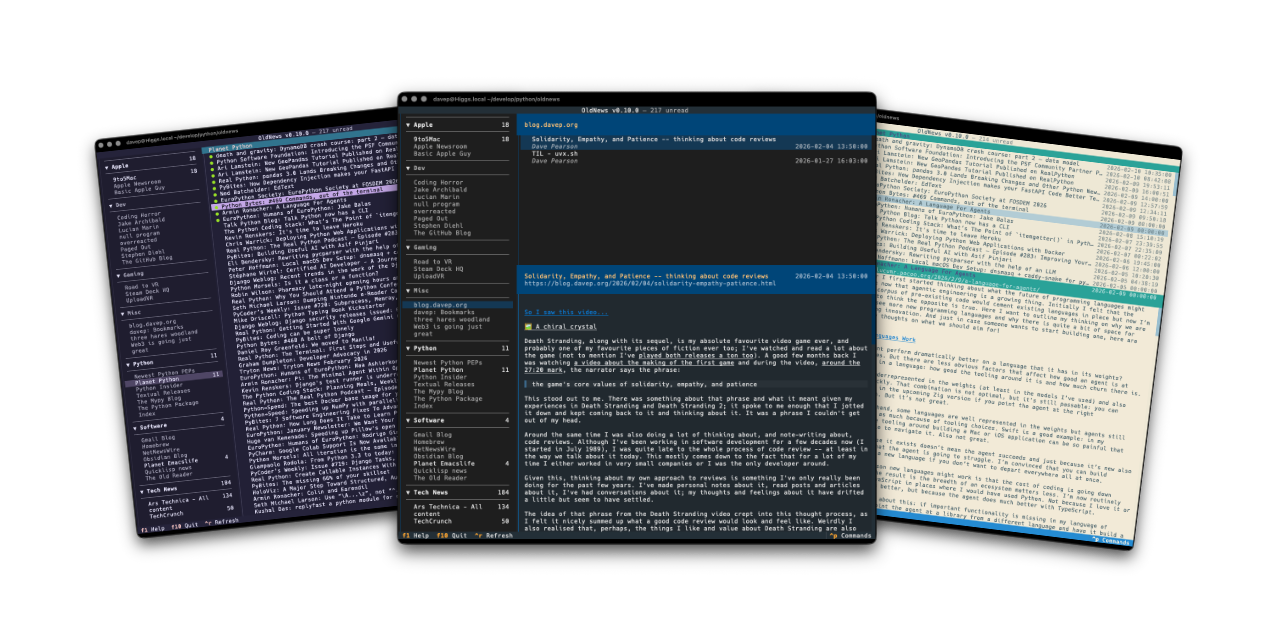
OldNews

Yesterday evening I released v1.4.0 of OldNews, my terminal-based client for TheOldReader.

The change in this release is pretty straightforward, but something I kept finding myself wanting. I've added three new commands to the application:

  • JumpToSubscriptions - Jump to the subscriptions panel
  • JumpToArticles - Jump to the articles panel
  • JumpToArticle - Jump to the article panel

By default they're bound to 1, 2 and 3. So now skipping around the UI and navigating to a different article or blog is just a bit quicker.

If you're a user of TheOldReader and fancy interacting with it from the terminal: OldNews is licensed GPL-3.0 and available via GitHub and also via PyPI. It can also be installed using uv:

uv tool install oldnews

If you don't have uv installed you can use uvx.sh to perform the installation. For GNU/Linux or macOS or similar:

curl -LsSf uvx.sh/oldnews/install.sh | sh

or on Windows:

powershell -ExecutionPolicy ByPass -c "irm https://uvx.sh/oldnews/install.ps1 | iex"

If uv isn't your thing then it can also be installed with pipx:

pipx install oldnews

Once installed, run the oldnews command.

BlogMore v2.13.0

1 min read

Following on from yesterday's release of BlogMore, I've been looking at some more information in the Google Search Console, which helped me uncover a couple more bugs in relation to URL generation.

This time I noticed a couple of issues, both related to the clean_urls setting. The first was that, in the recently added calendar page, all of the URLs for the links into the date-based archive weren't taking clean_urls into account. That's now fixed.

The second problem was the canonical <link> tag in the headers of the various archive pages (categories, tags, date-based): none of the URLs used in the tag were being cleaned up if clean_urls was true. That's now also fixed.

The main "problem" those two issues were causing was Google was seeing the sitemap for my blog declare one URL, but discovering different versions of the URL elsewhere; the main offending part here being the canonical URL declaration that disagreed with the sitemap.

To the best of my understanding the above fixes should clean a lot of that up.

Also in this new release is a small new feature. After cleaning up the sitemap generation in v2.12.0 I got to thinking that, perhaps, there would be occasions where a user would want to be able to add extra items to the sitemap. With this in mind I've added the sitemap_extras configuration property. With this you can declare extra URLs to drop into the sitemap, if one is being generated.

sitemap_extras:
  - /some/path/
  - /some/file.html

I don't think I have a use for this right now, I'm not sure I'll ever have a use for it, but it feels like a low-cost feature to add that could be useful to someone at some point.

obs2nlm v1.2.0

1 min read

Three months back I released obs2nlm, a tool that takes an Obsidian vault and turns it into a single Markdown file so it can be used as a source for NotebookLM.

Since then I've been using it a lot and it's working out really well.

Meanwhile, one of my vaults has started to creep up towards the documented word limit for a single source in NotebookLM (500,000 words). Right now it's sitting at around 75% and is steadily creeping up.

So, with this in mind, I've made a change I've been planning from the start and have added a --split option. If used, if the generated file looks like it's going to hit the word limit, a second (or more) file will be created. The naming scheme is simple enough: if you ask obs2nlm to create an output file called dirt.md and it needs to run over, it'll then create dirt-2.md, dirt-3.md, and so on. The idea then is that, rather than upload that single Markdown file as a source, you upload all of the generated Markdown files.

Given you get up to 50 sources per notebook, this should see me right for any reasonable vault. As for if it will affect the quality of the results I get when I query the notebook... that's hard to say until I find myself in that situation. If Google are to be believed it shouldn't be an issue, and the alternative is to fall foul of the limit so this seems like the only sensible solution.

I've also added a --dry-run command line switch too; this should be handy for checking how big a vault is when compared to the word limit, without actually generating any files.

BlogMore v2.12.0

1 min read

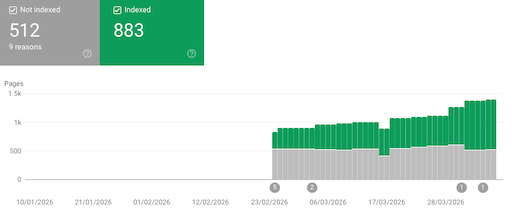
Since kicking off building BlogMore and swapping this blog over to using it I've been playing with the Google Search Console. It's something I've not used in decades, but felt it was time to dip back in again and understand how it works these days.

There are two motivations for this: the first is that, when it comes to my day job, I have cause to interact with people who do use the search console a lot, and so it's worth understanding what they work with and why it matters to them. The second reason is it's a reasonable measure of how good a site BlogMore generates.

Page index inclusion progress

So far the results have been pretty good, and the console has helped me find oddities and things that need tidying up.

So this release of BlogMore includes a couple of changes that stem from looking at the latest updates in the console.

The first is that I've cleaned up how the sitemap.xml gets generated. I noticed that if I had any HTML inside my extras directory it was turning up in the sitemap; something I didn't intend and didn't want. So that's now fixed: only pages generated by BlogMore will appear in sitemap.xml1.

The second is that the stats page, despite being in the sitemap, had a noindex header for some reason. That's now been fixed. The only generated page I've intentionally set up so that it isn't indexed is the search page.

Finally, there's one change unrelated to the above: I realised that if you have with_read_time set to false, the reading time stats still appeared on the stats page; that seems unnecessary and unwanted on a site that doesn't show reading times. So, as of v2.12.0, that section of the stats won't show if reading times are turned off.


  1. Now I think about it, I suppose there might be occasion where someone wants extra HTML to appear in the sitemap. I might consider the idea of allowing extra entries to be declared via the configuration file. 

BlogMore v2.11.0

2 min read

After adding the streak display to the stats a couple of days back, I got a little more obsessed with knowing what sort of runs of days of posting to the blog I had. I even said in that post:

It almost makes me want to do a whole-blog-lifetime version of it, or perhaps some sort of more calendar-oriented version of the archive.

Despite saying that I fancied the idea of that calendar-type view, first off I got to thinking it would be interesting to see a table of my 10 longest streaks. So that got added and can now be found in the stats page.

A table of my 10 longest streaks

Having added that, I kept thinking about the whole-blog visual view of "here's the whole time of the blog, and here are the days you posted". I did think it might be interesting to use the same style and layout as the streak display -- perhaps something that would look like my whole contribution history on GitHub that I wrote about back in 2023 -- but the problem with that is it's tricky to make it work well on all display types. I needed something that would collapse better on smaller displays.

So I decided that a more conventional calendar display might work better. While it took a bit of work to get it to really land as I wanted, it turned out pretty much how I wanted.

So now there is a with_calendar configuration option that, if set to true, will add a calendar link at the top of the site. By default it looks like this:

The default calendar view

If it looks a little unconventional at first glance, that's because it is. I wanted something that started with the most recent month in which there's a post, and which then worked backwards. This way I can see things as a proper history. But I can also see that this might seem odd to some people. Given this, I've also added a forward_calendar configuration option that can be used (when set to true), to flip the calendar into a more normal flow.

The alternative calendar view

As you might expect, the calendar links to other parts of the site: clicking on a day with a post takes you to the archive for that day, clicking on a month name where there are posts in a month takes you to the archive for that month, and the same again for a year title.

I'm pretty pleased with the result. In testing it seems nicely responsive to different display types and I'm also finding it to be yet another interesting way to discover older posts (and get a sense of when I was encouraged to post going back over the last 11 years of this particular blog1).

One final little feature I've added is a small enhancement to the read time that can appear on each post. While it's long since been possible to decide if you want it there or not, the calculation itself has been hard-wired to the assumption that 200 wpm is the reading speed of the reader. I've now added read_time_wpm as a configuration option so you can set it to suit your own taste.


  1. I have other, much older, blogs out there on the net. One day I might merge them with this one and back-fill the whole thing. 

BlogMore v2.10.0

1 min read

I've released an update to BlogMore, with another little straightforward addition. This time I'm revisiting the statistics page and adding a streak tracker, of sorts.

My blog streak

Modelled after the GitHub contribution tracker, or indeed any number of other streak trackers, it shows which days in the recent past I've blogged on, and also an indication of how many posts I've made that day.

Of course, it's not quite a full streak tracker. It's only going to show the days up to the day the site was last generated; so when a reader visits and looks, if you've not generated the site for a month, it's not going to show that you've not blogged for a month1. The point is that if you last blog in January, come March or so the reader isn't going to see 2 months of empty days, until you regenerate the site.

So, not perfect, but good enough I think. Also it gives the reader another method of discovering posts (each cell will take them to the archive for that day, so they can read the post or posts for that day).

I've also tried to make it vaguely responsive. There are narrower date ranges as the display gets narrower. We start out at 10 months (as you can see above), then drop to 9 months:

Last nine months

and then dropping to 5 months once we get to mobile-type screens:

Just five months

For all its flaws, I feel it's kind of fun and I like it as a new discovery tool. It almost makes me want to do a whole-blog-lifetime version of it, or perhaps some sort of more calendar-oriented version of the archive. For now though I'm going to settle with this and see if it encourages me to keep up a blogging streak.

While it isn't my intention to write posts for the sake of it, I am enjoying writing something more frequently, so this might just help keep me doing that.


  1. I could solve this problem by having the whole thing generated on the fly with some JavaScript, but that felt like it wasn't in the spirit of a static site generator. 

BlogMore v2.9.0

1 min read

After releasing blogmore.el v2.6 this morning, I noticed something about the post: the text that was marked up with <kbd> wasn't really standing out as keys. In blog posts, as in documentation, if I mention the name of a key, I like to mark it up with <kbd>. Ideally, with such markup, the styling of the page it's being used on will make it clear that it's supposed to be read as a key.

I've never put any such styling into the default styles made available in BlogMore.

So here we are with BlogMore v2.9.0, now with a bit of markup, and theme support, for keys marked up with <kbd>. So now, hopefully, if I say you should press Ctrl+F4 to make this blog look better, those keys should stand out a little better than they used to.

BlogMore v2.8.0

1 min read

I've just published v2.8.0 of BlogMore to PyPI. This is a small update which addresses a bug that Andy reported.

The fix was simple enough, and is another little interesting thing to keep in mind given that BlogMore is an ongoing Copilot experiment. When I first kicked off BlogMore I let it decide which library to use to handle Markdown (I'm more used to markdown-it-py via Textual and so via Hike), and so also let it decide which extensions made most sense given the request. I've honestly never run into the idea of metadata before, only ever dealing with or caring about frontmatter1.

On the other hand, I will say this: I was cooking dinner when the report came in; I pointed Copilot at the issue and let it figure it out. After eating, clearing things away, and general post-dinner chilling, I dropped into the repo to see what it had made of it and... it had figured the issue out and fixed it.


  1. I guess technically they're the same thing, but here I mean I'm more used to the delimited YAML of frontmatter than whatever it is the meta plugin was dealing with.