Posts tagged with "PyPI"

BlogMore v2.9.0

1 min read

After releasing blogmore.el v2.6 this morning, I noticed something about the post: the text that was marked up with <kbd> wasn't really standing out as keys. In blog posts, as in documentation, if I mention the name of a key, I like to mark it up with <kbd>. Ideally, with such markup, the styling of the page it's being used on will make it clear that it's supposed to be read as a key.

I've never put any such styling into the default styles made available in BlogMore.

So here we are with BlogMore v2.9.0, now with a bit of markup, and theme support, for keys marked up with <kbd>. So now, hopefully, if I say you should press Ctrl+F4 to make this blog look better, those keys should stand out a little better than they used to.

BlogMore v2.8.0

1 min read

I've just published v2.8.0 of BlogMore to PyPI. This is a small update which addresses a bug that Andy reported.

The fix was simple enough, and is another little interesting thing to keep in mind given that BlogMore is an ongoing Copilot experiment. When I first kicked off BlogMore I let it decide which library to use to handle Markdown (I'm more used to markdown-it-py via Textual and so via Hike), and so also let it decide which extensions made most sense given the request. I've honestly never run into the idea of metadata before, only ever dealing with or caring about frontmatter1.

On the other hand, I will say this: I was cooking dinner when the report came in; I pointed Copilot at the issue and let it figure it out. After eating, clearing things away, and general post-dinner chilling, I dropped into the repo to see what it had made of it and... it had figured the issue out and fixed it.


  1. I guess technically they're the same thing, but here I mean I'm more used to the delimited YAML of frontmatter than whatever it is the meta plugin was dealing with. 

A new engine

2 min read

For about 2 and a half years now this blog has been built with Pelican. For the most part I've enjoyed using it, it's been easy enough to work with, although not exciting to work with (which I think is a positive thing to say about a static site generator).

There were, however, a couple or so things I didn't like about the layout I was getting out of it. One issue was the archive, which was a pretty boring list of titles of all the posts on the site. It would have been nice to have them broken down by date or something, at least.

Of course, there are lots of themes, and it also uses templates, so I could probably have tweaked it "just so"; but every time I started to look into it I found myself wanting to "fix" the issue by building my own engine from scratch.

Thankfully, every time that happened, I'd come to my senses and go off and work on some other fun personal project. Until earlier this week, that was.

The thing is... I've been looking for a project where I could dive into the world of "AI coding" and "Agents" and all that nonsense. Not because I want to abandon the absolute thrill and joy I still get from writing actual code as a human, but because I want to understand things from the point of view of people who champion these tools.

The only way I'm going to have an informed opinion is to get informed; the only way to get informed is to try this stuff out.

So, here I am, with my blog now migrated over to BlogMore; a project that gives me a blog-focused static site generator that I 100% drove the development of, but for which I wrote almost none of the code.

At the moment it's working out well, as a generator. I'm happy with how it works, I'm happy with what it generates. I also think it's 100% backwards-compatible when it comes to URLs and feeds and so on. If you do see anything odd happening, if you do see anything that looks broken, I'd love to hear about it.

As for this being a "100% AI" project, and how I found that process and how I feel about the implications and the results... that's a blog post to come.

I took lots of notes.

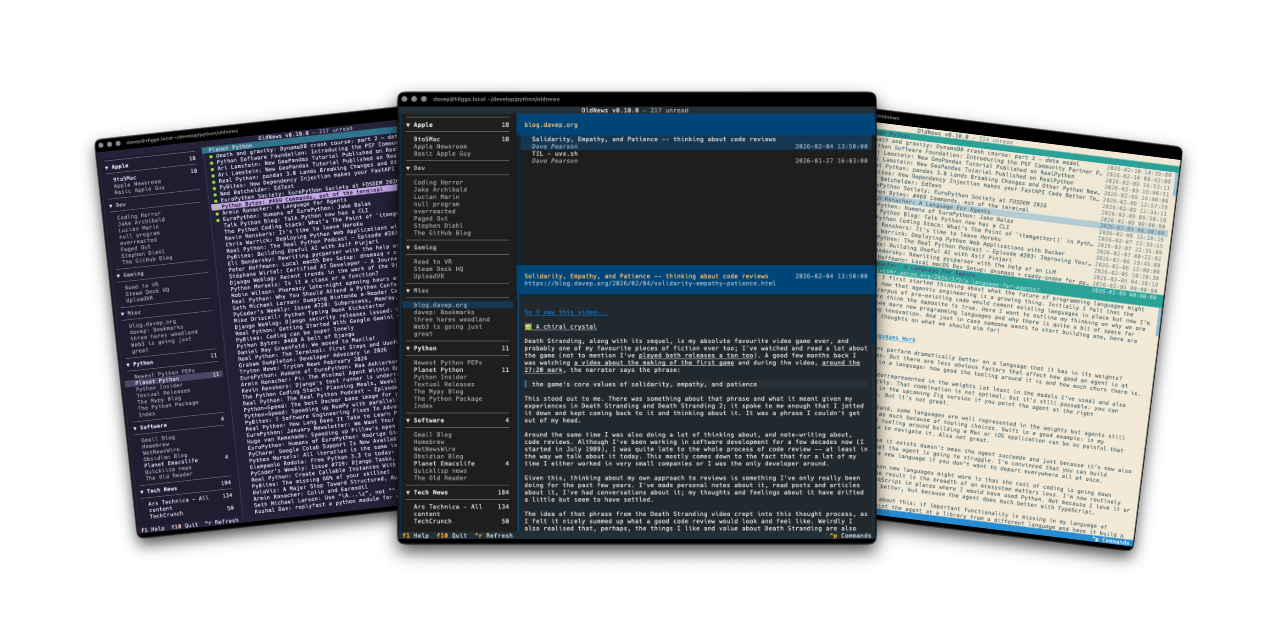
OldNews - A terminal-based client for TheOldReader

3 min read

OldNews

I honestly can't remember when I was first introduced to the idea of RSS/Atom feeds, and the idea of having an aggregator or reader of some description to keep up with updates on your favourite sites. It's got to be over 25 years ago now. I can't remember what I used either, but I remember using one or two readers that ran locally, right up until I met Google Reader. Once I discovered that I was settled.

As time moved on and I moved from platform to platform, and wandered into the smartphone era, I stuck with Google Reader (and the odd client for it here and there). It was a natural and sensible approach to consuming news and updates. It also mostly felt like a solved problem and so felt nice and stable.

So, of course, I was annoyed when Google killed it off, like so many useful things.

When this happened I dabbled with a couple of alternatives and, at some point, finally settled on TheOldReader. Since then it's been my "server" for feed subscriptions with me using detsktop and mobile clients to work against it.

But... I never found anything that worked for me that ran in the terminal. Given I've got a thing for writing terminal-based tools it made sense I should have a go, and so OldNews became my winter break project.
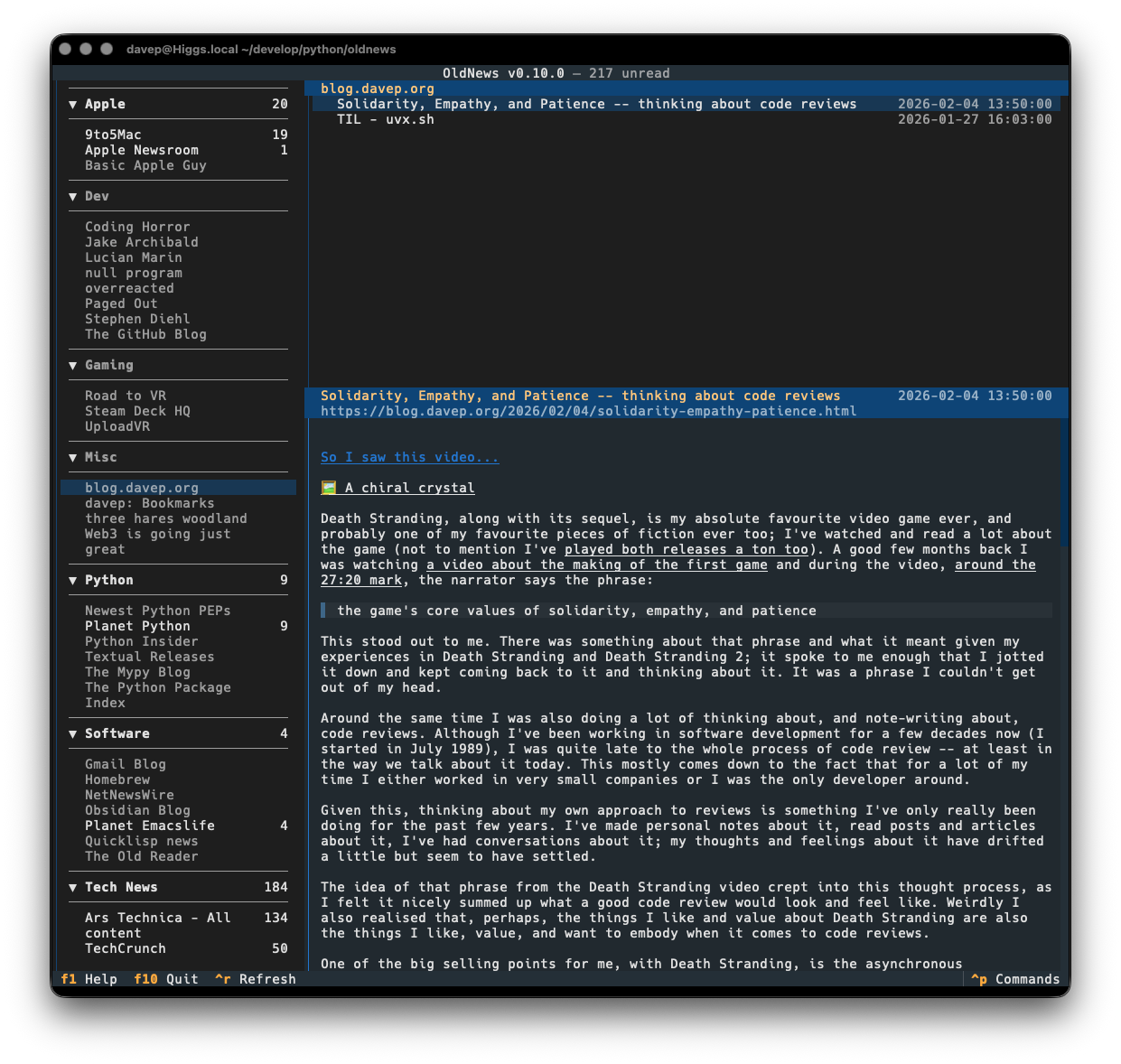
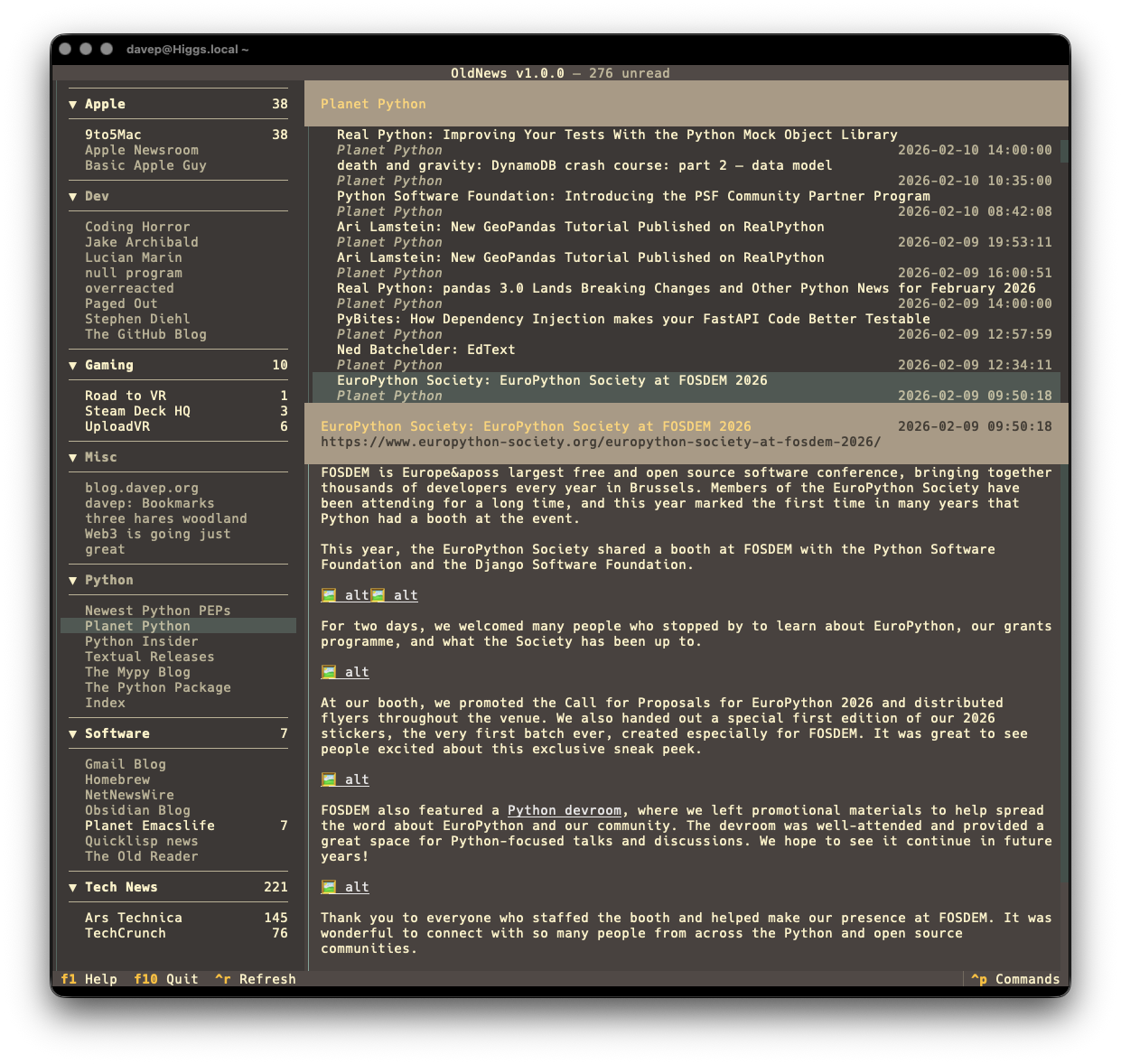
Reading an article in OldNews

I've written it as a client application for the API of TheOldReader, and only for that, and have developed it in a way that works well for me. All the functionality I want and need is in there:

  • Add subscriptions
  • Rename subscriptions
  • Remove subscriptions
  • Add folders
  • Rename folders
  • Remove folders
  • Move subscriptions between folders
  • Mark read/unread
  • Read articles (that provide actual content in their feeds)

Currently there's no support for starring feeds or interacting with the whole "friend" system (honestly: while I see mention of it in the API, I know nothing of that side of things and really don't care about it). As time goes on I might work on that.

As with all of my other terminal-based applications, there's a rich command palette that shows you what you can do, and also what keyboard shortcuts will run those commands. While I do still need to work on some documentation for the application (although you'd hope that anyone looking for an RSS reader at this point would mostly be able to find their way around) the palette is a good place to go looking for things you can do.
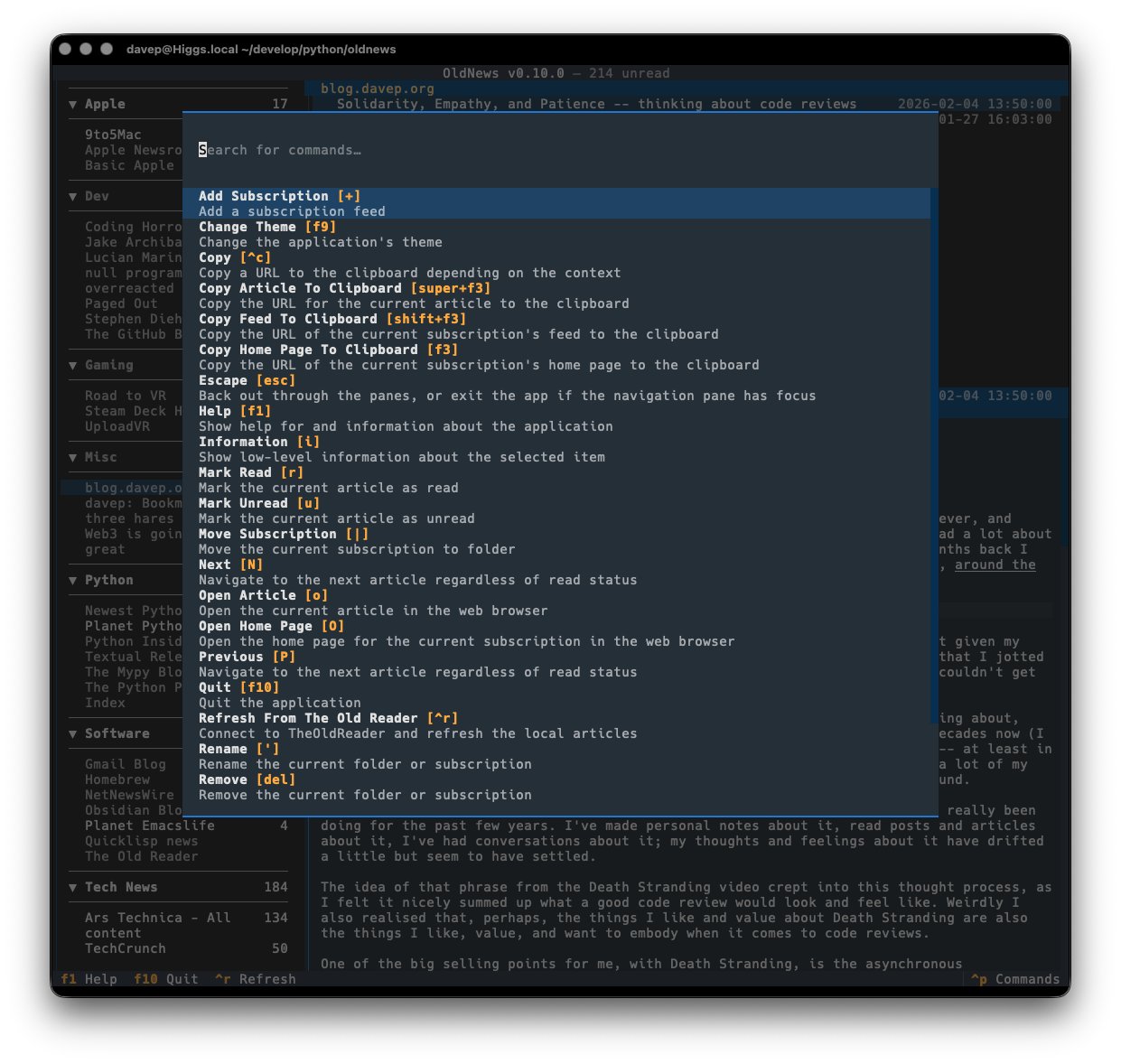
The command palette

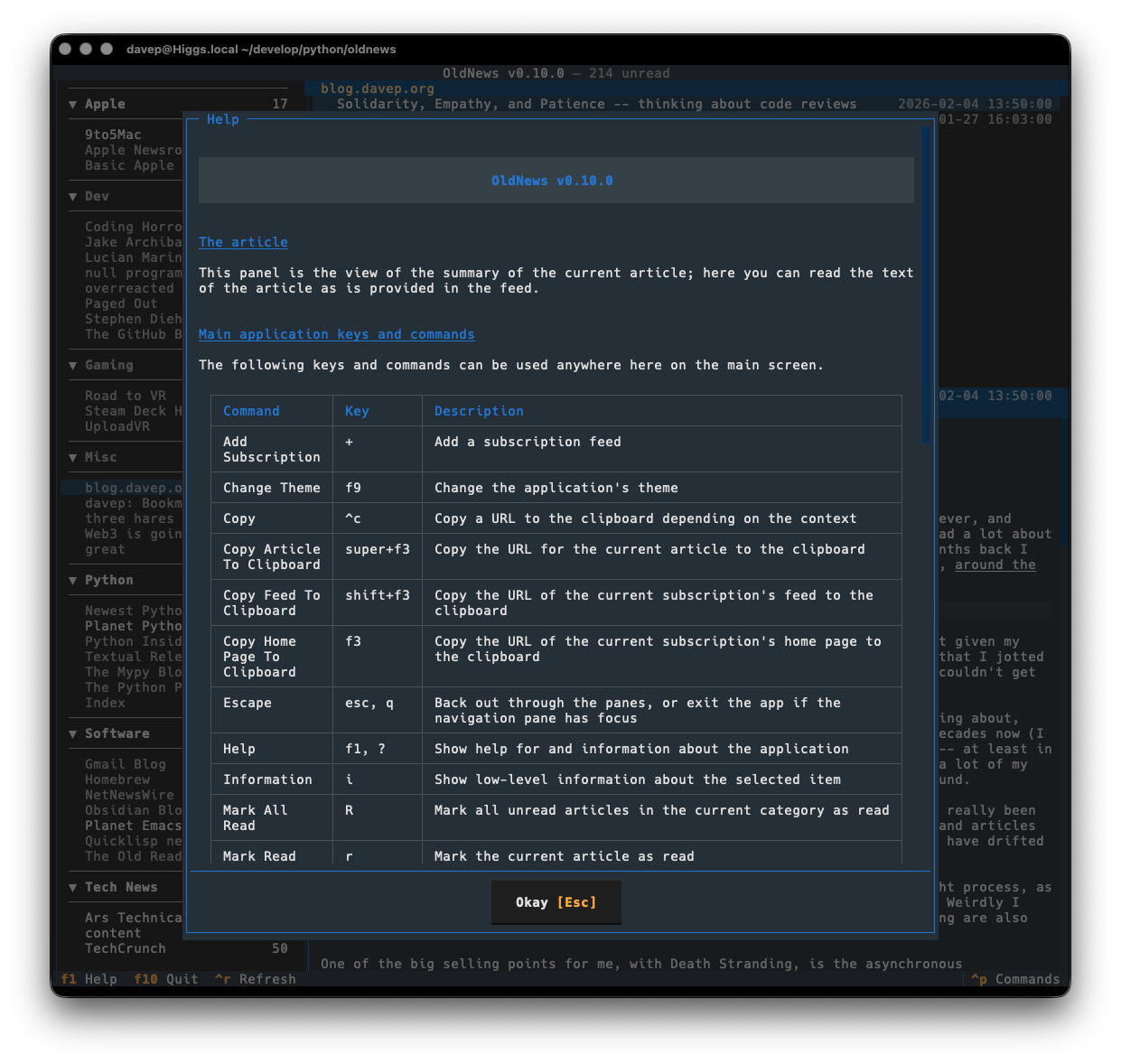
Plus there's a help screen too.

The help screen

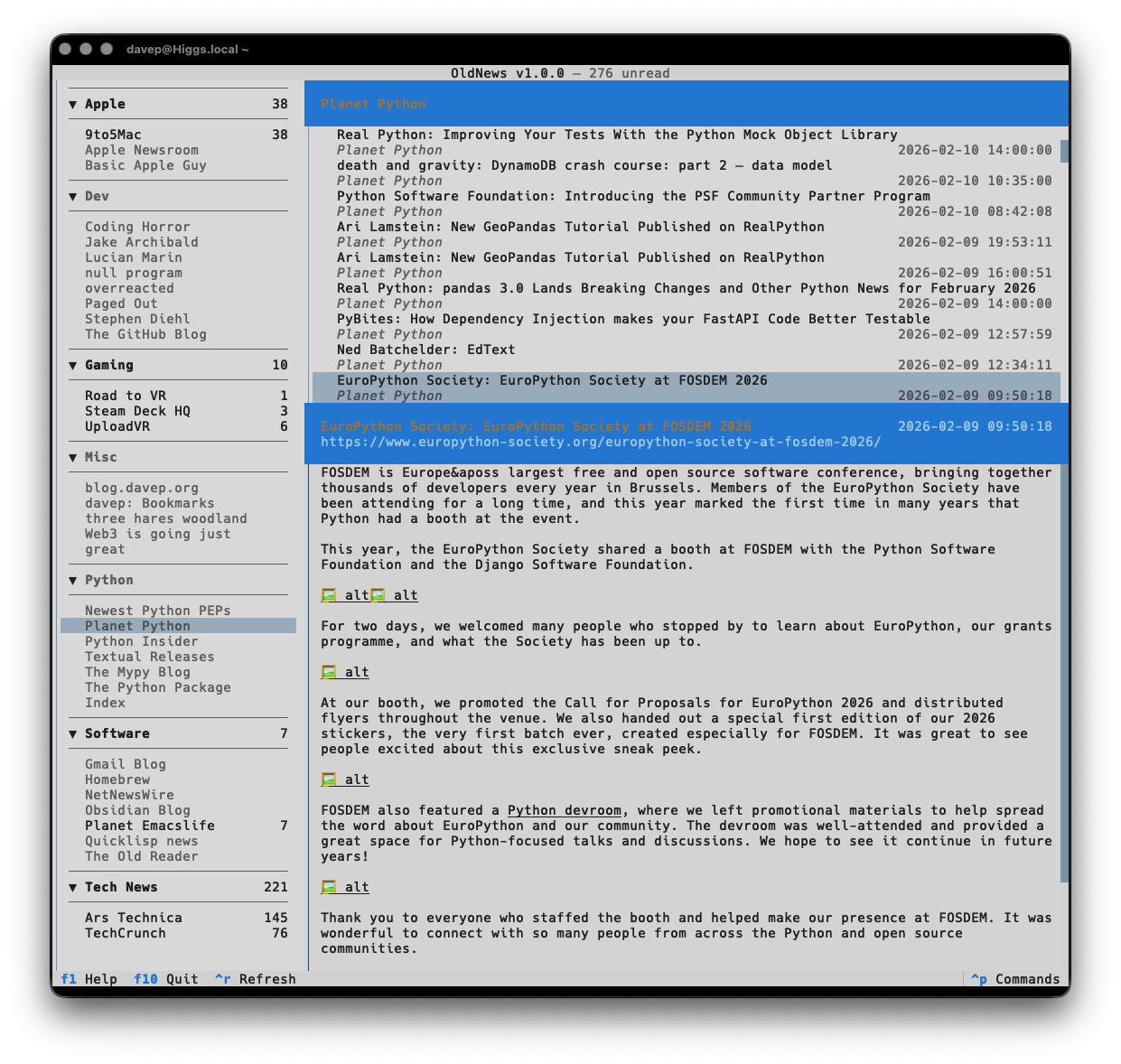
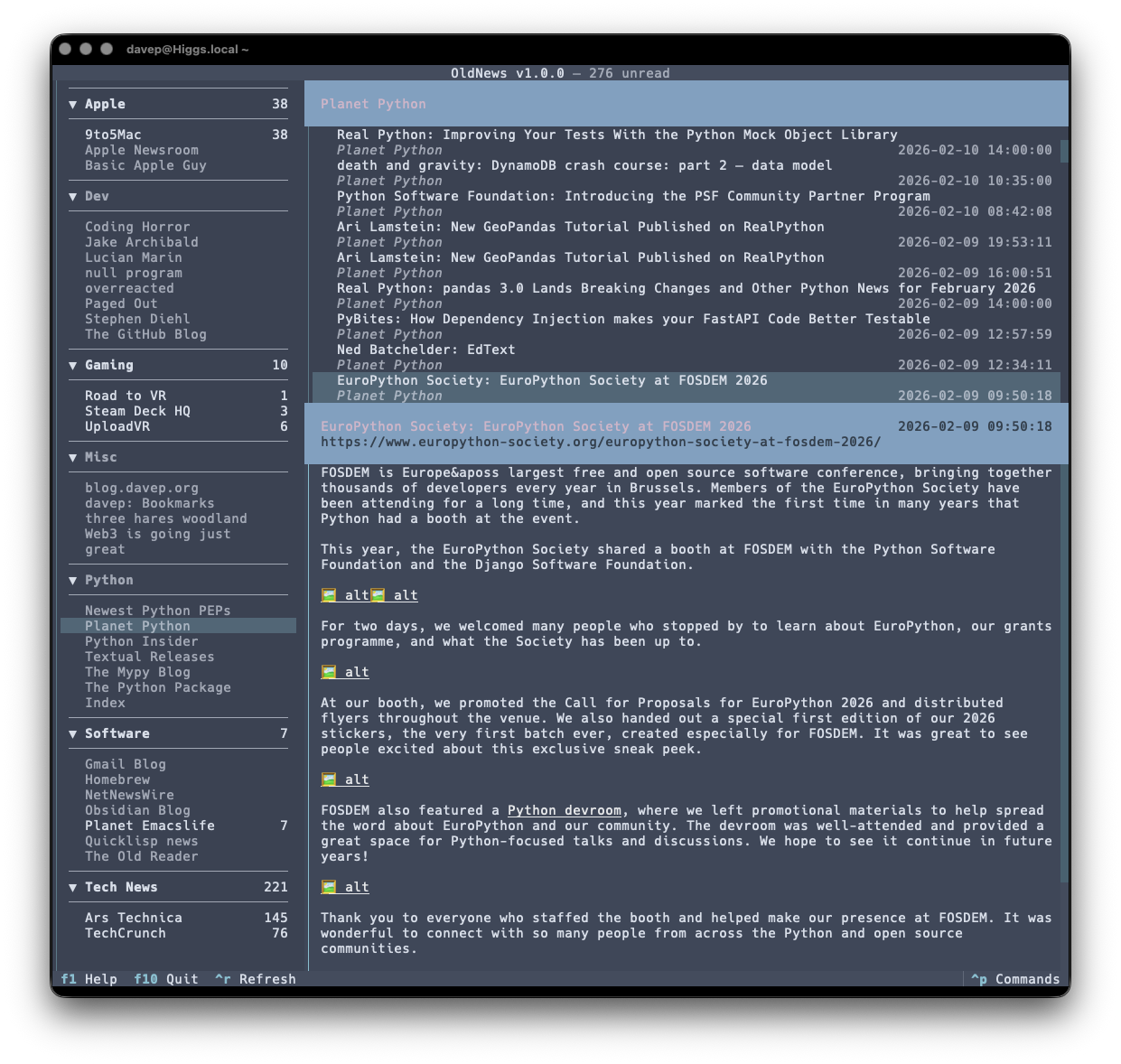
If themes are your thing, there's themes:
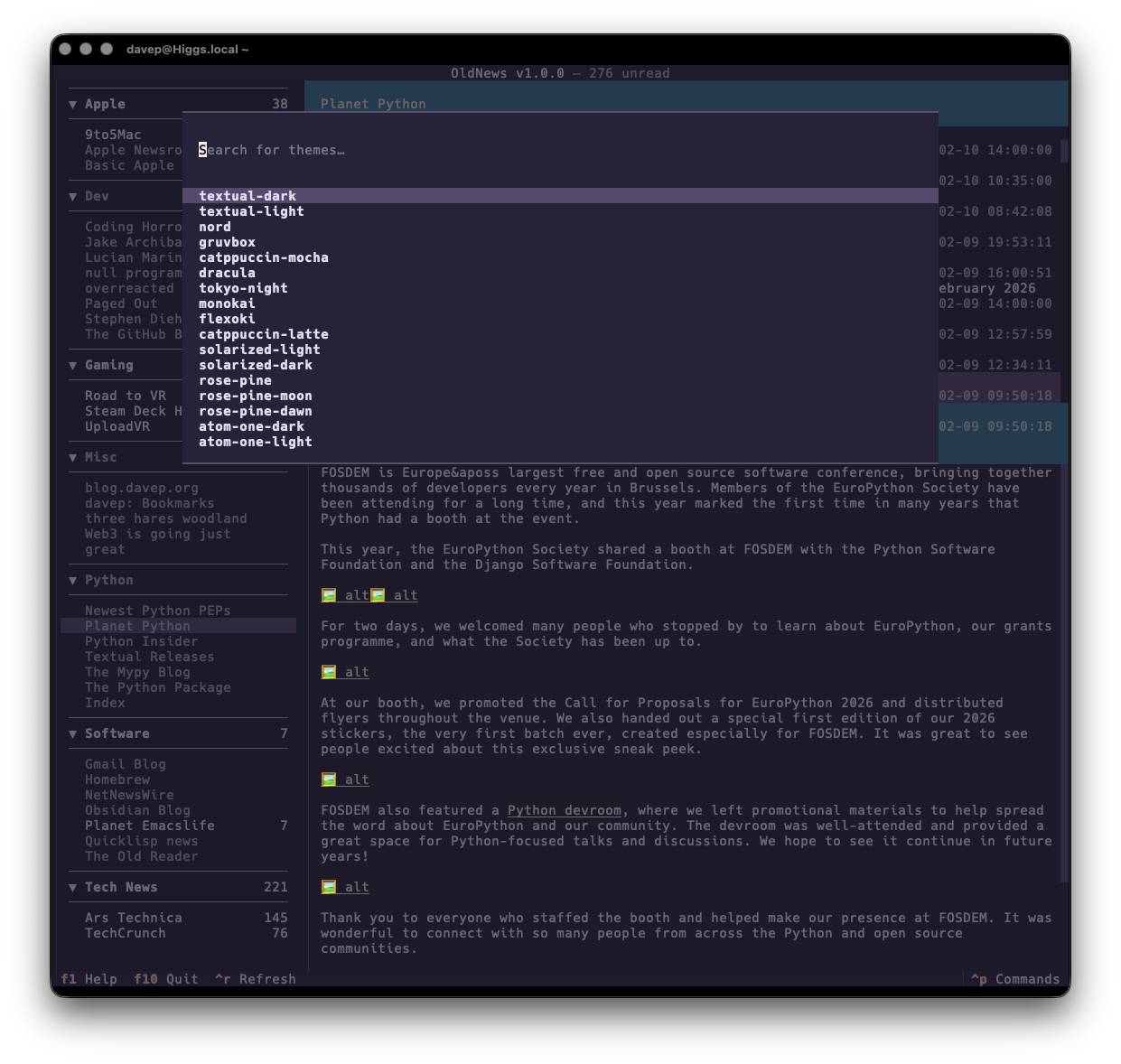
Available themes Gruvbox Textual Light Nord

That's a small selection, and there's more to explore.

Also on the cosmetic front there's a simple compact mode, which toggles between two ways of showing the navigation menu, the article lists and the panel headers.
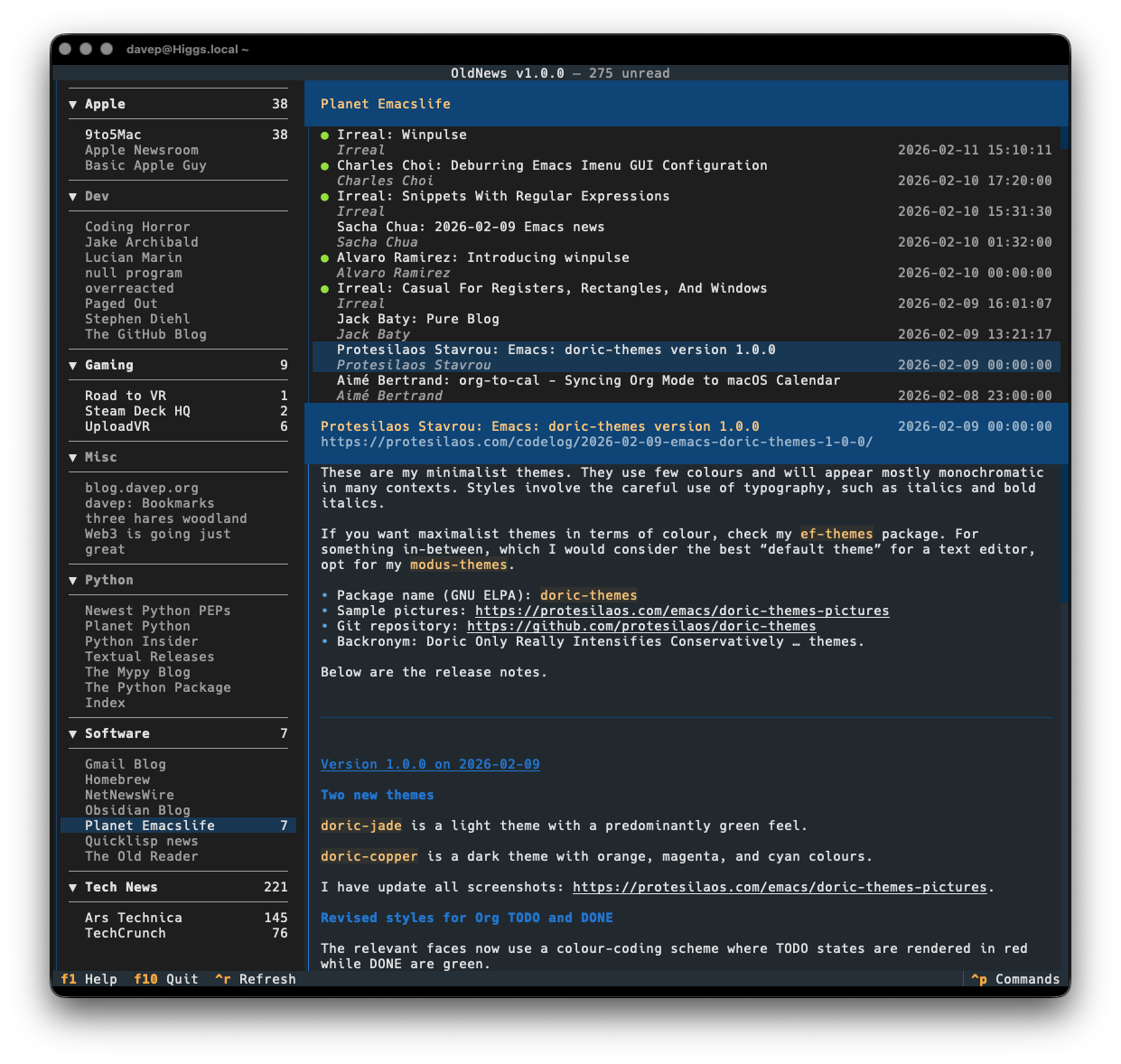
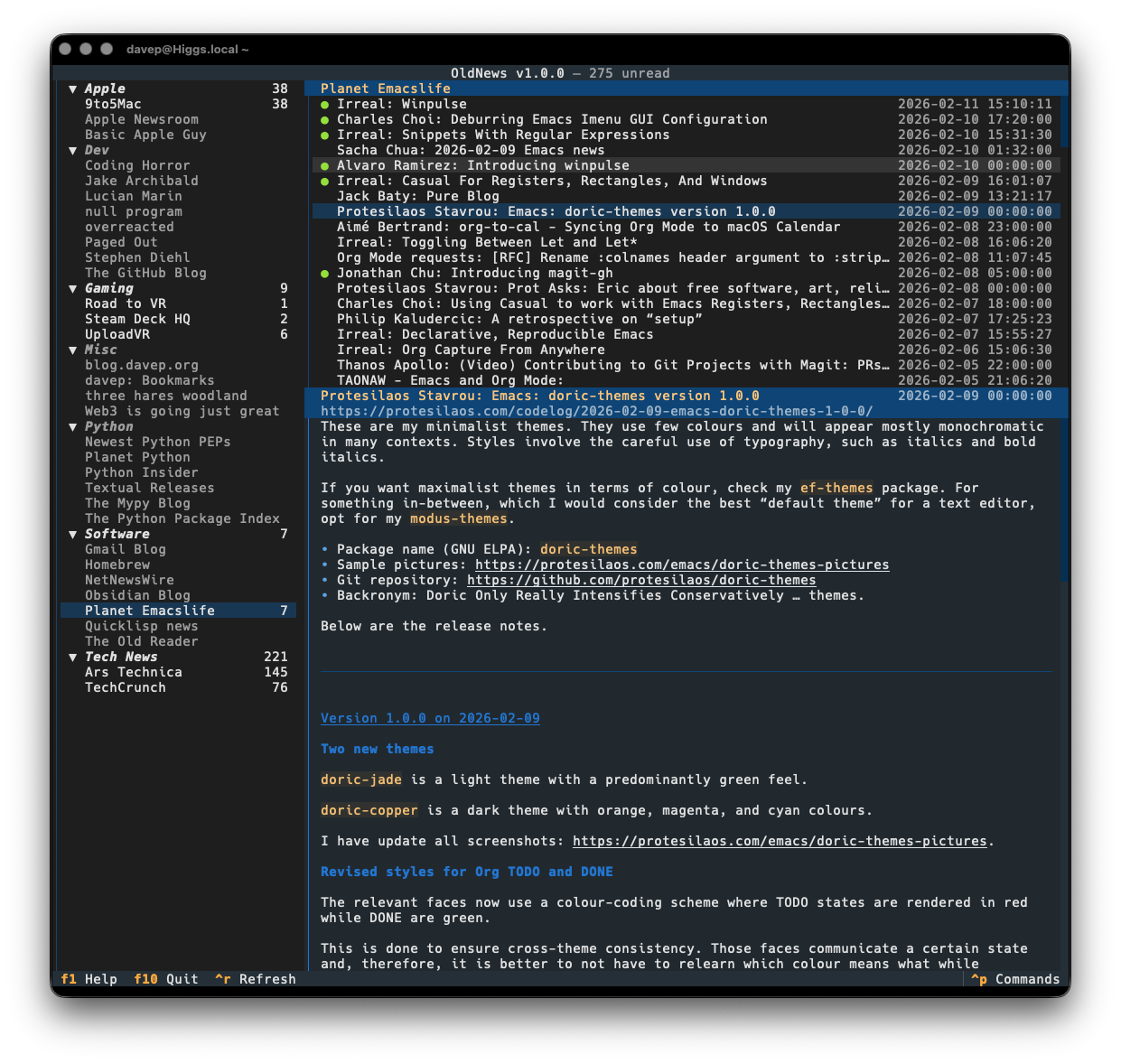
Not compact Compact

OldNews has been a daily-driver for a wee while now, while also under active development. I think I've covered all the main functions I want and have also shaken out plenty of bugs, so today's the day to call it v1.0.0 and go from there.

If you're a user of TheOldReader and fancy interacting with it from the terminal too then it's out there to try out. It's licensed GPL-3.0 and available via GitHub and also via PyPI. If you have an environment that has pipx installed you should be able to get up and running with:

pipx install oldnews

It can also be installed using uv:

uv tool install oldnews

If you don't have uv installed you can use uvx.sh to perform the installation. For GNU/Linux or macOS or similar:

curl -LsSf uvx.sh/oldnews/install.sh | sh

or on Windows:

powershell -ExecutionPolicy ByPass -c "irm https://uvx.sh/oldnews/install.ps1 | iex"

Once installed, run the oldnews command.

Hopefully this is useful to someone else; meanwhile I'll be using it more and more. If you need help, or have any ideas, please feel free to raise an issue or start a discussion.
TIL - uvx.sh

1 min read

In the past few months, like a lot of folk in the Python world, I've been won over by uv. When it comes to managing my own projects my journey over the past few years as been pipenv, then rye, and then when rye was killed off I finally swapped to uv (later than I should have, I realised in hindsight). At each step I've found each tool cleaner, easier to work with and more feature-rich.

There's no doubt in my mind that uv has done the most work to make installing Python-based tools (or at least PyPI-based tools) as friction-free an experience as possible.

Now I've discovered uvx.sh. The thing with uv is the person installing your application first needs to get and install uv; this site removes that friction. Now if someone wants to install obs2nlm (for example) they should be able to just do:

curl -LsSf uvx.sh/obs2nlm/install.sh | sh

and away they go (assuming they have curl installed, which is generally going to be far more likely than having uv installed).

Of course, there are the usual caveats and concerns about the "just pipe this stuff via sh trust me bro" approach, but if you are comfortable with suggesting this kind of install method it looks worth adding this to an application's installation documentation.

I think I'm going to start mentioning it as an option.

ng2nlm - Feed NotebookLM a Norton Guide

2 min read

After having knocked up obs2nlm the other day I realised there was another source of sources available to me that might be fun to throw into NotebookLM: one or more of the Norton Guide files in my collection!

And so, after a wee bit of hacking on a wet Sunday afternoon, ng2nlm was born.

In terms of what it does, it's pretty much the same as obs2nlm, only it uses ngdb to read the contents of a Norton Guide and turn it into a single Markdown file which can then be used as a source in NotebookLM.

So far it seems to be working a treat.

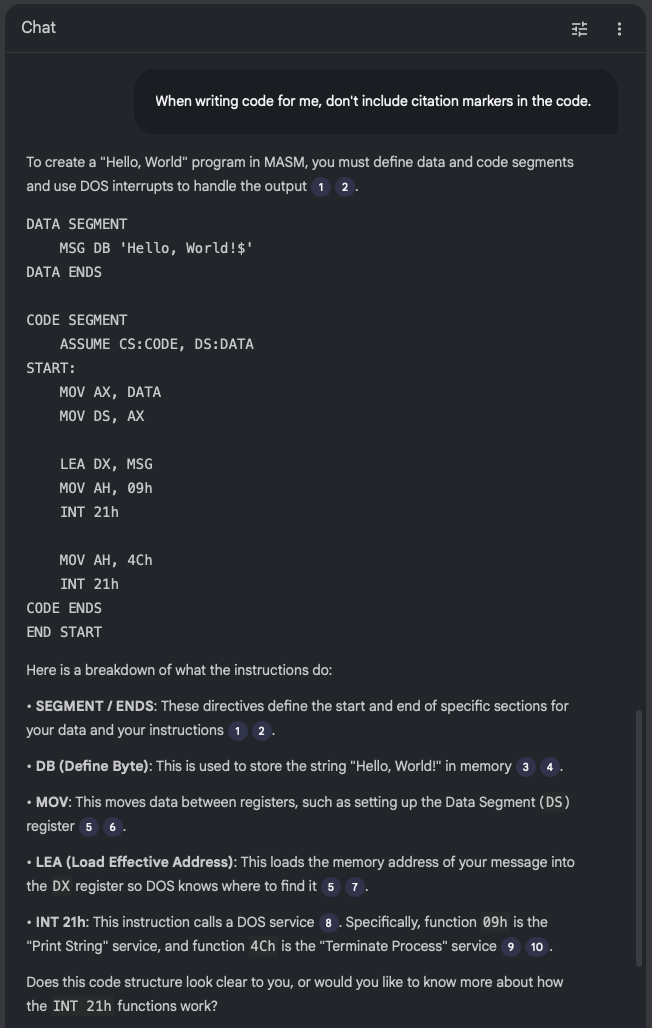
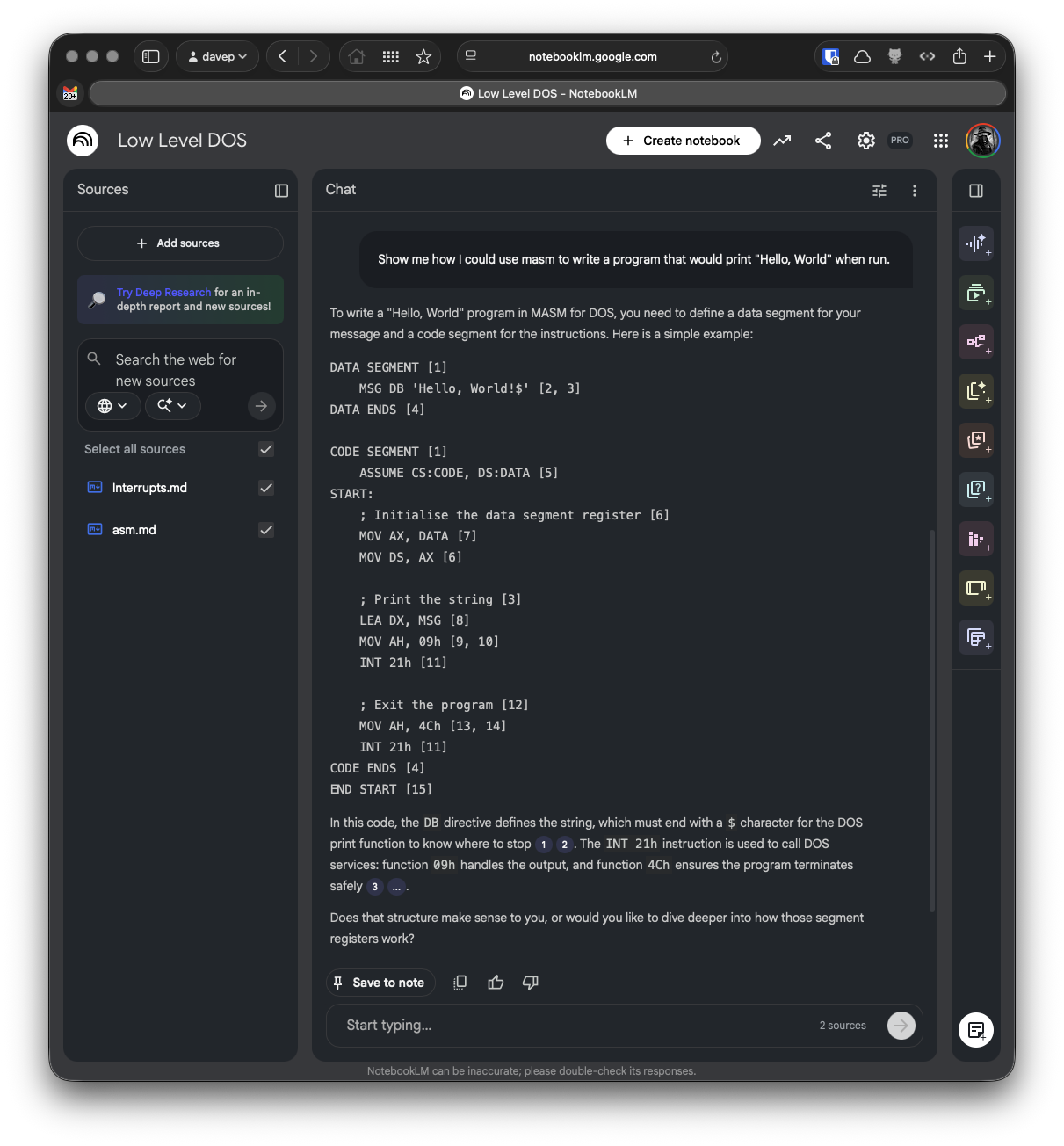
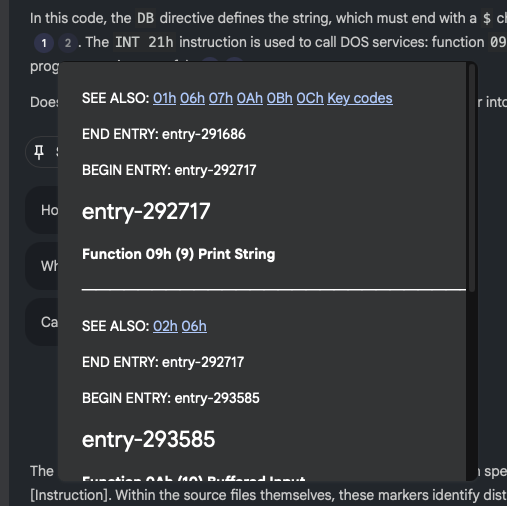
Learning abut low-level DOS programming

Here I grabbed the guide to assembly language Norton Guide, and the DOS interrupts Norton Guide, turned them into sources, created a notebook and let it do its thing.

I can't vouch for how valid the answer to my question is -- it's a long time since I wrote any 8086 assembler code and it's a moment since I last had to dig into DOS interrupts and the like -- but I like the result.

Probably the biggest issue I see at the moment is with the code examples: it seems to have a habit of adding some sort of citation marker that links to nowhere when it's emitting code. I think this is down to the instructions I've given it in the source I output, at least that's what it's suggesting when I ask it:

Me: What are all the numbers in square brackets for?

NotebookLM: The numbers in square brackets are passage indices used to cite which specific part of the sources supports each statement [Instruction]. Within the source files themselves, these markers identify distinct entries or sections within the Norton Guide databases.

Given I am trying to encourage it to cite its sources, I think this is where the confusion comes from. In "normal" paragraphs it does do a good job of citing its source and linking to it:

NotebookLM citing a source

so presumably, when it "thinks" it's outputting code it doesn't do the markup to actually do the linking, and so things end up looking a little confused.

If I ask that citations aren't included in the code, this does seem to have the desired effect:

No citations in the code

So, given this, perhaps I can use the --additional-instructions switch for the particular source to encourage it to not add citation links to code? Or of course I could tweak ng2nlm itself to include that instruction to start with. While it's a little specific to one use case, Norton Guide files do tend to be coding-related so it could make sense.

Anyway, in the very unlikely event that you have a need to turn one or more Norton Guide files into sources to throw at NotebookLM or similar tools: ng2nlm exists.

obs2nlm - Feed NotebookLM an Obsidian Vault

3 min read

I'm sure I've mentioned a couple of times before that I've become quite the fan of Obsidian. For the past few years, at any given point, I've had a couple of vaults on the go. Generally I find such vaults a really useful place to record things I'd otherwise forget, and of course as a place to go back and look things up.

But... even then, it's easy enough to forget what you might have recorded and know that you can even go back and look things up. Also I tend to find that I can't quite figure out a good way of getting a good overview of what I've recorded, over time.

Meanwhile: I've been playing around with Google's NotebookLM as a tool to help research and understand various topics. After doing this with my recent winter break coding project (more on that in the future) I realised I really should get serious about taking this approach with my Obsidian Vaults.

I'm sure this is far from novel, I'm sure lots of people have done similar things already; in fact I'd quickly dabbled with the idea a few months ago, had a bit of a laugh at some of the things the "studio" made of a vault, and promptly forgot about it.

This time though I got to thinking that I should try and take it a little more seriously.

And so obs2nlm was born.

The idea is simple enough: enumerate all the Markdown files in the vault, wrap them in boundary markers, add some instructions to the start of the file to help NotebookLM "comprehend" the content better, throw in a table of contents to give clues to the structure of the vault, and see what happens when you use the resulting file as a source.

So far it's actually turning out to be really helpful. I've been using it to get summaries regarding my work over the past 18 months or so and it's helped me to consolidate my thoughts on all sorts of issues and subjects.

It's not perfect, however. I've had it "hallucinate" some stuff when making things in the studio (most notably in the slide deck facility); for me though I find this an acceptable use of an LLM. I know the subject it's talking to me about and I know when it's making stuff up. This, in turn, makes for a useful lesson in how and when to not trust the output of a tool like this.

Having tested it out with a currently-active vault, I'm now interested to find out what it'll make of some of the archived vaults I have. Back in 2024 I wrote a couple or so tools for making vaults from other things and so I have a vault of a journal I kept in Journey for a number of years, a vault of a journal I'd kept before then in Evernote, and I also have a vault of all the tweets I wrote before I abandoned Twitter. I also have a vault that was dedicated to recording the daily events and thoughts of my time working at Textualize. It's going to be fun seeing what NotebookLM makes of each of those; especially the last one.

Anyway, if Obsidian is your thing, and if you are dabbling with or fancy dabbling with NotebookLM, perhaps obs2nlm will be handy for you.

DHV

2 min read

DHV

Back in the very early days of my involvement with Textualize, while looking for fun things to build to test out the framework and find problems with it, I created textual-astview. The idea was pretty simple: exercise Textual's Tree widget by using it to display the output of Python's abstract syntax tree module.

While the code still works, Textual has moved on a lot, as has my approach to building applications with Textual, and so I've been wanting to do a ground-up rewrite of it. At the same time I was also thinking that it might be interesting to build a tool that provides other ways of understanding how your Python source gets turned into runnable code; with this in mind I've ended up building a terminal-based application called DHV.

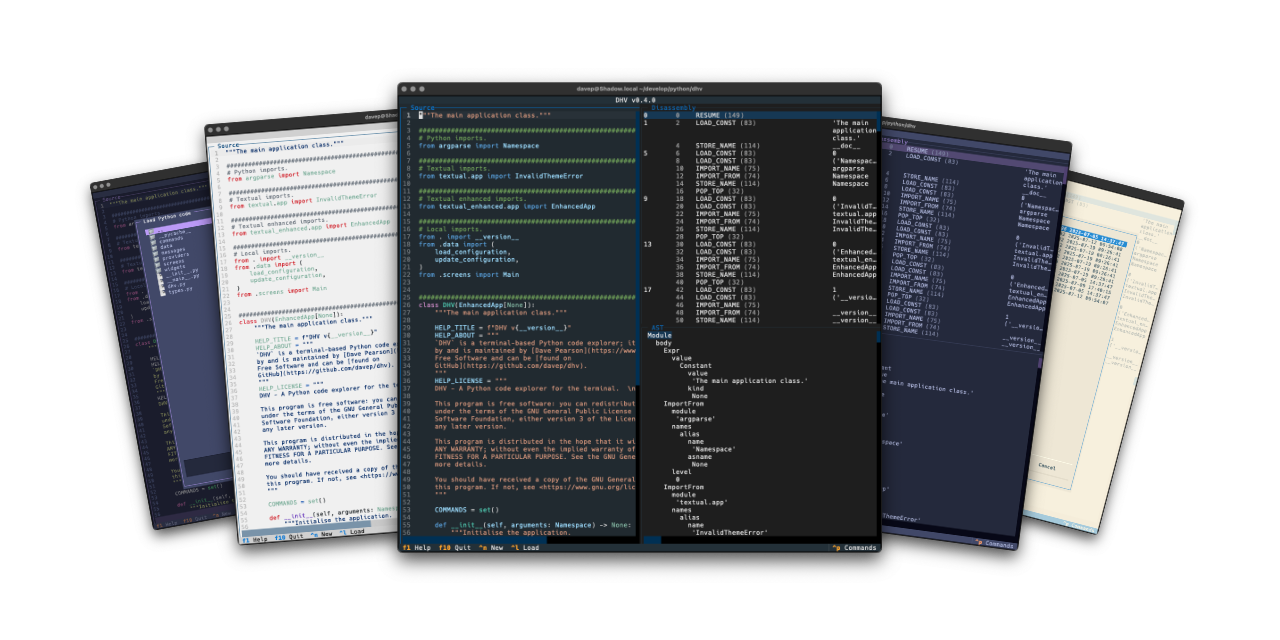
DHV in action

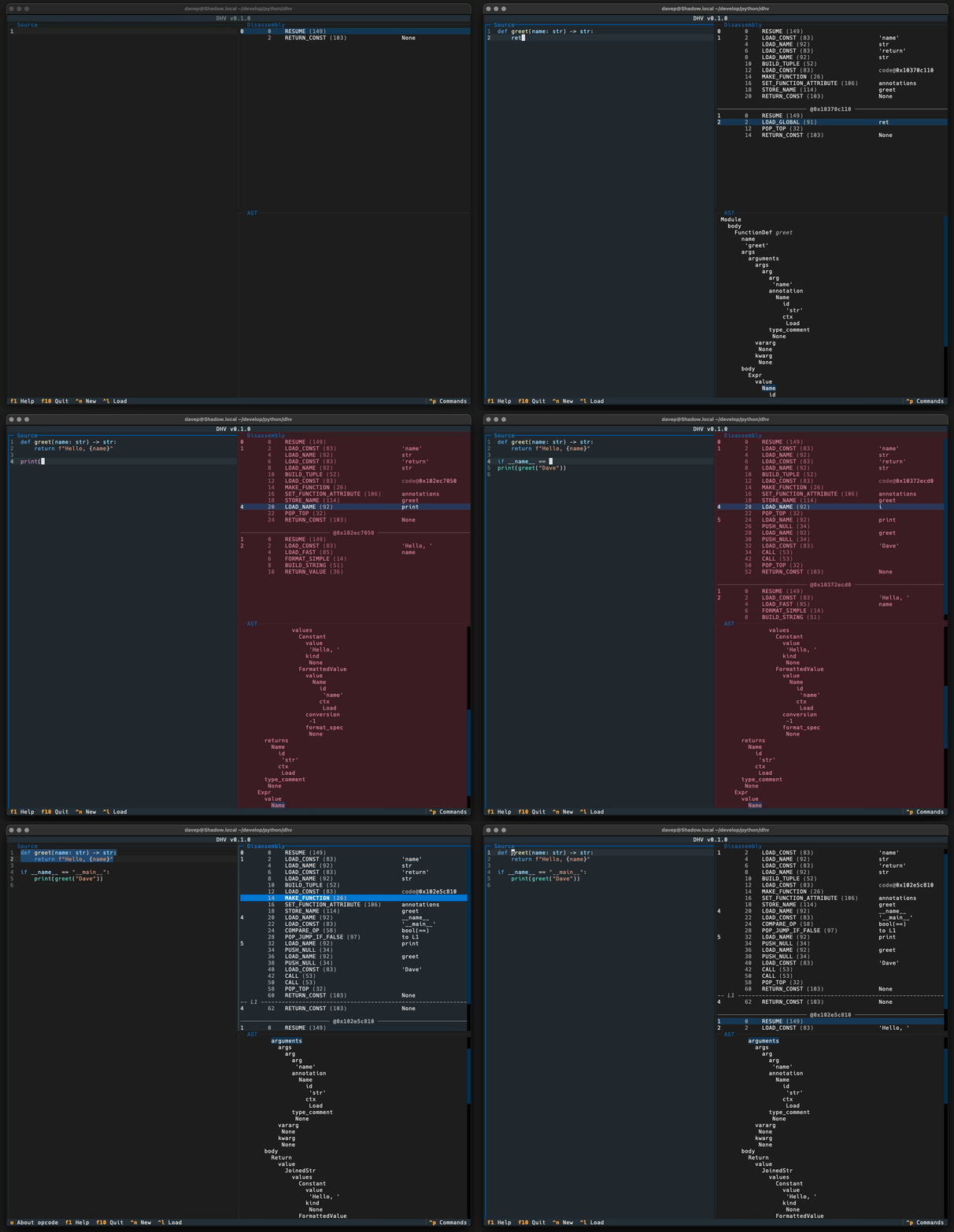
The idea is pretty straightforward: you type in, paste in, or load up, Python code, and you get a real-time display of what the resulting bytecode and abstract syntax tree would be.

If you've ever wondered what a particular bit of code looks like under the hood, or wondered if one particular approach to a problem is "more efficient"1 than another, or just wondered to yourself if 1+1 ends up being a complex operation or simply gets turned into 2, this tool might be useful to experiment and see.

As of now DHV only works with Python 3.13. The main reason for this is that the Python dis module is a bit of a moving target and has had some noticeable interface changes over the past few versions. When I find some time I might work on making DHV a little more backward-compatible. But for now keep this in mind: when you're looking at the results for some code you're looking at what Python 3.13 (or later) would do, earlier Pythons may differ.

DHV is licensed GPL-3.0 and available via GitHub and also via PyPI. If you have an environment that has pipx installed you should be able to get up and going with:

pipx install dhv

If you're a fan of uv and friends you can install it like this:

uv tool install --python 3.13 dhv

  1. I'm sure many of us have worked with that person who claims "this is more efficient" without providing any evidence; this might just be the tool to let you check that assertion. 

Complexitty

2 min read

Complexitty

Much like Norton Guide readers or the 5x5 puzzle, code that has fun with the Mandelbrot set is another one of my goto exercises. I've written versions in many languages, and messed with plots in some different environments, as varied as in VR on the web to wearable items.

Back in the early days of my involvement with Textualize I wrote a deliberately worst-approach version using that framework. The whole thing was about taking a really silly approach while also stress-testing Textual itself. It did the job.

Later on I did a second version that targets Textual. This time it did a better job and was the catalyst for building textual-canvas. This version was intended more to be a widget that happened to come with an example application, and while it was far more better than the on-purpose-terrible version mentioned above, I still wasn't 100% happy with the way it worked.

Recently I did some maintenance work on textual-canvas, cleaning up the repository and bringing it in line with how I like to maintain my Python projects these days, and this prompted me to look back at textual-mandelbrot and rework it too. Quickly I realised it wasn't really sensible to rewrite it in a way that it would be backward compatible (not that I think anyone has ever used the widget) and instead I decided to kick off a fresh stand-alone application.

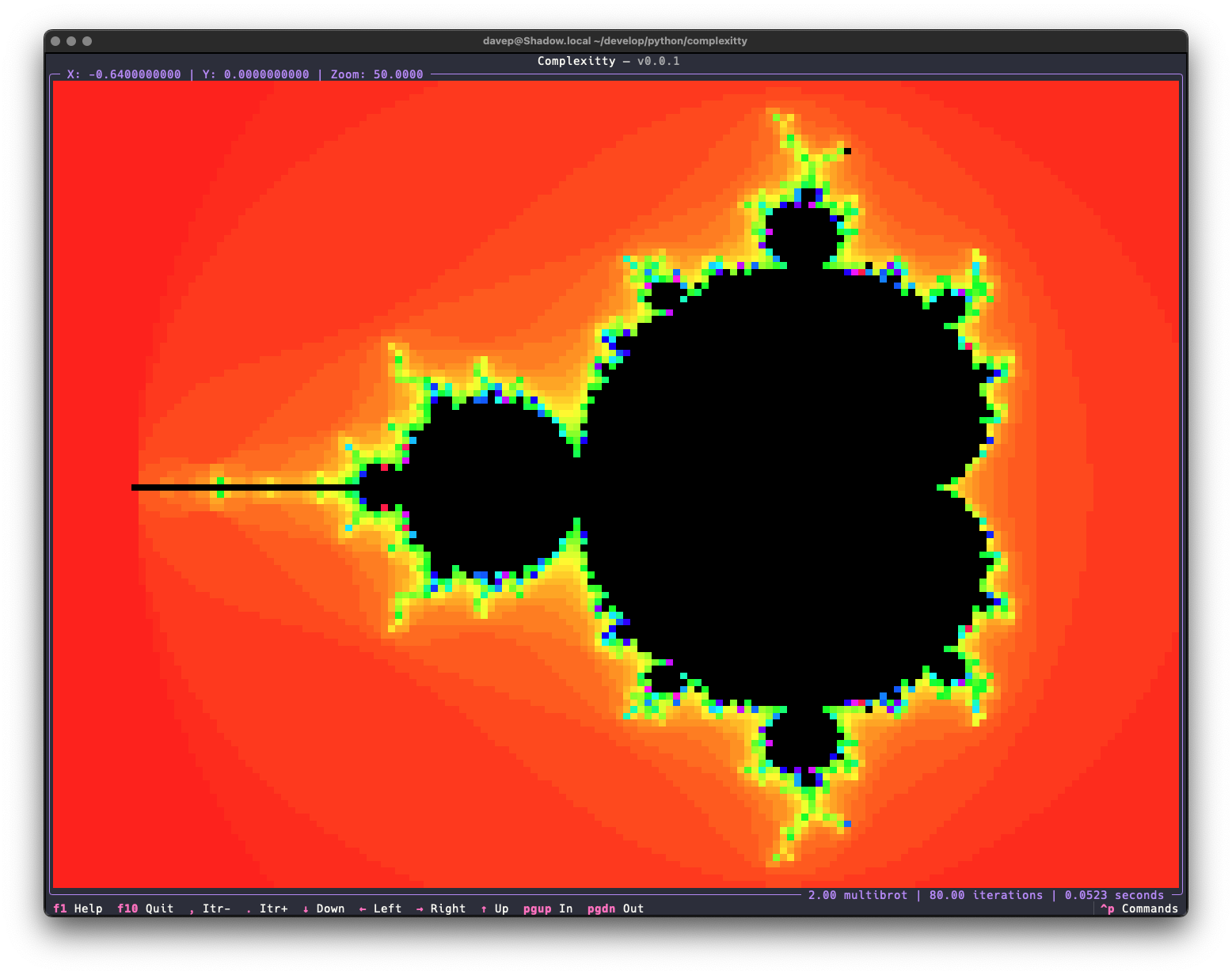
Complexitty is the result.

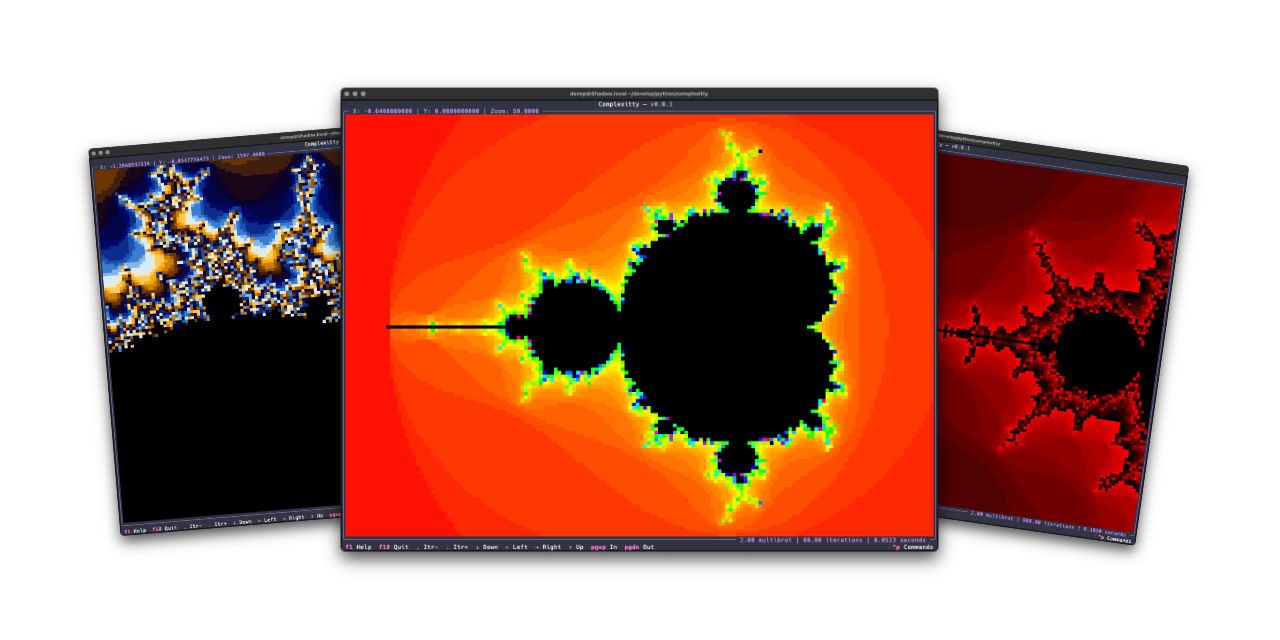
Complexitty on startup

Right now the application has all the same features as the mandelexp application that came with textual-mandelbrot, plus a couple more. Also it's built on top of the common core library I've been putting together for all my own terminal-based Python applications. As time goes on I'll add more features.

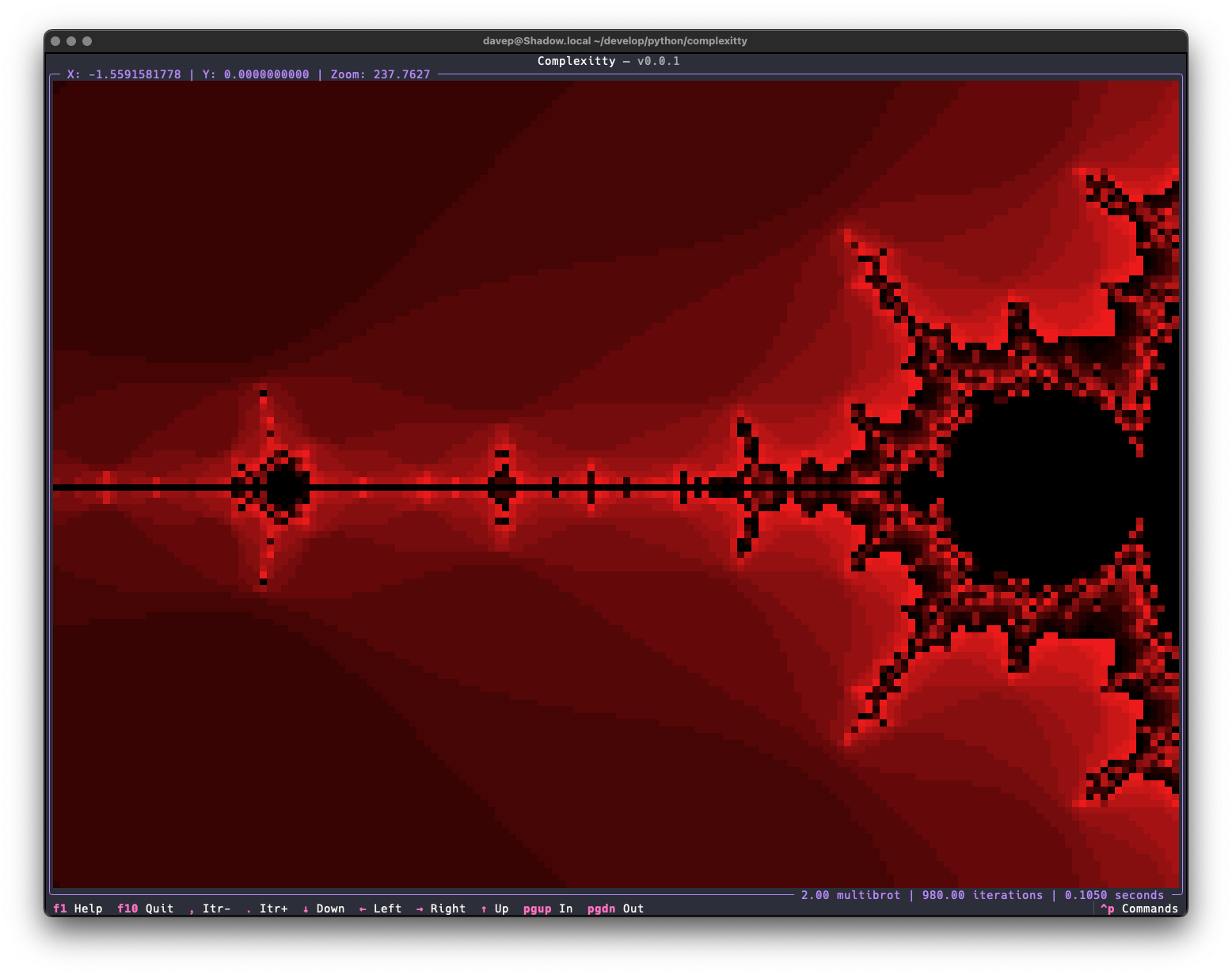
Zoomed in with Complexitty

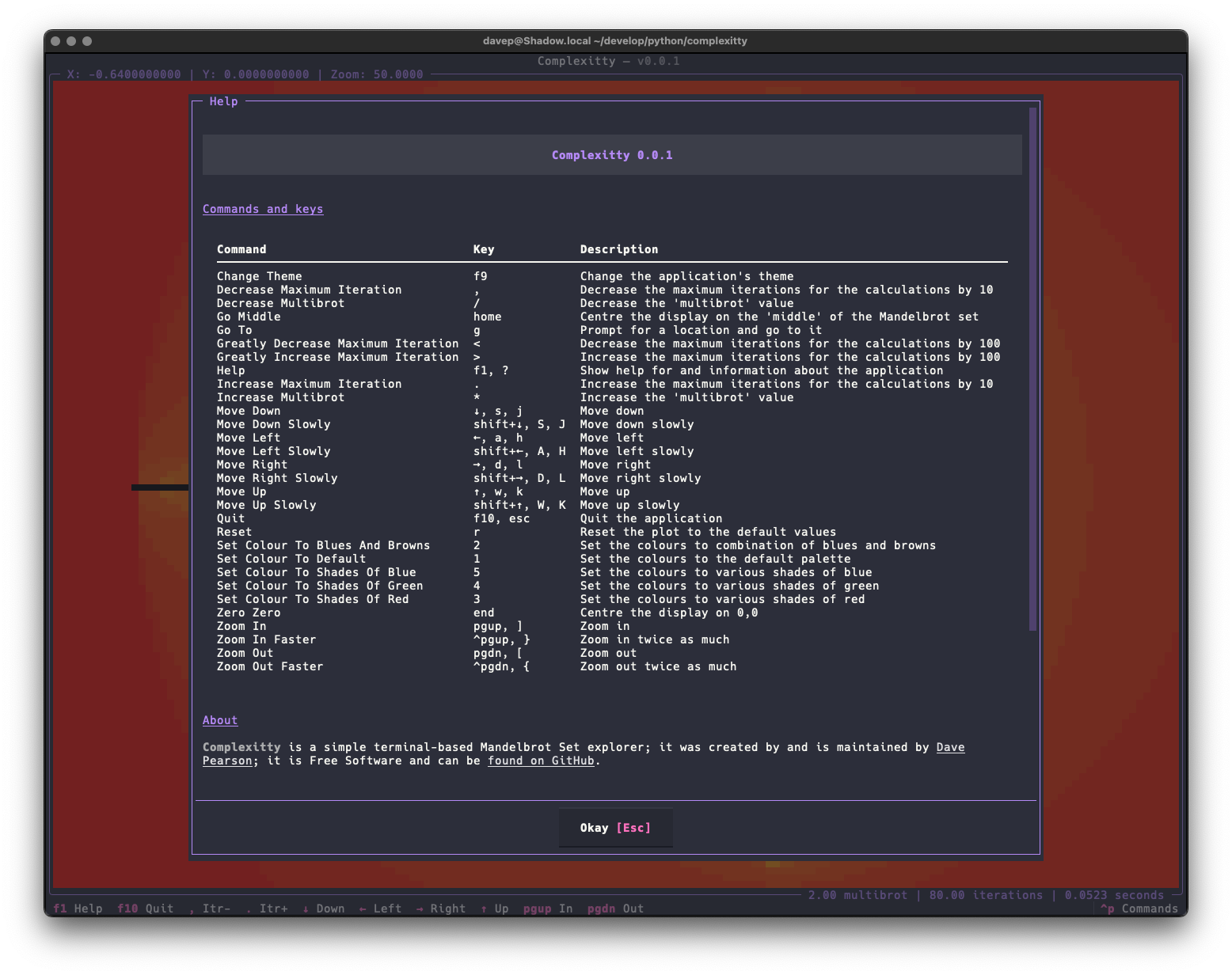
As with most of my recent TUI-based projects, the application is built with comprehensive help for commands and key bindings.

The help screen

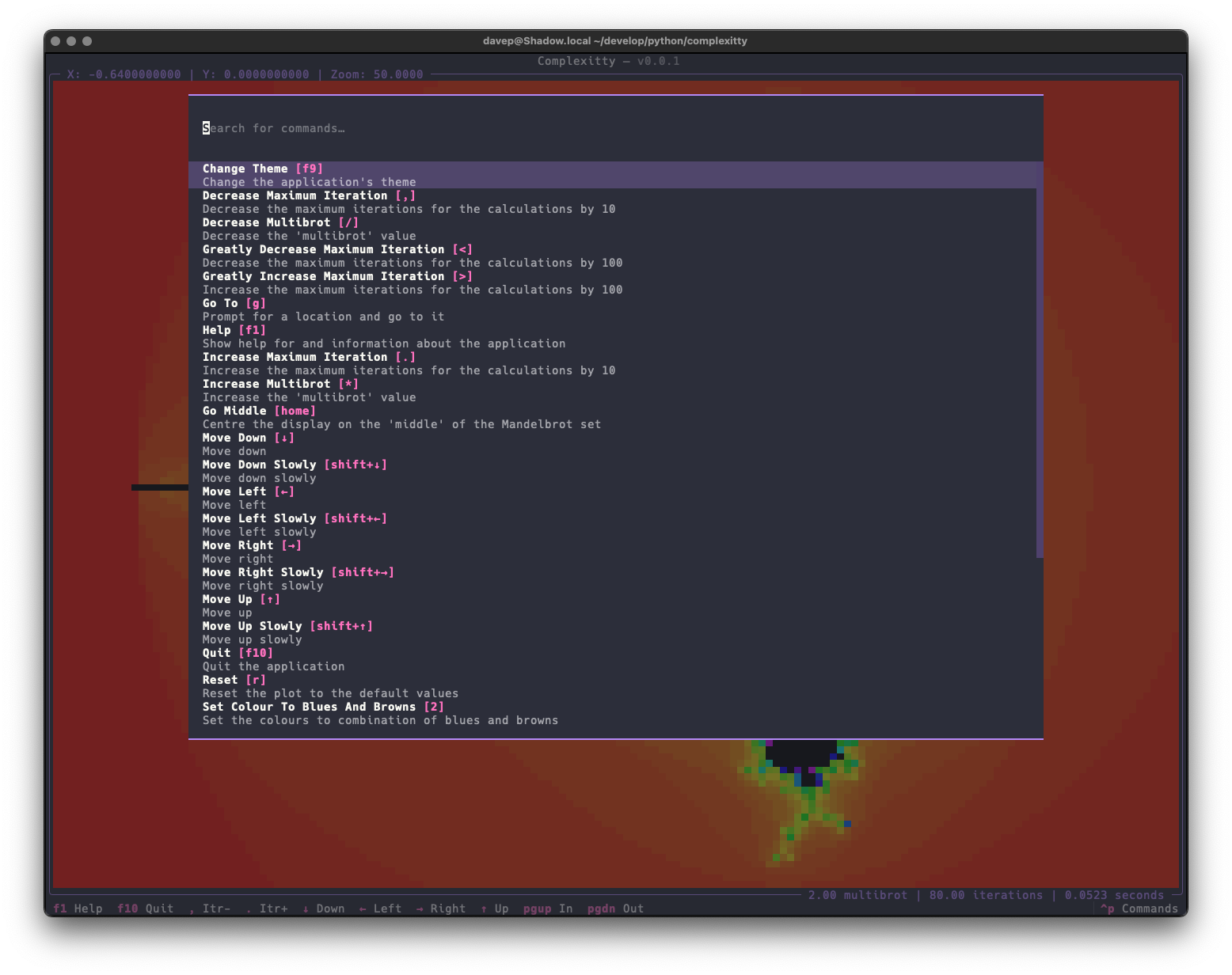
and there's also a command palette that helps you discover (and run) commands and their keyboard bindings.

The command palette

Complexitty is licensed GPL-3.0 and available via GitHub and also via PyPI. If you have an environment that has pipx installed you should be able to get up and going with:

pipx install complexitty

It can also be installed with Homebrew by tapping davep/homebrew and then installing complexitty:

brew tap davep/homebrew
brew install complexitty

ng2web v1.0.0

1 min read

It pretty much all started with this:

 * Revision 1.1  1996/02/15 18:57:13  davep
 * Initial revision

That's from the rcs log for the source for w3ng, a tool I wrote so I could read Norton Guide files in my web browser, served by Apache, running on my GNU/Linux server in my office. The tool itself was written as a CGI tool (remember them?).

I believe I posted about this to comp.lang.clipper and pretty quickly some folk asked if it might be possible to do a version that would write the whole guide as a collection of HTML files for static hosting, rather than serving them from a cgi-bin utility. That seemed like a sensible idea and so:

 * Revision 1.1  1996/03/16 09:49:00  davep
 * Initial revision

ng2html was born.

Fast forward around a quarter of a century and I decided it would be fun to write a library for Python that reads Norton Guide files, and a tool called ng2web was the first test I wrote of it, designed as a more flexible replacement for ng2html. I've tweaked and tinkered with the tool since I first created it, but never actually "finished" it.

That's changed today. I've just released v1.0.0 of ng2web.

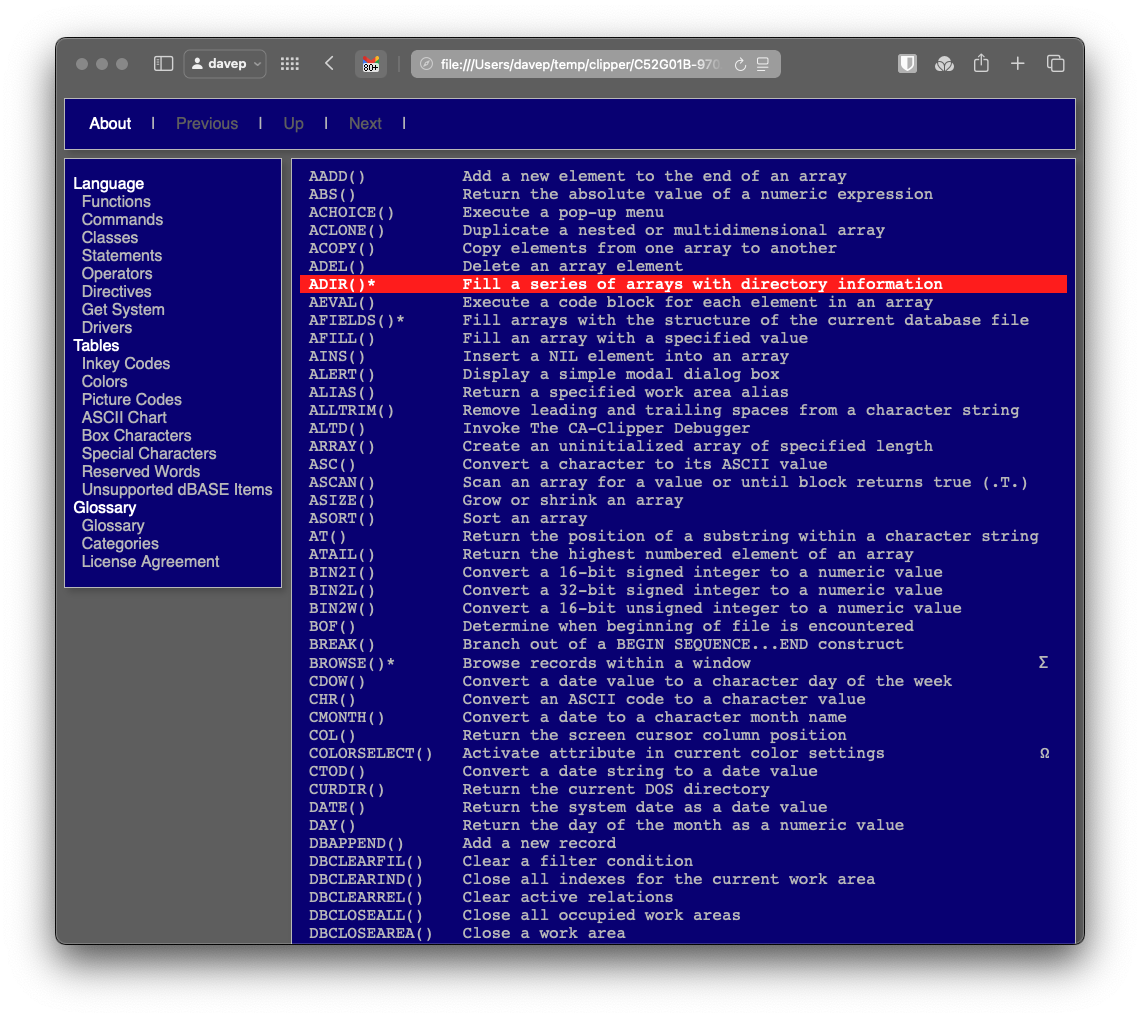
A page generated with ng2web

If turning one or more Norton Guide files into static websites seems like the sort of thing you want to be doing, take a look at the documentation.

ng2web is licensed GPL-3.0 and available via GitHub and also via PyPi. If you have an environment that has pipx installed you should be able to get up and going with:

$ pipx install ng2web

It can also be installed with Homebrew by tapping davep/homebrew and then installing ng2web:

$ brew tap davep/homebrew
$ brew install ng2web