Posts tagged with "Python"

BlogMore v2.9.0

1 min read

After releasing blogmore.el v2.6 this morning, I noticed something about the post: the text that was marked up with <kbd> wasn't really standing out as keys. In blog posts, as in documentation, if I mention the name of a key, I like to mark it up with <kbd>. Ideally, with such markup, the styling of the page it's being used on will make it clear that it's supposed to be read as a key.

I've never put any such styling into the default styles made available in BlogMore.

So here we are with BlogMore v2.9.0, now with a bit of markup, and theme support, for keys marked up with <kbd>. So now, hopefully, if I say you should press Ctrl+F4 to make this blog look better, those keys should stand out a little better than they used to.

BlogMore v2.8.0

1 min read

I've just published v2.8.0 of BlogMore to PyPI. This is a small update which addresses a bug that Andy reported.

The fix was simple enough, and is another little interesting thing to keep in mind given that BlogMore is an ongoing Copilot experiment. When I first kicked off BlogMore I let it decide which library to use to handle Markdown (I'm more used to markdown-it-py via Textual and so via Hike), and so also let it decide which extensions made most sense given the request. I've honestly never run into the idea of metadata before, only ever dealing with or caring about frontmatter1.

On the other hand, I will say this: I was cooking dinner when the report came in; I pointed Copilot at the issue and let it figure it out. After eating, clearing things away, and general post-dinner chilling, I dropped into the repo to see what it had made of it and... it had figured the issue out and fixed it.


  1. I guess technically they're the same thing, but here I mean I'm more used to the delimited YAML of frontmatter than whatever it is the meta plugin was dealing with. 

BlogMore v2.7.0

1 min read

Given I've been on a little bit of an Emacs Lisp side quest, it's been a couple or so days since I made a release of BlogMore. Today's release comes after a feature request about draft posts.

While support for marking posts as drafts, and including or excluding them from a build, is something that's been in BlogMore from the start, it's not something I've ever used. These days, when I'm writing a post, especially if it's one that's taking a while to write, I'll do it in a branch and eventually PR into main before publishing. Given this it was useful to get a request relating to the feature as it helps me understand how someone else might use it.

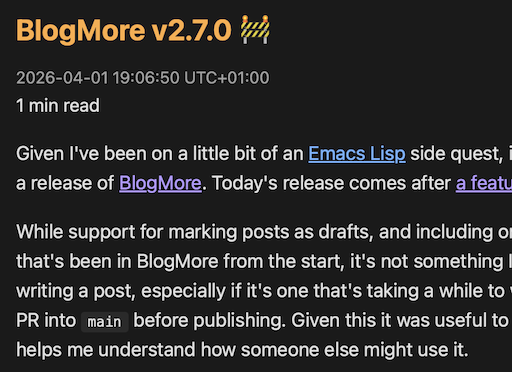
So as of v2.7.0, if a post is marked as a draft, and if drafts are included in the build, it will be pretty obvious:

A draft post

When the post's title appears in the archive it will also appear obvious that it's still a draft too:

A draft post in the archive

All of this is, of course, modifiable via the template API and via styling, so if the choice of colour or icon doesn't suit it can be modified to taste.

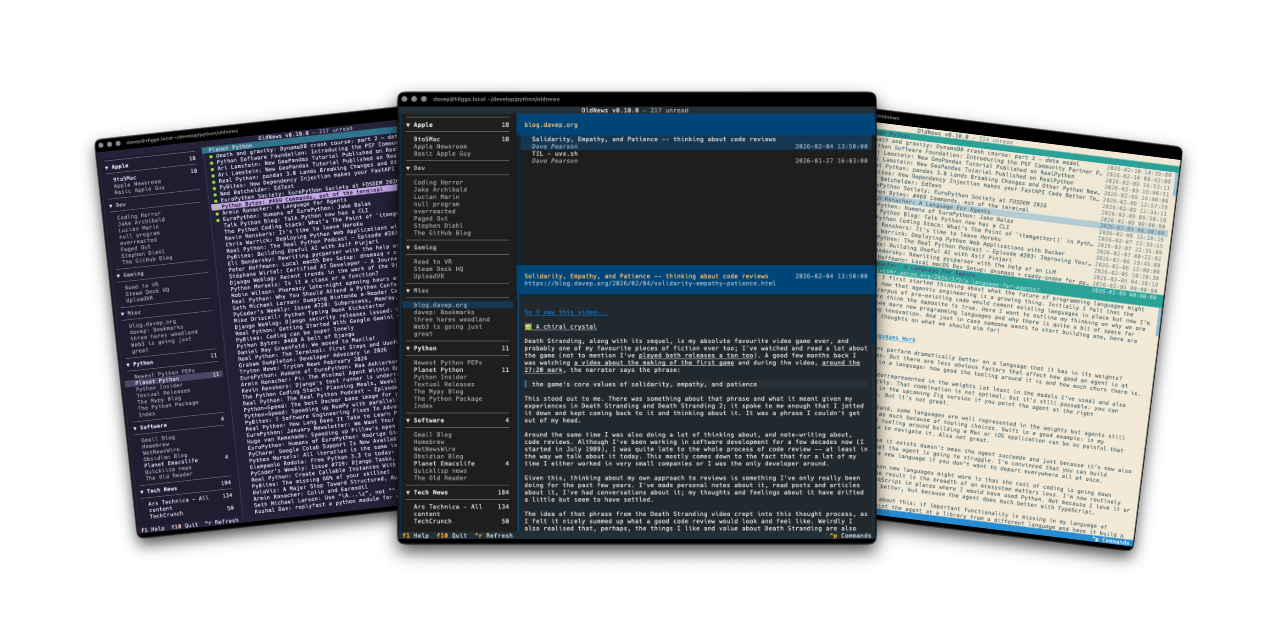
OldNews v1.3.0

1 min read

OldNews

Yesterday evening I released v1.3.0 of OldNews, my terminal-based client for TheOldReader.

The main reason for this release is that html_to_markdown had a major release and the one function I use from it fundamentally changed the return type, causing OldNews to crash any time you tried to read an article.

It was a quick enough fix, although it's one I want to go back and review and perhaps see if there's a better approach, or see if this new return type offers something I could be making better use of.

The one other change, which I made a wee while ago but hadn't got round to releasing yet (I've been kind of distracted recently), is that OldNews now only makes a call out to the API to mark an article as read when you read it, but only if it was previously unread. A small internal change nobody should really notice, but it saves on work.

If you're a user of TheOldReader and fancy interacting with it from the terminal too then it's out there to try out. It's licensed GPL-3.0 and available via GitHub and also via PyPI. If you have an environment that has pipx installed you should be able to get up and running with:

pipx install oldnews

It can also be installed using uv:

uv tool install oldnews

If you don't have uv installed you can use uvx.sh to perform the installation. For GNU/Linux or macOS or similar:

curl -LsSf uvx.sh/oldnews/install.sh | sh

or on Windows:

powershell -ExecutionPolicy ByPass -c "irm https://uvx.sh/oldnews/install.ps1 | iex"

Once installed, run the oldnews command.

BlogMore v2.6.0

2 min read

Yesterday I read a rather positive post about BlogMore, which was lovely to see. But... when I saw the link for it over on Mastodon I noticed something wasn't quite right about the description in the preview:
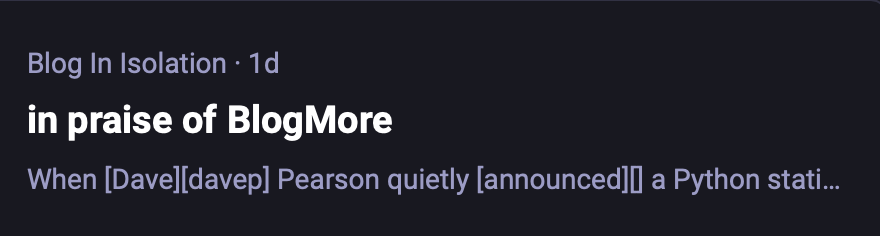
The preview of the post

See, when BlogMore makes a post, if the author of the post hasn't provided a description in the frontmatter, the first paragraph of text will be used instead. When doing this the code should strip out any markup (and also skip any initial images, that sort of thing).

But, as you can see, there are things like [Dave][davep] in that description. So I checked in with Andy and that was something that came from the underlying Markdown. After a bit of checking, it became obvious that the code in BlogMore was only looking for and removing inline links, but wasn't doing anything about reference links.

So, as usual, one prompt later and the issue was handled.

As it stands, I don't think I'll keep up with the current approach. It doesn't feel quite right to me. The whole point is that the Markdown should be rendered down to pure text and then the first actual paragraph of text is used. The code I have there now is doing some regexp-based mucking about as an approximate approach. It works, more or less, but it feels like it's implementing a poor Markdown parser when there's a Markdown parser already built in.

Given this, at some point soon, I might have a play and look at the idea of "let's have a Markdown to pure text parser" and then use that. I could see it being useful for other purposes too.

Anyway, the upshot of all of this is that BlogMore v2.6.0 is now available and it handles the stripping of reference links from the description, plus the recently-added strikethrough markup too.
BlogMore v2.5.0

1 min read

I've released BlogMore v2.5.0 out into the world. This release is the result of an observation Andy made about the Markdown library used in BlogMore (it might apply to MarkdownIT too, which would of course affect Hike): it doesn't support strikethrough markup out of the box.

I'm not sure I've ever used that markup anywhere on my blog, but I've used it often enough on GitHub (for example) that I just assume it's going to be there (and now I think about it Hike might be okay 'cos it uses Textual's Markdown widget which I know for certain uses GitHub-flavoured Markdown). But, for sure, the Markdown library doesn't implement it because it's not part of the original approach to Markdown.

On the other hand: implementing a form of strikethrough markup is one of the samples in the documentation on writing extensions, so it seemed like a very reasonable thing to add. Given this, one quick prompt to the agents later and strikethrough was added.

Now I'm going to totally have to find a reason to use this markup from time to time to time.

BlogMore v2.4.0

1 min read

After adding the stats page to BlogMore yesterday I realised that the main stylesheet was starting to get fairly large. Not so big that it was a problem for downloading (and of course normally it would get cached anyway), just more that it was carrying around styles for things that only appear on one page (the styles for the stats, for example).

So I decided to break it up. Now, as well as the main style.css, there's also:

This should keep the load times for the main pages and individual posts just a wee bit faster when first encountered, leaving off all those styles that aren't necessary.

All of which means, along with a wee wording change on the stats page, BlogMore v2.4.0 is in the wild and ready to use.

Hike v1.4.0

1 min read

Hike, my wee terminal-based Markdown viewer/browser, has had an update to v1.4.0. In this update I've made a change I've been meaning to make for ages: some support for "wiki links".

By that I mean the sort of link markup you often see in Markdown documents made with Obsidian:

In other words [[this]] instead of [this](kind-of-link.md)

Personally it's something I seldom need, but on the occasion I have been delving into my Obsidian vaults with Hike I've wished the links at least rendered "correctly", even if they wouldn't fully work.

On that note, it's worth keeping in mind that this "wiki link" implementation in Hike doesn't support something that Obsidian does: find the most likely target file for a given link. If you click such a link, Hike expects the file to be exactly where the link suggests. There's no going off and finding the most likely match in the "vault", etc (Hike obviously has no concept of a "vault").

I'm open to the idea of extending this at some point, perhaps, but not yet. The intention here isn't to build a terminal-based Obsidian-a-like, but instead to build and maintain a workable Markdown browser/viewer (and occasional editor).

Hike is licensed GPL-3.0 and available via GitHub and also via PyPI. If you have an environment that has pipx installed you should be able to get up and going with:

pipx install hike

If you're more into uv:

uv tool install hike

If you don't have uv installed you can use uvx.sh to perform the installation. For GNU/Linux or macOS or similar:

curl -LsSf uvx.sh/hike/install.sh | sh

or on Windows:

powershell -ExecutionPolicy ByPass -c "irm https://uvx.sh/hike/install.ps1 | iex"

BlogMore v2.3.0

1 min read

I've just pushed BlogMore v2.3.0 up to PyPI. This release has a couple of bug fixes and a couple of significant new features.

The first new feature, which came in as a request, is to add support for control over the themes used for code blocks, including independent control of the themes used for light and dark mode. With these you can specify any of the Pygments styles to use for code blocks. Personally, I prefer to have things blend in, but this now also gives you the chance to have them really contrast (use a light mode theme for dark-mode blog, or a dark mode theme for a light-mode blog).

The other big feature popped into my head earlier today and once I thought about it I had to have it. It's similar to something I had for the photography section of the older version of my website, consisting of a bunch of useless but fun stats and facts about the content.

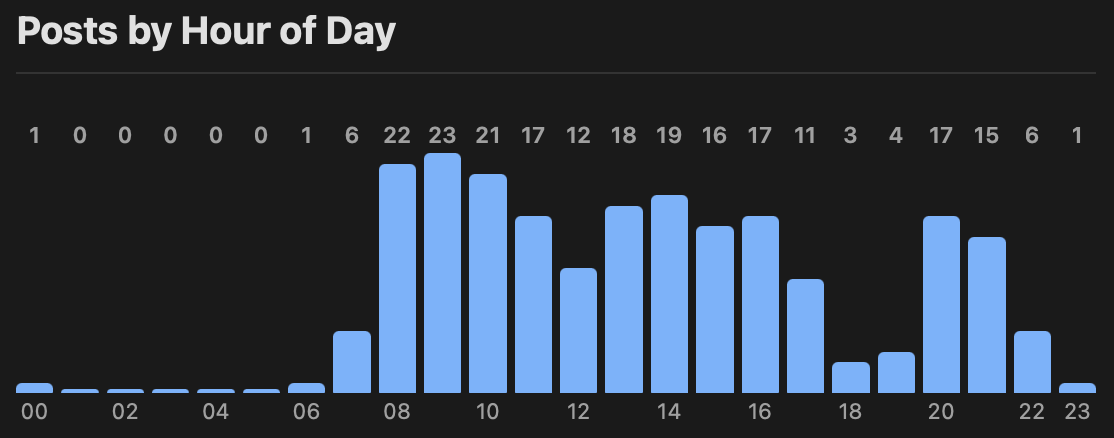
Things like which hour of the day I tend to post during:

Hour of day

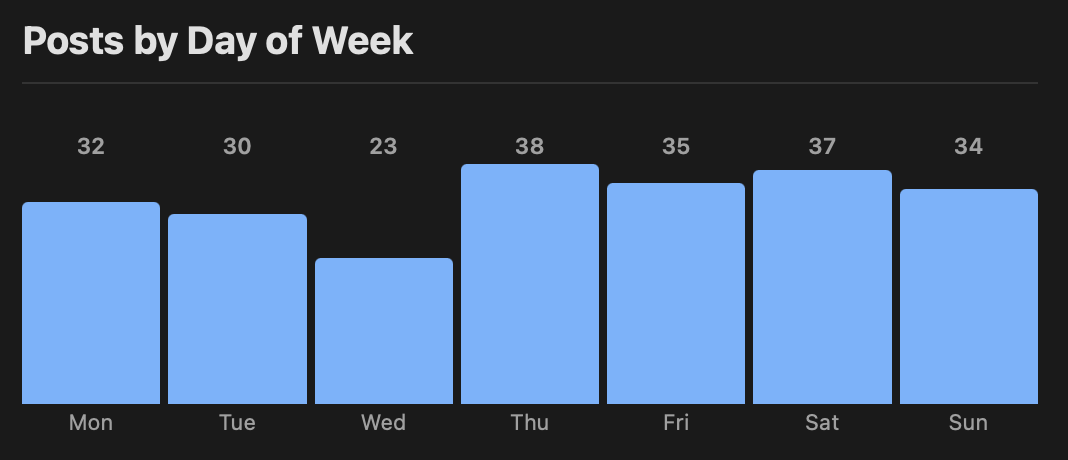
Or the day of the week:

Day of week

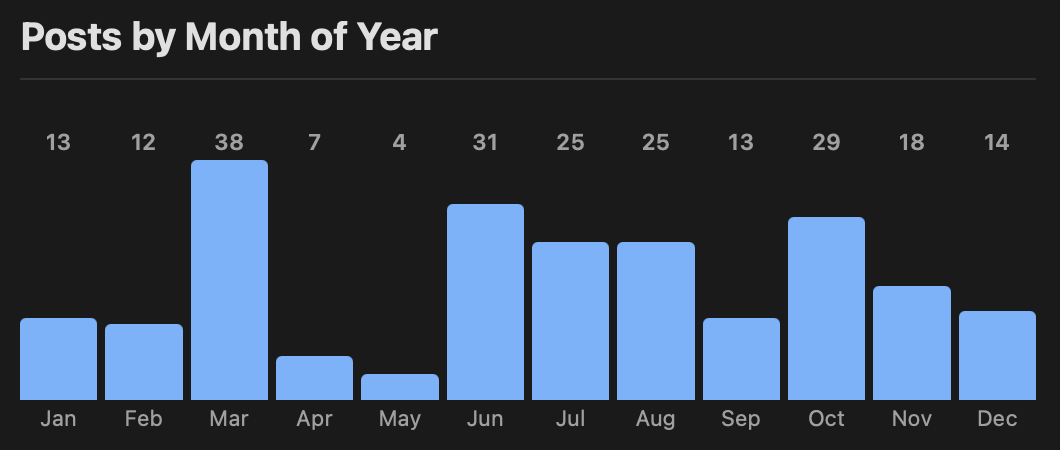
Or the month of the year1:

Month of year

This is designed to be turned off by default -- I can imagine most folk would not want this sort of thing on their blog -- but it can easily be turned on with with_stats. The location of the stats can also be controlled using stats_path.


  1. Unsurprisingly March is leaping ahead as of the time of writing. 

BlogMore v2.2.0

1 min read

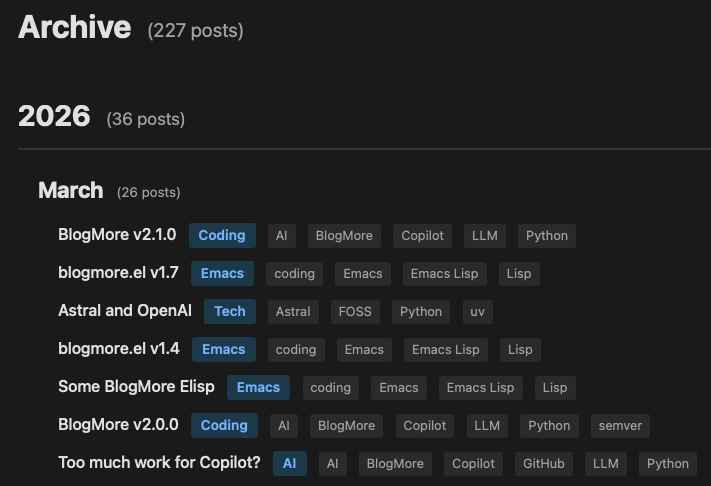
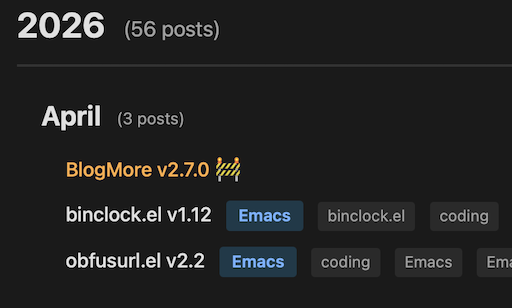
I've just bumped BlogMore to v2.2.0. This release adds post counts to the archive page.

Post counts in the archive

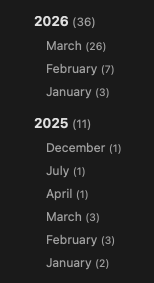
The overall count appears at the top of the page, with further counts broken down for each year and each month. I've tried to ensure that the counts appear subtle enough, but still readable.

Also, serving the same purpose, but giving more information at a glance, I've added the same counts to the table of contents that appears to the right of the archive if you're on a suitably wide display.

Counts in the ToC

This means I can easily see that I've posted more times this month than I have in any other month since I started this blog. In fact, I've posted more times this month than I have in quite a few individual years in the past.

So... that's today's "I thought I'd added everything but oh look here's another thing to add" feature. Which goes some way to explain why there are so many posts this month, I guess.