Posts tagged with "textual"

So you're looking for a wee bit of Textual help...

(Modified: 2026-04-28 09:34:45 UTC+01:00)
11 min read

Introduction

Patience, Highlander. You have done well. But it'll take time. You are generations being born and dying. You are at one with all living things. Each man's thoughts and dreams are yours to know. You have power beyond imagination. Use it well, my friend. Don't lose your head.

Juan Sánchez Villalobos Ramírez, Chief metallurgist to King Charles V of Spain

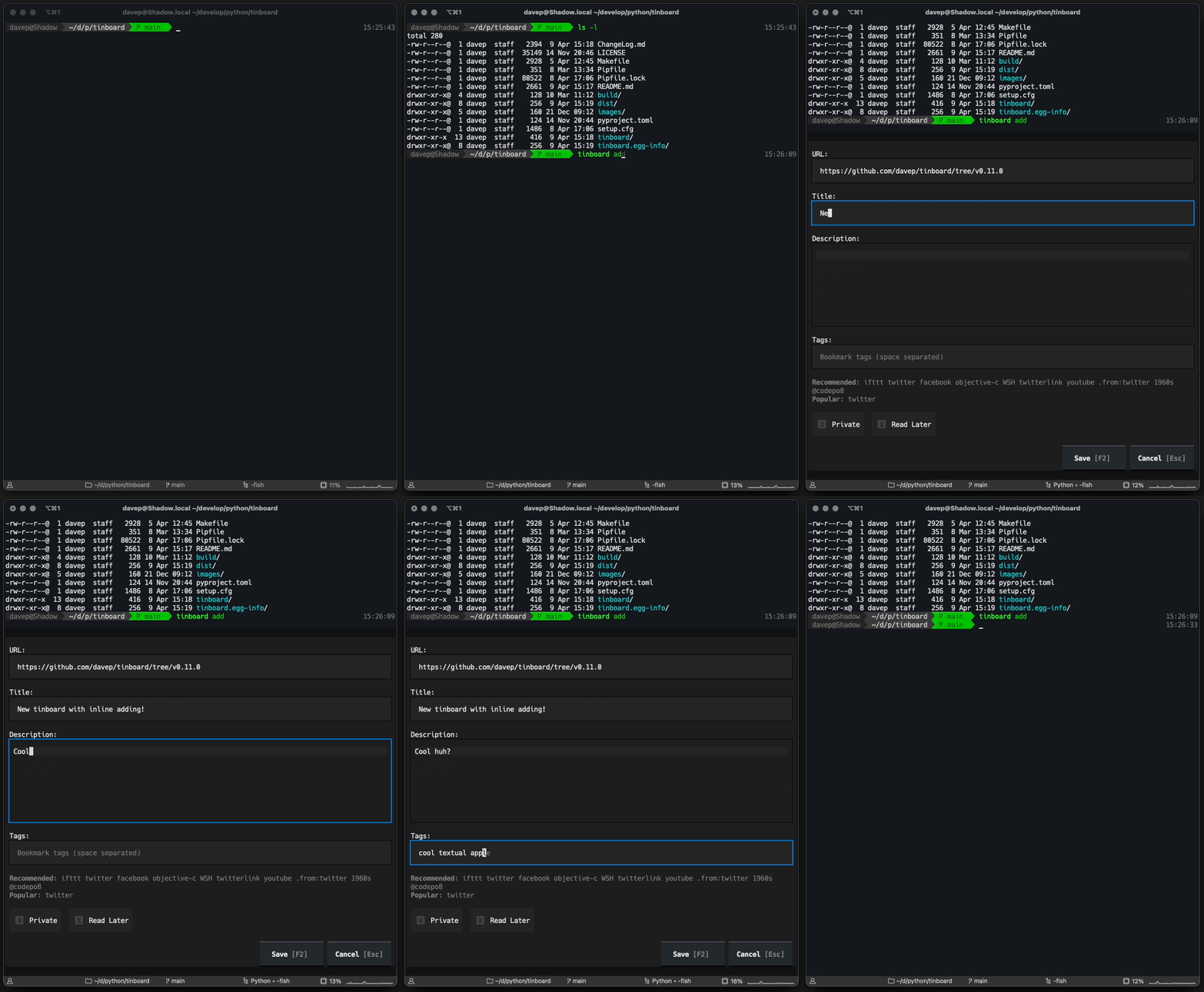
As of the time of writing, I'm a couple or so days off having been with Textualize for 3 months. It's been fun, and educational, and every bit as engaging as I'd hoped, and more. One thing I hadn't quite prepared for though, but which I really love, is how so many other people are learning Textual along with me.

Even in those three months the library has changed and expanded quite a lot, and it continues to do so. Meanwhile, more people are turning up and using the framework; you can see this online in social media, blogs and of course in the ever-growing list of projects on GitHub which depend on Textual.

This inevitably means there's a lot of people getting to grips with a new tool, and one that is still a bit of a moving target. This in turn means lots of people are coming to us to get help.

As I've watched this happen I've noticed a few patterns emerging. Some of these good or neutral, some... let's just say not really beneficial to those seeking the help, or to those trying to provide the help. So I wanted to write a little bit about the different ways you can get help with Textual and your Textual-based projects, and to also try and encourage people to take the most helpful and positive approach to getting that help.

Now, before I go on, I want to make something very clear: I'm writing this as an individual. This is my own personal view, and my own advice from me to anyone who wishes to take it. It's not Textual (the project) or Textualize (the company) policy, rules or guidelines. This is just some ageing hacker's take on how best to go about asking for help, informed by years of asking for and also providing help in email, on Usenet, on forums, etc.

Or, put another way: if what you read in here seems sensible to you, I figure we'll likely have already hit it off over on GitHub or in the Discord server. ;-)

Where to go for help

At this point this is almost a bit of an FAQ itself, so I thought I'd address it here: where's the best place to ask for help about Textual, and what's the difference between GitHub Issues, Discussions and our Discord server?

I'd suggest thinking of them like this:

Discord

You have a question, or need help with something, and perhaps you could do with a reply as soon as possible. But, and this is the really important part, it doesn't matter if you don't get a response. If you're in this situation then the Discord server is possibly a good place to start. If you're lucky someone will be hanging about who can help out.

I can't speak for anyone else, but keep this in mind: when I look in on Discord I tend not to go scrolling back much to see if anything has been missed. If something catches my eye, I'll try and reply, but if it doesn't... well, it's mostly an instant chat thing so I don't dive too deeply back in time.

ℹ️ Note

As a slight aside here: sometimes people will pop up in Discord, ask a question about something that turns out looking like a bug, and that's the last we hear of it. Please, please, please, if this happens, the most helpful thing you can do is go raise an issue for us. It'll help us to keep track of problems, it'll help get your problem fixed, it'll mean everyone benefits.

My own advice would be to treat Discord as an ephemeral resource. It happens in the moment but fades away pretty quickly. It's like knocking on a friend's door to see if they're in. If they're not in, you might leave them a note, which is sort of like going to...

GitHub

On the other hand, if you have a question or need some help or something where you want to stand a good chance of the Textual developers (amongst others) seeing it and responding, I'd recommend that GitHub is the place to go. Dropping something into the discussions there, or leaving an issue, ensures it'll get seen. It won't get lost.

As for which you should use -- a discussion or an issue -- I'd suggest this: if you need help with something, or you want to check your understanding of something, or you just want to be sure something is a problem before taking it further, a discussion might be the best thing. On the other hand, if you've got a clear bug or feature request on your hands, an issue makes a lot of sense.

Don't worry if you're not sure which camp your question or whatever falls into though; go with what you think is right. There's no harm done either way (I may move an issue to a discussion first before replying, if it's really just a request for help -- but that's mostly so everyone can benefit from finding it in the right place later on down the line).

The dos and don'ts of getting help

Now on to the fun part. This is where I get a bit preachy. Ish. Kinda. A little bit. Again, please remember, this isn't a set of rules, this isn't a set of official guidelines, this is just a bunch of "if you want my advice, and I know you didn't ask but you've read this far so you actually sort of did, don't say I didn't warn you!" waffle.

This isn't going to be an exhaustive collection, far from it. But I feel these are some important highlights.

Do...

When looking for help, in any of the locations mentioned above, I'd totally encourage:

Be clear and detailed

Too much detail is almost always way better than not enough. "My program didn't run", often even with some of the code supplied, is so much harder to help than "I ran this code I'm posting here, and I expected this particular outcome, and I expected it because I'd read this particular thing in the docs and had comprehended it to mean this, but instead the outcome was this exception here, and I'm a bit stuck -- can someone offer some pointers?"

The former approach means there often ends up having to be a back and forth which can last a long time, and which can sometimes be frustrating for the person asking. Manage frustration: be clear, tell us everything you can.

Say what resources you've used already

If you've read the portions of the documentation that relate to what you're trying to do, it's going to be really helpful if you say so. If you don't, it might be assumed you haven't and you may end up being pointed at them.

So, please, if you've checked the documentation, looked in the FAQ, done a search of past issues or discussions or perhaps even done a search on the Discord server... please say so.

Be polite

This one can go a long way when looking for help. Look, I get it, programming is bloody frustrating at times. We've all rage-quit some code at some point, I'm sure. It's likely going to be your moment of greatest frustration when you go looking for help. But if you turn up looking for help acting all grumpy and stuff it's not going to come over well. Folk are less likely to be motivated to lend a hand to someone who seems rather annoyed.

If you throw in a please and thank-you here and there that makes it all the better.

Fully consider the replies

You could find yourself getting a reply that you're sure won't help at all. That's fair. But be sure to fully consider it first. Perhaps you missed the obvious along the way and this is 100% the course correction you'd unknowingly come looking for in the first place. Sure, the person replying might have totally misunderstood what was being asked, or might be giving a wrong answer (it me! I've totally done that and will again!), but even then a reply along the lines of "I'm not sure that's what I'm looking for, because..." gets everyone to the solution faster than "lol nah".

Entertain what might seem like odd questions

Aye, I get it, being asked questions when you're looking for an answer can be a bit frustrating. But if you find yourself on the receiving end of a small series of questions about your question, keep this in mind: Textual is still rather new and still developing and it's possible that what you're trying to do isn't the correct way to do that thing. To the person looking to help you it may seem to them you have an XY problem.

Entertaining those questions might just get you to the real solution to your problem.

Allow for language differences

You don't need me to tell you that a project such as Textual has a global audience. With that rather obvious fact comes the other fact that we don't all share the same first language. So, please, as much as possible, try and allow for that. If someone is trying to help you out, and they make it clear they're struggling to follow you, keep this in mind.

Acknowledge the answer

I suppose this is a variation on "be polite" (really, a thanks can go a long way), but there's more to this than a friendly acknowledgement. If someone has gone to the trouble of offering some help, it's helpful to everyone who comes after you to acknowledge if it worked or not. That way a future help-seeker will know if the answer they're reading stands a chance of being the right one.

Accept that Textual is zero-point software (right now)

Of course the aim is to have every release of Textual be stable and useful, but things will break. So, please, do keep in mind things like:

  • Textual likely doesn't have your feature of choice just yet.
  • We might accidentally break something (perhaps pinning Textual and testing each release is a good plan here?).
  • We might deliberately break something because we've decided to take a particular feature or way of doing things in a better direction.

Of course it can be a bit frustrating at times, but overall the aim is to have the best framework possible in the long run.

Don't...

Okay, now for a bit of old-hacker finger-wagging. Here's a few things I'd personally discourage:

Lack patience

Sure, it can be annoying. You're in your flow, you've got a neat idea for a thing you want to build, you're stuck on one particular thing and you really need help right now! Thing is, that's unlikely to happen. Badgering individuals, or a whole resource, to reply right now, or complaining that it's been $TIME_PERIOD since you asked and nobody has replied... that's just going to make people less likely to reply.

Unnecessarily tag individuals

This one often goes hand in hand with the "lack patience" thing: Be it asking on Discord, or in GitHub issues, discussions or even PRs, unnecessarily tagging individuals is a bit rude. Speaking for myself and only myself: I love helping folk with Textual. If I could help everyone all the time the moment they have a problem, I would. But it doesn't work like that. There's any number of reasons I might not be responding to a particular request, including but not limited to (here I'm talking personally because I don't want to speak for anyone else, but I'm sure I'm not alone here):

  • I have a job. Sure, my job is (in part) Textual, but there's more to it than that particular issue. I might be doing other stuff.
  • I have my own projects to work on too. I like coding for fun as well (or writing preaching old dude blog posts like this I guess, but you get the idea).
  • I actually have other interests outside of work hours so I might actually be out doing a 10k in the local glen, or battling headcrabs in VR, or something.
  • Housework. :-/

You get the idea though. So while I'm off having a well-rounded life, it's not good to get unnecessarily intrusive alerts to something that either a) doesn't actually directly involve me or b) could wait.

Seek personal support

Again, I'm going to speak totally for myself here, but I also feel the general case is polite for all: there's a lot of good support resources available already; sending DMs on Discord or Twitter or in the Fediverse, looking for direct personal support, isn't really the best way to get help. Using the public/collective resources is absolutely the best way to get that help. Why's it a bad idea to dive into DMs? Here's some reasons I think it's not a good idea:

  • It's a variation on "unnecessarily tagging individuals".
  • You're short-changing yourself when it comes to getting help. If you ask somewhere more public you're asking a much bigger audience, who collectively have more time, more knowledge and more experience than a single individual.
  • Following on from that, any answers can be (politely) fact-checked or enhanced by that audience, resulting in a better chance of getting the best help possible.
  • The next seeker-of-help gets to miss out on your question and the answer. If asked and answered in public, it's a record that can help someone else in the future.

Doubt your ability or skill level

I suppose this should really be phrased as a do rather than a don't, as here I want to encourage something positive. A few times I've helped people out who have been very apologetic about their questions being "noob" questions, or about how they're fairly new to Python, or programming in general. Really, please, don't feel the need to apologise and don't be ashamed of where you're at.

If you've asked something that's obviously answered in the documentation, that's not a problem; you'll likely get pointed at the docs and it's what happens next that's the key bit. If the attitude is "oh, cool, that's exactly what I needed to be reading, thanks!" that's a really positive thing. The only time it's a problem is when there's a real reluctance to use the available resources. We've all seen that person somewhere at some point, right? ;-)

Not knowing things is totally cool.

Conclusion

So, that's my waffle over. As I said at the start: this is my own personal thoughts on how to get help with Textual, both as someone whose job it is to work on Textual and help people with Textual, and also as a FOSS advocate and supporter who can normally be found helping Textual users when he's not "on the clock" too.

What I've written here isn't exhaustive. Neither is it novel. Plenty has been written on the general subject in the past, and I'm sure more will be written on the subject in the future. I do, however, feel that these are the most common things I notice. I'd say those dos and don'ts cover 90% of "can I get some help?" interactions; perhaps closer to 99%.

Finally, and I think this is the most important thing to remember, the next time you are battling some issue while working with Textual: don't lose your head!

ℹ️ Note

This advice blog post was first hosted on the Textual devlog.

OIDIA

2 min read

Another little thing that's up on PyPi now, which is the final bit of fallout from the Textual dogfooding sessions, is a little project I'm calling OIDIA.

The application is a streak tracker. I'm quite the fan of streak trackers. I've used a few over the years, both to help keep me motivated and honest, and also to help me track that I've avoided unhelpful things too. Now, most of the apps I've used, and use now, tend to have reminders and counts and stats and are all about "DO NOT BREAK THE STREAK OR ELSE" and that's mostly fine, but...

To keep things simple and to purely concentrate on how to build Textual apps, I made this a "non-judgement" streak tracker. It's designed to be really simple: you add a streak, you bump up/down the number of times you did (or didn't do) the thing related to that streak, for each day, and that's it.

No totals. No stats. No reminders and bugging. No judgement.

Here it is in action:

When I started it, I wasn't quite sure how I wanted to store the data. Throwing it in a SQLite database held some appeal, but that also felt like a lot of faff for something so simple. Also, I wanted to make the data as easy to get at, to use elsewhere, and to hack on, as possible. So in the end I went with a simple JSON file.

On macOS and GNU/Linux streaks.json lives in ~/.local/share/oidia, on Windows it'll be in... I'm not sure off the top of my head actually; it'll be in whatever directory the handy xdg library has chosen. and because it's JSON that means that something like this:

OIDIA in action

ends up looking like this:

[
    {
        "title": "Hack some Python",
        "days": {
            "2022-12-02": 1,
            "2022-12-03": 1,
            "2022-12-04": 1,
            "2022-12-05": 1,
            "2022-12-06": 1,
            "2022-12-07": 1,
            "2022-12-08": 1,
            "2022-12-01": 1,
            "2022-11-30": 1,
            "2022-11-29": 1,
            "2022-11-28": 1
        }
    },
    {
        "title": "Brush my teeth",
        "days": {
            "2022-12-02": 2,
            "2022-12-03": 2,
            "2022-12-04": 2,
            "2022-12-05": 2,
            "2022-12-06": 2,
            "2022-12-07": 2,
            "2022-12-08": 1,
            "2022-12-01": 2,
            "2022-11-30": 2,
            "2022-11-29": 2,
            "2022-11-28": 2
        }
    },
    {
        "title": "Walk",
        "days": {
            "2022-12-02": 1,
            "2022-12-03": 1,
            "2022-12-04": 1,
            "2022-12-05": 1,
            "2022-12-06": 1,
            "2022-12-07": 1,
            "2022-12-08": 1,
            "2022-12-01": 1,
            "2022-11-30": 1,
            "2022-11-29": 1,
            "2022-11-28": 1
        }
    },
    {
        "title": "Run 5k",
        "days": {
            "2022-12-03": 2,
            "2022-12-05": 1,
            "2022-11-30": 1,
            "2022-11-28": 2
        }
    },
    {
        "title": "Run 10k",
        "days": {
            "2022-12-03": 1,
            "2022-11-28": 1
        }
    }
]

Of course, it remains to be seen how well that actually scales; possibly not so well over a long period of time, but this was written more as another way to explore Textual than anything else. Even then, it would be pretty trivial to update to something better for holding the data.

If this seems like your thing (and I will be supporting it and onward developing it) you can find it over on PyPi, which means it can be installed with pip or the ever-handy pipx:

pipx install oidia

Be the Keymaster!

(Modified: 2026-04-28 10:21:31 UTC+01:00)
3 min read

That didn't go to plan

So... yeah... the dogfooding... When I wrote my previous post I had wanted to try and do a post towards the end of each week, highlighting what I'd done on the "dogfooding" front. Life kinda had other plans. Not in a terrible way, but it turns out that getting both flu and Covid jabs (AKA "jags" as they tend to say in my adopted home) on the same day doesn't really agree with me too well.

I have been working, but there's been some odd moments in the past week and a bit and, last week, once I got to the end, I was glad for it to end. So no blog post happened.

Anyway...

What have I been up to?

While mostly sat feeling sorry for myself on my sofa, I have been coding. Rather than list all the different things here in detail, I'll quickly mention them with links to where to find them and play with them if you want:

FivePyFive

While my Textual 5x5 puzzle is one of the examples in the Textual repo, I wanted to make it more widely available so people can download it with pip or pipx. See over on PyPI and see if you can solve it. ;-)

textual-qrcode

I wanted to put together a very small example of how someone may put together a third party widget library, and in doing so selected what I thought was going to be a mostly-useless example: a wrapper around a text-based QR code generator website. Weirdly I've had a couple of people express a need for QR codes in the terminal since publishing that!

A Textual QR Code

PISpy

PISpy is a very simple terminal-based client for the PyPI API. Mostly it provides a hypertext interface to Python package details, letting you look up a package and then follow its dependency links. It's very simple at the moment, but I think more fun things can be done with this.

OIDIA

I'm a big fan of the use of streak-tracking in one form or another. Personally I use a streak-tracking app for keeping tabs of all sorts of good (and bad) habits, and as a heavy user of all things Apple I make a lot of use of the Fitness rings, etc. So I got to thinking it might be fun to do a really simple, no shaming, no counting, just recording, streak app for the Terminal. OIDIA is the result.

As of the time of writing I only finished the first version of this yesterday evening, so there are plenty of rough edges; but having got it to a point where it performed the basic tasks I wanted from it, that seemed like a good time to publish.

Expect to see this getting more updates and polish.

Wait, what about this Keymaster thing?

Ahh, yes, about that... So one of the handy things I'm finding about Textual is its key binding system. The more I build Textual apps, the more I appreciate the bindings, how they can be associated with specific widgets, the use of actions (which can be used from other places too), etc.

But... (there's always a "but" right -- I mean, there'd be no blog post to be had here otherwise).

The terminal doesn't have access to all the key combinations you may want to use, and also, because some keys can't necessarily be "typed", at least not easily (think about it: there's no F1 character, you have to type F1), many keys and key combinations need to be bound with specific names.

So there's two problems here: how do I discover what keys even turn up in my application, and when they do, what should I call them when I pass them to Binding?

That felt like a "well Dave just build an app for it!" problem. So I did:

If you're building apps with Textual and you want to discover what keys turn up from your terminal and are available to your application, you can:

pipx install textual-keys

and then just run textual-keys and start mashing the keyboard to find out.

There's a good chance that this app, or at least a version of it, will make it into Textual itself (very likely as one of the devtools). But for now it's just an easy install away.

I think there's a call to be made here too: have you built anything to help speed up how you work with Textual, or just make the development experience "just so"? If so, do let folk know, and come yell about it on the #show-and-tell channel in the Discord server.

ℹ️ Note

This personal development blog post was first hosted on the Textual devlog.

New Things On PyPi

(Modified: 2026-04-28 11:12:56 UTC+01:00)
4 min read

An update

So, it's fast approaching 2 months now since I started the new thing and it's been a busy time. I've had to adjust to a quite a few new things, not least of which has been a longer and more involved commute. I'm actually mostly enjoying it too. While having to contend with buses isn't the best thing to be doing with my day, I do have a very fond spot for Edinburgh and it's nice to be in there most days of the week.

Part of the fallout from the new job has been that, in the last couple of weeks, I've thrown some more stuff up on PyPi. This comes about as part of a bit of a dog-fooding campaign we're on at the moment. While they have been, and will continue to be, mentioned on the Textualize blog, I thought I'd give a brief mention of them here on my own blog too given they are, essentially, personal projects.

gridinfo

This is one I'd like to tweak some more and improve on if possible. It is, in essence, a Python-coded terminal tool that does more or less the same as slstats.el. It started out as a rather silly quick hack, designed to do something different with rich-pixels.

Here's the finished version (as of the time of writing) being put through its paces:

Download from here, or install and play with it with a quick pipx install gridinfo.

unbored

The next experiment with Textual was to write a terminal-based client for the Bored-API. My initial plan for this was to just have a button or two that the user could mash on and they'd get an activity suggestion dropped into the middle of the terminal; but really that seemed a bit boring. Then I realised that it'd be a bit more silly and a bit more fun if I did it as a sort of TODO app. Bored? Run it up and use one of the activities you'd generated before. Don't like any of them? Ignore them and generate some more! Feeling bad that you've got such a backlog of reasons to not be bored? Delete a bunch!

And so on.

Here's a short video of it in action:

Download from here, or install and play with it with a quick pipx install unbored.

textual-qrcode

This one... this one I'm going to blame on the brain fog that followed flu and Covid jabs that happened the day before (and which are still kicking my arse 4 days later). Monday morning, at my desk, and I'm wondering what to next write to experiment with Textual, and I realised it would be interesting to write something that would show off that it's easy to make a third party widget library.

And... yeah, I don't know why, but I remembered qrencode.el and so textual-qrcode was born!

The most useless Textal widget yet

I think the most amusing part about this is that I did it in full knowledge that it would be useless; the idea being it would be a daft way of showing off how you could build a widget library as an add-on for Textual. But... more than one person actually ended up saying "yeah hold up there this could actually be handy!"

If you're one of those people... you'll find it here.

FivePyFive

While I was on a roll putting stuff up on PyPi, I also decided to tweak up my Textual-based 5x5 and throw that up too. This was my first app built with Textual, initially written before I'd even spoken to Will about the position here. At one point I even did a version in Lisp.

It's since gone on to become one of the example apps in Textual itself but I felt it deserved being made available to the world via an easy(ish) install. So, if you fancy trying to crack the puzzle in your terminal, just do a quick:

pipx install fivepyfive

and click away.

You can find it over here.

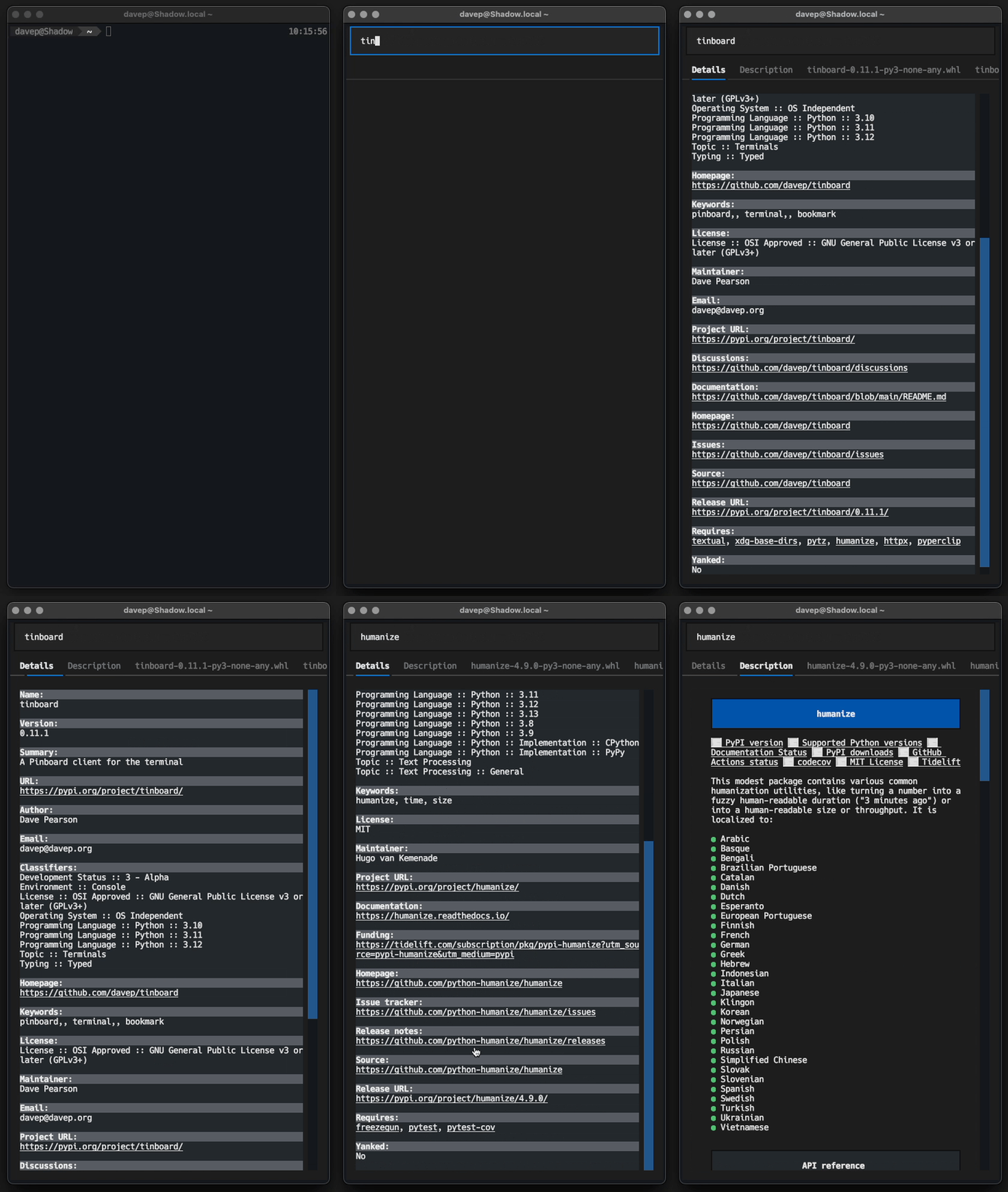
PISpy

Finally... for this week anyway, is a tool I've called PISpy. It's designed as a simple terminal client for looking up package information on PyPi. As of right now it's pretty straightforward, but I'd like to add more to it over time. Here's an example of it in action:

One small wrinkle with publishing it to PyPi was the fact that, once I'd chosen the name, I checked that it hadn't been used on PyPi (it hadn't) but when it came to publishing the package it got rejected because the name was too similar to another package! I don't know which, it wouldn't say, but that was a problem. So in the end the published name ended up having to be slightly different from the actual tool's name.

See over here for the package, and you can install it with a:

pipx install pispy-client

and then just run pispy in the terminal.

Conclusion

It's been a fun couple of weeks coming up with stuff to help exercise Textual, and there's more to come. Personally I've found the process really helpful in that it's help me learn more about the framework and also figure out my own approach to working with it. Each thing I've built so far has been a small step in evolution on from what I did in the previous thing. I doubt I've arrived at a plateau of understanding just yet.

On dog food, the (original) Metaverse, and (not) being bored

(Modified: 2026-04-28 08:52:53 UTC+01:00)
8 min read

Introduction

Cutler, armed with a schedule, was urging the team to "eat its own dog food". Part macho stunt and part common sense, the "dog food diet" was the cornerstone of Cutler’s philosophy.

G. Pascal Zachary — Show-Stopper!

I can't remember exactly when it was -- it was likely late in 1994 or some time in 1995 -- when I first came across the concept of, or rather the name for the concept of, "eating your own dog food". The idea and the name played a huge part in the book Show-Stopper! by G. Pascal Zachary. The idea wasn't new to me of course; I'd been writing code for over a decade by then and plenty of times I'd built things and then used those things to do things, but it was fascinating to a mostly-self-taught 20-something me to be reading this (excellent -- go read it if you care about the history of your craft) book and to see the idea written down and named.

While Textualize isn't (thankfully -- really, I do recommend reading the book) anything like working on the team building Windows NT, the idea of taking a little time out from working on Textual, and instead work with Textual, makes a lot of sense. It's far too easy to get focused on adding things and improving things and tweaking things while losing sight of the fact that people will want to build with your product.

So you can imagine how pleased I was when Will announced that he wanted all of us to spend a couple or so weeks building something with Textual. I had, of course, already written one small application with the library, and had plans for another (in part it's how I ended up working here), but I'd yet to really dive in and try and build something more involved.

Giving it some thought: I wasn't entirely sure what I wanted to build though. I do want to use Textual to build a brand new terminal-based Norton Guide reader (not my first, not by a long way) but I felt that was possibly a bit too niche, and actually could take a bit too long anyway. Maybe not, it remains to be seen1.

Eventually I decided on this approach: try and do a quick prototype of some daft idea each day or each couple of days, do that for a week or so, and then finally try and settle down on something less trivial. This approach should work well in that it'll help introduce me to more of Textual, help try out a few different parts of the library, and also hopefully discover some real pain-points with working with it and highlight a list of issues we should address -- as seen from the perspective of a developer working with the library.

So, here I am, at the end of week one. What I want to try and do is briefly (yes yes, I know, this introduction is the antithesis of brief) talk about what I built and perhaps try and highlight some lessons learnt, highlight some patterns I think are useful, and generally do an end-of-week version of a TIL. TWIL?

Yeah. I guess this is a TWIL.

gridinfo

I started the week by digging out a quick hack I'd done a couple of weeks earlier, with a view to cleaning it up. It started out as a fun attempt to do something with Rich Pixels while also making a terminal-based take on slstats.el. I'm actually pleased with the result and how quickly it came together.

The point of the application itself is to show some general information about the current state of the Second Life grid (hello to any fellow residents of the original Metaverse!), and to also provide a simple region lookup screen that, using Rich Pixels, will display the object map (albeit in pretty low resolution -- but that's the fun of this!).

So the opening screen looks like this:

The initial screen of gridinfo, showing the main SL stats

and a lookup of a region looks like this:

Looking up the details of the first ever region

Here's a wee video of the whole thing in action:

Worth a highlight

Here's a couple of things from the code that I think are worth a highlight, as things to consider when building Textual apps:

Don't use the default screen

Use of the default Screen that's provided by the App is handy enough, but I feel any non-trivial application should really put as much code as possible in screens that relate to key "work". Here's the entirety of my application code:

class GridInfo( App[ None ] ):
    """TUI app for showing information about the Second Life grid."""

    CSS_PATH = "gridinfo.css"
    """The name of the CSS file for the app."""

    TITLE = "Grid Information"
    """str: The title of the application."""

    SCREENS = {
        "main": Main,
        "region": RegionInfo
    }
    """The collection of application screens."""

    def on_mount( self ) -> None:
        """Set up the application on startup."""
        self.push_screen( "main" )

You'll notice there's no work done in the app, other than to declare the screens, and to set the main screen running when the app is mounted.

Don't work hard on_mount

My initial version of the application had it loading up the data from the Second Life and GridSurvey APIs in Main.on_mount. This obviously wasn't a great idea as it made the startup appear slow. That's when I realised just how handy call_after_refresh is. This meant I could show some placeholder information and then fire off the requests (3 of them: one to get the main grid information, one to get the grid concurrency data, and one to get the grid size data), keeping the application looking active and updating the display when the replies came in.

Pain points

While building this app I think there was only really the one pain-point, and I suspect it's mostly more on me than on Textual itself: getting a good layout and playing whack-a-mole with CSS. I suspect this is going to be down to getting more and more familiar with CSS and the terminal (which is different from laying things out for the web), while also practising with various layout schemes -- which is where the revamped Placeholder class is going to be really useful.

unbored

The next application was initially going to be a very quick hack, but actually turned into a less-trivial build than I'd initially envisaged; not in a negative way though. The more I played with it the more I explored and I feel that this ended up being my first really good exploration of some useful (personal -- your kilometerage may vary) patterns and approaches when working with Textual.

The application itself is a terminal client for the Bored-API. I had initially intended to roll my own code for working with the API, but I noticed that someone had done a nice library for it and it seemed silly to not build on that. Not needing to faff with that, I could concentrate on the application itself.

At first I was just going to let the user click away at a button that showed a random activity, but this quickly morphed into a "why don't I make this into a sort of TODO list builder app, where you can add things to do when you are bored, and delete things you don't care for or have done" approach.

Here's a view of the main screen:

The main Unbored screen

and here's a view of the filter pop-over:

Setting filters for activities

Worth a highlight

Don't put all your BINDINGS in one place

This came about from me overloading the use of the escape key. I wanted it to work more or less like this:

  • If you're inside an activity, move focus up to the activity type selection buttons.
  • If the filter pop-over is visible, close that.
  • Otherwise exit the application.

It was easy enough to do, and I had an action in the Main screen that escape was bound to (again, in the Main screen) that did all this logic with some if/elif work but it didn't feel elegant. Moreover, it meant that the Footer always displayed the same description for the key.

That's when I realised that it made way more sense to have a Binding for escape in every widget that was the actual context for escape's use. So I went from one top-level binding to...

...

class Activity( Widget ):
    """A widget that holds and displays a suggested activity."""

    BINDINGS = [
        ...
        Binding( "escape", "deselect", "Switch to Types" )
    ]

...

class Filters( Vertical ):
    """Filtering sidebar."""

    BINDINGS = [
        Binding( "escape", "close", "Close Filters" )
    ]

...

class Main( Screen ):
    """The main application screen."""

    BINDINGS = [
        Binding( "escape", "quit", "Close" )
    ]
    """The bindings for the main screen."""

This was so much cleaner and I got better Footer descriptions too. I'm going to be leaning hard on this approach from now on.

Messages are awesome

Until I wrote this application I hadn't really had a need to define or use my own Messages. During work on this I realised how handy they really are. In the code I have an Activity widget which takes care of the job of moving itself amongst its siblings if the user asks to move an activity up or down. When this happens I also want the Main screen to save the activities to the filesystem as things have changed.

Thing is: I don't want the screen to know what an Activity is capable of and I don't want an Activity to know what the screen is capable of; especially the latter as I really don't want a child of a screen to know what the screen can do (in this case "save stuff").

This is where messages come in. Using a message I could just set things up so that the Activity could shout out "HEY I JUST DID A THING THAT CHANGES ME" and not care who is listening and not care what they do with that information.

So, thanks to this bit of code in my Activity widget...

    class Moved( Message ):
        """A message to indicate that an activity has moved."""

    def action_move_up( self ) -> None:
        """Move this activity up one place in the list."""
        if self.parent is not None and not self.is_first:
            parent = cast( Widget, self.parent )
            parent.move_child(
                self, before=parent.children.index( self ) - 1
            )
            self.emit_no_wait( self.Moved( self ) )
            self.scroll_visible( top=True )

...the Main screen can do this:

    def on_activity_moved( self, _: Activity.Moved ) -> None:
        """React to an activity being moved."""
        self.save_activity_list()
⚠️ Warning

The code above used emit_no_wait. Since this blog post was first published that method has been removed from Textual. You should use post_message_no_wait or post_message instead now.

Pain points

On top of the issues of getting to know terminal-based-CSS that I mentioned earlier:

  • Textual currently lacks any sort of selection list or radio-set widget. This meant that I couldn't quite do the activity type picking how I would have wanted. Of course I could have rolled my own widgets for this, but I think I'd sooner wait until such things are in Textual itself.
  • Similar to that, I could have used some validating Input widgets. They too are on the roadmap but I managed to cobble together fairly good working versions for my purposes. In doing so though I did further highlight that the reactive attribute facility needs a wee bit more attention as I ran into some (already-known) bugs. Thankfully in my case it was a very easy workaround.
  • Scrolling in general seems a wee bit off when it comes to widgets that are more than one line tall. While there's nothing really obvious I can point my finger at, I'm finding that scrolling containers sometimes get confused about what should be in view. This becomes very obvious when forcing things to scroll from code. I feel this deserves a dedicated test application to explore this more.

Conclusion

The first week of "dogfooding" has been fun and I'm more convinced than ever that it's an excellent exercise for Textualize to engage in. I didn't quite manage my plan of "one silly trivial prototype per day", which means I've ended up with two (well technically one and a half I guess given that gridinfo already existed as a prototype) applications rather than four. I'm okay with that. I got a lot of utility out of this.

Now to look at the list of ideas I have going and think about what I'll kick next week off with...

ℹ️ Note

This personal development blog post was first hosted on the Textual devlog.


  1. Far future edit: it didn't happen, but I did eventually build it