Posts tagged with "transient"

blogmore.el v2.7

2 min read

There's no question that the experiment that is BlogMore has resulted in me blogging more. Although my previous setup wasn't exactly all friction, there's something about "owning" most of the tools and really knowing how they work, and being able to quickly modify them so they work "just so", that makes me more inclined to quickly write something up.

I can see this if I look at the numbers in the archive for this blog. In March alone I wrote 43 posts; that's more than I wrote in any whole year, other than 2023. While I suspect this will start to calm down as work on BlogMore and blogmore.el settles down, I sense I'll be writing a bit more often for some time to come.

Because of this I decided to do a little bit of housekeeping on the posts directory in the blog's source repository. Originally I had the Markdown source for every post all in one directory. Then last month I broke those down by year. Then earlier today, seeing how this year is going, I decided to break 2026 down by month.

Then I realised I had a problem in blogmore.el. It assumed that the Markdown file for a new post (blogmore-new) would always be created in a subdirectory named after the year, underneath the defined posts directory. Until today that was the case1, but now I wanted it to work differently.

So this is why I'm making a second release in one day: I added the ability to configure the subdirectory where a new post is created. I've changed the default now so that it assumes the user wants the subdirectory to be YYYY/MM/DD (because more granular feels like the right default). In my case I don't want that, I just want YYYY/MM, but now I can configure that. The value that is set is a function that returns the name of the subdirectory, so in the case of my blog I have it as:

(lambda () (format-time-string "%Y/%m/"))

On the other hand, for my photoblog I want the full date as a subdirectory so I can leave it as the default. The whole use-package for blogmore now looks like:

(use-package blogmore
  :ensure t
  :defer t
  :vc (:url "https://github.com/davep/blogmore.el" :rev :newest)
  :init
  (add-hook 'blogmore-new-post-hook #'end-it)
  (blogmore-work-on "blog.davep.org")
  :custom
  (blogmore-blogs
   '(("blog.davep.org"
      ;; Root directory for posts.
      "~/write/davep.github.com/content/posts/"
      ;; Subdirectory for new posts, relative to the root.
      (lambda () (format-time-string "%Y/%m/")))
     ("seen-by.davep.dev"
      ;; Root directory for posts.
      "~/write/seen-by/content/posts/")))
  :bind
  ("<f12> b" . blogmore))

Technically this is a breaking change because it bumps the meaning of each "position" in the values within blogmore-blogs. However, in my case, because I was only ever defining the blog name and the top-level directory for the posts (both mandatory), this didn't break anything; I also strongly suspect nobody else is using this so I very much doubt I'm messing with someone else's setup2. If I have I apologise; do let me know.

Anyway, all of this goes to explain why the heck I made two releases of the same package back to back in the same day. This is what happens when my namesake is having fun outside and so I just want to sit on the sofa, hack on some code, and watch the chaos in the garden.
  1. For my blog, which again shows that blogmore.el started as a quick hack for getting work done on my blog, but I also want to make it as configurable as possible. 

  2. Even if someone else is using this I would suspect they hadn't configured anything more than I have. 

blogmore.el v2.6

2 min read

Like most people, I imagine, I first ran into transient when first using magit. I took to it pretty quickly and it's always made sense to me as a user interface. But... I've never used it for any code I've ever written.

I think, incorrectly, I'd half assumed it was going to be some faff to set up, and of course for a good while it wasn't part of Emacs anyway. Given this, I'd always had it filed under the heading "that's so neat I'll give it a go one day but not at the moment".

Meanwhile... ever since I did the last big revamp of my Emacs configuration, I found myself leaning into a command binding approach that does the whole prefix-letter-letter thing. For reasons I can't actually remember I fell into the habit of using F121 as my chosen prefix key. As such, over the past 10 or so years (since I greatly overhauled my Emacs setup), I've got into setting up bindings for commands that follow this prefix convention.

So when I created blogmore.el I set up the commands following this pattern.

(use-package blogmore
  :ensure t
  :defer t
  :vc (:url "https://github.com/davep/blogmore.el" :rev :newest)
  :init
  (add-hook 'blogmore-new-post-hook #'end-it)
  (blogmore-work-on "blog.davep.org")
  :custom
  (blogmore-blogs
   '(("blog.davep.org" "~/write/davep.github.com/content/posts/")
     ("seen-by.davep.dev" "~/write/seen-by/content/posts/")))
  :bind
  ("<f12> b b" . blogmore-work-on)
  ("<f12> b n" . blogmore-new)
  ("<f12> b e" . blogmore-edit)
  ("<f12> b d" . blogmore-toggle-draft)
  ("<f12> b s c" . blogmore-set-category)
  ("<f12> b a t" . blogmore-add-tag)
  ("<f12> b u d" . blogmore-update-date)
  ("<f12> b u m" . blogmore-update-modified)
  ("<f12> b l p" . blogmore-link-post)
  ("<f12> b l c" . blogmore-link-category)
  ("<f12> b l t" . blogmore-link-tag))

It works well, it makes it nice and easy to remember the bindings, etc. Nobody needs me to sell them on the merits of this approach.

Then I got to thinking last night: why am I setting up all those bindings when I could probably do it all via a transient? So that was the moment to actually RTFM and get it going. The first version was incredibly quick to get up and running and I was kicking myself that I'd taken so long to actually look at the package properly.

This morning I've worked on it a little more and the final form is still pretty straightforward.

(transient-define-prefix blogmore ()
  "Show a transient for BlogMore commands."
  [:description
   (lambda ()
     (format "BlogMore: %s\n"
             (if (blogmore--chosen-blog-sans-error)
                 (blogmore--blog-title)
               "No blog selected")))
   ["Blog"
    ("b"  "Select blog" blogmore-work-on)]
   ["Post"
    ("n" "New post" blogmore-new :inapt-if-not blogmore--chosen-blog-sans-error)
    ("e" "Edit post" blogmore-edit :inapt-if-not blogmore--chosen-blog-sans-error)
    ("d" "Toggle draft status" blogmore-toggle-draft :inapt-if-not blogmore--blog-post-p)
    ("c" "Set post category" blogmore-set-category :inapt-if-not blogmore--blog-post-p)
    ("t" "Add tag" blogmore-add-tag :inapt-if-not blogmore--blog-post-p)
    ("u d" "Update date" blogmore-update-date :inapt-if-not blogmore--blog-post-p)
    ("u m" "Update modified date" blogmore-update-modified :inapt-if-not blogmore--blog-post-p)]
   ["Links"
    ("l c" "Link to a category" blogmore-link-category :inapt-if-not blogmore--blog-post-p)
    ("l p" "Link to a post" blogmore-link-post :inapt-if-not blogmore--blog-post-p)
    ("l t" "Link to a tag" blogmore-link-tag :inapt-if-not blogmore--blog-post-p)]])

With this in place I can simplify my use-package quite a bit, just binding a single key to run blogmore.

(use-package blogmore
  :ensure t
  :defer t
  :vc (:url "https://github.com/davep/blogmore.el" :rev :newest)
  :init
  (add-hook 'blogmore-new-post-hook #'end-it)
  (blogmore-work-on "blog.davep.org")
  :custom
  (blogmore-blogs
   '(("blog.davep.org" "~/write/davep.github.com/content/posts/")
     ("seen-by.davep.dev" "~/write/seen-by/content/posts/")))
  :bind
  ("<f12> b" . blogmore))

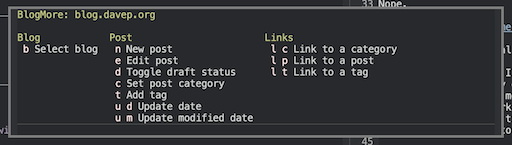
Now, when I'm working on a blog post, I can just hit F12 b and I get a neat menu:

BlogMore with all commands available

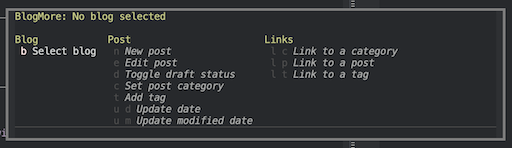
Better still, because of how transient works, I can ensure that only applicable commands are available, while still showing them all. So if I've not even got a blog selected yet:

With no commands available

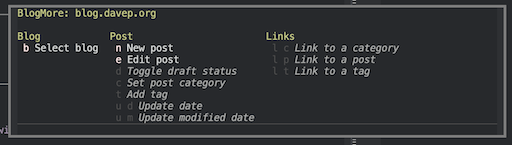
Or with a blog selected but not actually working on a post yet:

With some commands available

So far I'm really liking this approach, and I'm tempted to lean into transient more with some of my packages now. While on the surface it does seem that it has the downside of the binding choices being dictated by me, the fact is that the commands are all still there and anyone can use their own bindings, or I guess override the transient itself and do their own thing.


  1. Yes, it is a bit out of the way on the keyboard, but so is Esc. I find my muscle memory has no problem with it.