obs2nlm - Feed NotebookLM an Obsidian Vault

Posted on 2026-01-10 11:18 +0000 in Coding • Tagged with journal, Obsidian, AI, LLM, Python • 3 min read

I'm sure I've mentioned a couple of times before that I've become quite the fan of Obsidian. For the past few years, at any given point, I've had a couple of vaults on the go. Generally I find such vaults a really useful place to record things I'd otherwise forget, and of course as a place to go back and look things up.

But... even then, it's easy enough to forget what you might have recorded and know that you can even go back and look things up. Also I tend to find that I can't quite figure out a good way of getting a good overview of what I've recorded, over time.

Meanwhile: I've been playing around with Google's NotebookLM as a tool to help research and understand various topics. After doing this with my recent winter break coding project (more on that in the future) I realised I really should get serious about taking this approach with my Obsidian Vaults.

I'm sure this is far from novel, I'm sure lots of people have done similar things already; in fact I'd quickly dabbled with the idea a few months ago, had a bit of a laugh at some of the things the "studio" made of a vault, and promptly forgot about it.

This time though I got to thinking that I should try and take it a little more seriously.

And so obs2nlm was born.

The idea is simple enough: enumerate all the Markdown files in the vault, wrap them in boundary markers, add some instructions to the start of the file to help NotebookLM "comprehend" the content better, throw in a table of contents to give clues to the structure of the vault, and see what happens when you use the resulting file as a source.

So far it's actually turning out to be really helpful. I've been using it to get summaries regarding my work over the past 18 months or so and it's helped me to consolidate my thoughts on all sorts of issues and subjects.

It's not perfect, however. I've had it "hallucinate" some stuff when making things in the studio (most notably in the slide deck facility); for me though I find this an acceptable use of an LLM. I know the subject it's talking to me about and I know when it's making stuff up. This, in turn, makes for a useful lesson in how and when to not trust the output of a tool like this.

Having tested it out with a currently-active vault, I'm now interested to find out what it'll make of some of the archived vaults I have. Back in 2024 I wrote a couple or so tools for making vaults from other things and so I have a vault of a journal I kept in Journey for a number of years, a vault of a journal I'd kept before then in Evernote, and I also have a vault of all the tweets I wrote before I abandoned Twitter. I also have a vault that was dedicated to recording the daily events and thoughts of my time working at Textualize. It's going to be fun seeing what NotebookLM makes of each of those; especially the last one.

Anyway, if Obsidian is your thing, and if you are dabbling with or fancy dabbling with NotebookLM, perhaps obs2nlm will be handy for you.
A map of my year in Obsidian

Posted on 2023-09-11 20:07 +0100 in Life • Tagged with journal, Obsidian, graph • 3 min read

Some time around late October or early November last year, around the time I started working at Textualize, I "discovered" Obsidian. While I didn't need another note-taking application (having gone through Evernote, trying to use Org, dabbling with a couple of other things and finally settling mainly on Apple Notes), I was quite taken by its style and ubiquity and the fact that it was, at heart, just a bunch of Markdown files.

So quite quickly I started using it; not to replace Apple Notes (which is still my general note-taking tool of choice), but to keep work notes and a daily coding journal, the latter coming in useful for the quick end-of-day meetings we normally have.

One of the things I was quite taken by was the graph. It was interesting and fun to see how each of my work days related to other work days, and what subjects kept getting pulled in, etc.

So come the start of this year I had an idea: what would it be like to keep a personal vault, but one where I track things I've done. Not a journal as such (I do keep one of those too, have done for many years now, but that's for other far more important reasons -- perhaps I'll write about that one day too), just a daily record of stuff I've achieved, stuff I've actually done, the routine things and the exceptional things?

What would that graph look like?

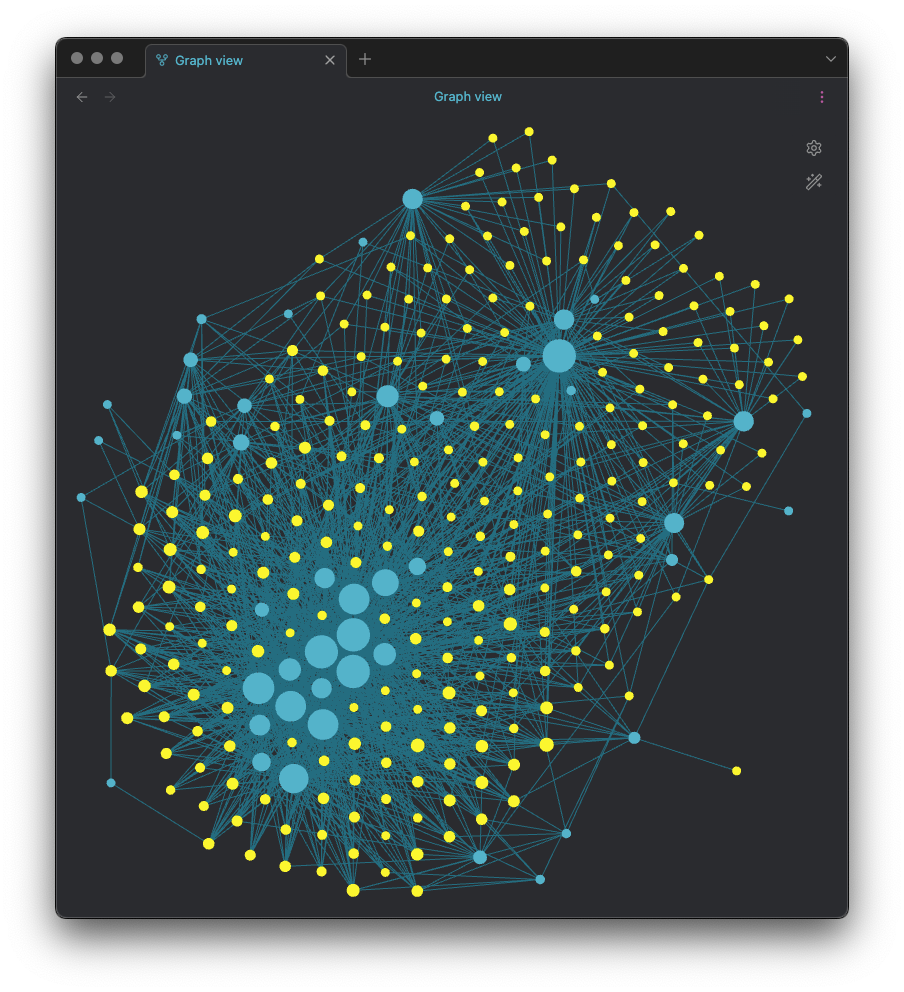
While it's not the end of this year yet, here's how that's shaping up:

The main graph

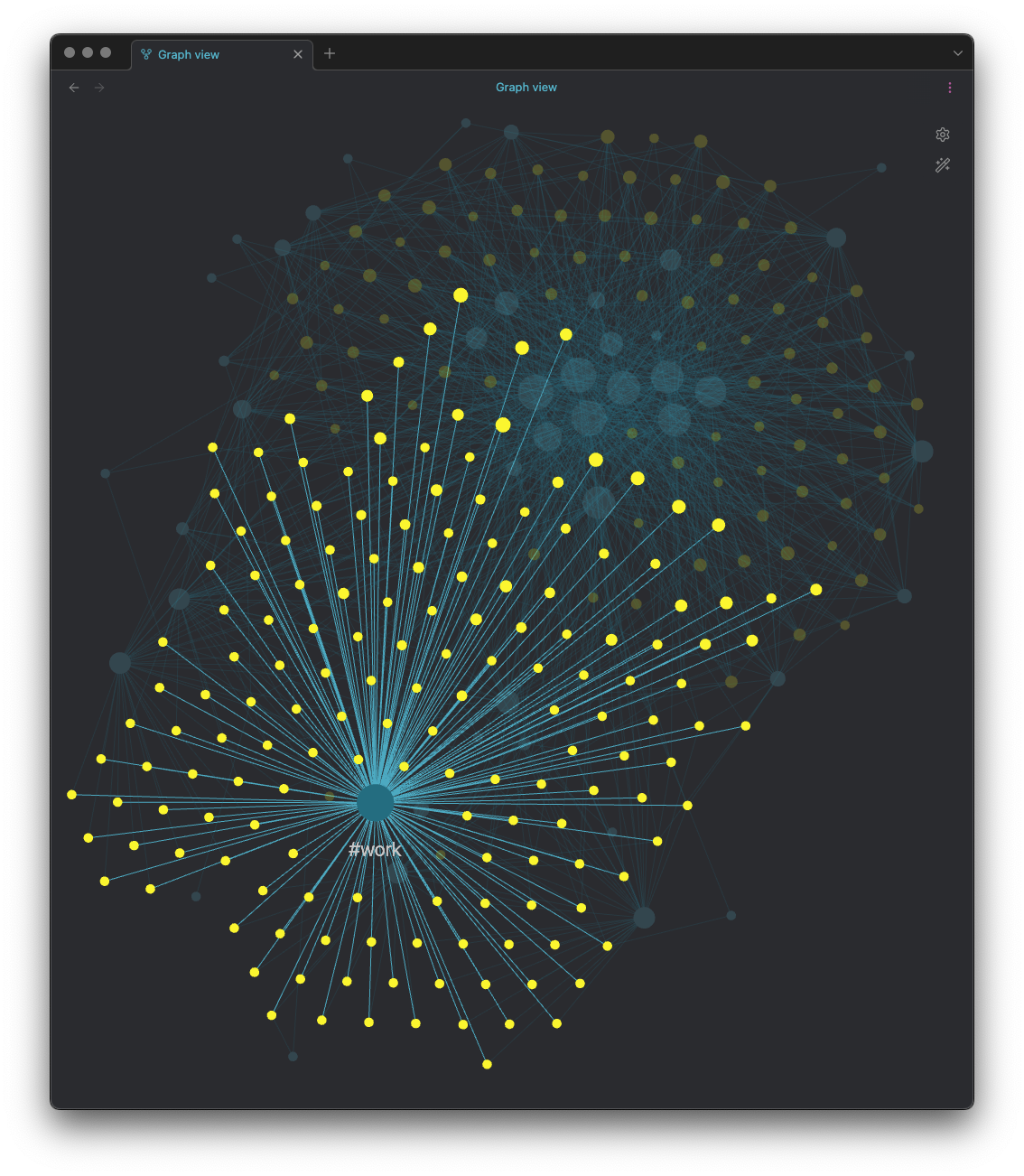
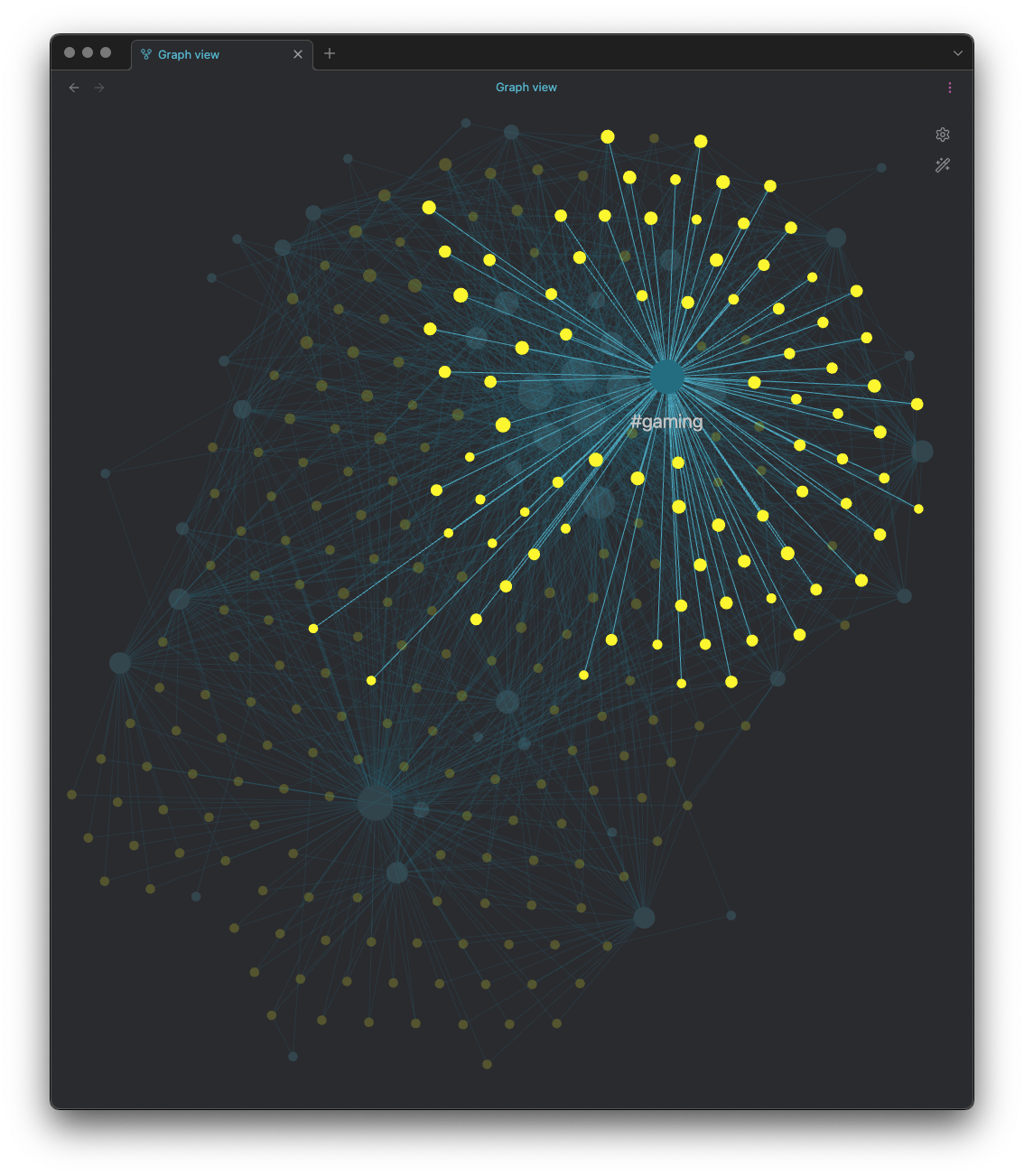
Each of the yellow circles is a day, each of the blue ones is a tag of some sort. As you'd imagine, the size of the circles relates to how often that item is tagged. So I can see what proportion of my days so far this year have been tagged with being heavily involved with work:

Work

Likewise, if I want to see how many days this year have involved a significant spot of gaming:

Gaming

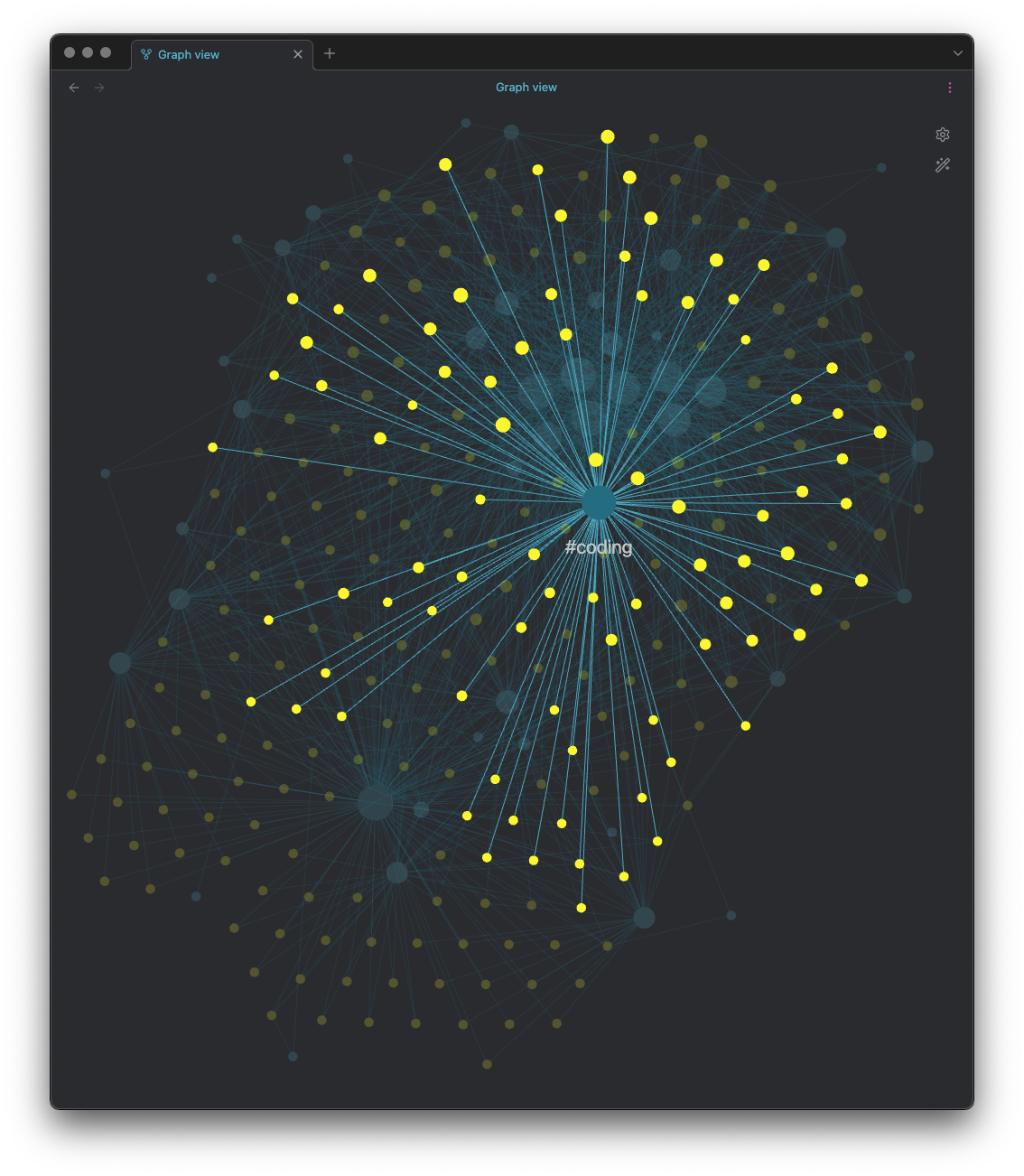
Ditto for days where I've done some coding on pet projects, or even some personal-time coding relating to work projects (it might be work, but it's also Free Software and I do like to support FOSS!)

Coding

I sort of have a curated set of tags I apply, but I've not made it a strict set; if some new situation crops up that calls for a new tag I'll use it. Mostly though I try and keep the tags pretty general so lots of days can relate to the same general subject.

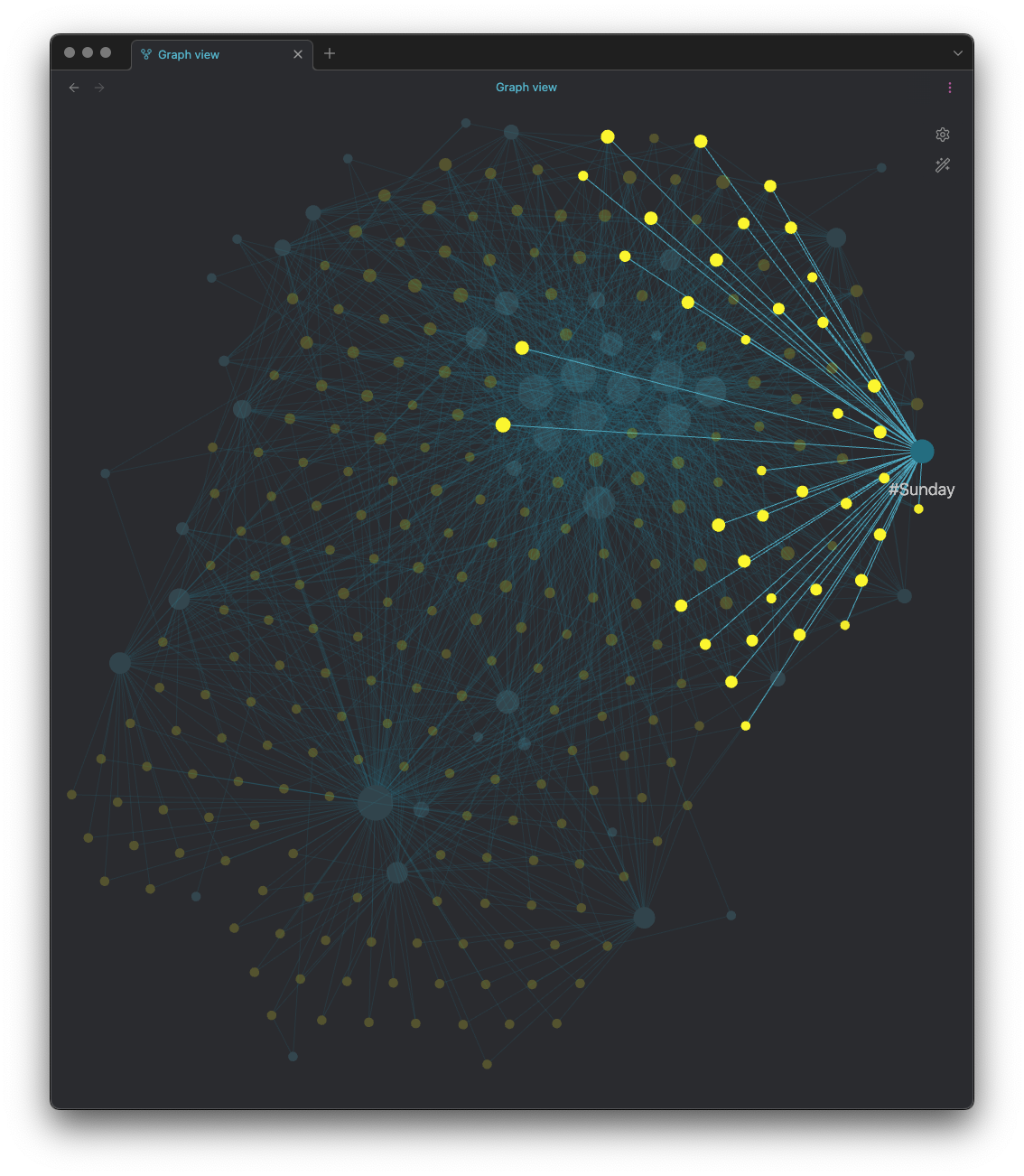
Another thing I've done is tag each and every day with the day of the week, so while it's not really surprising to find that Sunday doesn't dominate over other days, I can see which days are Sundays and perhaps wander along the connections and see what I get up to:

Sunday

I don't quite know what I hope to get out of this, I don't really know if there's anything useful to be had here at all, but it will be interesting to look back over it at the end of the year. It also means that I'll have a directory hierarchy full of Markdown files, all tagged and filled with information, which I'll be able to grep and slice and dice and count and perhaps pull into a database and cross-reference with stuff and things.

Or perhaps it's all just really me not having a good use for Obsidian but inventing one anyway. ;-)