Posts from February 2026

Five days with Copilot

14 min read

Another itch to scratch

As I mentioned yesterday, I've been a happy user of Pelican for a couple or so years now, but every so often there's a little change or tweak I'd like to make that requires diving deeper into the templates and the like and... I go "eh, I'll look at it some time soon". Another thought that often goes through my head at those times is "I should build my own static site generator that works exactly how I want" -- because really any hacker with a blog has to do that at some point.

Meanwhile... I've had free access to GitHub Copilot attached to my GitHub account for some time now, and I've hardly used it. At the same time -- the past few months especially -- I've been watching the rise of agents as coding tools, as well as the rise of advocates for them. Worse still, I've seen people I didn't expect to be advocates for giving up on coding turning to these tools and suddenly writing rationales in favour of them.

So, suddenly, the idea popped into my head: I should write my own static site generator that I'll use for my blog, and I should try and use GitHub Copilot to write 100% of the code, and documentation, and see how far I get. I doing so I might firm up my opinions about where we're all going with this.

The requirements were going to be pretty straightforward:

  • It should be a static site generator that turns Markdown files into a website.
  • It should be blog-first in its design.
  • It should support non-blog-post pages too.
  • It should be written in Python.
  • It should use Jinja2 for templates.
  • It should have a better archive system than I ever got out of my Pelican setup.
  • It should have categories, tags, and all the usual metadata stuff you'd expect from a site where you're going to share content from.

Of course, the requirements would drift and expand as I went along and I had some new ideas.

Getting started

To kick things off, I created my repo, and then opened Copilot and typed out a prompt to get things going. Here's what I typed:

Build a blog-oriented static site generation engine. It should be built in Python, the structure of the repository should match that of my preferences for Python projects these days (see https://github.com/davep/oldnews and take clues from the makefile; I like uv and ruff and Mypy, etc).

Important features:

  • Everything is written in markdown
  • All metadata for a post should come from frontmatter
  • It should use Jinja2 for the output templates

As you can see, rather than get very explicit about every single detail, I wanted to start out with a vague description of what I was aiming for. I did want to encourage it to try and build a Python repository how I normally would, so I pointed it at OldNews in the hope that it might go and comprehend how I go about things; I also doubled-down in the importance of using uv and mypy.

The result of this was... actually impressive. As you'll see in that PR, to get to a point where it could be merged, there was some back-and-forth with Copilot to add things I hadn't thought of initially, and to get it to iron out some problems, but for the most part it delivered what I was after. Without question it delivered it faster than I would have.

Some early issues where I had to point out problems to Copilot included:

  • The order of posts on the home page wasn't obvious to me, and absolutely wasn't reverse chronological order.
  • Footnotes were showing up kinda odd.
  • The main index for the blog was showing just posts titles, not the full text of the article as you'd normally expect from a blog.

Nothing terrible, and it did get a lot of the heavy lifting done and done well, but it was worth noting that a lot of dev-testing/QA needed to be done to be confident about its work, and doing this picked up on little details that are important.

An improvement to the Markdown

As an aside: during this first PR, I quickly noticed a problem where I was getting this error when generating the site from the Markdown:

Error generating site: mapping values are not allowed in this context
  in "<unicode string>", line 3, column 15

I just assumed it was some bug in the generated code and left Copilot to work it out. Instead it came back and educated me on something: I actually had bad YAML in the frontmatter of some of my posts!

This, by the way, wouldn't be the last time that Copilot found an issue with my input Markdown and so, having used it, improved my blog.

A major feature from a simple request

Another problem I ran into quickly was that previewing the generated site wasn't working well at all; all I could do was browse the files in the filesystem. So, almost as an offhand comment, in the initial PR, I asked:

Can we get a serve mode please so I can locally test the site?

Just like that, it went off and wrote a whole server for the project. While the server did need a lot of extra work to really work well1, the initial version was good enough to get me going and to iterate on the project as a whole.

The main workflow

Having kicked off the project and having had some success with getting Copilot to deliver what I was asking for, I settled into a new but also familiar workflow. Whereas normally, when working on a personal project, I'll write an issue for myself, at some point pick it up and create a PR, review and test the PR myself then merge, now the workflow turned into:

  • Write an issue but do so in a way that when I assign it to Copilot it has enough information to go off and do the work.
  • Wait for Copilot to get done.
  • Review the PR, making change requests etc.
  • Make any fixes that are easier for me to fix by hand that describe to Copilot.
  • Merge.

In fact, the first step had some sub-steps to it too, I was finding. What I was doing, more than ever, was writing issues like I'd write sticky notes: with simple descriptions of a bug or a new feature. I'd then come back to them later and flesh them out into something that would act as a prompt for Copilot. I found myself doing this so often I ended up adding a "Needs prompt" label to my usual set of issue labels.

All of this made for an efficient workflow, and one where I could often get on with something else as Copilot worked on the latest job (I wasn't just working on other things on my computer; sometimes I'd be going off and doing things around the house while this happened), but... it wasn't fun. It was the opposite of what I've always enjoyed when it comes to building software. I got to dream up the ideas, I got to do the testing, I got to review the quality of the work, but I didn't get to actually lose myself in the flow state of coding.

One thing I've really come to understand during those 5 days of working on BlogMore was I really missed getting lost in the flow state. Perhaps it's the issue to PR to review to merge cycle I used that amplified this, perhaps those who converse with an agent in their IDE or in some client application keep a sense of that (I might have to try that approach out), but this feels like a serious loss to me when it comes to writing code for personal enjoyment.

The main problems

I think it's fair to say that I've been surprised at just how well Copilot understood my (sometimes deliberately vague) requests, at how it generally managed to take some simple plain English and turn it into actual code that actually did what I wanted and, mostly, actually worked.

But my experiences over the past few days haven't been without their problems.

The confidently wrong problem

Hopefully we all recognise that, with time and experience, we learn where the mistakes are likely to turn up. Once you've written enough code you've also written plenty of bugs and been caught out by plenty of edge-cases that you get a spidey-sense for trouble as you write code. I feel that this kind of approach can be called cautiously confident.

Working with Copilot2, however, I often ran into the confidently wrong issue. On occasion I found it would proudly3 request review for some minor bit of work, proclaiming that it had done the thing or solved the problem, and I'd test it and nothing had materially changed. On a couple of occasions, when I pushed back, I found it actually doubting my review before finally digging in harder and eventually solving the issue.

I found that this took time and was rather tiring.

There were also times where it would do the same but not directly in respect to code. One example I can think of is when it was confident that Python 3.14 was still a pre-release Python as of February 2026 (it isn't).

This problem alone concerns me; this is the sort of thing where people without a good sense for when the agent is probably bullshitting will get into serious trouble.

The tries-too-hard problem

A variation on the above problem works the other way: on at least one occasion I found that Copilot tried too hard to fix a problem that wasn't really its to fix.

In this case I was asking it to tidy up some validation issues in the RSS feed data. One of the main problems was root-relative URLs being in the content of the feed; for that they needed to be made absolute URLs. Copilot did an excellent job of fixing the problem, but one (and from what I could see only one) relative URL remained.

I asked it to take a look and it took a real age to work over the issue. To its credit, it dug hard and it dug deep and it got to the bottom of the problem. The issue here though was it tried too hard because, having found the cause of the problem (a typo in my original Markdown, which had always existed) it went right ahead and built a workaround for this one specific broken link.

Now, while I'm a fan of Postel's law, this is taking things a bit too far. If this was a real person I'd tasked with the job I would have expected and encouraged them to come back to me with their finding and say "dude, the problem is in your input data" and I'd have fixed my original Markdown.

Here though it just went right ahead and added this one weird edge case as something to handle.

I think this is something to be concerned about and to keep an eye on too. I feel there's a danger in having the agent rabbit-hole a fix for a problem that it should simply have reported back to me for further discussion.

The never-pushes-back problem

Something I did find unsurprising but disconcerting was Copilot's unwillingness to push back, or at least defend its choices. Sometimes it would make a decision or a change and I'd simply ask it why it had done it that way, why it had made that choice. Rather than reply with its reasoning it would pretty much go "yeah, my bad, let me do it a way you're probably going to find more pleasing".

A simple example of this is one time when I saw some code like this:

@property
def some_property(self) -> SomeValue:
    from blogmore.utils import some_utility_function
    ...

I'm not a fan of imports in the body of methods unless there's a demonstrable performance reason. I asked Copilot why it had made this choice here and its reply was simply to say it had gone ahead and changed the code, moving the import to the top of the module.

I see plenty of people talk about how working with an agent is like pair-programming, but I think it misses out on what's got to be the biggest positive of that approach: the debate and exchange of ideas. This again feels like a concern to be mindful of, especially if someone less experienced is bringing code to you where they've used an agent as their pair buddy.

The overall impression

Now I'm at the end of the process, and using the result of this experiment to write this post4, I feel better informed about what these tools offer, and the pitfalls I need to be mindful of. Sometimes it wasn't a terrible way of working. For example, on the first day I started with this, at one point on a chilly but sunny Sunday afternoon, I was sat on the sofa, MacBook on lap, guiding an AI to write code, while petting the cat, watching the birds in the garden enjoy the content of the feeder, all while chatting with my partner.

That's not a terrible way to write code.

On the other hand, as I said earlier, I missed the flow state. I love getting lost in code for a few hours and this is not that. I also found the constant loop of prompt, wait, review, test, repeat, really quite exhausting.

As best as I can describe it: it feels like the fast food of software development. It gets the job done, it gets it done fast, but it's really not fulfilling.

At the end of the process I have a really useful tool, 100% "built with AI", under my guidance, which lets me actually be creative and build things I do create by hand. That's not a bad thing, I can see why this is appealing to people. On the other hand the process of building that tool was pretty boring and, for want of a better word... soulless.

Conclusion

As I write this I have about 24 hours of access to GitHub Copilot Pro left. It seems this experiment used up my preview time and triggered a "looks like you're having fun, now you need to decide if you want to buy it" response. That's fair.

So now I'm left trying to decide if I want to pay to keep it going. At the level I've been using it at for building BlogMore it looks like it costs $10/mth. That actually isn't terrible. I spend more than that on other hobbies and other forms of entertainment. So, if I can work within the bounds of that tier, it's affordable and probably worth it.

What I'm not sure about yet is if I want to. It's been educational, I can 100% see how and where I'd use this for work (and would of course expect an employer to foot the bill for it or a similar tool), and I can also see how and where I might use it to quickly build a personal-use tool to enable something more human-creative.

Ultimately though I think I'm a little better informed thanks to this process, and better aware of some of the wins people claim, and also better informed so that I can be rightly incredulous when faced with some of the wilder claims.

Also, it'll help put some of my reading into perspective.


  1. Amusingly I uncovered another bug while writing this post. 

  2. I keep saying Copilot, but I think it's probably more correct to say "Claude Sonnet 4.5" as that's what seemed to be at play under the hood, if I'm understanding things correctly. 

  3. Yes, of course that's an anthropomorphism, you'll find plenty of them in this article as it's hard not to write about the subject in any other way; it's an easy shortcut to explain some ideas 

  4. Actually I'm writing this post as I always do: in Emacs. But BlogMore is in the background serving a local copy of my blog so I can check it in the browser, and rebuilding it every time I save a change. 

A new engine

2 min read

For about 2 and a half years now this blog has been built with Pelican. For the most part I've enjoyed using it, it's been easy enough to work with, although not exciting to work with (which I think is a positive thing to say about a static site generator).

There were, however, a couple or so things I didn't like about the layout I was getting out of it. One issue was the archive, which was a pretty boring list of titles of all the posts on the site. It would have been nice to have them broken down by date or something, at least.

Of course, there are lots of themes, and it also uses templates, so I could probably have tweaked it "just so"; but every time I started to look into it I found myself wanting to "fix" the issue by building my own engine from scratch.

Thankfully, every time that happened, I'd come to my senses and go off and work on some other fun personal project. Until earlier this week, that was.

The thing is... I've been looking for a project where I could dive into the world of "AI coding" and "Agents" and all that nonsense. Not because I want to abandon the absolute thrill and joy I still get from writing actual code as a human, but because I want to understand things from the point of view of people who champion these tools.

The only way I'm going to have an informed opinion is to get informed; the only way to get informed is to try this stuff out.

So, here I am, with my blog now migrated over to BlogMore; a project that gives me a blog-focused static site generator that I 100% drove the development of, but for which I wrote almost none of the code.

At the moment it's working out well, as a generator. I'm happy with how it works, I'm happy with what it generates. I also think it's 100% backwards-compatible when it comes to URLs and feeds and so on. If you do see anything odd happening, if you do see anything that looks broken, I'd love to hear about it.

As for this being a "100% AI" project, and how I found that process and how I feel about the implications and the results... that's a blog post to come.

I took lots of notes.

OldNews - A terminal-based client for TheOldReader

3 min read

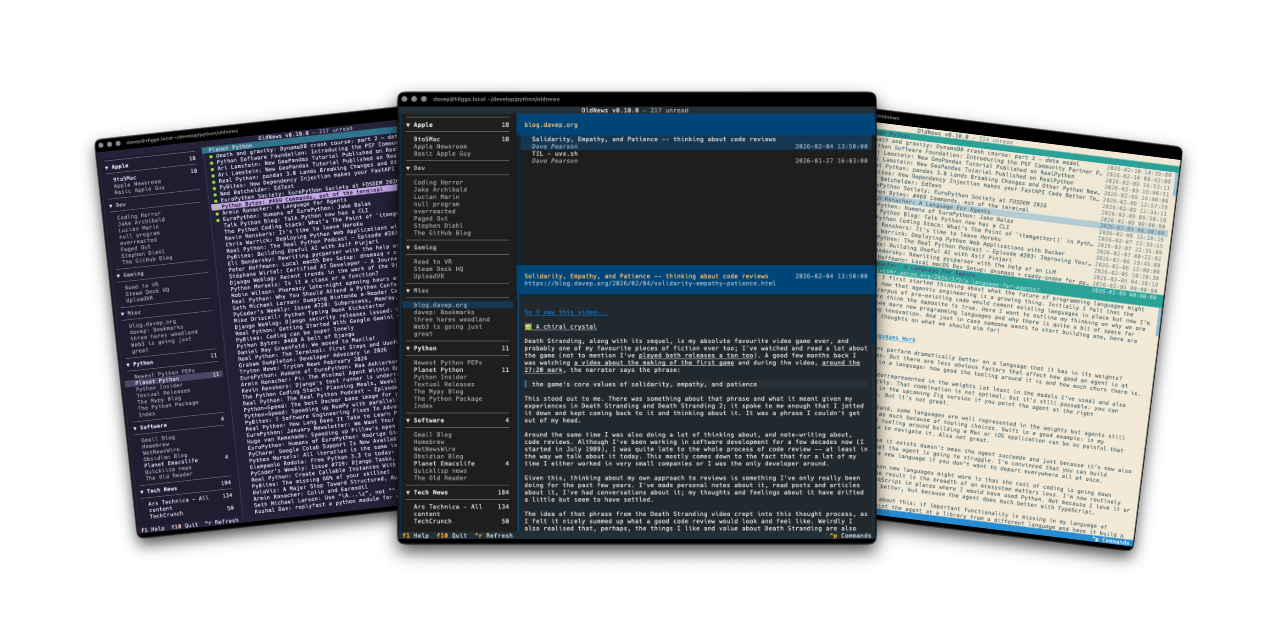
OldNews

I honestly can't remember when I was first introduced to the idea of RSS/Atom feeds, and the idea of having an aggregator or reader of some description to keep up with updates on your favourite sites. It's got to be over 25 years ago now. I can't remember what I used either, but I remember using one or two readers that ran locally, right up until I met Google Reader. Once I discovered that I was settled.

As time moved on and I moved from platform to platform, and wandered into the smartphone era, I stuck with Google Reader (and the odd client for it here and there). It was a natural and sensible approach to consuming news and updates. It also mostly felt like a solved problem and so felt nice and stable.

So, of course, I was annoyed when Google killed it off, like so many useful things.

When this happened I dabbled with a couple of alternatives and, at some point, finally settled on TheOldReader. Since then it's been my "server" for feed subscriptions with me using desktop and mobile clients to work against it.

But... I never found anything that worked for me that ran in the terminal. Given I've got a thing for writing terminal-based tools it made sense I should have a go, and so OldNews became my winter break project.

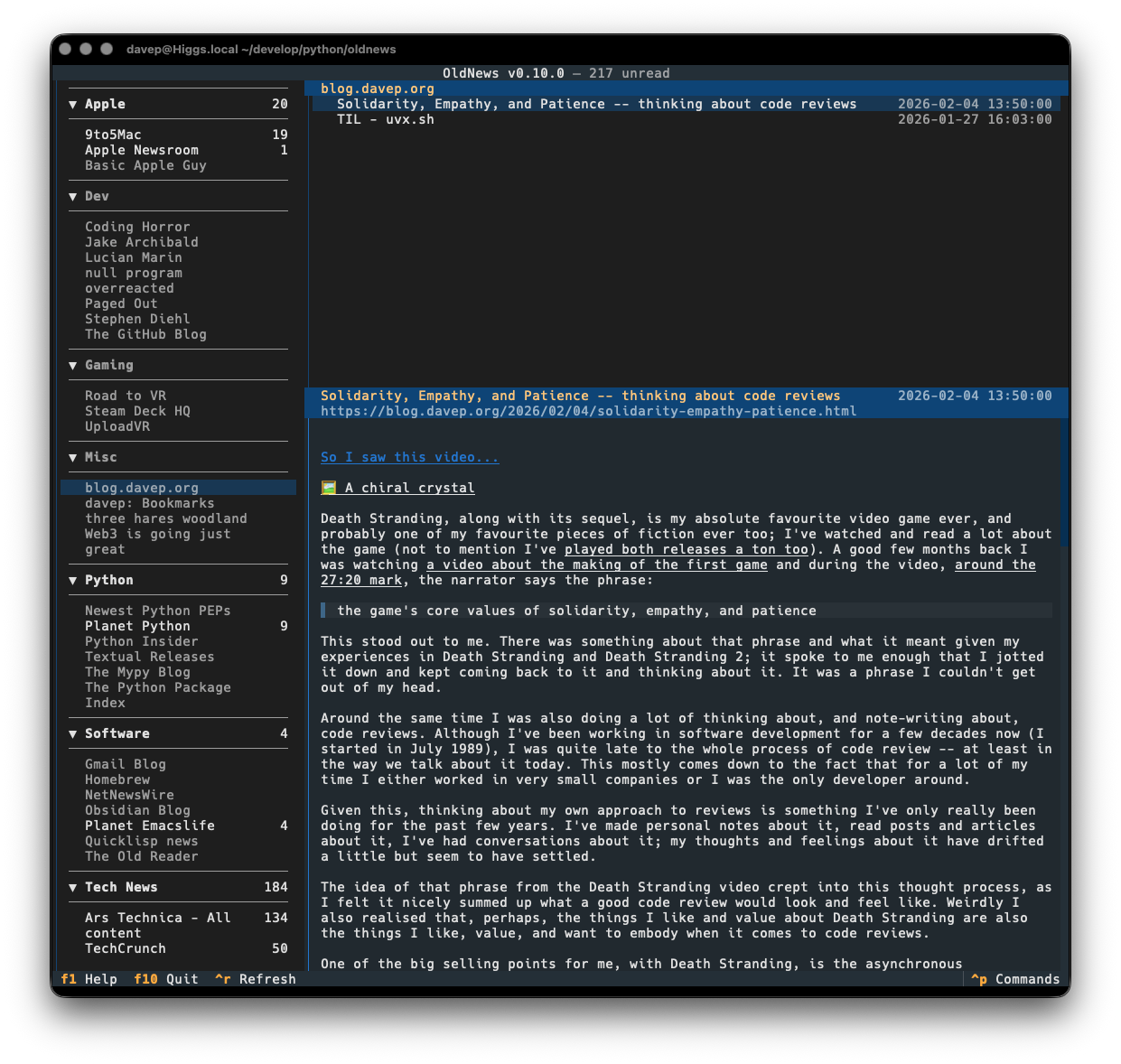
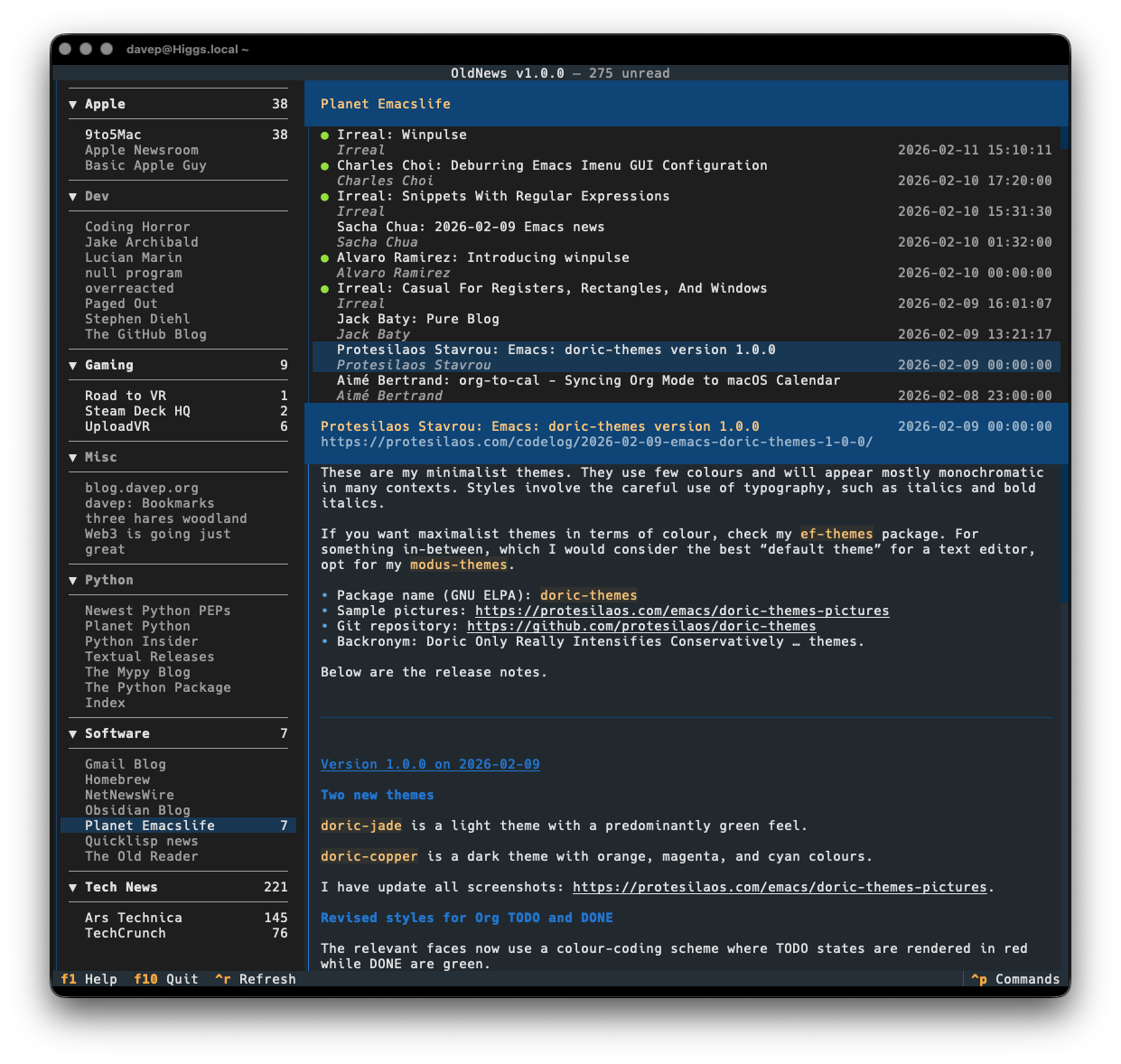
Reading an article in OldNews

I've written it as a client application for the API of TheOldReader, and only for that, and have developed it in a way that works well for me. All the functionality I want and need is in there:

  • Add subscriptions
  • Rename subscriptions
  • Remove subscriptions
  • Add folders
  • Rename folders
  • Remove folders
  • Move subscriptions between folders
  • Mark read/unread
  • Read articles (that provide actual content in their feeds)

Currently there's no support for starring feeds or interacting with the whole "friend" system (honestly: while I see mention of it in the API, I know nothing of that side of things and really don't care about it). As time goes on I might work on that.

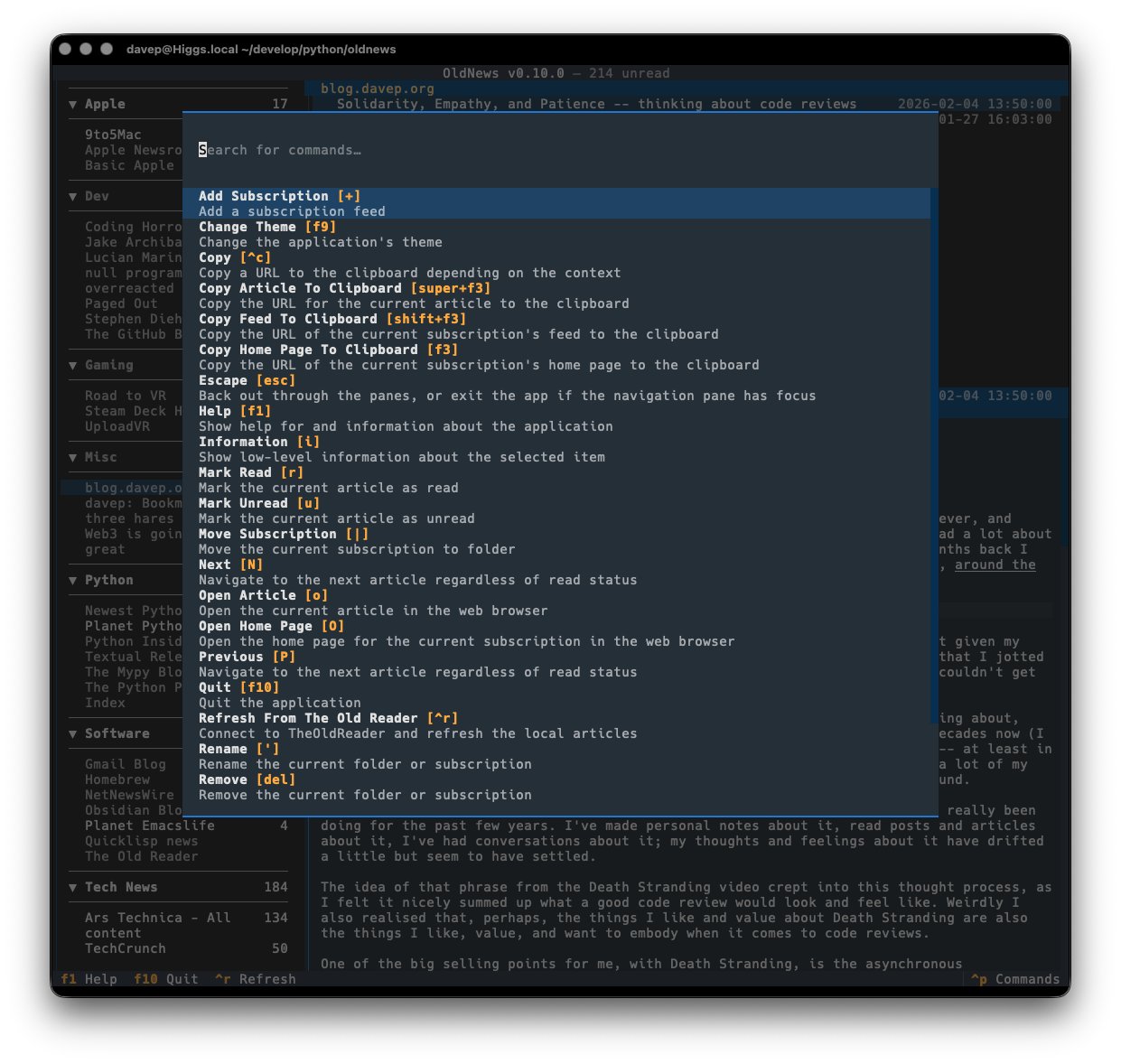
As with all of my other terminal-based applications, there's a rich command palette that shows you what you can do, and also what keyboard shortcuts will run those commands. While I do still need to work on some documentation for the application (although you'd hope that anyone looking for an RSS reader at this point would mostly be able to find their way around) the palette is a good place to go looking for things you can do.

The command palette

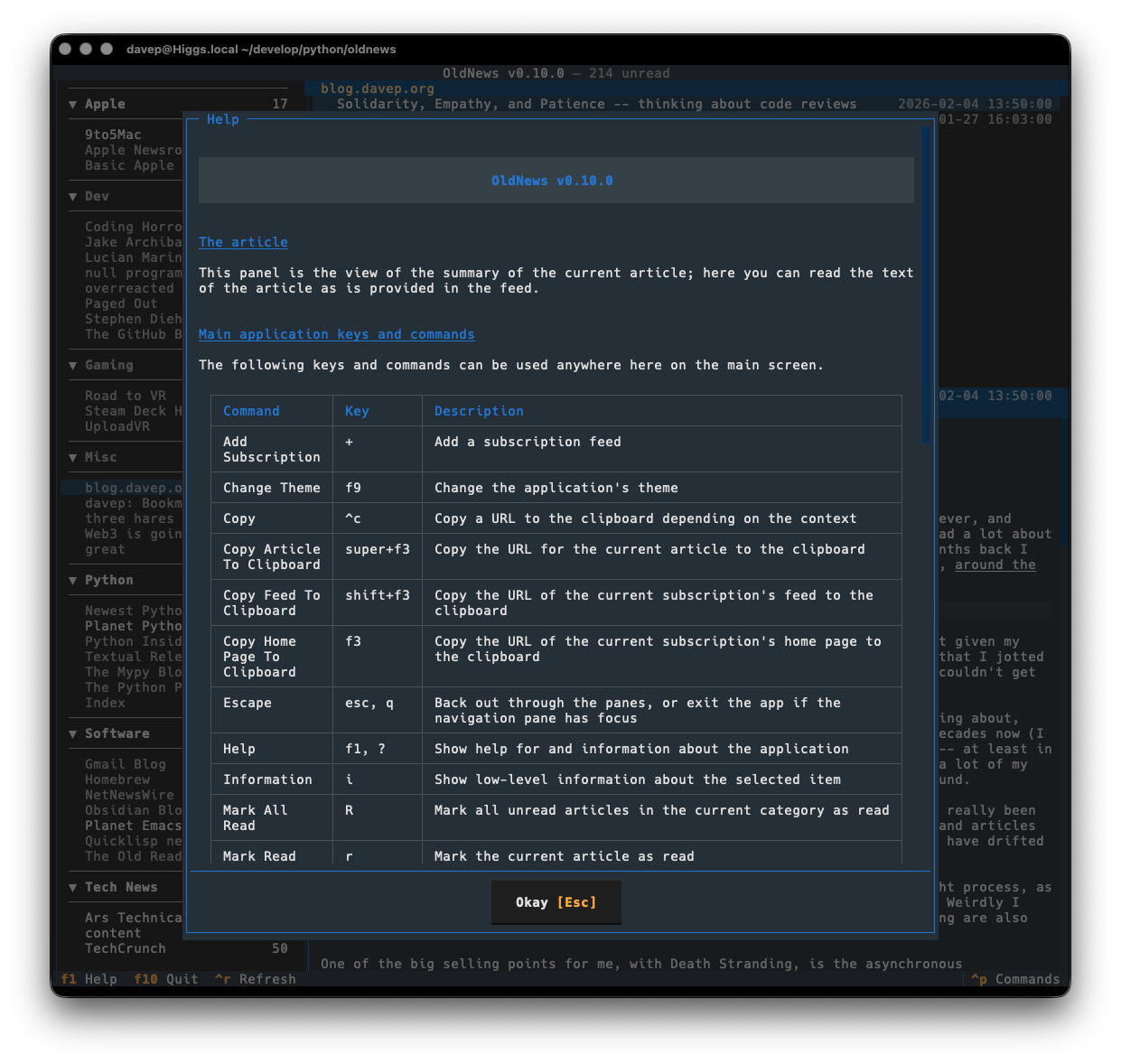
Plus there's a help screen too.

The help screen

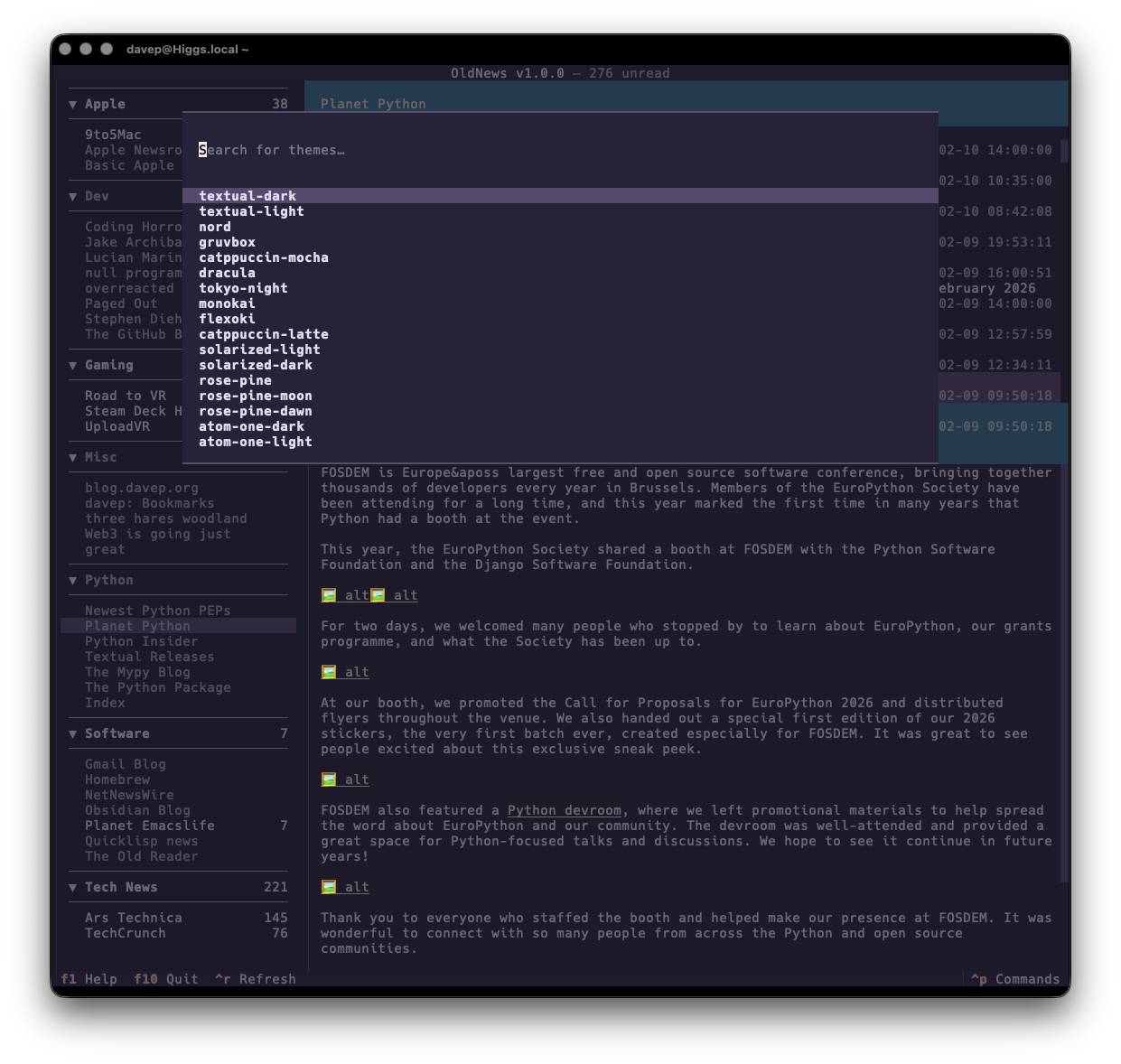
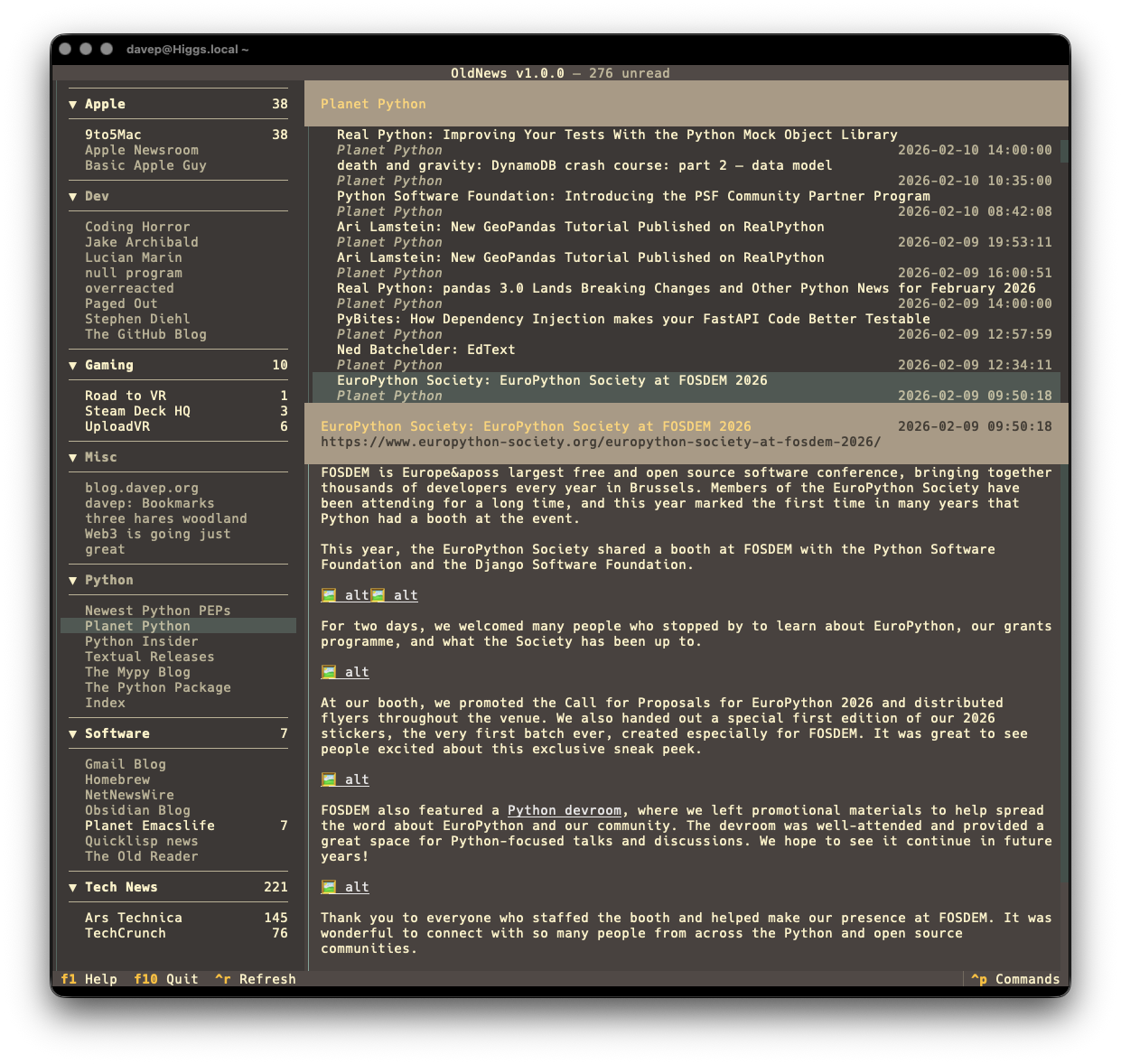
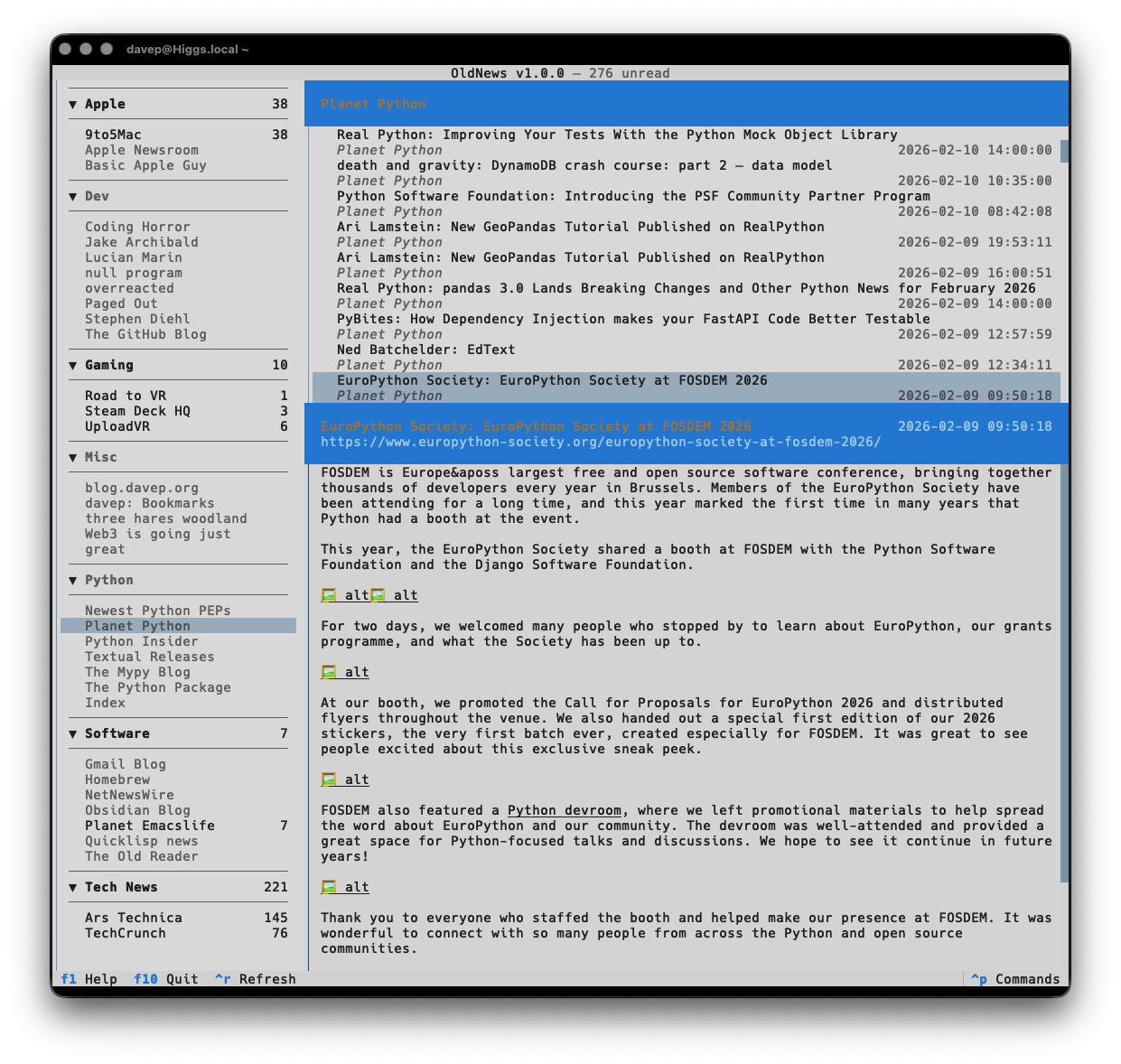
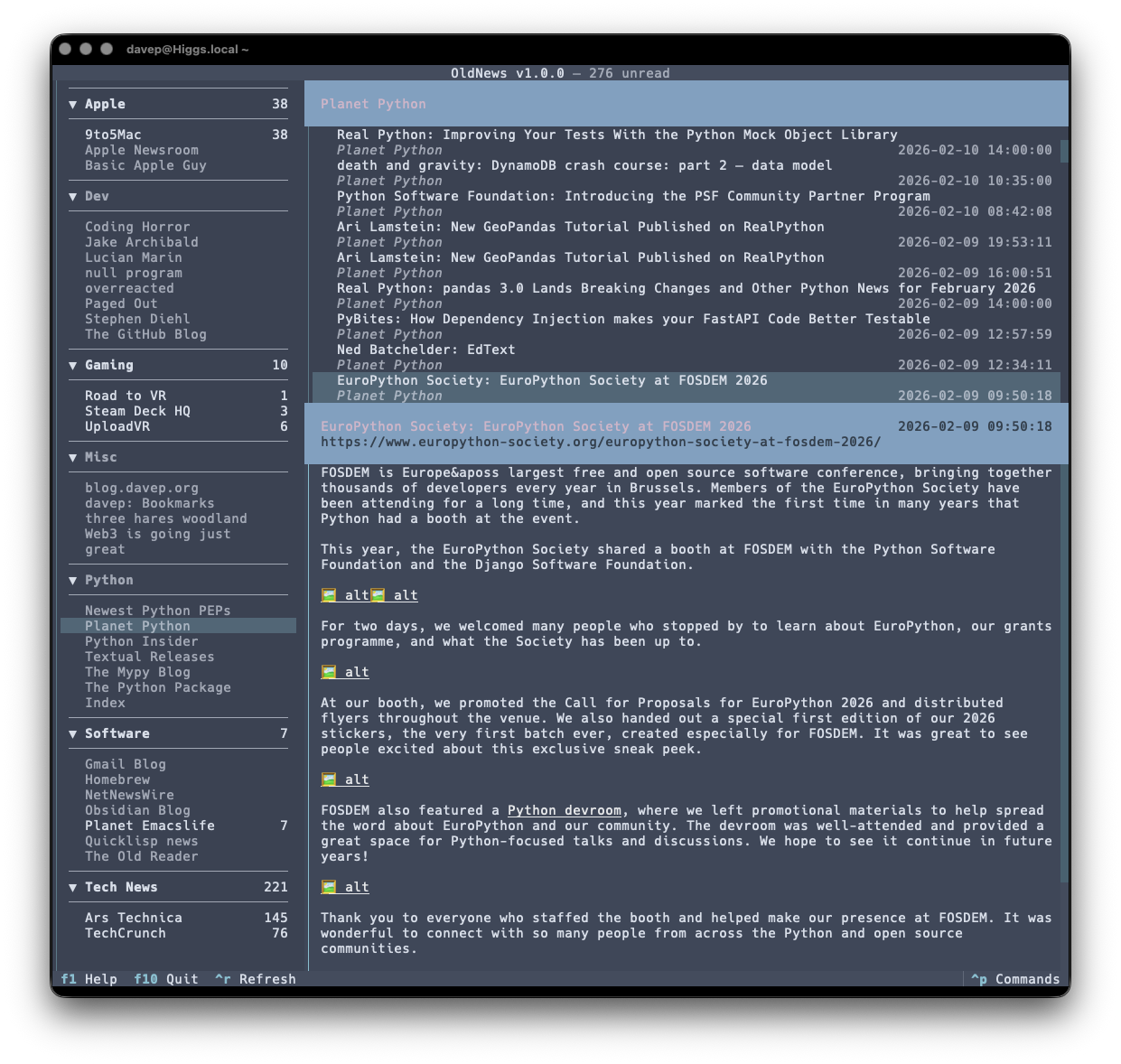
If themes are your thing, there's themes:

Available themes Gruvbox Textual Light Nord

That's a small selection, and there's more to explore.

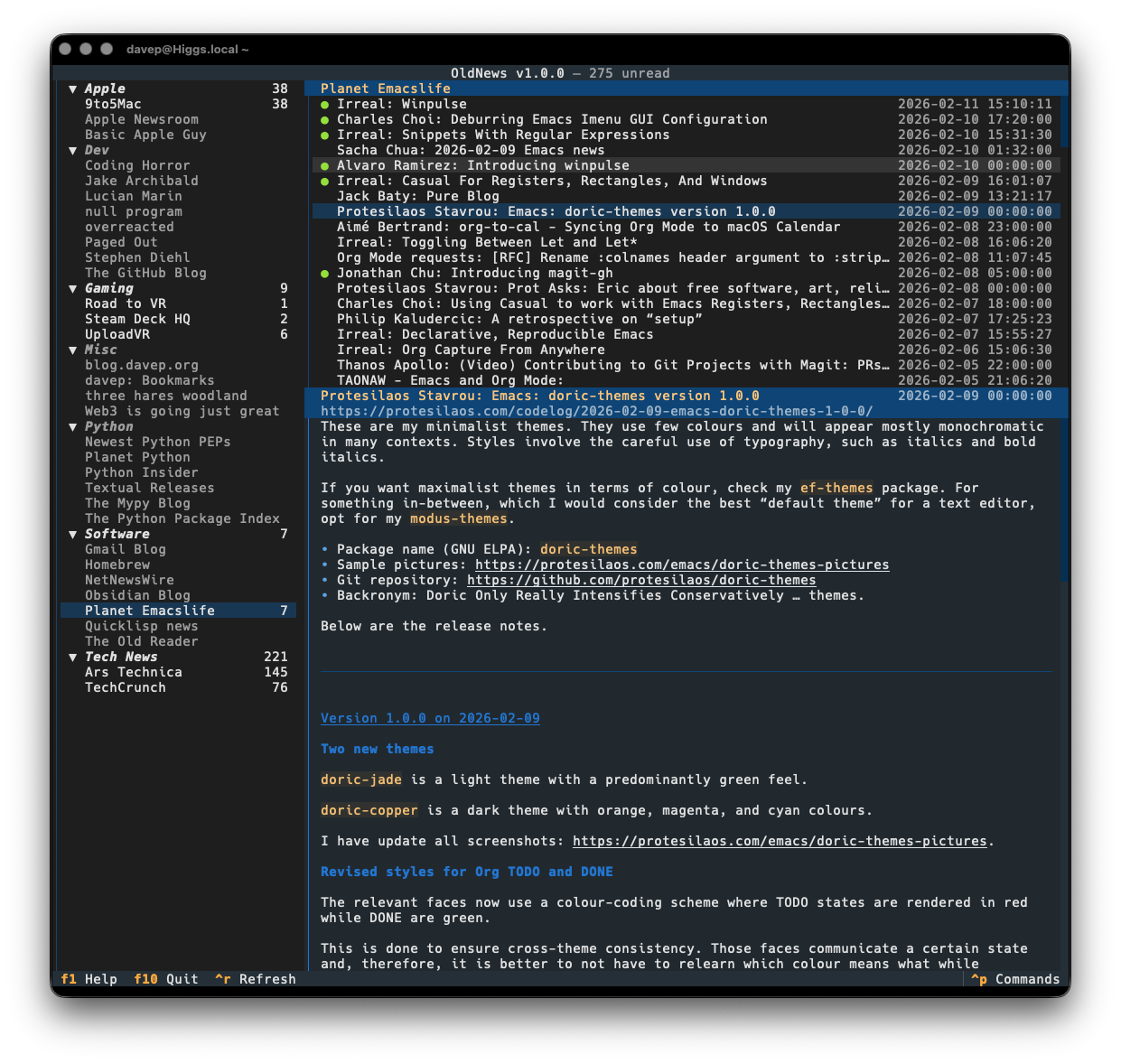
Also on the cosmetic front there's a simple compact mode, which toggles between two ways of showing the navigation menu, the article lists and the panel headers.

Not compact Compact

OldNews has been a daily-driver for a wee while now, while also under active development. I think I've covered all the main functions I want and have also shaken out plenty of bugs, so today's the day to call it v1.0.0 and go from there.

If you're a user of TheOldReader and fancy interacting with it from the terminal too then it's out there to try out. It's licensed GPL-3.0 and available via GitHub and also via PyPI. If you have an environment that has pipx installed you should be able to get up and running with:

$ pipx install oldnews

It can also be installed using uv:

uv tool install oldnews

If you don't have uv installed you can use uvx.sh to perform the installation. For GNU/Linux or macOS or similar:

curl -LsSf uvx.sh/oldnews/install.sh | sh

or on Windows:

powershell -ExecutionPolicy ByPass -c "irm https://uvx.sh/oldnews/install.ps1 | iex"

Once installed, run the oldnews command.

Hopefully this is useful to someone else; meanwhile I'll be using it more and more. If you need help, or have any ideas, please feel free to raise an issue or start a discussion.

Solidarity, Empathy, and Patience -- thinking about code reviews

8 min read

So I saw this video...

A chiral crystal

Death Stranding, along with its sequel, is my absolute favourite video game ever, and probably one of my favourite pieces of fiction ever too; I've watched and read a lot about the game (not to mention I've played both releases a ton too). A good few months back I was watching a video about the making of the first game and during the video, around the 27:20 mark, the narrator says the phrase:

the game's core values of solidarity, empathy, and patience

This stood out to me. There was something about that phrase and what it meant given my experiences in Death Stranding and Death Stranding 2; it spoke to me enough that I jotted it down and kept coming back to it and thinking about it. It was a phrase I couldn't get out of my head.

Around the same time I was also doing a lot of thinking about, and note-writing about, code reviews. Although I've been working in software development1 for a few decades now (I started in July 1989), I was quite late to the whole process of code review -- at least in the way we talk about it today. This mostly comes down to the fact that for a lot of my time I either worked in very small companies or I was the only developer around.

Given this, thinking about my own approach to reviews is something I've only really been doing for the past few years. I've made personal notes about it, read posts and articles about it, I've had conversations about it; my thoughts and feelings about it have drifted a little but seem to have settled.

The idea of that phrase from the Death Stranding video crept into this thought process, as I felt it nicely summed up what a good code review would look and feel like. Weirdly I also realised that, perhaps, the things I like and value about Death Stranding are also the things I like, value, and want to embody when it comes to code reviews.

One of the big selling points for me, with Death Stranding, is the asynchronous multiplayer aspect of it; the reason Kojima calls it a "Strand type game". I have my game, I have my goal, but other people can indirectly affect it, either doing work in their game that leaks into mine in a beneficial way, or by leaking into mine in a way that I have to clean up. There's something really satisfying about this asynchronous collaboration. That feels similar to the collective effort of working in a single repository, each person working on their own branch or PR, sometimes in tandem, sometimes in series, sometimes to the benefit of each other and sometimes in ways that block each other.

But that's not the point here. There's a similarity if I think about it, but I don't want to get too carried away on that line of thought. It's the phrase from the video I care about; it's the approach of involving solidarity, empathy and patience I want to think about more.

Solidarity

In the mountains

This, for me, is all about where you position yourself when you approach reviewing code. I sense things only work well if you view the codebase as something with common ownership. I've worked on and with a codebase where the original author invited others in to collaborate, but where they constantly acted as a gatekeeper, and often as a gatekeeper who was resistant to their own contributions being reviewed, and it was an exhausting experience.

I believe the key here is to work against a "your code" vs "my standard" approach, instead concentrating on an "our repository" view. That's not to say that there shouldn't be standards and that they shouldn't be maintained -- there should be and they should be -- but more to say that they should be agreed upon, mutually understood to be worthwhile, and that any callout of a standard not being applied is seen as a good and helpful thing.

The driving force here should be the shared intent, and how the different degrees of knowledge and experience can come together to express that intent. If a reviewer can see issues with a submission, with a proposed change or addition to the codebase, the ideal approach is to highlight them in such a way as to make it feel like we discovered them, not that I discovered them and you should sort it out. Depending on the degree of proposed change, this might actually be expressed by (if you're using GitHub, for example) using the "Suggested Change" feature to directly feed back into the PR, or perhaps for something a little more complex, or the offer to pair up to work on the solution.

Empathy

Sam and Fragile

As someone who has written a lot of code, and so written a lot of bugs and made a lot of bad design choices, I feel empathy is the easiest of the three words to get behind and understand, but possibly the hardest one to actually put into practice.

When you look at a PR, it's easy to see code, to see those design choices, and to approach the reading as if you were the one who had written it, assessing it through that lens. In my own experience, this is where I find myself writing and re-writing my comments during a review. As much as possible I try and ask the author why they've taken a particular approach. It could be, perhaps, that I've simply missed a different perspective they have. If that's the case I'll learn something about the code (and about them); if that isn't the case I've invited them to have a second read of their contribution. It seems to me that this benefits everyone.

I feel that where I land with this is the idea of striving to act less like a critic and more like a collaborator, and in doing so aiming to add to an atmosphere of psychological safety. Nobody should feel like there's a penalty to getting something "wrong" in a contribution; they should ideally feel like they've learnt a new "gotcha" to be mindful of in the future (both as an author and a reviewer). Done right the whole team, and the work, benefits.

Patience

Arriving at the plate gate

The patience aspect of this view of reviews, for me, covers a few things. There's the patience that should be applied when reading over the code; there's the patience that should be applied when walking someone through feedback and suggestions; and there's the patience needed by the whole team to not treat code reviews as a speed bump on the road to getting work over the line. While patience applies to other facets of a review too, I think these are the most important parts.

In a work environment I think it's the last point -- that of the team's collective patience -- that is the most difficult to embody and protect. Often we'll find ourselves in a wider environment that employs a myopic view of progress and getting things done, where the burn-down chart for the sprint is all that matters. In that sort of environment a code review can often be seen, by some, as a frustrating hurdle to moving that little card across that board. Cards over quality. Cards over sustainability.

It's my belief that this is one of those times where the phrase "slow down to speed up" really does apply. For me, review time is where the team gets to grow, to own the project, to own the code, to really apply the development and engineering principles they want to embody. Time spent on a review now will, in my experience, collectively save a lot more time later on, as the team becomes more cohesive and increasingly employs a shared intuition for what's right for the project.

This is not (entirely) a post about code reviews

Near the wind farm

The thing with code reviews, or any other team activities, is they don't exist in a vacuum. They take on the taste and smell of the culture in which they operate. It's my experience that it doesn't matter how much solidarity, empathy or patience you display during your day-to-day, if it's counter to the culture in which you work it's always going to be exhausting, it's always going to feel like a slog.

If leadership in technology, in software engineering, were to show more of these three basic qualities, they'd start to appear like they realise that they're working with actual humans, not producers of code; and I think we need more of that now than at any time in the history of coding.

Since I first saw that video, and heard that phrase, and had it run around my head, I've come to feel that it's not just a good mantra for code reviews; I think it's a simple blueprint for what good tech leadership should look like. If there was more "Strand-type" leadership in my chosen industry I feel it would be more open, more accessible, would offer more psychological safety and ultimately would result in teams, and projects, that thrive.


  1. Or software engineering, if you prefer, but that's a whole other blog post I'll never get round to writing one day.